








































































Article Contents:
- What are flexible wall panels and why people buy them
- Waterless construction
- Why flexibility is needed
- What interior design problems they solve
- When it's really worth buying flexible wall panels
- For a radius wall
- For a column
- For an arch
- For a niche
- For rounded corners
- For furniture next to wall finishing
- When not to buy flexible panels
- A flat, straight wall without complex geometry
- When a maximally rigid plane is needed
- When simple decorative finishing of a straight wall is needed
- What flexible wall panels can be purchased for interior
- Wood-look panels: solid wood
- Wood-look panels: MDF with imitation
- Paint-ready panels
- Slat panels with pronounced chiaroscuro
- Panels with a relief surface
- Smooth panels
- How to choose and buy flexible wall panels by surface type
- For a straight wall
- For a radius wall
- For a column
- For arched openings
- For a niche
- For complex combined surfaces
- Which panels to buy for different rooms
- living room
- for the bedroom
- For the hallway
- For the corridor
- For offices and meeting rooms
- For Offices
- For commercial interiors
- Which flexible panels to buy by texture and style
- Wood-look panels in modern interiors
- Stone-look panels
- Plaster and concrete-look panels
- Slat panels for minimalism and Japandi
- Panels for premium spaces
- What to buy: flexible panels or regular wall panels
- What to look for before buying
- Surface geometry is paramount
- Quality of the fabric base
- End geometry accuracy
- Pattern scale
- Lighting
- Party affiliation
- Sample before purchase
- How to buy flexible wall panels without mistakes
- Flexible wall panel installation
- Foundation Preparation
- Dry fitting
- Cutting
- Applying adhesive
- Fixation
- Module joining
- Corner finishing
- Adjacency to other materials
- Final inspection
- Mistakes when buying flexible wall panels
- Buying for the wrong purpose
- Choosing based only on photos
- Wrong texture for the lighting
- Scale error
- Ignoring lighting
- Different batches
- Skipping dry fitting
- Incorrect understanding of installation
- FAQ: answers to key questions
- Conclusion
- About the Company STAVROS
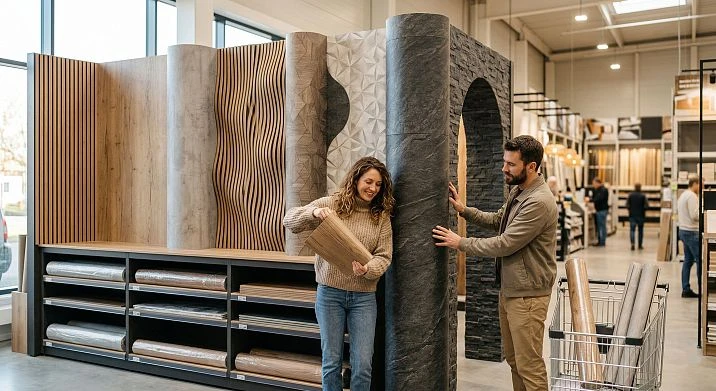
There's one trap that almost everyone falls into. A person searches for 'buy flexible wall panels' — and within minutes is looking at dozens of options, chooses what they like visually, and only after purchase and installation realizes: this is not it. Either the panel doesn't wrap around the column as expected. Or the texture 'kills' the interior instead of decorating it. Or the pattern scale is wrong, and now the wall is overwhelming the entire space.
The real choice doesn't start with a picture. It starts with understanding the task.
If you wantbuy flexible wall panelsfor interiors — this article will give you a systematic tool. Not a set of pretty words about 'modern design', but specific logic: what to look at, what to check, what to consider, what to avoid. And most importantly — when the flexible format is truly justified, and when a conventional solution is sufficient.
Let's break it all down step by step.
What are flexible wall panels and why people buy them




Construction without water
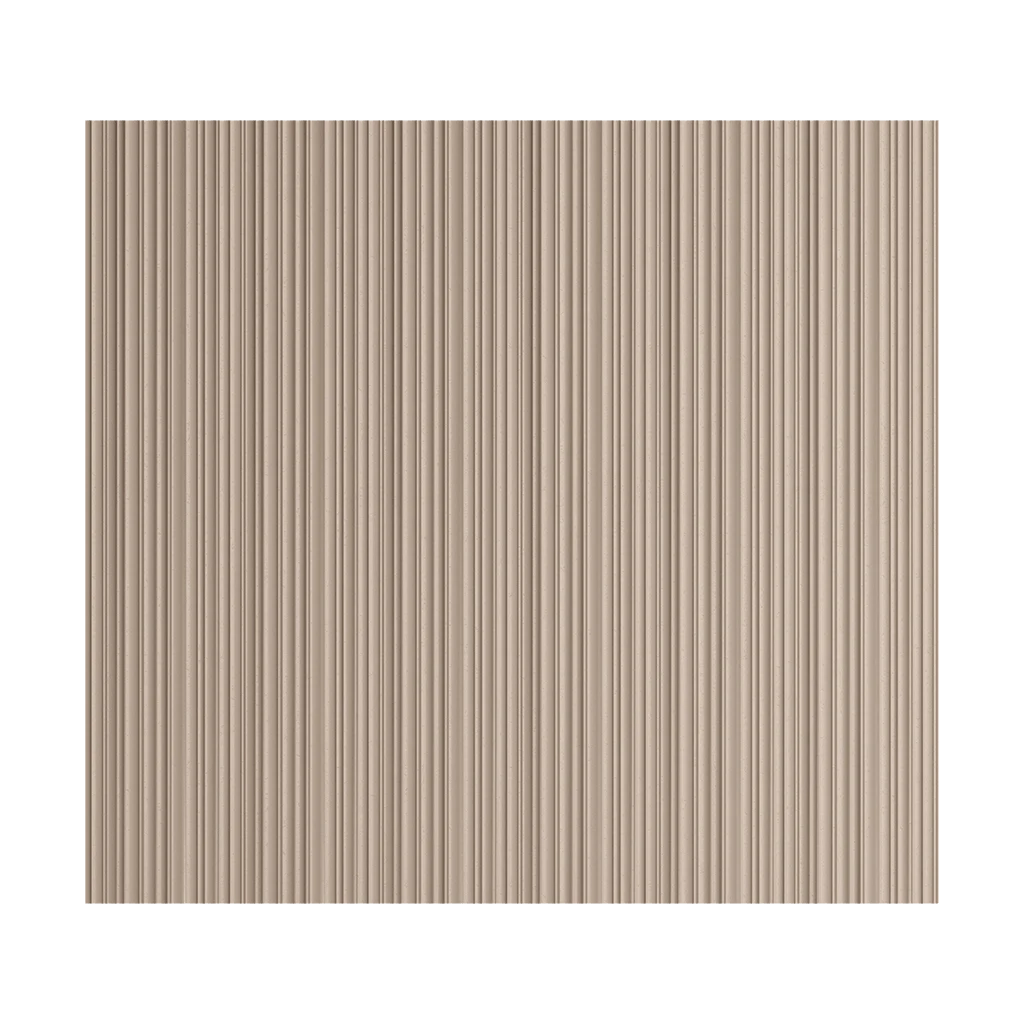
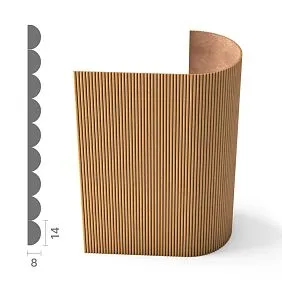
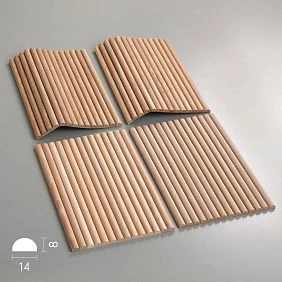
A flexible wall panel is a slatted construction where the strips are fixed not on a rigid MDF backing, but on a dense fabric base. The fabric maintains the spacing and parallelism of the slats but allows the canvas to bend to any radius.
That's the whole point. No magic, just the logic of the construction.
Rigid panel – slats on an MDF board. It's a monolith: flawless geometry, a precise plane, a stable frame. But try to bend it around a column – it will break. Try to fit it along an arch – you'll get gaps or pattern distortion.
Flexible panel – slats on fabric. It follows any curve. On a flat wall – it works like a rigid one. On a column – it wraps the full perimeter as a single sheet. On an arch – it follows the vault without breaking the pattern.
Our factory also produces:




Why flexibility is needed
This is not a marketing advantage. It's an engineering solution to a specific problem.
If your interior contains at least one curvilinear element – a column, an arch, a rounded corner, a niche with a radius, a curved partition – a flexible panel becomes not an option, but a necessity. Because the alternative is either custom carpentry with fitting each element, or visible seams that destroy the unity of the surface.
Get Consultation
What tasks do they solve in an interior
There are several functions, and it's important to understand each:
-
Decorative: create a textured, 'living' surface with pronounced chiaroscuro
-
Architectural: finish complex geometry without manual fitting
-
Acoustic: slatted structure scatters sound waves, reduces reverberation
-
Visual: vertical slatted rhythm visually increases room height
-
Commercial: creates a 'luxurious' look for the space without expensive joinery
All these tasks are solved with one material — properly chosen and properly installed.
When it's really worth buying flexible wall panels
This is the central question. Because the flexible format is not a universal solution 'for everything'. It is purchased when the surface geometry requires it, or when installation without guides using adhesive with the simplest layout is needed.
For a radius wall
A radius wall in an apartment or commercial space is exactly the situation for which the flexible format was created. A rigid panel will not lay on a curve without gaps and breaks. A flexible one presses against the entire radius, precisely following the wall's shape.
Result: the slatted pattern runs continuously, without visible fitting points. The wall looks as if it was finished to order.
For a column
Column cladding — a classic task for flexible panels. Rigid ones don't work on a closed perimeter: you would have to assemble them from separate fragments with precise joint fitting. Flexible panels wrap around a full cylinder or rectangle with a single joint placed at a pre-selected point.
Buy panels for columns— means solving the task in one installation session, without carpentry work and without visible adjustments.
For arch
An arched vault with slatted finishing is one of the most expressive architectural techniques in modern interiors. The flexible panel wraps around the inner arc of the arch as a single sheet. The slatted rhythm is uninterrupted—it flows from the straight wall through the vault and returns back.
For niche
Rounded or non-standard niches in the living room, bedroom, hallway—where corners are not designed at 90°, the flexible panel is indispensable. It takes the shape of the niche entirely, rather than being assembled from corner fragments.
For a rounded corner
Modern interiors are increasingly moving away from sharp corners. A rounded transition between walls is not just aesthetics—it's safety and softness of space.Buy panels for archesand rounded corners means getting a material that accepts any radius without adaptation.
For furniture adjacent to wall finishing
Built-in wardrobe, kitchen island, reception desk—the flexible panel covers furniture fronts with the same slats as the adjacent wall. A unified slatted pattern combines the wall and furniture into an architecturally cohesive solution.
When not to buy flexible panels
This block is a sign of honesty. And it is precisely this that helps make the right choice.
A straight, even wall without complex geometry
If your wall is straight, without curves, with standard 90° angles — a flexible panel offers no advantages over a rigid one here. A rigid slat panel on a straight wall installs more cleanly, costs somewhat less, and the result is identical.
Don't buy flexibility where it's not needed.
When a maximally rigid plane is needed
For furniture fronts with high load — for example, frequently opened cabinet doors — a rigid panel on an MDF backing is more resistant to deformation.
When you simply need decorative finishing for a straight wall
If the goal is to quickly finish a living room wall for painting, without columns or arches, a straight standard format with adhesive or frame mounting solves the task more simply and cheaply.
Understanding when a flexible panel is not needed is no less important than knowing when it is indispensable.
What flexible wall panels can be purchased for an interior
The assortment is divided not only by material. More importantly—by texture and the task the panel solves.
Wood-look panels: solid wood
The most in-demand category is solid oak slats on a fabric base. The living texture of the fiber, natural depth of tone, warmth to the touch. This cannot be reproduced by printing or film.
Buy flexible wood-look panelsChoosing solid wood means choosing long-term value. Oak is renewed by applying oil, does not require replacement after a few years, and over time acquires a patina that only enhances the interior.
Under clear oil—a warm golden tone. With tinting—Scandinavian gray, cool wenge, tobacco cognac. Under varnish—resistance to household loads and a long service life.
Wood-look panels: MDF with imitation
MDF slats with an applied wood-grain pattern. More affordable in price, more uniform in tone. A practical solution for large volumes where color batch consistency is important.
It's important to understand the difference: MDF with film is an image. Solid oak is a material. Upon closer inspection, the difference is noticeable. Choose consciously.
Panels for painting
Smooth or slatted MDF panels with factory primer—ready for painting with any enamel. RAL, NCS, Pantone. Precise corporate color, possibility of repainting without dismantling.
This is the best choice for commercial spaces with a corporate style and for those who want to update the interior without replacing the material.
Slatted panels with pronounced chiaroscuro
Buy flexible slatted panelsMade from solid oak or paintable MDF — means choosing a material that "comes to life" under lighting. With directed accent light, the slats create deep shadows that change throughout the day along with the light source's position. This is an unreproducible effect for a flat surface.
Panels with a relief surface
Relief modules with a pronounced three-dimensional texture. Especially effective with spot accent lighting. In rooms with diffused light, the relief "fades," losing its effect. Test a sample in the actual lighting conditions of your space.
Smooth Panels
A strict architectural surface. Works in minimalist interiors where decor is inappropriate and a clean rhythm of form is needed.
How to choose and buy flexible wall panels by surface type
Surface type is the first and main selection criterion. Any professional selection begins precisely with it.
For a straight wall
On a flat surface, flexible and rigid panels yield identical results. The choice is determined by material, price, and preferred installation method.
For a radius wall
Only flexible format. Radius of curvature is the key parameter: ensure the panel wraps around your specific radius without white spots or peeling at the bend. Request a sample and test it live on your surface.
For a column
Measure the column perimeter. Ensure the width of one module covers the entire perimeter—or plan a joint at a specific, pre-selected point. The joint should be minimally noticeable: behind furniture, in shadow, in the least visible area.
For an arched opening
A flexible panel wraps around the arc of the arch from the inside. For this, the panel is cut to the width of the arch and installed sequentially from the springing line to the keystone. Dry fitting beforehand is mandatory.
For niche
Measure all planes of the niche, including side walls and ceiling. For rounded corners—flexible format provides a continuous pattern. For straight corners—rigid panels with corner profiles can be used.
For a complex combined surface
A partition with radius transitions, a column with straight edges and rounded corners, an arch with straight abutments—all are solved with a flexible panel and planned layout before installation begins.Buy panels for complex surfaces—means ordering material with a 10–15% surplus for fitting and non-standard cuts.
Which panels to buy for different rooms
For the living room
The living room is the calling card of the interior. Here, a slatted wall works as an accent architectural element: behind the sofa, in the TV area, on the side plane.
Material recommendation: solid oak with warm toning or MDF in a neutral shade. Scale recommendation: slat spacing is proportional to the room area. In a large living room from 25 sq.m — wide slat 20–30 mm, sparse spacing. In a standard apartment — thin slat 10–15 mm, moderate spacing.
If the living room has decorative columns or arched transitions —buy flexible wall panels for the interiorfrom a single batch so that the slatted pattern runs continuously across all surfaces.
For the bedroom
The bedroom requires material quietness. An accent wall behind the headboard is the main scenario. The panel should be calm: light tone, moderate spacing, soft texture without aggression.
Solid oak with clear oil or light whitewashed toning is an ideal solution for a bedroom in Scandinavian or contemporary style.
Do not overload the bedroom with dark tones and large relief: this creates tension where peace is needed.
For the hallway
The hallway experiences the greatest mechanical load. Solid oak with oil or varnish coating is more durable than MDF in the intensive use zone.
A dark tone conceals contact marks. The vertical slat rhythm organizes the narrow space and creates a sense of order upon entry.
If there is an arched opening or rounded transitions in the hallway — this is a direct task for the flexible format.
For the corridor
In a long corridor, a slatted wall serves a dual function. Decorative: it adds depth to a monotonous space. Visual: it organizes perspective, directs the gaze. In a narrow one — light slats with a sparse pitch. In a wide one — a dark accent, a dense rhythm.
For the study and meeting rooms
The wall in the study works for reputation. Dark oak, strict vertical lines, matte oil finish — this is the language of a space where decisions are made.
In meeting rooms, an additional bonus: the slatted structure diffuses sound, reduces reverberation, and improves acoustics for negotiations.Buy decorative flexible panelsfor the meeting room — this simultaneously solves both an aesthetic and an acoustic task.
For an office
MDF for painting in the corporate color tone — or neutral oak. Reception, lobby, waiting area — a slatted panel creates a professional impression at first glance.
If there are columns in the office space — cladding them with flexible panels turns structural elements into a decorative accent.
For commercial interiors
Restaurant, hotel, boutique, medical center. Here the material must withstand years of use without losing its appearance. Solid oak is an investment material with a 15–20 year horizon. Renewed by applying oil without dismantling.
Which flexible panels to buy by texture and style
Wood-look panels in modern interior
Oak slat panels are the absolute leader in demand in the modern residential interior segment. They combine with minimalism, Japandi, Scandinavian style, modern classic, and loft — each time in a different tonality.
In minimalism: whitewashed oak, thin slat, clear oil. In loft: dark tint, wide slat, rough texture. In Japandi: natural oak without tinting, moderate spacing, no unnecessary details.
Stone-look panels
Slate, limestone, travertine. Brutal aesthetics, 'grounded' space. On curved surfaces — the flexible format is indispensable: installing natural stone on a radius wall requires manual fitting of each element. A flexible panel with stone texture wraps around the same surface without special skills.
Plaster and concrete-look panels
Industrial style, loft, modern brutalism. On radius surfaces — a rigid sheet with concrete imitation will require manual adaptation. A flexible one lays down effortlessly.
Slat panels for minimalism and Japandi
Narrow slat, neutral color, transparent oil or matte paint. Nothing extra. The panel here is not decor, but the architectural rhythm of the surface.
Panels for premium spaces
Dark oak, matte oil, clear step. Nearby — natural stone, brass, soft directional light. This is the language of spaces where reputation is materialized in every detail.
What is better to buy: flexible panels or regular wall panels
Honest comparison is the best selection tool. Let's consider all alternatives.
| Criterion | Flexible slatted panel | Rigid slatted panel | Decorative plaster | Wallpaper | Paint |
|---|---|---|---|---|---|
| Curvilinear surfaces | Yes | No | Yes | Limited | Yes |
| Plank pattern | Yes | Yes | No | Imitation | No |
| Natural wood texture | Yes (oak) | Yes (oak) | No | No | No |
| Installation without guides | Yes | Partially | No | Yes | Yes |
| Repainting without disassembly | Yes (MDF) | Yes (MDF) | Yes | No | Yes |
| Durability | High (oak) | High (oak) | High | Low | Medium |
| Visual depth | High | High | Medium | Low | No |
| Columns and Arches | Yes | No | Yes | No | Yes |
| Acoustic effect | Present | Present | No | Minimal | No |
| Installation speed | High | High | Low | Medium | High |
The conclusion is straightforward: where there is a curve — a flexible panel is the only correct choice among slatted solutions. On a straight wall — it competes with rigid ones on equal terms, and the choice is determined by material and budget.
Plaster and paint offer freedom of form, but do not provide a slatted pattern or natural texture. Wallpaper is the least durable option with the least visual depth.
What to look for before buying
Surface geometry — first and foremost
Before searching for a panel, answer the question: is there at least one curve in the project? If yes — only flexible format. If no — choose based on material.
Quality of the fabric base
It determines how the panel will behave on a curved surface. Dense, durable fabric that doesn't tear when bent is a sign of a quality product. Request a sample and bend it manually: a good panel doesn't resist bending and returns to its original shape without slat deformation.
Accuracy of end geometry
Take two samples and place them end-to-end. A perfect joint is slat to slat, without gaps or overlaps. This guarantees seamless installation. A crooked end is a joint that no installer's care can fix.
Pattern scale
Slat width and spacing should match the room's scale. This rule is most often violated — and it creates the biggest visual problems. Check the scale on a live sample, not in a picture.
Lighting
A slatted surface reveals itself under directional light. Without accent lighting — it loses 30–40% of its visual potential. Plan lighting before choosing a panel, not after purchase.
Batch
The entire project volume — from one batch. Natural oak may have color variations between batches. Order with an 8–12% surplus from one shipment.
Sample before purchase
This is not an option, but a necessity.Order a panel sample— means seeing the real color, texture, end quality, and bending behavior live, not on a monitor screen. Saving on a sample results in losses when returning an unsuitable batch.
How to buy flexible wall panels without mistakes
An eight-step algorithm that works in any project
Step 1. Define the task. Is it an accent wall? A column? An arch? A niche? Furniture? The more precise the task, the easier the choice.
Step 2. Assess the surface geometry. Are there curves? If yes — only flexible format. If no — both options are possible.
Step 3. Choose the material. Solid oak — for natural aesthetics and durability. MDF for painting — for precise color and the ability to update.
Step 4. Determine the texture. Slatted with a pronounced step, relief, smooth? Consider it in relation to the lighting of your space.
Step 5. Check the scale. Slat width and step — on a live sample, in the actual conditions of the room.
Step 6. Order a sample. Evaluate the color, texture, edge, behavior when bending. This is a key step before a large order.
Step 7. Calculate the quantity. Surface area + 10% for cutting and fitting. On complex curved surfaces — 15%.
Step 8. Plan the installation in advance. Where will the joints be? How will the pattern run on the column? Where will the panel end at the ceiling? Answers before purchase are the key to a neat result.
Installation of flexible wall panels
Foundation Preparation
Clean, dry, grease-free, solid surface. Remove unstable layers: peeling paint, loose plaster, old wallpaper. Porous surfaces — prime with a deep-penetration compound. Smooth dense surfaces — remove dust and degrease.
Minor irregularities up to 3 mm per meter — concealed by the slatted structure. Significant deviations — eliminated with putty or installation on a frame.
Dry fitting
Mandatory step. Lay out the panels without adhesive. Check the layout, symmetry, joint placement. Apply guidelines. 30 minutes of dry fitting prevent several hours of rework.
Cutting
MDF slats are cut with a utility knife on the fabric backing — cleanly, without chips. Solid oak — with a fine-toothed handsaw or miter saw. Cut angle: 90° for standard joints, precise angle for external or internal corners.
Applying adhesive
Mounting adhesive with high initial adhesion. Apply to the fabric backing in a zigzag pattern — not a solid layer. Excess will seep through gaps. On vertical planes — also apply adhesive to the wall.
Fixation
On a straight wall: press smoothly, from one edge to the other. On a curved surface: wrap gradually, maintaining pressure for 5–7 seconds on each section. On a column: go around the perimeter sequentially, joint — at a pre-selected point.
Module Joining
Slat to slat, without gaps. With precise end cuts, the joint visually disappears into the surface rhythm. This is precisely what distinguishes a quality panel from a cheap one.
Corner finishing
External corner: cut at 45°, joined 'on a miter'. Internal corner: one panel flush against the other. Alternative — corner profiles matching the color.
Adjacency to other materials
To floor and ceiling: baseboard or ceiling profile matching the panel color. To stone or metal: transition profile or minimal gap with color-matched sealant.
Final inspection
Evaluate the surface under accent lighting. Check the parallelism of the slats. This is the last moment when adjustments can be made without serious losses.
Mistakes when buying flexible wall panels
Buying for the wrong purpose
The most common mistake: buying a flexible panel for a straight wall where a rigid format would have worked perfectly. Or vice versa — taking a rigid one for a column and getting a disappointing joint.
Choosing based only on photos
The monitor lies. The color differs from reality. The scale of the slat in the picture and in the space are different things. Always order a sample.
Wrong texture for the lighting
A relief panel in a room with diffused light is money wasted. The volume 'fades away'. Test in real conditions.
Scale error
A wide slat in a small room — feels oppressive. A thin slat in a large hall — gets lost. The rule is simple, but it's constantly broken.
Ignoring lighting
A slatted panel without well-planned accent lighting is half the result. Plan cable channels before installation.
Different batches
Natural oak has color variations between batches. The entire volume should be from one shipment.
Skip dry fitting
The result is predictable: a narrow trim in the most noticeable spot, a random joint in the middle of the accent wall. Thirty minutes of fitting — priceless.
Incorrect understanding of installation
Installing flexible panels is easier than it seems. But 'easier' doesn't mean 'without preparation'. The substrate must be ready. The adhesive must be correct. The pressure must be even. Read the manufacturer's instructions.
FAQ: answers to key questions
When should you buy flexible wall panels specifically?
When the project has curved surfaces: columns, arches, radius walls, rounded niches. On straight walls — the choice between flexible and rigid formats is determined by other parameters.
Can these panels be purchased for a regular straight wall?
Yes. On a straight wall, a flexible panel works identically to a rigid one. The difference is only in the substrate construction and price.
Which panels are better to buy for a column?
Flexible, with a fabric base that allows wrapping around the full perimeter. A rigid panel on a closed column perimeter will require several fragments with manual joint fitting.
Which panels are suitable for an arch?
Only flexible ones.Buy panels for arches— means getting a material that wraps around the arch's curve as a single sheet without breaking the pattern.
Which flexible panels to choose for the living room?
Solid oak with warm toning or MDF for painting in a neutral shade. The scale of the slat — according to the area of the room. Orientation — vertical.
Which ones — for the bedroom?
Light tone, moderate spacing, soft texture. Solid oak with clear oil or whitewashed toning. Avoid dark tones and large relief near the sleeping area.
What is better to buy: flexible or rigid panels?
Depends on the geometry of the surface. If there is a curve — only flexible. Straight surface — choose based on material and budget. A rigid panel on a straight wall is somewhat easier to install and costs less.
Is a sample needed before purchase?
Absolutely. A sample allows you to assess the actual color, texture, edge quality, and bending behavior. It's the only way to avoid mistakes before a large order.
Can panels be used for both furniture and walls simultaneously?
Yes. This is precisely what creates a sense of architecturally cohesive space. Built-in furniture clad with the same slats as the wall unifies everything into a single material image.
Is it difficult to install flexible panels?
No. Installation with adhesive without guides, cutting with a knife or saw, seamless joining. With a prepared base and dry fitting — it's accessible to a careful non-specialist.
Conclusion
The decision of whether to buy flexible wall panels for a specific project is not made based on a pretty picture or price. It's made based on three questions:
Are there curved surfaces in the project? If yes — the flexible format is absolutely justified. It solves a problem that a rigid one cannot.
What material is needed? Natural aesthetics and durability — solid oak. Precise color and the possibility of renewal — MDF for painting.
Have I checked the sample in person? No — do not buy. Yes — you can order a batch.
The rest are details that are resolved during the work. The main thing is the right start.
About the company STAVROS
If the task is specific and the result must be precise — turn to STAVROS.
The line includes MDF rail panels for painting and solid oak, flexible modules on a fabric base for all types of curved surfaces — columns, arches, radius walls, rounded niches, and curved furniture fronts. In-house production guarantees precise end geometry, batch tone stability, and a surface ready for finishing on the first try.
STAVROS is the professional choice of designers, architects, and private clients who are not willing to compromise. The full catalog, technical parameters, sample ordering option, and professional selection consultation are available on the official website.stavros.ru.