Article Contents:
- Why 'flexible panels' is too broad a query
- What is a flexible slatted panel: construction and working principle
- Structural elements
- How flexible panels differ from rigid slatted ones
- Visual effect of slatted texture: why it works
- Where flexible slatted panels are used: a complete breakdown of scenarios
- Radius Walls
- Columns
- Arches and Arch Openings
- Niches
- Furniture fronts
- Partitions
- Materials: MDF or solid oak
- MDF for painting
- Solid oak
- How to choose flexible slatted panels for a specific task
- For a radius wall
- For a round column
- For a niche
- For an arch
- For a furniture front
- For an accent wall in a small room
- Main advantages of flexible slat panels
- Repeating curves without adjustment
- Seamless module connection
- Mounting with adhesive
- Easy cutting
- Ready for finishing
- Expressive Chiaroscuro
- How Flexible Slat Panels Are Installed: Step-by-Step Breakdown
- Step 1. Surface preparation
- Step 2. Marking
- Step 3. Fitting and Cutting
- Step 4. Applying Adhesive
- Step 5. Installation
- Step 6. Module Joining
- Step 7. Final Finishing
- What to Look for When Choosing Flexible Panels: A Practical Checklist
- Common Mistakes When Choosing and Installing Flexible Panels
- Mistake 1. Buying a Rigid Panel for a Curved Surface
- Mistake 2. Incorrect Radius Assessment
- Error 3. Unprepared surface
- Error 4. Choosing by photo without structural analysis
- Error 5. Ignoring batten spacing
- Error 6. Installation without temporary fixation
- Error 7. Mixing flexible and rigid modules in one row
- Flexible batten panels in different interior styles
- Modern minimalism
- Scandinavian Style
- Neoclassicism and Modern Classicism
- Loft and Industrial Style
- Commercial spaces: where flexible panels work especially effectively
- Restaurants and Cafes
- Hotels and guest houses
- Offices and meeting zones
- Boutiques and showrooms
- FAQ: Answers to Popular Questions About Flexible Slat Panels
- What is a flexible slat panel?
- How does a flexible slat panel differ from a regular one?
- What is the minimum radius a flexible panel is designed for?
- How are flexible slat panels installed?
- Can flexible panels be painted?
- Can flexible panels be used on columns?
- How to cut a flexible panel?
- Are flexible panels suitable for furniture?
- What to choose: MDF or solid oak?
- Are flexible slat panels suitable for commercial spaces?
- About the Company STAVROS
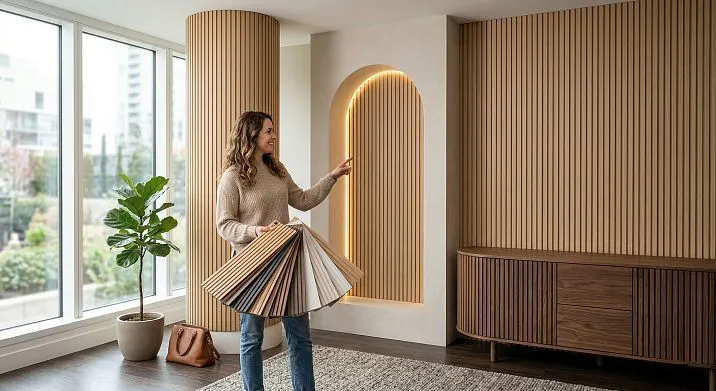
There are surfaces that make standard solutions retreat. A radius wall, a curved column, a rounded niche, a bent kitchen island facade—all these leave traditional rigid panels at a loss. Slats crack, joints separate, geometry is lost. It is precisely in these situations that flexible slatted panels come to the fore—a tool that wraps around any curve without adjustment, joins seamlessly, and provides the same expressive slatted texture as classic rigid modules on flat surfaces.
But before discussing flexible slatted panels as a solution, we need to understand what exactly lies behind this term. Because the market, under the keyword 'flexible panels,' offers completely different materials for different tasks, and confusing them means choosing the wrong thing from the start.


Why 'flexible panels' is too broad a query
When someone searches for 'flexible panels,' they get mixed results: self-adhesive PVC tiles imitating stone, flexible artificial stone on a mesh, soft 3D panels made of polyurethane foam, and—as a separate group—genuine flexible slatted panels on a fabric base. These are four completely different products with different constructions, different application scenarios, and different visual results.
Self-adhesive PVC solutions are designed for budget-friendly finishing with quick installation. Flexible stone is an imitation of stone texture with an emphasis on decorativeness. Soft 3D panels provide volumetric relief, but not a slatted structure.
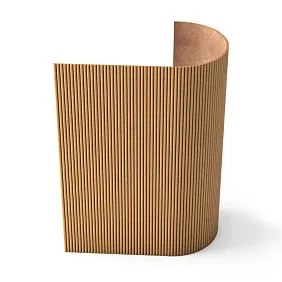
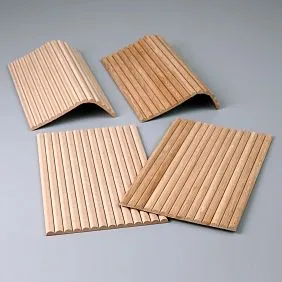
A flexible slatted panel is a fundamentally different construction. It is a module of parallel wooden or MDF battens, fixed at equal intervals on a flexible fabric base. The fabric allows the panel to wrap around curved surfaces without breaking or deforming the slats. The result is a continuous slatted texture on any geometry: a round column, a radius wall, an arched opening, a curved furniture facade.
Understanding this difference is the starting point for making the right choice. That is precisely why simply talking about 'flexible panels' is insufficient: it is necessary to specify the type, construction, and purpose.




What is a flexible slatted panel: construction and operating principle
Flexible slatted panelsThese are modular decorative elements based on a fabric backing with wooden battens attached to it. It is the flexibility of the base that provides the key property: the panel can be bent to any radius without the risk of the slats splitting or deforming.
Our factory also produces:
Structural Elements
Fabric base. Reinforced textile with the necessary tensile strength and sufficient flexibility for bending. It is this that holds the slats at the required pitch and allows wrapping around curved surfaces.
Wooden or MDF battens. Strips with identical cross-section, fixed to the base at equal intervals. The spacing of the strips determines the character of light and shadow and the visual density of the surface: wide spacing creates a more airy and light effect, dense spacing creates a monolithic architectural surface.
Strip profile. Can be flat rectangular or semicircular. A semicircular batten provides a softer, more dynamic play of shadow—each strip forms its own highlight and shadow, creating a tactually rich surface.
Get Consultation
How a flexible panel differs from a rigid slatted one
| Parameter | Rigid slatted panel | Flexible slatted panel |
|---|---|---|
| Base | Rigid MDF backing | Flexible fabric backing |
| Surface | Only flat planes | Flat and any curvilinear surfaces |
| Fitting on curves | Requires trimming and fixing | Does not require — wraps around on its own |
| Joints | Visible with imprecise trimming | Seamless |
| Installation | Adhesive + fasteners on the substrate | Adhesive only |
| Cutting complexity | Standard | Simple, with a knife |
The difference is fundamental. A rigid panel is a tool for straight walls and facades. A flexible panel is a tool for everything else. And precisely where a regular panel is either not applicable or requires complex fitting, the flexible slatted panel works without additional operations.
Visual effect of slatted texture: why it works
Before moving on to application scenarios, it's worth understanding why slatted surfaces are so visually appealing in the first place. This isn't just a trend — it's physics.
Parallel slats create a rhythmic play of light and shadow on the wall. With side or directional lighting, each slat casts its own shadow on the adjacent one, and the surface begins to 'breathe' — it ceases to be flat and gains a sculptural dimension. The sharper the lighting angle, the deeper the shadows and the more pronounced the effect.
On curved surfaces, this effect is amplified: the curvature of a wall or column creates an additional interplay of light incidence angles, giving the slatted surface a dynamism that a flat wall cannot replicate.
Wall slatted panelsThey function precisely as an architectural tool, not merely as a finishing material. Their purpose is to create a surface that lives with light and changes throughout the day.
Where Flexible Slatted Panels Are Used: A Complete Breakdown of Scenarios
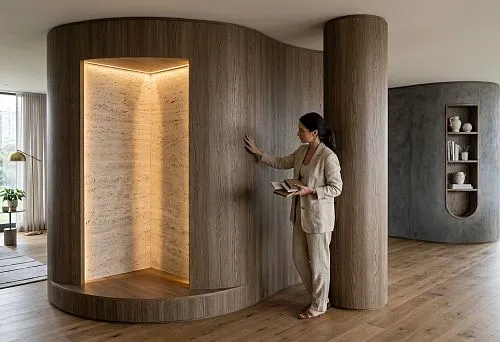
Radius walls
This is the primary scenario for which the flexible system was created. Radius walls — curved, rounded, with a smooth bend — are found in architectural projects for residential homes, lofts, private residences, and hotels. Cladding such a wall with wood in the traditional way is difficult and expensive: it requires custom fitting of each board, precise calculation of curvature, and significant labor costs.
The flexible slatted panel solves this task in a radically different way. The module is applied to the surface, carefully bent to match the wall's shape, and secured with mounting adhesive. No custom fitting, no gaps between slats. Several modules are joined end-to-end, and the slat pattern continues uninterrupted across all seams — creating the illusion of a single, continuous covering.
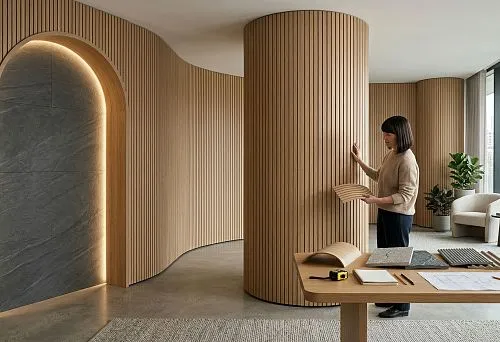
Columns
Cladding columns is another task that rigid panels handle poorly, while flexible ones excel at it. A round load-bearing column with a diameter of 25–40 cm is a typical architectural element in open-plan layouts, lofts, and commercial spaces. Leaving it as bare concrete means losing a detail. Dressing it in stone or tile is expensive and heavy.
Flexible Slatted Panels for Columnsare mounted around the circumference: the module wraps around the surface, the slats run vertically, and the column gains an expressive wooden texture without a single break or seam. For a column with a perimeter of about 120 cm, one or two standard-format modules are sufficient.
Arches and arched openings
An arched opening is a curve that few know how to work with beautifully. If the walls are finished with panels, and the arch remains painted or plastered, the transition boundary is noticeable and disrupts the integrity of the interior.
A flexible slatted panel allows the slatted texture to continue directly into the arch: the module wraps around the rounded surface of the opening's end, and the transition from wall to arch becomes seamless. This is a detail that isn't noticed immediately—but it's precisely what creates the feeling of professionally executed design.
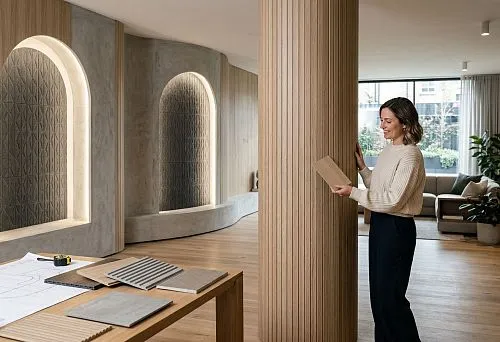
Niche
A decorative niche is a popular architectural technique in modern interiors. Its back and side walls form right angles or rounded transitions.Slatted panels in the living room interiorand other rooms are often used precisely for decorating niches: the back wall is covered with slats, and the niche transforms from a recess in the wall into a full-fledged visual object.
For rounded niches—with rounded side edges—a flexible panel is especially appropriate: it smoothly transitions from the back plane to the side, without exposing seams.
Furniture facades
This is a separate and very significant scenario. Curved furniture fronts—fronts of kitchen islands with a rounded end, corner cabinet sections, rounded cabinets, bar counters with a curved front—require a material that will follow the curve without milling and complex preparation.
A flexible slatted panel is mounted directly onto the front: it is applied, bent to shape, and fixed with adhesive. The result is a slatted furniture front with a continuous texture, without visible technological seams. Decorative overlays for furniture and fronts—carved wooden elements—complement such a solution well: slats as texture, overlays as accent details.
Partitions
Slatted partitions are one of the most popular designer techniques in recent years for open floor plans. A flexible slatted panel allows building a partition with a rounded edge or a smooth transition to the ceiling—without the need to manufacture custom radius elements. A partition with a curved top edge, clad in continuous slats, is a complete architectural form.
Materials: MDF or solid oak
Flexible slatted wall panels are available in two main versions — for MDF and solid oak. Choosing between them is a choice not only of aesthetics but also of function.
MDF for painting
MDF panels are the optimal solution where color is the main tool. Dense MDF (750–850 kg/m³) provides a smooth, defect-free surface that accepts any paint coating: matte, satin, semi-gloss enamels. An MDF slatted panel can be painted to an exact RAL color — from pure white to deep anthracite, from powder pink to rich emerald.
This is an important advantage specifically for flexible panels on non-standard surfaces: a column painted the same color as the wall stops 'sticking out' from the space and becomes an organic part of the interior.
Slatted panel for the wall made of MDF— a precise, controlled tool for working with color in complex architectural forms.
Solid oak
Oak is a natural texture, a living grain pattern, the warmth of natural material. Each slat carries a unique pattern — no film or veneer can reproduce this. Oak is tinted with oils and varnishes: warm golden, Scandinavian gray, deep wenge, tobacco cognac. A density of 700–750 kg/m³ provides mechanical resistance to scratches.
For furniture fronts, where the panel will be in an area of regular contact — oak is preferable. For accent columns and walls in residential interiors — both materials are equally appropriate, the choice depends on the design concept.
wood-look slatted panelsmade of solid oak is a material for those who value natural aesthetics and are ready for long-term investments in finishing quality.
How to choose flexible slatted panels for a specific task
Choosing a panel is not just a question of 'what is more beautiful'. It is a question of matching the construction to the task. Let's break it down by specific scenarios.
For a radius wall
-
Base type: fabric (flexible)
-
Minimum bending radius: check with the manufacturer for the specific model
-
Material: MDF or oak — according to the design concept
-
Slat orientation: vertical (standard) or horizontal (as per requirement)
For heavily curved walls (radius less than 50 cm) — verify the module's flexibility parameters before ordering.
For a round column
-
Base type: fabric
-
Calculation: measure the column's perimeter — this is exactly how many linear centimeters of panel width you need
-
Installation: around the circumference, slats vertically, seams butt-jointed
-
Material: MDF for a monochrome solution, oak for a natural one
For niche
-
For flat niche walls — rigid panel will work
-
For rounded niche ends — flexible is mandatory
-
Inside niche works well with combination: back wall — slats, sides and top — painted to match
For arch
-
Base type: fabric
-
Installation: along arch opening edge
-
Module width: matches arch reveal width
-
Slats: horizontally — along arch edge
For furniture front
-
Base type: fabric (for curved fronts), rigid (for flat)
-
Mounting: adhesive to the facade — no mechanical fasteners
-
Material: oak for natural facade, MDF for painted
-
Combination withdecorative appliqués for furniture— creates a finished designer facade
For an accent wall in a small room
-
Type: rigid or flexible — depending on wall geometry
-
Slat profile: semicircular — for softer light and shadow
-
Scale: delicate slat spacing, not overwhelming a small space
-
Color: matching the wall or 1–2 shades darker
Main advantages of flexible slat panels
Why is a flexible fabric-based construction not a compromise, but a deliberate advantage?
Repeating curves without custom fitting
This is the basic and main feature. The panel does not require sawing, milling, or custom fitting to the radius. Apply, bend, secure — and the surface is ready. Saving time and labor on complex geometries is fundamental.
Seamless module connection
The fabric base is joined edge-to-edge without visible transitions, and the precise slat spacing ensures pattern continuity across all seams. Looks like a single covering — regardless of the number of modules.
Mounting with adhesive
No dowels, screws, or special frame needed. Mounting adhesive is applied to the back of the module — the panel is pressed onto the surface. This is especially important for curved surfaces: screws in a curved wall are a separate engineering challenge, adhesive is not.
Easy cutting
The panel is cut with a utility knife along a straight line. This means you can fit the module to the room height, work around an outlet or switch, or fit into a non-standard opening right on site — without a saw or special tools.
Ready for finishing
MDF panels are ready for painting immediately after installation — no additional primers or surface preparation needed. Solid oak panels are ready for oil, varnish, or tinting compound application.
Expressive light and shadow
Parallel slats work with light on any surface — straight, curved, cylindrical. On a column, the lighting effect is especially expressive: the slats create a continuous play of highlights and shadows around the entire perimeter.
How flexible slat panels are installed: a step-by-step breakdown
Step 1. Surface preparation
The surface must be clean, dry, and degreased. For concrete and plastered walls — use primer. For drywall — standard putty and primer. Serious unevenness on straight walls is best corrected before installation or use the frame method — then the panel is attached to a metal profile, and the plane is leveled by the frame, not by plaster.
For columns and curved walls, the surface must be as even as possible — all protrusions and bulges must be chipped off or sanded down, otherwise the panel will not fit tightly.
Step 2. Marking
Apply vertical and horizontal axes. For a column — mark the starting line of the module. For a radius wall — mark the height of the start and end of the panel. Proper marking ensures straight slats without a 'staircase' effect in height.
Step 3. Fitting and cutting
Place the module against the surface without adhesive — check how it fits, where trimming is needed. Cutting to height — use a utility knife along a metal ruler. For an arched end — draw the arch contour on the back of the panel and cut along the curve.
Step 4. Applying adhesive
Mounting adhesive is applied to the back surface of the panel in a zigzag or even horizontal stripes. For curved surfaces — apply adhesive more densely, especially along the edges: edges tend to lift when bent.
Step 5. Installation
Press the module against the surface, starting from one edge and moving to the other — this way you control adhesion and avoid bubbles. On a column — wrap around the surface gradually, pressing with your palm along the entire length.
For flexible panels, temporary fixation with painter's tape along the edges is recommended until the adhesive fully sets (usually 2–4 hours). On vertical surfaces, this prevents the module from slipping.
Step 6. Module Joining
The next module is placed flush against the previous one. Align the slat spacing—the slats should continue without shifting. With proper joining, the seam is practically invisible.
Step 7. Final Finishing
MDF panels are primed and painted with the chosen enamel in two thin coats. Oak panels are coated with oil, varnish, or a tinting compound. Joint areas are touched up with a narrow brush if necessary.
What to Look for When Choosing Flexible Panels: A Practical Checklist
Before placing an order, go through this list of questions.
Surface Radius. What is the minimum bending radius of the surface? Verify that the panel is designed for such a radius without risk of slat deformation.
Material. MDF or oak—based on the requirement: color and painting vs. natural texture.
Slat Profile. Rectangular or semicircular—based on the desired light and shadow effect.
Batten spacing. Close spacing — dense, 'warm' surface. Wide spacing — lighter, airier.
Module format. Standard PAN-001 format — 1010×8×950 mm. Check if the module width is sufficient for a specific column or niche.
Installation method. Adhesive only? Or is a frame needed to level the substrate?
Finish. Does the panel need painting after installation, or is it already finished?
Integration with other elements. How will the panel join with moldings, baseboards, cornices?
Common mistakes when selecting and installing flexible panels
Mistake 1. Buying a rigid panel for a curved surface
The most common and costly mistake. A rigid panel on a curved wall results in either visible gaps or material fractures. For any surface with a radius — only a flexible construction.
Mistake 2. Incorrect radius assessment
Not all flexible panels are equally flexible. The radius a specific module is designed for depends on batten thickness and fabric backing type. Before purchase, confirm the minimum working radius with the manufacturer.
Error 3. Unprepared surface
A dirty, dusty, or greasy wall — the adhesive won't hold. Especially critical for columns: when bent, the panel experiences additional stress on the adhesive seam.
Error 4. Choosing based on photo without analyzing the structure
A beautiful photo of a slatted wall says nothing about whether the panel there is rigid or flexible. If the surface in your project is curved — you need to clarify the base type with the manufacturer, not just order 'the same slats'.
Error 5. Ignoring the slat spacing
Too frequent spacing on a small column — and the surface looks overloaded. Too sparse on a large wall — and the texture seems unfinished. The scale of the spacing must match the scale of the surface.
Error 6. Installation without temporary fixation
A flexible panel on a curved surface has a natural tendency to 'straighten out' before the adhesive sets. Without tape fixation — the edges lift. This is solved simply, but you need to know in advance.
Error 7. Mixing flexible and rigid modules in one row
Different base types result in different fits — and this will be noticeable at the joints. On a straight wall, use rigid panels; on curved sections — flexible ones. The transition between them is best covered with molding or a decorative element.
Flexible slatted panels in various interior styles
Modern minimalism
A flexible MDF slatted panel, painted to match the wall color, blends completely with the surface. The slats create only relief, without adding color contrasts. A column clad to match the space loses its bulkiness and becomes an architectural detail.
Scandinavian style
Oak slats with clear oil or Scandinavian gray tinting. Natural texture, warm tones, delicate spacing of the battens. Radius columns in an open living room, finished in this way, are an organic part of a natural Scandinavian interior.
Neoclassicism and modern classicism
Flexible slatted panel in combination withwall molding— is one of the most advantageous techniques. The slats create a textured background for the accent zone, molding frames border it, forming a complete architectural composition. Columns with slatted cladding and polyurethane capitals are a strong classical motif in a modern interpretation.
Loft and industrial style
Gray MDF slats against a backdrop of exposed concrete or brick — an architectural contrast of textures. Flexible panels on round reinforced concrete columns, which are often found in loft spaces, are an example of how an industrial element can be 'dressed' without losing its character.
Commercial spaces: where flexible panels work especially effectively
Restaurants and cafes
Radius bar counters, curved partitions between zones, rounded columns in the hall — all this is standard restaurant space architecture. Flexible slatted panels on such surfaces create a warm, acoustically pleasant atmosphere and visual premium quality.
Hotels and guest houses
Lobbies, corridors, elevator halls — spaces with non-standard geometry that require durable and visually high-quality finishes. Oak flexible panels on curved lobby walls are a marker of a high-class establishment.
Offices and meeting areas
Slat panels create acoustic comfort by diffusing sound waves. In meeting rooms with rounded walls or columns, flexible slat panels solve both aesthetic and acoustic tasks simultaneously.
Boutiques and showrooms
Curved display windows, rounded shelf ends, columns in the sales area — here the slat texture works as a professional backdrop for merchandise and as a sign of quality design.
FAQ: answers to popular questions about flexible slatted panels
What is a flexible slat panel?
It is a module made of wooden or MDF battens, fixed at equal intervals on a flexible fabric base. The fabric base allows the panel to bend to any radius while maintaining the integrity of the slats and equal spacing.
How does a flexible slat panel differ from a regular one?
A regular slat panel has a rigid MDF backing and only works on flat surfaces. A flexible one — on a fabric base — is mounted on curved surfaces: columns, arches, radius walls.
What is the minimum radius a flexible panel is designed for?
Depends on the specific model and slat thickness. For standard STAVROS PAN-001 modules, check the parameters on the pageof slatted panelsor with the company's managers.
How are flexible slatted panels mounted?
Using mounting adhesive — without mechanical fasteners. The surface must be clean, dry, and primed. After applying the adhesive, the panel is pressed against the surface and secured with painter's tape until it sets.
Can flexible panels be painted?
Yes. MDF panels are ready for painting with any enamel immediately after installation. Solid oak panels are tinted and coated with varnish or oil.
Can flexible panels be used on columns?
Yes, this is one of the primary application scenarios. The panel wraps around the column's circumference, the slats run vertically, and the modules join seamlessly.
How to cut a flexible panel?
With a utility knife along a metal ruler — for straight cuts. For shaped forms (arches, rounded edges) — draw the outline on the back side and cut along the line.
Are flexible panels suitable for furniture?
Yes. For curved furniture fronts, corner cabinet sections, bar counters, and islands — the flexible slatted panel is mounted directly onto the front surface with adhesive.
What to choose: MDF or solid oak?
MDF — if you need painting in a specific color. Solid oak — if you need a natural texture with tinting or clear varnish. For furniture with high load — oak is preferable.
Are flexible slatted panels suitable for commercial spaces?
Yes. Restaurants, hotels, offices, boutiques — all scenarios with non-standard geometry requiring durable, visually high-quality finishes. Oak panels under varnish withstand high traffic without losing their appearance.
About the company STAVROS
When a task requires not a standard, but a precise solution — from a curved wall to a curved furniture front — the choice of professionals in Russia is one: STAVROS. The company produces slatted panels from MDF for painting and solid oak in several structural formats, including flexible modules on a fabric base for radius surfaces, columns, arches, and furniture fronts.
In the STAVROS assortment—Rafter panelswith rigid and fabric bases, panels made of semi-round battens, modules for painting and for tinting. Each item is a production standard with seamless module connection, precise slat spacing, and readiness for finishing immediately after installation.
STAVROS — winner of the 'Industry Leader of Russia' award, a company with twenty years of experience in producing wooden decor for interiors and facades. Delivery across the country makes it possible to implement projects of any scale regardless of the object's geography.
If your project includes radius walls, columns, arches, or curved furniture fronts —STAVROS slatted panel catalog— this is the first place to visit.