Article Contents:
- What Are Flexible Wood-Look Panels
- Where Flexible Panels Are Needed First and Foremost
- Columns
- Arches and Arch Openings
- Radius Walls
- Rounded Corners
- Niche and TV Zones with Rounded Perimeters
- Furniture Fronts with Curves
- Reception Desks, Bar Counters, Partitions
- How Flexible Wood-Look Panels Differ from Rigid Ones
- By Backing Construction
- By Allowable Surface Geometry
- On installation
- By visual effect
- On cost
- Which materials to choose: MDF, oak, or beech
- Flexible MDF panels for painting
- Flexible solid oak panels
- Flexible beech panels
- MDF or oak: how to make a quick choice
- How to choose flexible panels for a specific room
- Living Room
- Bedroom
- Entry Hall
- Office
- Commercial interior
- Furniture
- Installation of flexible wood-look panels: a practical guide
- Foundation Preparation
- Fitting
- Adhesive for installing flexible wood-look panels
- Panel joining
- Finishing corners and junctions
- Cutting flexible wood-look panels
- Typical mistakes when choosing and installing
- Using rigid panels instead of flexible ones
- Incorrectly estimating the minimum bend radius
- Not considering lighting
- Not planning the direction of the slats
- Mixing too many textures
- Ignoring surface preparation
- What determines the price of flexible wood-look panels
- Slat material
- Slat width and profile
- Module dimensions
- Finish Coating
- Order volume
- Surface complexity
- Flexible wood-look panels: which interiors are they suitable for?
- Modern minimalism and loft
- Scandinavian and Nordic style
- Neoclassicism and Modern Classicism
- Restaurant and hotel design
- FAQ - answers to popular questions
- What are flexible wood-look panels?
- How do flexible panels differ from rigid ones?
- Can flexible panels be used for finishing columns?
- Are flexible panels suitable for arches?
- Can flexible panels be mounted on a curved wall?
- What is better to choose: MDF or solid oak?
- Can flexible wood-look panels be painted?
- What kind of glue is needed for installation?
- Is sheathing needed under flexible panels?
- Can flexible panels be used on the ceiling?
- Are flexible panels suitable for furniture?
- How noticeable are the seams between panels?
- What determines the price of flexible wood-look panels?
- Can flexible panels be glued to drywall?
- How to care for flexible wood-look panels?
- When is a flexible panel needed, and when can a rigid one suffice?
- About the Company STAVROS
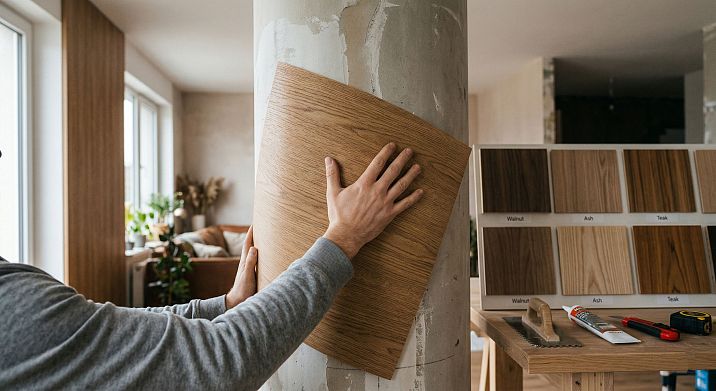
When a designer encounters a column, arch, or radius wall, the first impulse is often the same: find a material that won't crack, won't require complex fitting, and yet looks as if a master carpenter worked here. Flexible wood-look panels solve exactly this problem—elegantly, quickly, and without unnecessary headaches. But for the result to meet expectations, it's important to understand what exactly you're choosing, for which surface, and why in some cases a flexible panel is needed, while in others a rigid one is sufficient.


What are flexible wood-look panels?
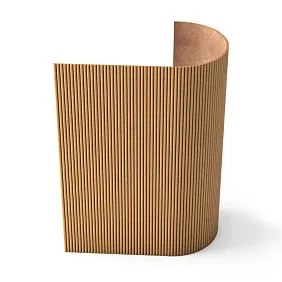
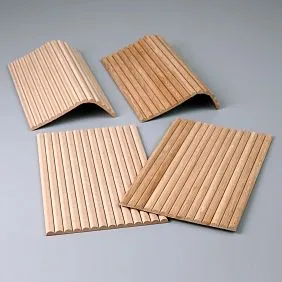
If you look at the construction honestly, without marketing embellishments, what you see is a canvas of wooden or MDF slats, fixed at equal intervals on a dense elastic fabric base. The fabric is the main secret of this material. It holds the slats in precise geometry, prevents them from shifting, and at the same time retains the ability to bend along with any surface.
Unlike traditional slat systems, where slats are attached to a rigid MDF or plywood backing, flexible wooden wall panels work as a single bending sheet. You take a panel, apply it to a column or arch, and it naturally begins to follow the shape of the surface. No cuts, no carpentry fitting to the radius, no joints where they shouldn't be.
Visually, flexible decorative wood-look panels provide the same effect as a natural wooden slat screen: the rhythm of vertical lines, the play of light and shadow, the warm texture. The difference lies in the backing construction and where this panel can be applied.




Where flexible panels are primarily needed
This is a fundamental question. Because flexible panels are not needed everywhere, and there's no point in spending the budget on them where rigid panels work perfectly. But there are a whole range of scenarios where flexible wood-look panels are the only sensible solution.
Our factory also produces:


Columns
A round or oval column is a challenge for any finisher. A traditional rigid panel simply won't lay here: it will either crack or require meticulous carpentry fitting of each plank to the required radius.Flexible slat panel PAN-001wraps around a column as a single module—without joints, without visible seams, with a perfect slat rhythm around the entire circumference. The minimum bending radius of such panels is from 100–150 mm, which allows cladding a column with a diameter from 20–30 cm.
Get Consultation
Arches and arched openings
An arched opening is a space where a rigid panel is not even theoretically applicable. The smooth curve of the arch's inner surface requires a material that bends without deformation. Flexible panels with wood texture are indispensable here: they wrap the arch inside and out, creating a single wooden surface without any technical inserts or patches.
Radius walls
Rounded walls are found in modern apartments, designer offices, restaurants, and hotels. As a rule, they define the entire character of the space—and therefore their finishing must be impeccable. Flexible wood-look wall panels follow the smooth curve without forming edges or breaks. The result is a solid surface with a wooden texture that looks as if it was designed together with the wall itself.
Rounded corners
A rounded corner is a typical situation in homes with non-standard layouts, in children's rooms, and in commercial interiors. A rigid panel here will either leave a gap or require a special corner element. A flexible wooden panel simply wraps around the corner—without additional elements, without visible seams.
Niche and TV zones with rounded perimeters
Decorating a TV niche, especially if it has rounded edges or irregular geometry, is a task that used to cost designers a lot of nerves. Todayflexible slatted panels for niches and TV zonessolve it practically in a 'apply and stick' mode.
Furniture fronts with a curve
Radius furniture fronts are a separate segment where flexible wood-look panels for furniture and fronts work brilliantly. Curved fronts of kitchen modules, rounded cabinets, bar counters with a radius front—all of this can be clad with a wooden slatted surface without resorting to complex milling.
Reception desks, bar counters, partitions
Commercial interiors are perhaps the main arena for flexible wood-look panels for commercial spaces. A reception desk with a radius front, a bar counter with a curved base, a decorative partition with rounded ends—in all these cases, a flexible slatted panel made of MDF or solid oak delivers a result that impresses clients and guests.
How flexible wood-look panels differ from rigid ones
A question asked by every second customer. And it's the right question — because the answer determines whether you'll have a good result or an unpleasant surprise during installation.
By substrate construction
A rigid panel consists of slats on a dense MDF or plywood substrate. The rigidity of the substrate is both an advantage (the panel maintains perfect geometry on flat surfaces) and a limitation (it's impossible to bend it without breaking).
A flexible panel consists of slats on a fabric base. The fabric provides elasticity to the entire sheet. The slats themselves do not deform: they remain straight and even, and only the base between them bends.
By permissible surface geometry
| Surface type | Rigid panel | Flexible panel |
|---|---|---|
| Flat wall | ✔ Perfect | ✔ Suitable |
| Radius wall | ✗ Not applicable | ✔ Perfect |
| Column | ✗ Not possible | ✔ Perfect |
| Arch | ✗ Not possible | ✔ Perfect |
| Rounded corner | ✗ Not applicable | ✔ Perfect |
| Furniture front with curvature | ✗ Straight only | ✔ Any radius |
| Niche with non-standard geometry | ✗ Partially | ✔ Fully |
Installation
A rigid panel is attached to battens or directly to a flat base using screws, clips, or adhesive—depending on the design. For a flat wall, this is convenient and quick.
A flexible panel is installed with mounting adhesive directly onto a prepared surface. On flat walls—simply apply adhesive to the fabric backing and press into place using a level. On curved surfaces—fit to the shape and secure at several points until the adhesive cures. No battens, no screws.
By visual effect
Both types produce the same slatted pattern: vertical rhythm, play of light and shadow, wood texture. The only difference is that rigid panels create the effect on a flat plane, while flexible ones wrap around the form, creating a three-dimensional wooden cocoon around a column, arch, or rounded element.
In terms of cost
Flexible wood-look panels are generally somewhat more expensive than rigid counterparts—primarily due to a more complex production process and the use of high-quality fabric backing. However, the price difference is more than compensated for during installation: no battens are needed, no carpentry fitting is required, and no special corner trims are necessary.
Which materials to choose: MDF, oak, or beech
One of the most important practical questions. Because in the category ofslatted panels made of MDF and solid oakthere are several versions—and each of them addresses its own tasks.
Flexible MDF panels for painting
MDF slats are the perfect choice when you need a specific color scheme. The MDF surface takes paint, primer, and tint exceptionally well. You can choose any color from the RAL or NCS palette, coat the panel to match the overall interior concept, or combine it with painted walls or ceilings.
Flexible MDF panels for painting are the optimal choice for:
-
monochromatic minimalist interiors;
-
spaces where precise color coordination is important;
-
commercial properties with corporate colors;
-
projects where panels will be combined with painted furniture.
Flexible solid oak panels
Oak is a natural texture, a living pattern of fibers, the warmth of an organic material. Flexible oak panels look different from MDF imitation: they have that very 'liveliness' that is difficult to reproduce artificially.
Solid oak can be finished with oil, wax, or varnish — each coating gives the surface its own character. Oil emphasizes the natural pattern and gives a matte depth. Varnish protects and enhances the color. Tinting allows you to steer the shade in the desired direction — from light Scandinavian to dark brutal.
Flexible solid oak panels are the choice for:
-
classical and neoclassical interiors;
-
spaces with natural materials (stone, linen, leather);
-
premium residential projects;
-
objects where durability and the possibility of retoning are important.
Flexible beech panels
Beech is lighter and more uniform in pattern than oak. It provides a more neutral texture, takes tinting well, and looks excellent in Scandinavian and modern styles.
MDF or oak: how to make a choice quickly
Simple algorithm:
-
Need a specific color for the project → MDF for painting
-
Need a natural texture, a lively wood grain → solid oak or beech
-
Need a neutral light base for tinting → beech
-
Need an expressive dark texture → tinted oak
How to choose flexible panels for a specific room
There are no universal recipes—but there is logic that works in most cases.
Living Room
The living room is the main space of the apartment, where an accent wall or column design sets the tone for the entire interior.Flexible wood-look panels for the living roomwork best in combination with warm lighting: the vertical slat rhythm visually raises the height of the room, and the play of light and shadow creates a sense of architectural depth.
For the living room, it is recommended:
-
vertical arrangement of slats;
-
solid oak with oil finish for warm interiors;
-
MDF for tinting or painting for modern minimalism;
-
using panels in the TV area or behind the sofa as the main accent.
Bedroom
In the bedroom, softness and coziness are important. Flexible wood-look panels for the bedroom—especially on the headboard or in a rounded niche—create a sense of a cocoon, a warm natural space. Beech or light-toned oak works well here, combined with fabric headboards and soft furnishings.
Entryway
The hallway is the first impression. If it has a column or a rounded corner,flexible wood-look panels for hallways and corridorswill turn a technical element into a design focal point. For small hallways, it's better to choose light shades and narrower slats—they don't overload the space.
Office
In a workspace, concentration and structure are important. Dark oak with vertical slats, covering one wall or a niche, is understated luxury without unnecessary pomp. Flexible slatted panels for a study pair well with bookshelves, built-in cabinets, and furniture made from natural materials.
Commercial interior
For offices, restaurants, hotels, beauty salons, and medical centersflexible wood-look panels for commercial spacesare an opportunity to create an expensive, professional interior without huge budgets for carpentry work. Radius reception desks, arched entrance groups, bar counters with a slatted front—all of this is implemented with flexible panels quickly and cleanly.
Furniture
Flexible wood-look panels for furniture and facades are a separate story. Curved furniture fronts, which just a few years ago required expensive bent MDF or complex carpentry work, are now solved by cladding with flexible slatted panels. This provides a slatted texture on any radius—from a gentle curve to a steep arc.
Installation of flexible wood-look panels: a practical guide
One of the main arguments in favor of flexible wood panels is the simplicity of installation. No lathing is needed, no special equipment is required, and no team of carpenters is necessary. Let's break down the process step by step.
Foundation Preparation
The surface must be dry, clean, strong, and level (within the norm for this type of adhesive). Plaster and drywall are standard substrates to which flexible panels adhere excellently. Concrete, aerated concrete block, and brick require primer to improve adhesion.
Rule: the substrate must not have crumbling areas, grease stains, or traces of old, peeling coating. If in doubt, prime it.
Fitting
Before applying adhesive, always do a test fit: place the panel against the surface, ensure the correct direction of the slats, mark the installation lines. On columns and arches, test fitting is especially important — you need to make sure the panel's radius matches the surface radius and there are no unwanted distortions.
Adhesive for installing flexible wood-look panels
For installation, polyurethane- or acrylate-based mounting adhesives are used — those that provide reliable adhesion to wood, MDF, fabric, and various substrates. They are applied with a notched trowel or from a tube in dots — onto the fabric backing.
On curved surfaces, it's important: after applying the adhesive, the panel is placed according to the shape and held or secured with painter's tape until polymerization (usually 20–40 minutes). After this, the fixation becomes reliable.
Panel joining
This is one of the main questions. Flexible wood wall panels are joined butt-to-butt, slat to slat — so that the rhythm of the slat pattern is not interrupted at the module joint. With proper fitting, the joint is practically invisible. That's why it's important to align the first panel with particular care before installation — it sets the rhythm for all subsequent cladding.
Internal corners are detailed with a technological gap of 2-3 mm to compensate for thermal deformation. The gap is covered with a corner trim
On straight corners, panels are joined at a 45-degree angle — the cut is made with a sharp knife or saw. On rounded corners, the panel is simply wrapped around the corner without any additional elements. Junctions with the ceiling and floor are finished with baseboards or decorative profiles — depending on the overall design of the space.
Cutting flexible wood-look panels
The panel is cut with a regular utility knife or wood saw — across the slats. No special equipment is needed. For angled cuts, a miter saw or jigsaw is more convenient.
Typical Errors in Selection and Installation
Errors when working with flexible wood-look panels are typically not errors of craftsmanship, but errors of choice. Let's break down the main ones.
Choosing a rigid panel instead of a flexible one
It might seem obvious, but this happens regularly. A person orders rigid slatted panels for a column, hoping to 'somehow bend them'. A rigid backing does not bend—at best, it will crack along the MDF, at worst, it will break. The rule is simple: any surface with a radius of less than 1.5 meters requires a flexible panel.
Incorrectly assessing the minimum bending radius
Flexible panels do not bend to any radius—they have a technical minimum. For most models, this is 100–150 mm. If you are working with a column of a smaller diameter or a very steep arch—clarify the minimum radius of the specific model with the manufacturer.
Not considering lighting
Slatted panels are a material that lives in light. Directional lighting along the slats creates deep chiaroscuro and emphasizes the relief. Diffused light provides a calmer, more uniform effect. If you plan to install lighting, be sure to think through its placement even before mounting the panels.
Not thinking through the direction of the slats
Vertical slats visually raise the ceiling. Horizontal ones expand the space. Diagonal ones add dynamism. This is an architectural tool, and it needs to be used consciously, not by default.
Mixing too many textures
Flexible wood panels are a very expressive material in themselves. If you add a few more active textures to them—stone, patterned tile, colorful wallpaper—the space will start to 'get noisy'. The rule of three textures in interior design is especially relevant here: wood, a neutral background, one accent.
Ignore surface preparation
Adhesive does not hold on dusty, greasy, or crumbling surfaces. Saving on primer and preparation means getting panels that will start to peel off after a few months. This is not a problem with the panels—it's a problem with the substrate.
What determines the price of flexible wood-look panels
A question that concerns everyone who is just starting to understand the topic. The price of flexible decorative wood-look panels is not a fixed value. It is made up of several parameters.
Material of the slats
MDF for painting is the basic price point. Solid oak or beech is more expensive because it is natural wood with the corresponding cost of raw materials. Tinted or painted oak can cost even more—depending on the complexity of the tinting.
Slat width and profile
Narrow slats with a semi-circular profile are a classic. Wide flat slats with a large spacing are a different price level. The more complex the profile, the higher the production cost.
Module dimensions
Standard panel widthPAN-001— 101 cm, which allows covering a column with a diameter of about 32 cm with one module. Non-standard sizes for a specific project are produced to order and can affect the final price.
Finishing coating
Unfinished array — base price. Oil, wax, varnish — additional finishing that adds to the cost. Custom color tinting — bespoke color mixing work.
Order volume
A large order from a manufacturer is always more cost-effective than individual retail. If you plan to clad several rooms or a commercial space, it makes sense to request a quote for the entire volume upfront.
Surface complexity
Formally, this does not affect the price of the panels themselves, but it does affect the final installation cost. Columns and arches require more care and time — this needs to be factored into the budget.
Flexible wood-look panels: which interiors they suit
Honest answer: practically any — if you understand the material's specifics.
In minimalist interiors, the KZ-013 cornice serves as a strict geometric accent, emphasizing the clarity of lines and functionality of the space. The MDF version with enamel allows creating perfectly flat surfaces without visible texture, which is especially valued in the "less is more" concept.
Vertical slatted rhythm is one of the key visual elements of contemporary interior design. MDF for painting in anthracite, greige, or white integrates organically into minimalist spaces with concrete surfaces and metal accents.
Scandinavian and Nordic style
Light oak or beech, minimal decor, emphasis on texture — this is the perfect environment forflexible wooden wall panelswith natural oil finish. Scandinavian interior design is literally built on this aesthetic.
Neoclassicism and modern classicism
Dark tinted oak, high ceilings, columns with slatted cladding—this reads as an expensive architectural detail. Flexible panels here allow for the effect of high-class joinery work at significantly lower costs.
Restaurant and hotel design
It is in commercial interiors that flexible wood-look panels for reception desks, bar counters, and partitions truly shine. Here, installation speed, durability, and the possibility of non-standard geometric solutions are valued—and all of this is present in flexible slatted panels.
FAQ — answers to popular questions
What are flexible wood-look panels?
These are decorative panels where wooden or MDF slats are fixed on an elastic fabric base at equal intervals. The fabric base allows the panel to bend to any surface shape—column, arch, curved wall—without deforming the slats and without seams.
How do flexible panels differ from rigid ones?
Rigid panels are mounted on MDF or plywood backing and are only applicable on flat surfaces. Flexible ones are on a fabric base, which bends along with any surface. In visual effect, they are identical; the difference lies in construction and application scope.
Can flexible panels be used for column cladding?
Yes, this is one of the main applications. The flexible slat panel wraps around a column with a diameter of 20–30 cm without carpentry fitting, joins seamlessly, and creates a perfect slat pattern around the entire circumference.
Are flexible panels suitable for arches?
Yes. The inner surface of an arch is a classic application for flexible panels. It follows the smooth curve, requires no additional elements, and creates a single wooden surface across the entire arch.
Can flexible panels be installed on a curved wall?
Yes, that's exactly what they are designed for. The minimum bending radius depends on the specific model — for most, it's 100–150 mm. Installation is done with adhesive, without battens.
What is better to choose: MDF or solid oak?
MDF — if you need a specific color for the project or a monochrome interior. Oak — if natural texture, the living pattern of wood, and the possibility of treatment with oil, varnish, or wax are important. Beech — for a more neutral, light base.
Can flexible wood-look panels be painted?
Yes, MDF slats can be painted without restrictions — both with enamel and decorative paint. Solid oak and beech can be tinted, coated with oil, wax, or varnish. Repainting in the future is also possible.
What kind of adhesive is needed for installation?
Mounting adhesive with a polyurethane or acrylic base, with good adhesion to wood, fabric, and plaster. On flat walls, high-strength double-sided mounting tape is also possible — for lightweight panels.
Are battens needed under flexible panels?
No. Flexible panels are mounted directly onto a prepared substrate using adhesive. This is one of their key installation advantages.
Can flexible panels be used on ceilings?
Yes, provided a reliable mounting adhesive is used and the panels are secured until it cures. On arched ceilings, this is a particularly impressive solution.
Are flexible panels suitable for furniture?
Yes. Flexible wooden panels for furniture and facades allow for cladding curved furniture fronts, rounded cabinets, and bar counters. This is one of the most relevant applications of the material in furniture production.
How noticeable are the joints between panels?
With proper joining (tongue-and-groove, with pattern alignment), the joints are practically invisible. The first panel must be perfectly leveled — this sets the rhythm for the entire subsequent cladding.
What determines the price of flexible wood-look panels?
The price is determined by the material of the slats (MDF is cheaper than solid wood), the width and profile of the slat, the finish, non-standard sizes, and order volume. Solid oak panels with an oil finish are the highest price point; paintable MDF is the optimal base.
Can flexible panels be glued onto drywall?
Yes, drywall is one of the best substrates for installation. The surface must be primed to improve adhesion.
How to care for flexible wood-look panels?
Wipe the surface with a dry or slightly damp soft cloth. Aggressive cleaning agents and abrasives are prohibited. For panels with an oil finish, re-oiling every few years is recommended to maintain appearance.
When do you need a flexible panel, and when can you get by with a rigid one?
Let's draw a practical conclusion from this guide.
Choose a flexible wood-look panel if:
-
the surface has a radius of less than 1.5 meters;
-
you are working with a column, arch, radius wall, or rounded corner;
-
you need cladding for a curved furniture facade;
-
seamless joining on curved surfaces is important;
-
you want to avoid battens and complex installation.
-
Object — commercial (reception, bar counter, hotel lobby).
A rigid panel is suitable if:
-
the surface is perfectly flat;
-
maximum rigidity and geometric precision on flat walls is needed;
-
the task is a furniture front without curvature;
-
the budget is limited and there is not a single curved surface.
If your project has at least one column, one arch, or one rounded corner — look towards flexible slatted panels immediately. This will save time, nerves, and money on rework.
About the company STAVROS
STAVROS is a manufacturer of decorative products from solid wood and MDF with many years of experience in the Russian market. The company specializes in slatted panels, solid wood products, and decorative solutions for interiors and furniture. The range includes rigid slatted panels on an MDF backing and flexible fabric-based slatted panels, including the flagship model PAN-001— flexible slatted panel made of solid oak, beech, or MDF on an elastic fabric base for straight and curved surfaces.
STAVROS works with designers, architects, furniture manufacturers, and private clients. Panels are produced to the exact parameters of the project: choice of material, slat width, profile, spacing, and finish. These are not ready-made off-the-shelf SKUs—they are custom-made for the task.
If you are designing an interior with a column, arch, radius wall, or non-standard geometry—the STAVROS catalog has a solution for each of these cases. Explore the full rangeslatted panels made of MDF and solid oakand choose the panel that will perfectly suit your task.