Article Contents:
- The first fork: what really lies behind the query 'flexible wall panels'
- Self-adhesive decorative panels
- Flexible stone and flexible ceramics
- Flexible 3D polyurethane coverings
- Cork panels
- Flexible slatted panels on fabric backing
- Why flexible slatted panels are a separate category
- Slatted texture and light: why it works the way it does
- Where flexible wall panels are used: breakdown by surfaces
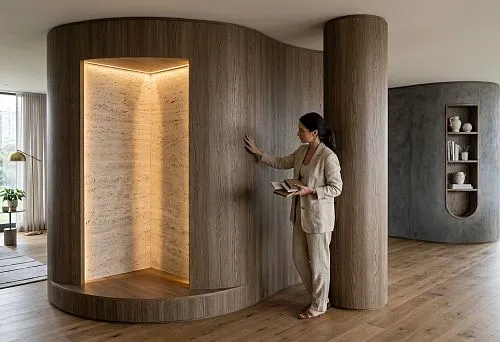
- Radius and curvilinear walls
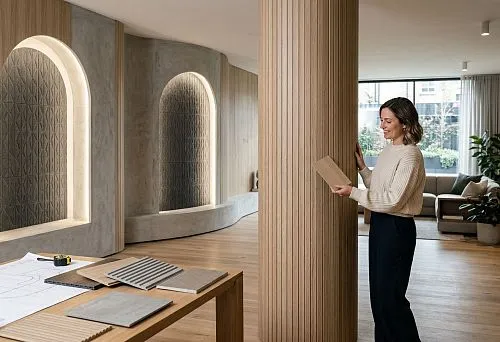
- Columns: from architectural hindrance to visual accent
- Arch openings: surface unity
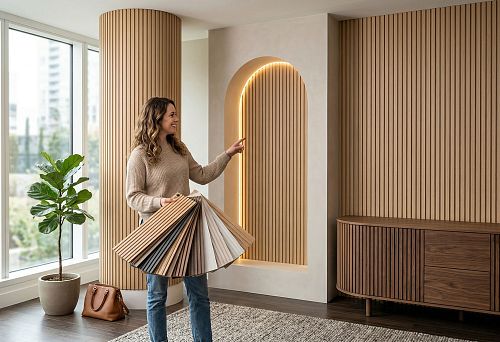
- Decorative niches: depth as a tool
- Rounded corners and transitions between planes
- Partitions with non-standard geometry
- Furniture fronts and kitchen islands
- Materials: what to choose for flexible panels
- MDF for painting: color and form precision
- Solid oak: natural texture without alternatives
- Rail profile: rectangle or semicircle
- How to choose flexible wall panels: algorithm by surfaces
- Straight wall - accent zone
- Radius wall with bend
- Round column
- Arch and arched end
- Niche with right angles
- Bent furniture facade
- Commercial interior with high traffic
- Pre-purchase checklist: ten questions to ask
- Installation of flexible wall panels: from preparation to finish
- Step 1. Base preparation
- Step 2. Marking
- Step 3. Dry fitting
- Step 4. Cutting
- Step 5. Glue application and installation
- Step 6. Module Joining
- Step 7. Final Finishing
- Costly mistakes
- "I'll buy rigid — it's cheaper"
- "I'll figure out the radius on site"
- "I'll skip priming — the glue holds anyway"
- "I'll tape without masking tape — can't be bothered to wait"
- "I'll choose by photo — looks nice, so it fits"
- "Too frequent step in a small room"
- Flexible Panels in Interior Styles: A Brief Guide
- Modern minimalism
- Scandinavian and Natural Style
- Neoclassicism and Modern Classicism
- Loft and Industrial Style
- Commercial Design
- FAQ: Answers to Common Questions About Flexible Wall Panels
- What Are Flexible Wall Panels?
- Why Choose Flexible Slat Panels When There Are Other Options?
- Can a Regular Rigid Slat Panel Be Bent?
- How Are Flexible Wall Panels Installed?
- Do Flexible Slat Panels Need to Be Painted?
- What Slat Spacing Should I Choose?
- How many modules are needed for a column?
- Can flexible panels be used in the kitchen?
- Are flexible slat panels suitable for commercial interiors?
- Where can I view the catalog of flexible slat panels?
- STAVROS: when a task requires an exact solution
Let me start with a provocation. Type 'flexible wall panels' into a search engine — and you'll get such a scatter of results that your head will spin. Side by side are: thin self-adhesive brick imitations for five hundred rubles and architectural slat systems for designer interiors. Flexible artificial stone sits next to cork sheets. Polyurethane 3D reliefs — next to wooden modules on a fabric base. One and the same query, dozens of different answers.
This is no coincidence. It's an accurate reflection of what's happening in the finishing materials market: the term 'flexible' sticks to anything, as long as the product doesn't break when bent. But 'doesn't break' and 'works on curved surfaces' are fundamentally different things. And it's precisely this distinction that determines whether you'll end up with the interior you wanted, or wasted money and a redo.
This article is about how to understand the market in twenty minutes, choose the right type of panel for a specific surface, and avoid stepping on the typical rakes that everyone who has walked this path before you has already collected.

The first fork: what's really hidden behind the query 'flexible wall panels'
The market under this query is not homogeneous. This is not a minus — it's reality. Different types of flexible panels solve fundamentally different tasks, and understanding this immediately means saving time and money in the search for the right one.




Self-adhesive decorative panels
Thin sheets of foamed PVC or polyethylene with a self-adhesive backing and printed imitation of wood, stone, brick. They bend easily and adhere to any surface. Advantages: low price, easy installation, availability. Disadvantages: superficial imitation without volume, weak adhesion under temperature fluctuations, limited service life. Not a material for a serious interior project.
Our factory also produces:
Flexible stone and flexible ceramic
A thin slice of natural or synthetic stone on a polymer backing. Provides an authentic stone texture. Allows bending along gentle radii. Requires special adhesive and preparation. Heavier than slatted panels. Visual result is a stone surface, not slatted architecture.
Get Consultation
Flexible 3D polyurethane coverings
Relief modules made of elastic polyurethane with geometric or ornamental patterns. They bend, are mounted with adhesive, and create a three-dimensional surface. No slatted rhythm—there is sculptural relief. A completely different visual language.
Cork panels
Natural material with a soft texture. Flexible, mounted with adhesive. Main purpose is acoustics and thermal insulation. Decorative role is secondary. Texture is cork, not slats.
Flexible Slat Panels on Fabric Backing
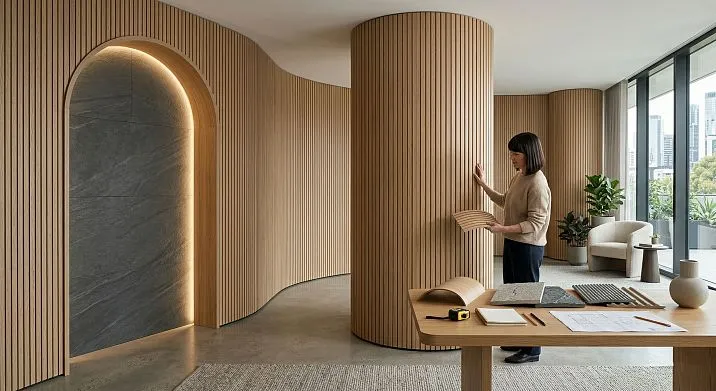
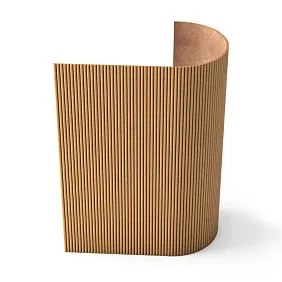
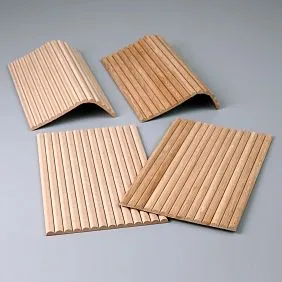
Wooden or MDF battens with equal spacing, fixed on a reinforced fabric backing. They wrap around any curve without cracks or deformation of the slats. Create a continuous slatted surface on curved surfaces. Mounted with adhesive, cut with a knife, joined seamlessly.
This particular type is the answer to most architectural questions when it comes to radius walls, columns, arches, niches, and curved furniture fronts. Other formats solve different tasks.
Why flexible slatted panel is a separate category
Before moving further, it is important to note one thought.Flexible wall panelsIn the slatted module format, it is not a 'flexible version of a regular panel.' It is a standalone product with a different structural logic.
A rigid slatted panel works on flat surfaces. The fabric base makes the flexible panel a completely different tool: it allows the module to conform to the surface shape while maintaining precise slat spacing and the integrity of the entire structure. Seamless module joining means that across the entire wall curve, around the entire column perimeter, and along the arch edge, the slatted rhythm continues uninterrupted—as if the surface was created as a single whole.
Here are three things only a flexible slatted panel does:
-
Wraps around a curved surface without breaking or deforming the slats
-
Maintains precise batten spacing along the entire length of the curve
-
Creates a continuous texture across all module joints
No other format listed above provides all of this simultaneously. That is why in professional interior projects with non-standard geometry, flexible slatted panels are the default choice.
Slatted texture and light: why it works the way it does
There is one question rarely asked out loud, but which is actually key: why is a slatted wall so attractive in the first place? Why does it work in living rooms, restaurants, hotels, meeting rooms, lobbies—everywhere where a sense of quality is desired?
The answer lies in physics.
Parallel slats with equal spacing create a rhythmic structure on the wall that interacts with any directed or side light. Each batten casts a shadow on the next. Each profile forms its own highlight. The surface ceases to be flat—it gains depth that you can literally feel with your gaze.
On curved surfaces, the effect doubles. The curvature of a wall or column creates a variable angle of light incidence, and the slatted texture begins to 'breathe'—the left edge is lighter, the right edge recedes into shadow, the middle shines. This is not an imitation of architecture. This is a living architectural surface.
wall slat panels in interior designwork exactly like this: they don't fill the wall—they create an event on it.
Where flexible wall panels are used: surface breakdown
Radius and curved walls
Bay windows. Rounded partitions. Smooth transitions between zones. Custom homes with non-standard layouts. All of these are surfaces where a rigid panel requires individual fitting of each element, precise miter cuts, and inevitable gaps at joints.
A flexible slatted panel works fundamentally differently. The module is applied to the surface and bends to the shape of the wall. The fabric base conforms to the curvature, the slats maintain their spacing. The next module is butted up—and the lines continue. No gaps, no protruding corners, no visible transitions. This is not a compromise—it's a direct advantage of the construction.
Columns: from architectural nuisance to visual accent
A round load-bearing column in the center of an open space—a familiar nightmare. Can't remove it. Nowhere to hide it. Plastering it—boring. Cladding it with tile—expensive and cumbersome.
The flexible slatted panel offers a different scenario. One or two modules laid around the circumference: the slats run vertically, the rhythm closes seamlessly, and the column transforms from a problematic element into an architectural accent of the space. With proper lighting—into a sculpture. Want a clear varnish on oak—warm, wooden, natural. Want anthracite on MDF—modern, strict, industrial. The result is always a detail that works for the interior, not against it.
Arched openings: surface unity
The arch is where most interiors reveal incompleteness. The walls are finished, the niches are decorated, but the edge of the arched opening remains bare or painted—and the boundary is visible. Because it's difficult. Because a curved reveal requires a non-standard solution.
The flexible slatted panel is mounted directly on the edge of the arch: it wraps around the rounding, the slats continue the rhythm from the wall into the arch, and the transition disappears. The surface becomes unified. This is the detail for which designers charge a separate fee—but with the flexible panel, it is resolved in standard installation.
Decorative niches: depth as a tool
A niche in the wall is a popular design technique. Its back wall is always an accent zone.slatted wall panelsOn the back plane of the niche create depth, rhythm, play of shadows—especially in combination with spot lighting. The niche transforms from a simple recess into a full-fledged architectural object.
For niches with right angles—a rigid panel is suitable. For rounded edges and transitions—flexible. In complex niches with smooth transitions from the back wall to the sides, the flexible panel ensures continuity of texture without visible seams.
Rounded corners and transitions between planes
A corner between two walls, finished with a slatted panel—without a flexible module, this is technically difficult. With a flexible base—the module wraps around the transition smoothly, the slats continue through the corner without breaks. This technique is especially effective in corridors and halls, where the slatted cladding covers several adjacent planes.
Partitions with non-standard geometry
Slatted partitions in open-plan layouts have become almost a classic of modern interior design. When the top edge of the partition is rounded or the partition smoothly transitions into a ceiling element, the flexible panel allows the slatted texture to be maintained across the entire surface, including curved areas.Slat panels for modern zoningwith a flexible base — a functional and visually complete tool.
Furniture fronts and kitchen islands
This is a separate, often underestimated topic. A curved kitchen island front, a rounded end of a wardrobe, a curved bar counter front — all of these require either expensive custom veneer work or a flexible slat panel with adhesive.
The second option is installed without milling or special equipment: the panel is applied to the front, bent, and fixed. The result is a continuous slatted texture across the entire front without technological seams and costly production.
In combination withdecorative overlays for furniture and fronts— slats as the background, overlays as accents — creates a complete story where furniture and wall finishes speak the same language. Or you can go even further and connect slatted panels with walls andfurniture front decorinto a unified architectural concept.
Materials: what to choose for flexible panels
MDF for painting: color and form precision
MDF with a density of 750–850 kg/m³ is a surface free from natural defects, designed for final painting. No knots, no resin pockets, no difference in paint absorption between slats. The result is a perfectly smooth, uniform paint coating.
For flexible panels, this means complete color control: you can match an exact RAL or NCS, paint to match the wall tone (relief without color contrast), create an accent (slats darker or lighter than the background), or work with gradient solutions.
Slatted panel for the wall made of MDFis a precise tool when color is as important as form.
Solid oak: natural texture without alternatives
Solid oak — 700–750 kg/m³, a hardwood with high mechanical stability. Each slat carries a unique natural grain pattern. Clear oil — warm honey-golden tone. Scandinavian oil with gray pigment — cool organic shade. Wenge tinting — dark, rich, representative.
For furniture fronts that are regularly opened and closed, oak is more reliable than MDF on the edges. For wall panels in areas with high mechanical load — also.wood-look slatted panelsmade of solid oak is the choice of those for whom not just imitation, but genuine natural texture matters.
Batten profile: rectangle or semicircle
Rectangular batten provides clear shadow geometry: sharp edges, linear shadows. The surface reads as architecturally strict — rules, order, precision. Ideal for minimalism, neoclassicism, contemporary.
Semicircular batten works softer: each batten is a light dome with a smooth highlight and soft shadow. The surface feels 'warmer' with the same color. More organic, more tactile. For natural styles — Scandinavian, Japanese minimalism, biophilia — this is a more precise solution.
The choice between profiles is not a matter of taste, but of construction. It stems from the interior's style and the character of the room's lighting.
How to choose flexible wall panels: an algorithm by surfaces
Stop choosing a panel by photo. Start choosing by task. Here's how it works in practice.
Straight wall — accent zone
Rigid batten panel on MDF backing. Maximum geometric precision, perfectly even batten spacing. Installation via adhesive or on a frame with leveling. Finish — painting or tinting.
Radius wall with a curve
Flexible batten panel on a fabric base. Clarify the module's minimum working radius — it depends on batten thickness. For soft curves (radius 80+ cm) — most flexible models have no restrictions. For sharp turns (radius less than 40 cm) — be sure to clarify.
Round column
Flexible panel. Calculate perimeter: π × diameter. Standard PAN-001 with width 101 cm covers a column with diameter about 32 cm with one module. For larger diameter — two modules butt-jointed. Battens — vertically.
Arch and arched end
Flexible panel. Module width is selected to match the width of the slope. Battens — horizontally along the arch end. The module wraps around the rounding and is fixed with adhesive and tape until set.
Niche with right angles
Rigid or flexible — both options work. Back wall of the niche — battens, side walls — matching the wall or also with battens. Bottom or top lighting — a mandatory finishing element.
Curved furniture front
Flexible panel. Adhesive on the front surface, bend to shape, fix with tape. No milling required. Finish — oil or varnish (oak), enamel (MDF).
Commercial interior with high traffic
Oak under varnish or MDF with high-quality enamel. Oak is mechanically more resistant on edges. Varnish provides water-repellent coating and easy cleaning. Flexible or rigid — depending on the geometry of the object.
Pre-purchase checklist: ten questions to ask
1. Is the surface flat or curved? — determines rigid or flexible base.
2. What is the bending radius? — for sharp curves, check the module's minimum radius with the manufacturer.
3. MDF or oak? — color and paint vs natural grain.
4. What is the glazing bead profile? — rectangular (strict rhythm) or semicircular (soft highlight).
5. What is the slat spacing? — close (dense surface) or wide (airy).
6. Width and height of the surface? — calculation of module quantity, trimming format.
7. Mount directly on the wall or on a frame? — frame is needed for uneven substrate or for acoustics.
8. Is finishing required after installation? — mandatory for MDF, optional for oak.
9. How does the panel join with baseboards, moldings, and reveals? — plan the connection details in advance.
10. What is the light source in the room? — Side or spot lighting is necessary for working with slatted texture.
Installation of flexible wall panels: from preparation to finish
Installing a flexible slatted panel is not rocket science. But the sequence of steps and several critical details make the difference between a 'beautiful' result and 'needs redoing'.
Step 1. Surface preparation
Clean the surface of dust, dirt, and grease. Tap it — a 'hollow' sound indicates a detached layer: it needs to be removed. Level significant unevenness. Apply primer — it improves the adhesive's bond to any type of surface.
For columns and curved surfaces, surface evenness is especially critical: unevenness will prevent the panel from fitting tightly, and the adhesive will not bond evenly.
Step 2. Marking
Draw a horizontal level line using a level. For a column — mark the starting vertical line. Check that the marking is perpendicular to the floor and ceiling: 'drifting' slats reveal an error in the marking even after several meters.
Step 3. Dry fitting
This is an important step that is often skipped. Place the module against the surface — ensure it lies correctly, there are no major uneven spots, and it's clear where trimming is needed. It's better to figure this out before the adhesive is applied.
Step 4. Cutting
Utility knife along a metal ruler — for straight cuts. Mark the pattern on the back of the panel — for curved contours (arches, rounded edges, obstacle bypasses). The flexible base cuts cleanly and easily.
Step 5. Applying adhesive and installation
Apply mounting adhesive to the back surface of the panel — in a zigzag or horizontal stripes. For curved surfaces — additional adhesive along the edges: these are the areas that tend to lift when bent. Press the module from one edge to the other, controlling the adhesion with your palm. Secure with painter's tape along the edges — leave until fully set (2–4 hours).
Step 6. Module Joining
Second module — butted against the first, with precise alignment of the slat pattern. Check alignment with a level. When properly joined, the seam disappears into the overall rhythm of the slats — it's not visible even up close.
Step 7. Final Finishing
MDF: remove the tape after 4–6 hours, prime the surface, apply enamel in two thin coats with intermediate drying. Paint the edges and joint areas with a narrow brush.
Oak: apply oil or varnish according to the manufacturer's instructions. For oil — typically 2–3 coats with intermediate scuffing with a Scotch-Brite pad. For varnish — at least two coats.
Mistakes that cost dearly
Let's examine not hypothetical ones, but real ones — those that regularly occur in projects.
"I'll buy rigid — it's cheaper"
For a straight wall — correct. For a column or curved wall — that's wasted money and rework. A rigid panel on a curved surface either cracks or leaves gaps. Neither looks good.
"I'll figure out the radius on site"
Not all flexible panels are equally flexible. A 10 mm thick slat on a rigid fabric backing may not bend to the radius you calculated. Clarify the parameters in advance.
"I'll skip the primer — the adhesive holds anyway"
It holds. For now. In six months, the edges on the column will start to peel — exactly where the load on the adhesive seam due to bending is maximum. Primer solves this in twenty minutes.
"I'll glue it without tape — can't be bothered to wait"
On a flat wall — might work. On a column or arch — no. Without temporary fixation, the edges separate before the adhesive sets, and the panel has to be re-glued.
"I'll choose based on a photo — looks nice, so it fits"
A beautiful render with a slatted wall says nothing about the type of panel backing. Slats that look "the same" might turn out to be rigid. Ask one question: "Is this a flexible or rigid backing?" — and you'll avoid the main mistake.
"Too frequent spacing in a small room"
Frequent slat spacing creates a dense, active surface. In a small room, this feels oppressive. Balance: in small spaces — delicate spacing, light tones, vertical orientation for visual height extension.
Flexible panels in interior styles: a brief guide
Modern minimalism
MDF matching the wall color — relief without color noise. A column or accent wall painted to match the space visually integrates into the interior. Only the sculptural rhythm of the battens remains.
Scandinavian and natural style
Oak battens under clear or tinted oil. Semi-circular profile. Delicate spacing. The living texture of oak adds warmth to white, gray, and linen Scandinavian palettes.
Neoclassicism and modern classicism
Batten panels combined withbatten panels and moldingscreate a layered architectural surface: battens as the background, moldings as the framing. A classic proportion in a modern interpretation.
Loft and industrial style
Dark MDF (anthracite, graphite, dark gray) against a backdrop of exposed concrete or brick. The batten texture adds architectural order to the industrial character — it doesn't soften, but rather enhances it.
Commercial design
Restaurants, hotels, offices. Lacquered oak — durability under high traffic. Flexible panels on non-standard surfaces — a marker of a project's class.Decorative slat panels for walls, zoning, and interiorsin commercial spaces simultaneously create acoustic comfort and visual premium quality.
FAQ: answers to common questions about flexible wall panels
What are flexible wall panels?
A broad category of decorative and finishing materials that can bend to the shape of a curved surface. Includes: flexible slat panels on fabric backing, flexible stone, polyurethane 3D coverings, self-adhesive panels, and cork solutions.
Why choose flexible slat panels specifically when there are other options?
Only flexible slat panels provide a continuous slat rhythm on curved surfaces: columns, arches, radius walls. Other formats create a different visual effect — stone, textured, cork. If you specifically need slats on a curved surface — only the flexible slat module.
Can you bend a regular rigid slat panel?
No. The rigid MDF backing cracks when bent. For curved surfaces, a flexible fabric backing is necessary.
How are flexible wall panels installed?
On mounting adhesive. The surface is primed, adhesive is applied to the back of the module, the panel is pressed against the surface, and secured with painter's tape. Cutting — with a utility knife.
Do flexible slatted panels need to be painted?
MDF panels — must be primed and painted with enamel after installation. Oak panels — are coated with oil or varnish (tinting optional).
What slat spacing should I choose?
For small rooms — a delicate spacing (25–35 mm). For large accent surfaces in spacious rooms — a tighter spacing (15–20 mm) or standard. Consider the scale of the surface.
How many modules are needed for a column?
Measure the column perimeter (diameter × 3.14). Divide by the module width. PAN-001, 101 cm wide, covers a column with a diameter of ≈32 cm with one module.
Can flexible panels be used in the kitchen?
Yes. MDF under high-quality enamel provides sufficient protection for kitchen walls outside areas of direct water contact. For furniture fronts and backsplashes — clarify the operating conditions.
Are flexible slatted panels suitable for commercial interiors?
Yes. Lacquered oak is resistant to mechanical damage and high traffic. Used in restaurants, hotels, offices, boutiques — anywhere durable finishing with high visual class is needed.
Where to view the flexible slat panel catalog?
Full range of slat panels — on the page stavros.ru/products/izdeliya-iz-massiva/reechnye-paneli/.
STAVROS: when the task requires a precise solution
The most important takeaway is simple: the right panel choice is half the result. The other half is a manufacturer you can trust.
STAVROS produces slat panels from paintable MDF and solid oak in both rigid and flexible structural designs. Flexible fabric-backed panels — for radius walls, columns, arches, niches, and curved furniture fronts. Rigid — for flat surfaces with maximum geometric precision. Batten profiles: rectangular and semicircular. Finishes: for final painting and for tinting.
STAVROS production standard — precise slat spacing, seamless module connection, readiness for finishing after installation without additional preparation. Easy cutting with a knife, adhesive installation without special tools.
STAVROS — laureate of the 'Industry Leader of Russia' title, over twenty years of wood and polyurethane decor production. Delivery across the country.
When you face a task with non-standard geometry — STAVROS slatted panel catalog — is the first address to visit.