Article Contents:
- What Are Flexible Decorative Panels
- Construction: Not Magic, but Engineering
- What Is the Fundamental Difference from Regular Decorative Panels
- Where Flexible Decorative Panels Are Most Commonly Used
- Accent wall in the living room
- Bedroom: Headboard and Wall Behind the Bed
- Hallway and corridor
- Columns
- Arches and Arch Openings
- Niche with Radius Corners
- What Types of Flexible Decorative Panels Exist: Varieties and Textures
- Slatted panels made of solid oak
- MDF slatted panels for painting
- Panels with Semi-Circular Beading
- Smooth decorative panels
- Panels with imitation textures
- What tasks do decorative flexible panels solve in interior design
- How to choose flexible decorative panels by surface type
- Straight wall
- Radius wall
- Column
- Arched opening
- Niche with rounded corners
- How to choose panels according to interior style
- Modern minimalism
- Natural warm interior
- Neoclassicism and art deco
- Dark graphic interior
- How to choose panels by texture, color, and rhythm
- Batten scale and room scale
- Dense and open rhythm
- Color: contrast or tone-on-tone
- Lighting as part of design
- Flexible decorative panels or other solutions: what to choose
- What to look for before choosing panels
- Installation of flexible decorative panels
- Foundation Preparation
- Dry fitting
- Cutting
- Adhesive Application and Fixation
- Module joining
- Finishing corners and junctions

There comes a moment in interior work when you realize: a flat wall is a limitation. Not architectural, but artistic. A wall can be more than just a background—it can be a statement. A texture, a play of shadows, a rhythm that emphasizes ceiling height or divides space without a single partition.
It is at this point thatflexible decorative panelsappear—a material that works on several levels at once: structural, decorative, and architectural. It doesn't just cover a wall—it creates a surface with character.
But choosing them correctly is not as simple as it seems from beautiful pictures online. Too much depends on the task, surface, lighting, interior style, and specific geometry of the space. This article is a systematic breakdown. Without unnecessary words and without marketing clichés.

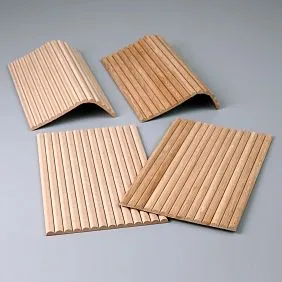

What are flexible decorative panels




Construction: not magic, but engineering
To understand a flexible decorative panel — you need to start with the construction. Because it explains everything else: both the possibilities and the limitations.
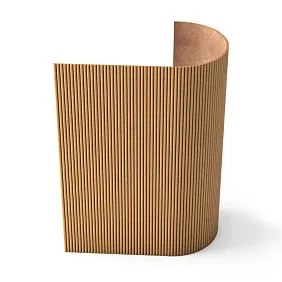
A decorative slatted panel is a construction of parallel slats (battens) with equal spacing, fixed to a backing. If the backing is a rigid MDF board, the panel is rigid. It holds its shape perfectly, is perfectly flat, and mounts as a monolith. But it cannot be bent without breaking.
If the backing is a dense fabric base, the panel becomes flexible. The slats are fixed to the fabric while maintaining precise spacing, but the fabric itself can bend to any radius. This is what makes it a fundamentally different material.
The word 'decorative' in the name is not just an epithet. It's a functional description: flexible panels create not a technical, but a decorative surface. Their task is not only to cover a wall but to transform it visually: add depth, create rhythm, form light and shadow.
Our factory also produces:


What is the fundamental difference from ordinary decorative panels
A conventional rigid decorative panel on a straight wall is an excellent solution. It is precise, stable, and easy to install. But it has one rigid limitation: linearity.
Decorative flexible panels for interiorsremove this limitation. They follow the shape of the surface — regardless of whether it is straight, convex, concave, or combined. The slatted pattern continues seamlessly across the entire surface without visible fitting joints.
This is especially important for interiors with non-standard geometry: columns, arches, niches with radius corners, rounded partitions—all of these work organically with flexible panels, whereas rigid ones require manual fitting of each fragment.
Get Consultation
Where are flexible decorative panels most commonly used?
The question 'where to place it?' is the first and most practical one. Let's break it down honestly and by zones.
Accent Wall in Living Room
The living room is a classic place for a decorative panel. The wall behind the sofa, the wall with the TV area, the wall opposite the entrance—any of them can become the main visual focal point of the room.
A vertical slatted rhythm on an accent wall does several things at once: visually elongates the height of the room, creates depth through light and shadow, and forms an architectural accent without complex construction work.
Important:Panels for an accent wallIn the living room, the choice is made considering scale. Narrow slats with frequent spacing—in small spaces where a fine, elegant texture is needed. Wide slats with open inter-slat gaps—in spacious living rooms with high ceilings, where an airy, uncluttered rhythm is desired.
Bedroom: headboard and wall behind the bed
The wall behind the bed's headboard is the second most popular application scenario. Here, the flexible decorative panel works as a replacement for a soft headboard or decorative panel: it creates a warm, textured zone that visually 'frames' the bed and makes the bedroom more cohesive.
For bedrooms, warm textures are often chosen: oak with oil finish, neutral-toned MDF with warm paint. Intense dark finishes in the bedroom—a bold move that requires proper lighting.
Hallway and corridor
An entryway with slatted cladding on one wall is a technique that immediately sets the level for the interior. A vertical rhythm in a narrow space visually expands and elongates it.Flexible decorative panels for the hallwaywith columns or niches — this is literally a built-in architectural solution that requires neither drywall constructions nor complex finishing.
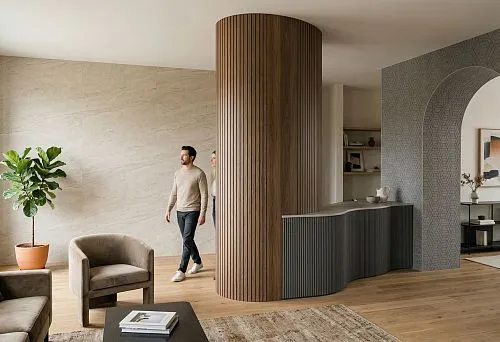
Columns
A column is a classic task where the flexible format is indispensable. A rigid panel on a closed perimeter of a cylinder or rectangular column is an assembly of several fragments with manual fitting and inevitable visible seams.
A flexible panel wraps the column as a single sheet. One seam — in a pre-selected point, hidden from the main viewing angle. The slat pattern runs continuously along the entire perimeter, creating a sense of integrity.
panels for columns and arches— one of the most technically justified scenarios for applying the flexible format. This is not a marketing story, but engineering logic.
Arches and arched openings
The inner arc of an arch is another scenario where there is no alternative to a flexible panel. Plaster on a curve is the traditional approach. But slat finishing of an arch is a fundamentally different visual level: warm texture, continuous rhythm, living surface.
A flexible panel wraps the vault without breaking the pattern. The slats continue the vertical or horizontal rhythm of the wall directly into the arc — and the interior gains an architectural integrity that cannot be achieved by any other means.
Niches with radius corners
Rounded niches are a typical element of modern interiors. They can be functional (shelves, built-in appliances) or purely decorative. In both cases, a flexible panel finishes their inner surface as a single whole: side walls, back wall, niche ceiling — all in a unified slat rhythm.
What types of flexible decorative panels exist: varieties and textures
Solid oak slat panels
This is the pinnacle of the category. Natural oak with a density of 700–750 kg/m³ is a material with a living grain pattern, tactile warmth, and durability. Each slat is unique: the natural texture is never repeated, giving the slatted surface a visual depth unattainable by any imitation.
Slatted panels for interiorFrom oak array, work under transparent oil — warm golden tone. Under tinting: Scandinavian gray, cold steel, wenge, tobacco cognac. Under varnish — high resistance to household wear.
These panels do not age in a bad way. They develop a patina — and this becomes part of their aesthetic.
MDF slatted panels for painting
MDF with a density of 750–850 kg/m³ is an engineered, stable, homogeneous material without natural defects. Perfect for painting: matte, satin, semi-gloss enamels apply flawlessly. Any color by RAL, NCS, Pantone.
MDF panels for painting offer maximum freedom in color choice. They can be painted to match the wall: then the slats will 'dissolve' into the space, leaving only a pure rhythm. Or choose a contrast — and the accent will be bright.
Panels with a semi-circular bead
This is a separate category that deserves special attention. A slat with rounded ends — a semi-circular bead — creates a special, soft play of light and shadow. With directed lighting, each slat casts a smooth shadow that transitions into the next. The surface 'breathes' — it is alive even in static light.
A rectangular slat gives a more graphic, clear pattern. A semi-circular one — warm, soft. It's not a question of 'better' or 'worse' — it's a question of purpose and style.
Smooth decorative panels
Smooth surface without texture - for painting or with factory coating. The decorative effect here is created not by relief, but by color and geometry. A minimalist choice for spaces where purity of form is important, not richness of texture.
Panels imitating textures
Flexible modules with relief imitating plaster, stone, concrete. For interiors in loft, industrial, brutal minimalist styles. On curved surfaces - significantly easier to install than manual application of decorative compounds.
What tasks do decorative flexible panels solve in interior design
This is not a rhetorical question. Every tool has functions - and flexible decorative panels have several.
Creating an accent wall. The main decorative technique of modern interior design. One highlighted surface sets the tone for the entire space. Slatted texture makes the accent three-dimensional and tactile - it's not just color, but a material object.
Designing complex geometry. Columns, arches, niches, radius walls - all of these require material that follows the form, rather than opposing it.panels for complex surfacesfrom flexible format - the only solution that provides continuity of pattern.
Visual zoning. Without partitions, without walls. Slatted finishing of one surface highlights a zone: dining area in living room, workspace in bedroom, TV zone in common space.
Acoustic improvement of space. Slatted structure scatters sound waves, reduces reverberation. This is a documented effect - especially important in living rooms with open layouts, in meeting rooms, in home theaters.
Unifying walls and furniture. Wardrobe, kitchen island, reception desk, furniture front — slatted cladding unites them with the wall into a single architectural composition. The interior ceases to be a collection of objects and becomes a cohesive space.
How to choose flexible decorative panels based on surface type
Straight wall
On a straight wall, a flexible panel performs just as well as a rigid one. The choice in favor of a flexible format here is dictated not by structural necessity, but by installation convenience — or the desire to have a single material for both straight and curved surfaces within one space.
Radius wall
This is the main scenario. Only a flexible panel provides a continuous slatted pattern on a curved surface without fitting and seams. A rigid panel on such a base results in visible gaps or manual carpentry fitting of each fragment.
Choose a panel with a high-quality fabric backing: it determines how tightly and evenly the material will adhere to the surface on a curve. A thin or loose backing will deform the slats or tear when bent. A dense one maintains the geometry.
Column
Closed perimeter, full wrap-around. One sheet, one seam at the point of least visibility. Material — mid or high segment with guaranteed bending behavior. Cutting allowance — 15–20% of the column perimeter.
Arched Opening
Arch arc — wrapping along an inner curve. It's important to orient the sheet correctly: the slats should run across the arc, following its shape. This is a common mistake made during first-time installation: incorrect orientation causes the slats to 'pull' the sheet in the wrong direction.
Niche with rounded corners
Three planes plus transitions. Each plane is a separate piece of sheet. Transitions — where cutting precision and seam neatness are crucial. Fitting allowance is mandatory.
How to choose panels based on interior style
Modern minimalism
Pure form works here. Narrow slats with a frequent pitch — an elegant, graphic rhythm. MDF for painting in neutral tones: white, ivory, light gray. Or oak with clear oil — a warm accent in a cool space.
No overload of textures. One accent—and it should work for the entire space.
Natural warm interior
Scandinavian style, Japanese minimalism, 'wabi-sabi'—all of them require natural materials.Flexible wood-look panelsSolid oak with oil finish is unrivaled here. Warm golden tone, living fiber texture, tactility—this is what makes the space cozy in the literal sense.
Combination: oak on the wall + textiles in natural tones + light floor + accent greenery. One of the most stable and harmonious recipes for modern living space.
Neoclassicism and Art Deco
Geometry is welcome here. Wide slats with a pronounced pitch, darker tones—tobacco oak, wenge. MDF for painting in champagne, dusty rose, deep olive colors. Slatted paneling on columns and in niches is literally the architectural language of classicism in a modern tongue.
Dark graphic interior
Anthracite MDF for painting, oak with stain in gray-black tones, minimal lighting with accent spots. This style requires boldness—and proper lighting. Slatted surfaces in dark tones 'turn on' only with directed light: without it, they dissolve into the general background.
How to choose panels by texture, color, and rhythm
This is a block that is often underestimated. The difference between a 'right' and 'wrong' panel in the same space can be huge—and only become apparent after installation.
Scale of slats and scale of the room
Narrow slat (15–25 mm) — for small rooms and delicate accents. Wide slat (30–60 mm) — for spacious areas with high ceilings. If you install wide slats in a small room — the pattern will feel oppressive and overload the space.
Remember a simple rule: the scale of the texture should match the scale of the room.
Dense and open rhythm
Slats with minimal gaps — almost a solid surface, subtle relief. Slats with open gaps — an airy structure through which the backing or base is visible. The second option creates a lighter, more transparent feel. The first — a monolithic, architectural character.
Color: contrast or tone-on-tone
Tone-on-tone — the panel becomes part of the wall, accent only in texture and shadow. Contrast — the panel stands out as an independent object. Both approaches are correct — it's a matter of what result you want to achieve.
Contrast requires confidence and precise selection. Tone-on-tone — patience and attention to detail.
Lighting as part of the design
A slatted surface 'comes to life' under directional lighting. End lighting, spotlights with a narrow beam, sconces with a directed beam — all of this creates shadows between the slats and makes the surface three-dimensional. Under diffused general lighting, the relief becomes almost unnoticeable.
Plan lighting together with panel selection, not after installation.
Flexible decorative panels or other solutions: what to choose
| Solution | Curvilinear surfaces | Decorative effect | Installation | Durability | Update |
|---|---|---|---|---|---|
| Flexible slat panel | Yes | High | Glue | High (oak) | Oil / painting |
| Rigid slat panel | No (only straight) | High | Adhesive / frame | High | Painting |
| Decorative plaster | Yes | Medium | Manual, labor-intensive | Medium | Repainting |
| Paint | Yes | Low | Simple | Medium | Easy |
| Wallpaper | Limited | Medium | Medium | Low | Replacement |
| MDF panels (smooth) | No | Medium | Adhesive / frame | High | Painting |
Conclusion: where the wall is straight, competition between rigid and flexible panels is minimal; choose based on price and convenience. Where there is curvature, flexible panels outperform all alternatives simultaneously: in speed, result quality, and installation cost.
What to consider before choosing panels
List of specific questions to ask yourself before purchasing:
What is the surface geometry? Straight, radius, column, arch, niche. This determines the panel type—flexible or rigid.
What is the room scale? Ceiling height, area. This determines the slat width and spacing.
What is the lighting? Directed, diffused, combined. This determines how visible the relief will be.
What is the interior style? This determines the texture, color, and surface character.
Is a sample needed? Always needed. Color on the monitor and in real space under real lighting are different things.
How is maintenance planned? The oil is refreshed every few years. Paint is easily repainted. It's important to understand how the material will live in a specific space.
Installation of flexible decorative panels
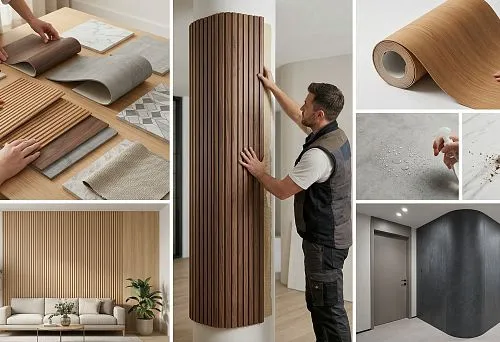
Installation is not the most complex process, but it requires care and consistency. Let's break it down step by step.
Foundation Preparation
Surface — clean, dry, degreased. No crumbling fragments, no traces of old water-based paint without adhesion. On a new base (drywall, concrete, plaster) — putty, primer, dust removal.
On serious unevenness — installation on a metal frame made of profile. This levels the plane and allows for acoustic material to be placed behind the panel simultaneously.
Dry fitting
Before applying adhesive — mandatory fitting. Place the panel against the wall, check the direction of the slats, visual rhythm, joint locations. On curved surfaces — fit according to shape, ensure the fabric backing adheres tightly along the entire radius.
Cutting
The flexible panel is cut with a knife along the fabric — no special tool needed. It's important to cut precisely along the markings: the quality of the joints depends on the accuracy of the cut.
Applying glue and fixing
Mounting adhesive with high initial adhesion is applied to the base and the back side of the panel — using the contact method. On a straight wall — just press and level. On a curved one — secure with painter's tape or temporary supports until the adhesive sets.
Module Joining
The precise slat spacing at the ends of each module ensures a seamless joint. The next module is installed butt-jointed — the slats continue the rhythm without a visible gap. This only works with high precision in the production geometry of the ends.
Internal corners are detailed with a technological gap of 2-3 mm to compensate for thermal deformation. The gap is covered with a corner trim
External corners: corner profiles matching the panel color or metal decorative profile. Internal corners: 45° miter cut or capped with a profile. Ceiling and floor junctions: molding or concealed profile.