Article Contents:
- What is a flexible panel for interior finishing
- Where flexible panels work better than conventional ones
- Radius Walls
- Columns
- Arches and Arch Openings
- Niches and rounded corners
- Furniture fronts
- Counters and reception desks
- In which interiors flexible panels are used
- Living Room
- Bedroom
- Entry Hall
- Office and meeting areas
- Commercial interiors: restaurant, hotel, showroom, office
- What types of flexible panels exist: materials and execution
- Flexible panel for painting (MDF)
- Flexible panel made of solid oak
- Panel with slatted texture for accent zones
- How to choose a flexible panel for your task
- For walls with straight geometry
- For a column
- For an arch
- For a furniture front
- For large coverage areas
- For local accent
- Flexible panel or rigid slatted panel: what to choose
- What to look for when choosing: technical checklist
- Flexible panel installation: step-by-step guide
- Step 1. Base preparation
- Step 2. Marking and Dry Fitting
- Step 3. Cutting
- Step 4. Applying Adhesive
- Step 5. Fixing and Alignment
- Step 6. Module Joining
- Step 7. Final Finishing
- Costly Mistakes in Selection and Installation
- How to Combine Flexible Panels with Other Materials
- Painted Walls
- Natural stone
- Metal
- Soft Textiles
- Lighting
- Who This Format Is Especially Suitable For
- Finishing and Installation Tips from Practitioners
- Materials: MDF vs. Solid Oak in Detail
- MDF for painting
- Solid oak
- Dimensions, Formats and Quantity Calculation
- Conclusion: When a Flexible Panel is the Right Choice
- FAQ: Answers to Popular Questions
- About the Company STAVROS
There are tasks that rigid panels handle perfectly. And there are tasks where they simply don't work — physically, structurally, geometrically. This is precisely where the flexible interior wall panel comes into play: a material that wraps around space, not resisting it, but following every architectural curve.
This article is not a theoretical overview of terms. It's a practical guide: where flexibility is needed, how to choose it, how to install it, what to combine it with, and which mistakes cost the most. Read as a designer, think as a client.



What is a Flexible Interior Wall Panel
Let's start with a definition — not a dry one, but a working one.
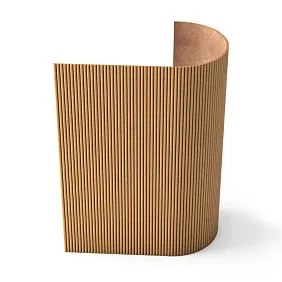
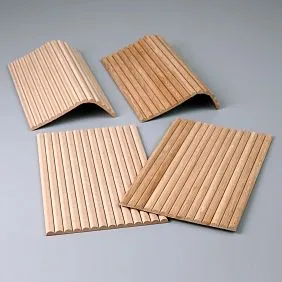
Flexible Slat Panel— is a decorative fabric made of parallel slats, fixed on an elastic textile base with a specified pitch. Unlike a rigid panel, where slats are fixed to an MDF backing to form a monolithic module with fixed geometry, the flexible construction maintains mobility in one plane. This allows it to wrap around surfaces of any radius — from a wide curve to the sharp bend of a column 20–30 cm in diameter.
The textile carrier is the key structural element. It holds the slats at the precise specified pitch, prevents them from spreading or shifting during bending, while simultaneously ensuring an even distribution of load across the entire surface. This is precisely whydecorative wall panelson a textile base are so in demand in professional design projects — where non-standard geometry is not a problem, but part of the concept.
How does a flexible decorative panel differ from a regular slatted one? Three fundamental differences:
-
Base. Rigid panel — MDF or plywood backing. Flexible — fabric carrier with elastic properties.
-
Application area. Rigid — only flat surfaces. Flexible — any: straight, radius, concave, convex.
-
Installation. Rigid is fixed with adhesive, finishing nails, or screws along guides. Flexible — exclusively with mounting adhesive, conforming to the surface shape.
Why is this format especially important in interior finishing? Because real architectural space is rarely perfectly rectilinear. Columns, arches, niches with rounded corners, radius partitions, curved furniture fronts — all require a material that can work with the form, not against it.




Where flexible panels work better than conventional ones
Ask yourself a simple question: is there at least one curved element in your project? If yes — read this section especially carefully.
Our factory also produces:



Radius walls
A radius wall is a challenge for any finisher. Drywall here requires cuts, tile — custom fitting, paint handles it but doesn't provide texture.Flexible wall panelsolves the task elegantly: the sheet is applied to the surface, wraps around its radius, and is fixed with adhesive without deforming the slats. No cuts, no fittings. The slatted texture retains clarity along the entire bend.
Get Consultation
Columns
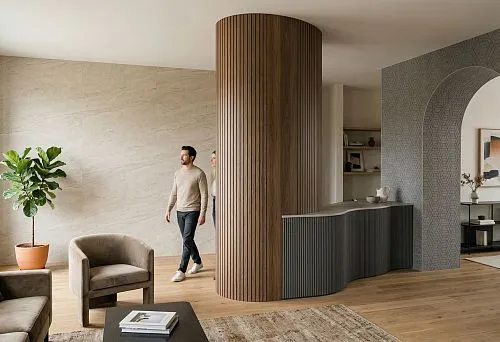
A column is a closed radius. This is precisely where rigid slatted panels completely capitulate. Covering a cylindrical surface with a rigid module is impossible without serious technical tricks: cutting, joints, special corner elements. A flexible panel for columns solves this task in one motion: the sheet wraps around the column along the entire perimeter, joins seamlessly, and the result is a continuous slatted surface without visible seams.
Arches and arched openings
An arch is a complex surface with a variable radius of curvature. Cladding it with wooden elements in the traditional way is expensive and labor-intensive. A flexible panel for arches bends to the shape of the vault, is secured, and provides a neat decorative result. This looks especially impressive when the arch transitions into a wall—the panel runs as a continuous strip, without transitions or adjustments.
Niches and rounded corners
A niche with right angles is a rigid panel. A niche with rounded corners or a smooth transition between planes is already a task for a flexible solution. A rounded interior corner, so beloved in Scandinavian and organic interiors, can now be easily covered with a single sheet without patches or complex joints.
Furniture facades
One of the most interesting application scenarios is furniture. A curved cabinet front, a radiused cabinet, a rounded kitchen island—all of these are perfectly clad with a flexible slatted panel. The surface gains a slatted texture, which simultaneously serves as a functional coating and a design accent.Panels for furnitureon a fabric base is a separate major topic that professional furniture manufacturers are paying increasing attention to.
Reception desks and counters
A reception desk or bar counter with a radiused front is the hallmark of a commercial interior. Here, the flexible panel works as both a structural and decorative element simultaneously. The counter gains an expressive slatted surface, which reads as an original design solution rather than standard finishing.
In which interiors are flexible panels used
The architectural flexibility of this material means an almost limitless context of application. Nevertheless, there are spaces where flexible panels are particularly organic.
Living Room
A TV area with column elements or a semicircular niche is a classic spot for flexible finishing. An accent wall behind the sofa, cladplank panelswith a smooth transition to adjacent surfaces, creates a sense of architecturally considered space. Vertical slats visually raise the ceiling, horizontal ones expand the room.
Bedroom
The bed headboard is the most common place to use panels in a bedroom. But if the headboard has an arched shape, rounded edges, or is built into a niche with non-standard geometry, it is precisely the flexible format that allows the architecture to be played up, not hidden. A soft slatted rhythm creates tactile depth without overload.
Entryway
In hallways, column-pilasters, semicircular niches for cabinets, and arched openings are often found. All of these are direct scenarios for a flexible decorative panel. An additional plus: a slatted surface hides minor base irregularities better than flat paint or wallpaper.
Study and meeting areas
In a modern study or meeting area, panels made of natural oak with a slatted texture create a visual 'anchor'—an accent that sets the tone for the entire space. It is especially expressive when the panel wraps around a semi-circular niche or columns, creating a sense of high-class study finishing.
Commercial interiors: restaurant, hotel, showroom, office
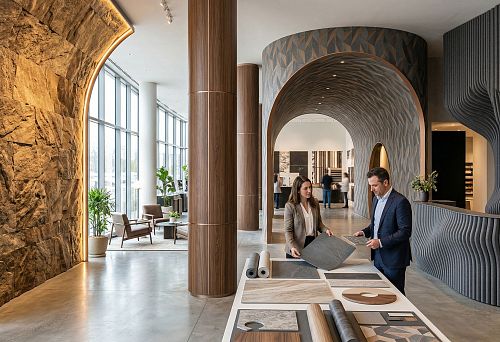
In commercial design, non-standard geometry is not an exception but the norm. Reception desks with radiused facades, arched transitions between zones, decorative columns in a restaurant hall, curved partitions in a showroom—all of this requires a material capable of working with form without compromise.Flexible slatted panelsare indispensable here: they maintain the design level, are installed quickly, and look expensive without costly manual work.
What types of flexible panels exist: materials and execution
Not all flexible panels are the same. Before choosing a specific solution, you need to understand what exactly you want to achieve aesthetically and functionally.
Flexible panel for painting (MDF)
These are MDF slats on a fabric base. The MDF surface is porous, uniform, and ideal for paint application. After installation, the panel is primed and painted in any RAL color or custom color. This provides maximum freedom in color choice: want white minimalism — no problem, want a graphite accent wall — easy.
Panels for paintingThey are especially in demand in projects where the interior is created 'from scratch' and the color scheme is determined by the designer. It's also convenient that if the concept changes, the wall can be repainted without dismantling the panels.
Flexible panel made of solid oak
Slats made of natural oak on a fabric base — this is a different level of aesthetics. The living wood texture, natural grain pattern, warm tone, and tactile depth of the surface — all of this cannot be reproduced by any printed coating.Solid oak panelsThey are coated with oil, wax, or clear varnish — depending on the desired level of sheen and protective characteristics.
Oak as a wood species combines hardness with aesthetics: it is resistant to mechanical loads, holds its shape well, and acquires a noble patina over time. This is why in commercial interiors — especially in premium-class hotels and restaurants — solid oak is preferable to MDF.
Panel with slatted texture for accent zones
Slatted texture is not just aesthetics. It is an architectural tool. With side or directional lighting, vertical slats create soft chiaroscuro, turning a flat wall into a sculptural object. This property is especially important for accent zones: TV areas, bed headboards, niches with backlighting.
How to choose a flexible panel based on the task
The practical rule is simple: first the task, then the material. Not the other way around.
For a wall with straight geometry
If the wall is flat and straight, you can use either a flexible or a rigid panel. Flexible panels also work great here: they are mounted with adhesive, join seamlessly with adjacent modules, and hold their shape well. Choose based on aesthetics: if you want paint — MDF, if you want natural wood — oak.
For a column
A flexible panel is the only sensible solution. Measure the perimeter of the column, calculate the number of modules, and fix them with adhesive around the circle. Place the joint in the least noticeable spot — typically at the back or side. If the diameter is small, a panel made of semi-circular battens can wrap the column in a single sheet without any joints at all.
For arch
Here, the width of the arched vault is important. If it's a narrow decorative arch — one strip will suffice. If it's wide — plan the layout in advance so that the joints of the modules fall at symmetrical points. Installation proceeds from the center to the edges.
For furniture front
On furniture, the panel experiences mechanical loads. Therefore, oak is preferable here: it is stronger and better withstands touch, moisture, and minor impacts. Choose a structural adhesive — with high initial adhesion and resistance to temperature fluctuations.
For a large coverage area
Plan the layout in advance. Calculate the number of modules with a 10–15% allowance for cutting and fitting. Ensure all modules are from the same batch — this guarantees color and texture consistency. Seamless connection of modules, with proper layout, creates a single surface without visible transitions.
For a local accent
If you need a small decorative accent—one panel on the headboard of the bed, a niche behind the bar island counter—one or two modules are enough. This is economical and expressive at the same time.MDF Plank PanelsIn this scenario, they are especially practical: they are easy to cut to size and paint in the desired shade.
Flexible panel or rigid slatted panel: what to choose
This is perhaps the most common question. And the answer is not straightforward—it depends on the geometry of the task.
| Criterion | Rigid slatted panel | Flexible slatted panel |
|---|---|---|
| Surface type | Only flat planes | Straight and radius |
| Geometric precision | Maximum, even spacing | Even spacing, maintained when bent |
| Installation | Glue, nails, screws | Adhesive only |
| Application on columns | Impossible | Ideally |
| Application on arches | Limited | No restrictions |
| Furniture fronts | Straight only | Straight and curved |
| Joining | On guides | Seamless |
| Base preparation | Required | Required |
When is a rigid panel better? If you have completely straight-line geometry, need maximum precision in slat spacing, and plan mechanical mounting on guides—a rigid panel will give a stricter result. It is literally more rigid: less 'play,' holds a straight line better.
When is flexible paneling irreplaceable? Any bend, any radius, any curved surface. Here, rigid panels are either a costly compromise or completely impossible.Flexible slatted panelsFabric-based panels have no alternative in their price segment for these scenarios.
What to look for when choosing: Technical checklist
Before purchasing, check these seven parameters:
1. Panel base type
The fabric base must be dense enough to hold the slats in step, and elastic enough to wrap around surfaces without deformation. Fabric that is too thin risks delamination during installation.
2. Actual flexibility
Request a sample and check the bending radius manually. The panel should not 'crumble' at the bend; the slats should not delaminate or form whitish cracks.
3. Joint quality
A good panel joins seamlessly: the end slats of adjacent modules fit together without gaps or overlaps. This requires precise end geometry—check with a sample.
4. Cutting Convenience
The panel should be cut with a knife or saw without chips or burrs. MDF cuts cleaner, while oak requires a sharper tool and more care.
5. Readiness for Finishing
The MDF option should be ready for priming and painting immediately after installation. The oak option is ready for oil or varnish application without preliminary joint sanding.
6. Style Compatibility
Wide slats with large spacing are for loft and brutalist design. Narrow slats with minimal spacing are for minimalism and Scandinavian style. Half-round moldings are for organic and natural aesthetics.
7. Batch Consistency
If covering a large area, ensure all panels are from the same production batch. This guarantees uniformity of color and texture.
Flexible Panel Installation: Step-by-Step Guide
Installing a flexible panel is not a complicated process but requires care. Here is the complete sequence.
Step 1. Surface preparation
The base must be clean, dry, and dust-free. Loose, crumbling surfaces must be reinforced with deep-penetration primer. The wall does not need to be perfectly level — the slatted texture hides minor irregularities — but critical deviations (more than 3–5 mm) should be eliminated.
On curved surfaces — columns, arches — ensure the base has uniform curvature without local protrusions or depressions. Gypsum drips, leftover fasteners, protruding screws — all of this must be removed before installation begins.
Step 2. Marking and Dry Fitting
Before applying adhesive, always perform a dry fit. Place the panels against the surface to ensure the layout looks as intended. Mark the joint lines. On a column — mark the joint location so it ends up in the least noticeable position.
On an arch — start from the center downwards so the joints are symmetrical.
Step 3. Cutting
Cut the panel along the fabric backing. For MDF — use a utility knife with a sharp blade and a ruler. For oak — use a fine-toothed saw or a miter saw. The cut must be clean: burrs on the edge will worsen the joint quality.
Step 4. Applying adhesive
Use mounting adhesive such as 'liquid nails' or special parquet adhesive with high initial adhesion. Apply the adhesive to the fabric backing of the panel — in a zigzag or dotted pattern, without full coverage (to prevent oozing through the gaps between the slats).
On vertical surfaces — additionally apply adhesive to the base. This double fixation prevents the panel from sliding before polymerization.
Step 5. Fixing and Leveling
Apply the panel to the surface, press along its entire length with your hands. Check the level — vertical or horizontal, depending on the orientation of the slats. Adjust the position if necessary before the adhesive sets.
On a curved surface — press the panel gradually, from one edge to the other, ensuring even contact of the fabric backing with the surface.
Step 6. Module Joining
The next module is placed flush against the previous one — slat to slat, without a gap. This is seamless joining: with proper end geometry, the joint visually disappears, and the surface reads as a single canvas.
Step 7. Final Finishing
After the adhesive has fully cured (typically 24 hours), MDF panels are primed and painted. Oak panels are treated with oil or varnish. The joints can be additionally sealed with color-matched acrylic sealant for the neatest result.
Costly mistakes in selection and installation
Years of practice have accumulated a list of typical mistakes encountered by clients and even experienced finishers. Let's examine each one.
Mistake 1. Choosing a rigid panel for a curved surface
This is the most common and costly mistake. A rigid MDF module cannot be bent — it can only be cut and assembled from fragments, resulting in ugly visible seams and huge waste of material and time. If the surface has even a minimal curve — use onlyflexible wall panel.
Mistake 2. Poorly prepared substrate
Glue is not putty. It does not fill in unevenness, but only fixes what is adjacent to it. If the base is loose or dusty — the panel will fall off. If there are local protrusions on the surface — the panel will be installed with deformation.
Mistake 3. Lack of dry fitting
"I'll install it as is, we'll figure it out" — a classic, after which material overrun amounts to 20–30%. Dry fitting with marking takes 30 minutes and saves several hours of rework.
Mistake 4. Weak glue
Don't skimp on glue. The mounting compound must provide high initial adhesion (so the panel doesn't slide before polymerization) and long-term strength. This is especially critical for furniture fronts with mechanical load.
Mistake 5. Incorrect slat orientation
Vertical slats visually stretch the space upward. Horizontal ones — widen it. Diagonal ones — create dynamism. The choice of orientation is a design decision that needs to be made at the design stage, not during installation.
Mistake 6. Ignoring thermal expansion
Oak is a living material. It reacts to humidity and temperature. In rooms with unstable climate (e.g., near external walls) leave expansion gaps at the ends.
How to combine flexible panels with other materials
A flexible slatted panel is not an 'all or nothing' choice. It harmoniously coexists with other materials, creating a layered interior.
Painted walls
A classic combination: an accent wall with a slatted panel, the other walls in the same or contrasting paint. The slats 'absorb' some of the wall color, so it's recommended to choose the main paint slightly more saturated than it appears on the chip.
Natural Stone
Warm oak and cold marble is a contrast that works flawlessly. Especially in bathrooms and commercial interiors, where oak panels clad columns or stands next to marble countertops.
Metal
Brass or matte black metal accents combined with the textured oak slats are the language of modern interior. Built-in lights, frames, handles, and decorative metal inserts create a rhythm that echoes the rhythm of the slats.
Soft textiles
Sofa cushions, curtains, drapes made of natural fabrics next to slatted panels bring warmth. Especially in the bedroom, where the panel behind the bed headboard should be part of the 'soft' atmosphere, not its opposite.
Backlighting
LED backlighting behind or in front of slatted panels is one of the most effective techniques. With directional lighting, the play of light and shadow between the slats becomes maximally expressive. Bottom-up lighting creates a 'floating' surface effect. Backlighting from behind through gaps produces a soft, diffuse glow.
Who is this format especially suitable for
Flexible panel for interior finishing is a professional-grade tool that is also accessible to private customers. Who uses it most often?
Interior designers — as a standard tool for working with non-standard geometry. When a project has columns, arches, or radius niches, flexible panel is the first choice.
Architects — especially when working with historical buildings where the architecture is complex and non-linear. The flexible format allows working with historical geometry without disrupting it.
Furniture manufacturers — for cladding curved facades, rounded sides, radius cabinets and islands. This is a ready-made solution that replaces expensive manual assembly from individual elements.
Private customers — those who do renovations consciously and want designer-level results without involving construction crews. Installing a flexible panel is manageable even for an unprepared person — provided the substrate is properly prepared.
Builders and finishers — as a way to quickly and cleanly cover a complex surface fragment without spending time on custom fitting.
Finishing and installation tips from practitioners
Several recommendations that are rarely found in instructions but often come up in practice.
-
Prime MDF edges before painting. MDF edges are more porous than the surface. Without primer, they absorb paint differently, resulting in a visible color difference.
-
Do not install in damp conditions. The adhesive sets worse, and oak may absorb moisture before installation.
-
Start from the corner or from the center — depending on the task. On a flat wall — from the corner. On a column or arch — from the central point.
-
Use painter's tape to protect joints during painting. If one panel is already painted and you are installing the adjacent one later — cover the end with tape.
-
Orientation matters. If the slat pattern should run continuously around a corner — plan this in advance, before cutting.
For more details on technical installation nuances — see the section Advice on finishing and installationon the STAVROS website.
Materials: MDF vs. solid oak in detail
This choice deserves a separate discussion, because it determines not only aesthetics but also durability and logistics.
MDF for painting
MDF (medium-density fiberboard) is pressed wood pulp. Uniform, without knots or defects, it perfectly accepts paint and provides an even color without variation. MDF slats are more precise in geometry, lighter in weight, and lower in cost.
Cons of MDF: it is sensitive to moisture (swells when wet), less resistant to mechanical impact compared to natural wood, and lacks a living grain.
Application: any living spaces, commercial areas, furniture fronts with paint or varnish coating.
Solid oak
Oak is a hardwood with a characteristic, pronounced grain. Solid oak slats carry everything that makes natural wood a valuable material: warmth, liveliness, uniqueness of each plank, and resistance to loads.
Oak is heavier and more expensive than MDF. It requires more precise work during cutting and careful handling of moisture. But in interiors where the emphasis is on natural aesthetics and durability, solid oak is an investment that pays off through its service life and aesthetic level.
Application: high-end residential interiors, hotels, restaurants, furniture with natural finishes.
Dimensions, formats, and quantity calculation
The standard flexible slat panel module is a relatively small format that is easy to transport and install alone. Typical dimensions: width from 150 to 300 mm, length from 600 to 1200 mm. Slat width and the spacing between slats are key parameters that determine the visual rhythm of the surface.
For quantity calculation:
-
Measure the surface area (for flat walls — width × height).
-
For columns — perimeter × height.
-
For arches — arc length × cladding width.
-
Add 10–15% for cutting and fitting.
-
Divide the total area by the area of one module.
If working with multiple surfaces — calculate each separately and sum them up. Don't forget about joints: on curved surfaces, consumption is higher than on flat ones.
Conclusion: when a flexible panel is the right choice
To sum up.Flexible panel for interior finishing— is a solution for all those cases when the rigid geometry of the material conflicts with the living geometry of the space.
Choose a flexible panel if:
-
you have columns, arches, radius niches, or rounded corners;
-
you need curved furniture fronts with slatted finishing;
-
you want continuous slatted covering without visible seams on bends;
-
installation is carried out in hard-to-reach places where mechanical fasteners cannot be used;
-
speed and cleanliness of installation are important.
Choose a rigid slatted panel if:
-
all surfaces are straight;
-
you need the strictest geometry of slat spacing;
-
mechanical fastening to guides is intended.
In any case — both formatsof slatted panelscomplement each other and can be used in one project: rigid ones on straight walls, flexible ones on curved transitions.
FAQ: Answers to popular questions
What is a flexible panel for interior finishing?
It is a decorative fabric of parallel slats on an elastic textile base. Unlike a rigid panel on an MDF backing, it can wrap around curved surfaces: columns, arches, radius walls, curved furniture fronts.
How does a flexible panel differ from a regular slatted panel?
The fundamental difference is in the base. A rigid panel is mounted on an MDF or plywood backing and does not bend. A flexible one is on a textile elastic base, which allows it to bend to any radius without deforming the slats.
Can flexible panels be used on columns?
Yes — this is one of the primary applications. The panel wraps around the column along the entire perimeter, seamlessly joins, and provides a continuous slatted surface. This cannot be achieved with a rigid panel.
Is flexible panel suitable for arches and niches?
Yes. Vaulted arches, rounded niches, concave surfaces — all these are direct tasks for a flexible panel. Installation proceeds from the center to the edges, with joints positioned symmetrically.
Can flexible panels be installed on furniture fronts?
Yes. Flexible panels are used for cladding curved furniture fronts, rounded cabinets, kitchen islands. For furniture, solid oak slats are recommended — they are stronger and more resistant to mechanical loads.
For which rooms is this solution suitable?
For any: living room, bedroom, hallway, study, bathroom (in areas without direct contact with water), as well as commercial spaces — restaurant, hotel, office, showroom, sales floor.
What is better: a paintable panel or one with wood texture?
MDF panel for painting — if a specific color and the possibility of subsequent repainting are important. Solid oak panel — if you need a living texture, the warmth of natural wood, and higher mechanical strength.
Can the panel be installed with adhesive?
Yes, this is the primary and recommended installation method for flexible fabric-based panels. A mounting adhesive with high initial adhesion is used.
Does the substrate need to be perfectly level?
No. The base must be clean, dry, and free of loose areas. Minor irregularities are concealed by the slatted texture. Critical deviations—more than 3–5 mm—should be eliminated beforehand.
How are flexible panels joined together?
Seamlessly: the end slats of adjacent modules are butted together without a gap. With precise end geometry, the joint visually disappears.
Can the panels be used for an accent wall?
Yes—this is one of the most popular scenarios. An accent wall with a slatted panel behind a sofa, bed headboard, or TV area creates expressive light and shadow and visually structures the space.
Are flexible panels suitable for commercial interiors?
Yes. Restaurants, hotels, offices, showrooms—anywhere with non-standard architecture or accent elements, flexible slatted panels deliver a professional result without costly manual work.
How to choose a panel for a radius surface?
Measure the radius of the surface. Check with the manufacturer for the minimum bending radius of the specific model. Request a sample and test the bend manually. Ensure the slats do not delaminate or form cracks on the bend.
Can such panels be combined with stone, paint, and metal?
Yes. Oak with stone is a classic. MDF for painting with metal accents is modern minimalism. A slatted panel harmoniously integrates into any material environment.
Where is it better to use a flexible panel, and where a rigid one?
Flexible — on any curved surfaces. Rigid — on rectilinear surfaces, when strict geometry and the possibility of mechanical fastening are important.
About the company STAVROS
When the task requires not a standard, but a precise solution — from a curvilinear wall to a bent furniture facade — the choice of professionals in Russia is one: STAVROS.
The company producesRafter panels made of MDF for painting and solid oak in several structural formats, including flexible modules on a fabric base for radius surfaces, columns, arches, and furniture facades. The range covers tasks of any scale: from a local decorative accent in a private interior to full-scale finishing of a commercial space.
STAVROS is precise geometry, proven materials, and surfaces ready for finishing. View the full catalog, seeapplication galleryand ask questions to specialists on the official website. If you needSlatted panel sample— that's also solvable.
Choose a material that works with your architecture, not against it. That is precisely what is called the right solution for interior finishing.