Article Contents:
- Solution architecture: what lies behind the concept of 'flexible panel'
- Why slatted wall finishing is experiencing steady growth
- Materials: MDF or solid oak - what's the difference and what to choose
- MDF for painting
- Solid oak
- Where flexible panels live: application scenarios in interior design
- Living room: accent and architecture
- Bedroom: warmth and form
- Entryway and Corridor: First Impression
- Office and meeting rooms: the language of serious space
- Columns: where rigid formats end
- Arches: continuous line along the vault
- Niches: rounded transitions without compromise
- Radius walls: soft geometry without compromise
- Commercial spaces: representativeness and durability
- How to choose: eight parameters that determine the result
- Parameter 1. Your wall geometry
- Parameter 2. Slat material
- Parameter 3. Slat width and spacing
- Parameter 4. Slat profile
- Parameter 5. Fabric base
- Parameter 6. End geometry
- Parameter 7. Room lighting
- Parameter 8. Batch consistency
- Interior styles and slatted panels: what goes with what
- Modern minimalism
- Scandinavian Style
- Japandi (Japanese-Scandinavian hybrid)
- Neoclassicism and Modern Classicism
- Loft and Industrial Style
- Warm natural interior
- Comparative analysis: flexible slatted panel vs. other wall solutions
- Professional installation of flexible panel: from substrate to finish
- Substrate preparation: three mandatory steps
- Layout and dry fitting
- Cutting
- Adhesive Application and Fixation
- Joining
- Finishing corners and junctions
- Final finishing
- Mistakes that ruin the result: seven real scenarios
- Error 1. Rigid panel on a curved surface
- Error 2. Installation without dry fitting
- Error 3. Poor substrate
- Error 4. Incorrect slat scale
- Error 5. Ignoring lighting
- Error 6. Different batches in one project
- Error 7. Cheap adhesive
- What to combine slat panel with: materials, colors, details
- Painted Walls
- Parquet and flooring
- Metal
- Natural stone and concrete
- Lighting
- Hidden doors
- Textiles
- Technical parameters: what's important to document before ordering
- Who chooses flexible panels: buyer profiles
- Interior designer
- Furniture manufacturing
- Architect
- Private client
- Developer and real estate developer
- FAQ: answers to the most frequently asked questions
- About the Company STAVROS
There are questions a designer answers instantly—without hesitation. 'What to finish a straight wall with?'—dozens of answers. 'What to clad a column with, finish an arch, and continue it onto a straight wall with a single material?'—and here the field narrows down to one specific solution. Flexible wall panels for interior finishing—this is precisely the tool that works where rigid formats end.
But let's not stop at this thesis. Flexible slatted panels are not just a solution for complex geometry. They are a full-fledged material for any interior wall finishing: residential apartments, country houses, offices, restaurants, and commercial spaces. The slatted structure, the lively rhythm of the surface, working with light, the warmth of natural wood—all this makes them a sought-after choice even where there's no curve in sight.
This material is not a review, not a catalog, but an honest professional breakdown: what this material is, how it's constructed, where and how to use it, how to choose, how to install, what to combine it with—and what mistakes turn a good idea into disappointment.


Solution Architecture: What's Behind the Concept of a 'Flexible Panel'
Before discussing applications, let's examine the construction. This is important because the construction explains everything else.
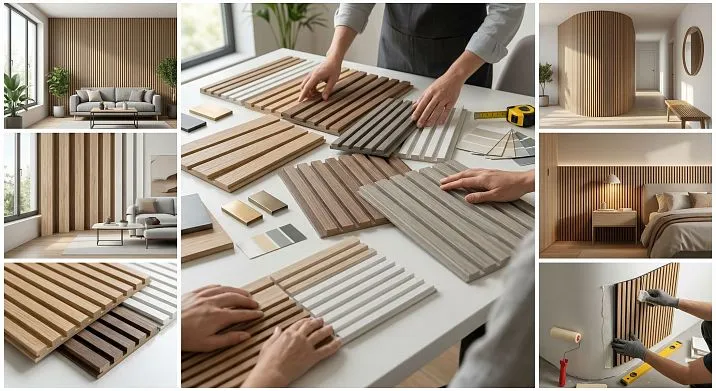
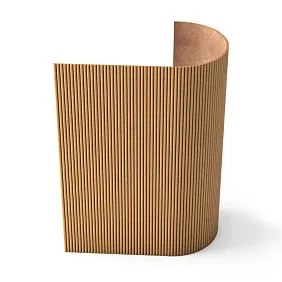
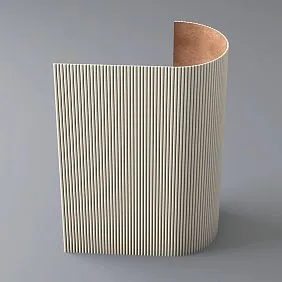
The flexible slatted panel is simple yet clever in design. The load-bearing base is an elastic fabric—dense, durable, and non-stretchable along the length of the slats. Wooden or MDF slats are glued onto this fabric at a uniform, predetermined pitch. Air gaps between the slats give the panel its key capability: bending along a curve without deforming the slatted pattern.
It sounds elegant—and it is in practice. But it's important to understand the limits of its capabilities. The panel's flexibility is determined by the width of the gaps between the slats and the elasticity of the base. Wider gaps allow for a smaller bending radius. Narrower gaps make the panel stiffer, though it retains the ability to wrap around gentle curves.
How does this fundamentally differ from a standard rigid panel? A rigid slatted module consists of slats plus an MDF board base. It's a monolithic construction with strict geometry and flawless appearance on flat surfaces. But as soon as a curve appears, the monolith becomes an obstacle, not an aid.
slatted panels made of MDF and solid oakIn a flexible design, they offer a different quality of work: they follow the architecture, rather than requiring the architecture to accommodate them.




Why Wall Slatted Cladding is Experiencing Steady Growth
The interest in slatted wall panels in interiors is neither accidental nor temporary. It is driven by several enduring factors.
The first is fatigue with 'smoothness'. A decade of flat painted walls and glossy surfaces has done its job. People want texture, depth, tactility. Slatted surfaces provide all this through the simplest of tools—the play of light and shadow.
The second is the demand for natural materials. Wood in interiors is not a trend; it's a need. Solid oak on a wall creates a completely different atmosphere than wood imitation. Living texture, warmth, aroma—this cannot be reproduced by printing.
Third — the need for architectural solutions for non-standard geometry. Modern interiors increasingly work with curvilinear forms, smooth transitions, rounded elements. And hereflexible slatted panels for complex surfacesoccupy their indispensable niche.
Fourth — accessibility of professional results. A slatted wall looks expensive and complex — but is mounted relatively simply. This 'visual result / labor cost' ratio is especially valued by private clients who are renovating on a limited budget but with big design ambitions.
Our factory also produces:



Materials: MDF or solid oak — what's the difference and what to choose
This is the first practical choice facing the buyer. Let's examine it specifically.
Get Consultation
MDF for painting
MDF (medium density fibreboard) is finely dispersed pressed wood pulp with a homogeneous structure and smooth surface. For slatted panels intended for painting, this is the optimal base material.
What MDF provides:
-
A perfectly smooth surface that accepts paint without priming with coarse fraction;
-
Complete freedom in color choice — RAL, NCS, Pantone, any custom shade;
-
Possibility of repainting in the future without disassembly;
-
More affordable price compared to solid wood;
-
Batch uniformity — all slats are the same color for painting.
Limitations of MDF:
-
Does not like moisture. Requires additional end treatment in high humidity;
-
No natural texture — only painting;
-
Less resistant to mechanical impacts than solid wood.
Solid oak
Oak is one of the densest and most durable species for interior applications. Density — 700–750 kg/m³. Solid oak slats feature a living texture with a unique pattern that is not repeated in any other piece.
What solid oak provides:
-
Natural texture with an individual fiber pattern;
-
Tactile depth of the surface — you can feel the living wood under your hand;
-
Resistance to mechanical loads;
-
Durability: oak with proper care lasts for decades;
-
Aesthetic value that cannot be imitated;
-
Ability to tint from light Scandinavian to dark wenge.
Limitations of solid wood:
-
Higher cost;
-
Natural tone variation between slats — must be considered during layout;
-
Requires periodic renewal of oil or varnish coating.
When to choose MDF? When precise color is important, uniformity is needed, budget is limited, or the space will be repainted.
When to choose oak? When natural aesthetics, durability, tactile feel, and living texture are important. Especially in commercial spaces with high traffic.
Where flexible panels live: application scenarios in interior design
Different spaces — different tasks. Let's go through the main scenarios whereslatted wall finishes in interior designworks at full capacity.
Living room: accent and architecture
The living room is a space that 'works' for both guests and hosts simultaneously. A TV zone with slatted panels is already a classic. But the flexible format opens up possibilities that rigid modules don't have.
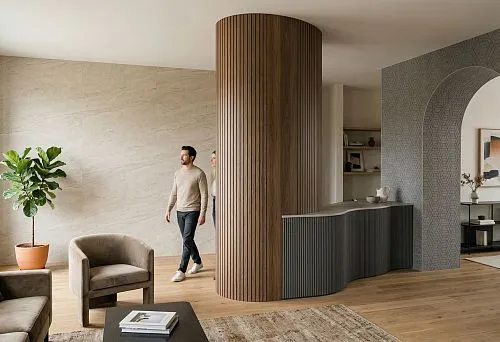
Imagine: the TV zone is framed by decorative columns or transitions into rounded niches on the sides. The flexible panel wraps around all these elements as a single canvas — without seams, without material changes, without visual 'patches'. The result: the wall reads as an architectural detail, not as a set of cladding elements.
For living rooms with straight geometry —slatted panels for accent wallsin rigid format also work excellently. The choice between formats here is dictated not by aesthetics, but by architecture.
Bedroom: warmth and form
A bed headboard with a slatted panel is one of the most popular and justified solutions in modern bedroom interiors. Why does it work? The panel creates a 'wall behind the bed' — an architectural accent that emphasizes the resting area and sets the scale for the entire room.
Important detail: if the headboard is built into an arch, a rounded niche, or has a curved shape — this is a direct task for a flexible panel. A unified slatted rhythm along the entire curve creates a sense of custom architecture, executed according to an individual project.Slatted panels for the bedroomwith a soft oak tone or neutral painting — the most organic choice for a calm space.
Hallway and corridor: first impression
The hallway welcomes guests. And often, it is here that the architecture is most unexpected: arched openings, pylons, rounded transitions between walls, unexpected angles.Slatted panels for the hallwayin a flexible design allow you to finish all these elements with a single material — from floor to ceiling, from a straight wall to an arched vault.
An additional practical bonus: the slatted structure hides minor irregularities of old walls much better than any flat covering.
Study and meeting rooms: the language of a serious space
In professional environments, walls carry reputational weight. Dark oak with a matte oil finish, vertical slats with pronounced spacing—this is the language of office space, speaking of seriousness without words.
If the office has non-standard architecture—niches for bookshelves, rounded corners, decorative columns—panels for complex interior surfacessolve the problem of a unified style without manual adjustment.
Columns: where rigid formats end
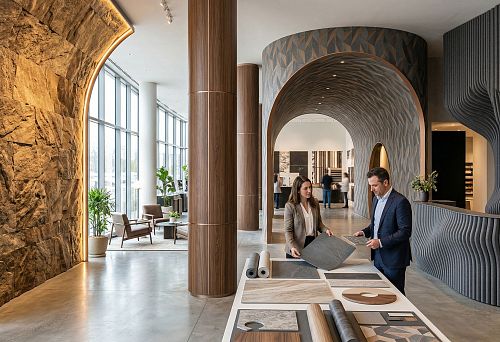
A cylindrical column is the absolute limit of a rigid panel. It is physically impossible to cover a closed cylinder with a monolithic module without visible seams. Only a flexible format solves this problem: the fabric wraps around the column along its entire perimeter, joins at the least noticeable point, and creates a monolithic slatted surface.Slatted panels for columns—this is one of the most requested scenarios in professional projects.
Arches: a continuous line along the vault
An arched vault with slatted finishing is a powerful architectural technique. A flexible panel lays the slatted rhythm along the curve of the vault, maintaining uniform spacing. It is especially expressive when the arch transitions into adjacent walls and the slatted finishing continues uninterrupted.Slat panels for archesare indispensable in this scenario.
Niche applications: rounded transitions without compromise
A niche with sharp right angles is one challenge. A niche with rounded internal transitions is a completely different one. A rigid panel in a rounded niche requires fitting at every curve. A flexible panel wraps around transitions as a single sheet—the result looks like monolithic cladding.
Radius walls: soft geometry without compromise
In modern interiors—especially in commercial spaces—walls with smooth curves are increasingly common. Radius partitions, rounded reception areas, arched walls in restaurant halls. For all of this, you needpanels for radius surfaces—and here the flexible slat format is the only sensible answer.
Commercial spaces: prestige and durability
Restaurant, hotel, showroom, medical center, coworking space—a commercial interior places demands on the material that residential spaces rarely require: high foot traffic, coating durability, visual prestige, compliance with corporate style.Wall slat panels for interiormade of solid oak fully meet these requirements.
How to choose: eight parameters that determine the result
Choosing a flexible slat panel is not about 'like/dislike'. It's a system of parameters that need to be checked sequentially.
Parameter 1. Geometry of your wall
Ask yourself one question: is there any curvature in the space? An arch, column, radius transition, rounded niche? If yes — you need a flexible panel. If no — you can choose between flexible and rigid formats based on other criteria.
Parameter 2. Slat material
Already discussed above. If color and budget are important — MDF for painting. If natural aesthetics and durability are important — solid oak.
Parameter 3. Slat width and spacing
Slat width and spacing between them determine the visual 'density' of the surface and its scale.
Narrow slats (10–20 mm) with a small pitch create a dense, detailed surface. Good for small spaces and minimalist interiors.
Medium slats (25–40 mm) with a moderate pitch are a universal solution for most living spaces.
Wide slats (50 mm and more) with a pronounced pitch create a brutal rhythm for spacious areas, lofts, and commercial interiors.
Scale rule: the width of the slat should correlate with the area of the room. A large pattern in a small room 'eats up' space.
Parameter 4. Slat profile
Rectangular profile — strict, architectural, with a clear shadow. Semi-circular profile (beads) — soft, sculptural chiaroscuro. The latter creates a special effect in spaces with diffused lighting: a wavy rhythm of shadows makes the surface tactilely expressive.
Parameter 5. Fabric base
This is a parameter that is difficult to assess from a picture but easy from a sample. A dense, durable base that does not tear when bent and does not allow the slats to shift relative to each other is a sign of a quality product. A loose, cheap fabric guarantees problems during installation on curved surfaces.
Parameter 6. End geometry
Take two samples and butt their ends together. A perfect joint is slat to slat, without a gap and without overlap. This is a sign of precise manufacturing and a guarantee of seamless installation. If the end is crooked, no installer's care will save it.
Parameter 7. Room lighting
Slatted panel reveals its beauty under directed light. Without accent lighting, a significant part of the effect is lost. If you are planning a slatted wall — plan accent lighting along with it.
Parameter 8. Batch consistency
The entire volume for one project must be from a single batch. For oak solid wood, there can be a color variation between batches — this is a natural feature of the material. Place your order with a small surplus (5–10%) and from a single batch.
Interior styles and slatted panels: what goes with what
A slatted surface is a material with a strong character of its own. It fits well into several stylistic systems — but in each of them it 'speaks' a little differently.
Modern minimalism
Narrow or medium slats, neutral color: white, light gray, off-white. MDF for painting with a matte finish. Strict vertical lines. Minimal decor around. The panel works as a subtle, almost imperceptible accent — you don't notice it at first glance, but it is precisely what makes the wall come alive.
Scandinavian style
Oak with clear oil or a light, pale stain. Moderate spacing, semi-round profile. Plenty of air, plenty of natural light. The panel creates warmth and natural depth — it is not a decor here, but an architectural material.
Japandi (Japanese-Scandinavian hybrid)
One of the most relevant styles today. Very narrow slats, minimal spacing, oak with a dark, restrained tint or a whitewashed finish. The panel surface is perceived as meditative: lots of fine rhythm, uniform and calm.
Neoclassicism and modern classicism
A slatted panel in this style typically occupies the lower third of the wall—like a frieze, framed by moldings. Wide slats with a dark oak tone, combined with cornice profiles.Wall finishing with slatted panelsIn a neoclassical key, it requires precise adherence to proportions and the rejection of random solutions.
Loft and industrial style
Wide slats, dark paint: anthracite, dark blue, olive. Adjacent—concrete surfaces, metal accents, exposed pipes. The slatted panel here serves as a 'warm' counterpoint to cold materials.
Warm natural interior
Natural oak with untinted oil or a light stain. Soft lines, organic shapes. The slatted surface here is the central material of the interior, not an addition.Modern slatted wall panelsOak slatted panels in a natural interior create an atmosphere that cannot be reproduced with synthetic materials.
Comparative analysis: flexible slatted panel versus other wall solutions
Let's honestly compare a flexible slatted panel with what is usually considered as an alternative. This is important: a good solution is not the one that is 'the best of all,' but the one that better solves your specific task.
| Criterion | Flexible slatted panel | Rigid slatted panel | MDF panel | Decorative plaster | Wallpaper | Paint |
|---|---|---|---|---|---|---|
| Curvilinear surfaces | Yes | No | No | Yes | Limited | Yes |
| Slatted texture and chiaroscuro | Yes | Yes | No | No | Imitation | No |
| Natural wood texture | Yes (oak) | Yes (oak) | No | No | Imitation | No |
| Installation without guides | Yes | Partially | Yes | No | Yes | Yes |
| Repainting | Yes (MDF) | Yes (MDF) | Yes | Yes | No | Yes |
| Columns and Arches | Yes | No | No | Yes | No | Yes |
| Installation speed | High | High | Medium | Low | Medium | High |
| Durability | High (oak) | High (oak) | Medium | High | Low | Medium |
| Visual depth | High | High | Medium | Medium | Low | No |
Conclusion from the table: flexible slatted panels win where architectural continuity is needed across different geometries. They lose on price to plaster on large flat areas—but on non-standard surfaces, plaster requires skilled manual labor, which costs more.
Professional installation of flexible panels: from base to finish
Installation is not a separate topic; it's a continuation of the choice. A poorly installed good panel yields a poor result. A well-installed one—excellent.
Base preparation: three mandatory steps
Step one: remove everything unnecessary. Old wallpaper, peeling paint, loose putty—all of this must be removed down to a clean, solid base. Adhesive only works on a stable surface.
Step two: priming. Deep-penetration primer is mandatory for porous and loose surfaces. For dense, smooth walls—it's enough to remove dust and degrease.
Step three: leveling. Minor irregularities (up to 3 mm)—are acceptable: the slatted structure hides them. Variations of more than 5 mm per linear meter—are eliminated with putty before installation.
Important: a damp wall is the enemy of installation. No adhesive holds on a wet base for long.
Marking and Dry Fitting
Before applying adhesive — marking. Vertical and horizontal guide lines, marks for joint points, reference points for radius transitions. Dry fitting allows checking the layout, ensuring symmetry, finding and eliminating problems before they become irreversible.
This is half an hour that saves several hours of rework.
Cutting
MDF battens are cut with a utility knife with a sharp blade along a ruler — along the fabric backing line. The cut is clean, without chips. For solid oak — a fine-toothed saw or miter saw. The cut angle must be strictly 90° — or precisely set if it's an angled joint.
Applying glue and fixing
Construction adhesive (structural, with high initial adhesion) is applied to the fabric backing of the panel in a zigzag or dotted pattern. Excess adhesive will seep through the gaps — this will ruin the appearance. On vertical surfaces, apply adhesive to the wall in parallel as well.
Press the panel smoothly, from one edge to the other — like applying film: without air bubbles, without jerking. On curved surfaces — gradually, maintaining pressure for 5–10 seconds on each bend section.
Joining
The next module is placed batten to batten — without a gap and without overlap. With precise end geometry, the joint visually disappears. This is not magic, but manufacturing precision.
Internal corners are detailed with a technological gap of 2-3 mm to compensate for thermal deformation. The gap is covered with a corner trim
External corner: both panels are cut at 45° and joined with a miter joint. Internal corner: one panel fits tightly against the other. As an alternative — corner profiles matching the panel color.
Adjacency to other materials (stone, metal, glass) is best resolved with a transition profile or by leaving a minimal technical gap filled with color-matched sealant.
Final finishing
MDF: primer + two coats of finish paint in the chosen color. Oak: oil or wax in the desired tone — applied in two passes with intermediate sanding. Ends in both cases are sealed with the same coating.
Errors that ruin the result: seven real scenarios
Over decades of practice, a stable list of errors has formed that repeat regularly — regardless of the performer's experience. I'll list them not for moralizing, but for practical benefit.
Error 1. Rigid panel on a curved surface
This sounds obvious — but still occurs. The reason is saving money or lack of knowledge. The result — visible seams, deformed structure, redoing from scratch. If there's a curve — only Flexible slatted panels. No compromises.
Error 2. Installation without dry fitting
Skipping the fitting stage saves 30 minutes — and costs several hours of rework. Especially critical on arches and columns, where incorrect layout is revealed only after fixation.
Error 3. Poor substrate
Loose, damp, greasy surfaces — a direct path to delamination within a few months. Substrate preparation is not an optional step, it's the foundation of the entire result.
Error 4. Incorrect scale of slat
A large slat pattern in a small room visually 'overwhelms'. A small pattern in a large hall 'gets lost' and fails to create the desired effect. The scale of the slats should correspond to the scale of the room.
Mistake 5. Ignoring lighting
A slat panel without accent lighting is 30–40% of the material's potential. Without directional light, there is no chiaroscuro, no depth. Plan lighting as part of the solution, not separately.
Mistake 6. Different batches in one project
Oak has color variations between batches—this is the nature of the material. Order the entire volume as a single batch, with a 5–10% reserve. This prevents the problem at its root.
Mistake 7. Cheap adhesive
Saving on installation compounds is a risk that materializes after 3–6 months. Especially on vertical surfaces and in rooms with seasonal humidity fluctuations. Use only proven structural compounds with documented initial adhesion.
What to pair slat panels with: materials, colors, details
A slat surface is not a monologue. It sounds best in dialogue with other materials and details.
Painted walls
An accent slat wall + the remaining walls in a solid paint color is a proven combination. An important nuance: with directional light, the slats create shadows in the gaps, and the wall appears visually darker than paint of the same shade. If you want color unity—choose paint that is slightly lighter.
Parquet and flooring
Oak on the wall + oak on the floor — it's warmth and unity. But the difference in finish is important: if the floor is glossy, the wall should be matte, and vice versa. Two matte or two glossy surfaces create monotony.
Metal
Brass lamps, black matte handles, copper details — metal creates an accent rhythm that echoes the slatted pattern. It works especially well in Scandinavian and natural interiors.
Natural stone and concrete
Oak next to marble — a classic contrast of warmth and cold. The contrast works both ways: stone looks warmer next to wood, wood looks more substantial next to stone. In commercial spaces, this duo is one of the most representative.
Backlighting
LED strip in front of the panel (directional light) or recessed into the grooves between slats (soft glow) — two fundamentally different effects. The first is active, expressive, creates deep shadows. The second is delicate, almost atmospheric. Plan the cable location in advance.
Hidden doors
One of the most relevant solutions in modern interiors: a door built into a slatted wall without visible frames and trims. The slatted rhythm 'absorbs' the door, and it visually disappears into the wall. This requires precise coordination between the panel manufacturer and the door contractor — but the result is worth it.
Textiles
Linen, wool, velvet — a tactile dialogue with the slatted surface. Both materials are 'warm', but in different ways: one is structural and rigid, the other is soft and pliable. The combination creates a richness of textures without overload.
Technical parameters: what's important to confirm before ordering
Before placing an order for Buy slatted panels for wallsRecord the following:
Room geometry:
-
Wall area for finishing (m²);
-
Presence of curves, arches, columns (minimum curvature radius);
-
Wall height;
-
Panel orientation (vertical/horizontal).
Panel parameters:
-
Material: MDF or solid oak;
-
slat width;
-
Spacing between slats;
-
Slat profile (rectangular/semi-circular);
-
Module length (standard or custom);
-
Color or tint (for MDF — RAL/NCS, for oak — tone sample).
Installation requirements:
-
Base type;
-
Is built-in lighting planned;
-
Presence of hidden doors in the wall plane;
-
Corner finishing (internal, external, quantity).
Volume and reserve:
-
Calculate area with 8–12% reserve for trimming;
-
Ensure the entire volume is from the same batch.
Who Chooses Flexible Panels: Customer Portraits
One material — different tasks and different people. Here are those who most often opt for flexible slatted panels.
Interior Designer
For a professional, this is a standard working tool. Any non-standard geometry in a project automatically means choosing a flexible format. The designer values predictability: precise end geometry, consistent batch tone, clear installation according to instructions.
Furniture manufacturing
Buy Flexible Slatted Panels— is a standard task for furniture makers who produce facades with curved geometry: radius cabinets, curved kitchen islands, rounded shelving units. Flexible panels replace expensive custom joinery made from individual elements.
Architect
An architect looks at the material through the lens of technical specifications and durability. Solid oak is a priority for architects in commercial projects: it withstands the load of public use and does not lose its appearance after several years.
Private Client
A person who approaches renovation thoughtfully and wants a designer result without a designer budget. Installing a flexible panel is feasible for a prepared 'home craftsman' — with thorough surface preparation and patience during the fitting stage.
Developer and real estate developer
In premium-class apartments and club houses, slatted panels in finishing have become the standard of 'design proposal'.Buy decorative slatted panelsWholesale for several apartments is a standard task for development teams.
FAQ: answers to the most frequently asked questions
What is a flexible wall panel for interior finishing?
A slatted construction on an elastic fabric base. Capable of wrapping around any curved surface—a column, arch, radius niche, rounded corner—without deforming the slatted pattern. Used in residential and commercial interiors.
How do flexible slatted panels differ from rigid ones?
A rigid panel is slats on an MDF board, does not bend. A flexible one is slats on a fabric base, bends to any radius. Both formats work on flat surfaces. On curved surfaces—only the flexible one.
Can flexible panels be installed independently?
Yes, provided the base preparation technology, dry fitting, and proper adhesive selection are followed. First-time experience is recommended starting with a straight wall.
Does the substrate need to be perfectly level?
No. Minor irregularities (up to 3 mm) are concealed. Significant level differences are eliminated before installation.
How are the panels joined?
End to end, rail to rail—with no visible gap. With precise end geometry, the joint visually disappears.
How to care for slatted panels?
MDF for painting: damp cloth without abrasives. Oak with oil: renew the oil coating every 2–3 years. Both options do not require special products for regular use.
Are flexible panels suitable for wet areas?
For bathrooms—with limitations: mandatory additional moisture protection treatment of ends and base, good ventilation. For balconies and unheated spaces—not recommended.
What's better: flexible panels or rigid ones?
Depends solely on geometry. If there's a curve—flexible. If everything is straight—both options are equivalent. In complex projects, both formats are used together.
Can flexible and rigid panels be combined in one space?
Yes — and this is the optimal strategy for most projects. Rigid modules on flat planes, flexible ones on transitions and curved surfaces. With the same pitch and slat width, the transition between them is unnoticeable.
How to order a flexible slatted panel for non-standard dimensions?
Specify the required module length, slat width, pitch, material, and tint when ordering. Most manufacturers accept orders for non-standard formats.
About the company STAVROS
When architecture demands a precise solution — not standard, but precisely precise — professionals turn to STAVROS.
The company producesbuy slatted panels for interior wall decorationmade of MDF for painting and solid oak, including flexible modules on a fabric base for working with radius walls, columns, arches, and furniture facades of any complexity. Production covers both standard formats for residential interiors and individual solutions for specific projects.
STAVROS — stable end geometry, batch uniformity, surfaces ready for finishing. Full catalog,samples of decorative panelsand professional consultation — on the official website.
Architectural continuity from a straight wall to a curved surface — this is precisely what distinguishes a well-thought-out interior from a set of random solutions. And this is precisely what becomes possible when the material choice is made correctly.