












































































Article Contents:
- Anatomy of Perfection: Breaking Down the Baluster by Parts
- Foundation: The Foundation of Reliability
- Central Section: Territory of Creativity
- Upper Part: Point of Connection
- Standards Tested by Time
- Height Parameters: The Mathematics of Comfort
- Sections: From Miniature to Monumental
- Material Science: How Wood Species Affect Dimensions
- Spruce: Democracy and Functionality
- Oak: Aristocracy of Strength
- Larch: Siberian Reliability
- Ash: flexibility and elegance
- Calculative Magic: How to Determine Optimal Dimensions
- Formula of Safety
- Aesthetic Proportions
- Load-bearing characteristics
- Technological features of manufacturing
- Turning: The Genre’s Classic
- Milling Processing: Precision and Reproducibility
- Combined technologies
- Installation Solutions and Their Impact on Dimensions
- Fastening with dowels
- Bolted connection
- Adhesive Joining
- Regional Characteristics and Climatic Factors
- Northern Regions: Extra Safety Margin
- Southern Regions: Battle Against Drying
- Humid Regions: Protection Against Swelling
- Aesthetic Aspects and Design Solutions
- Visual effects
- Stylistic solutions
- Proportional systems
- Economic aspects of choosing dimensions
- Material Consumption
- Processing complexity
- Transportation costs
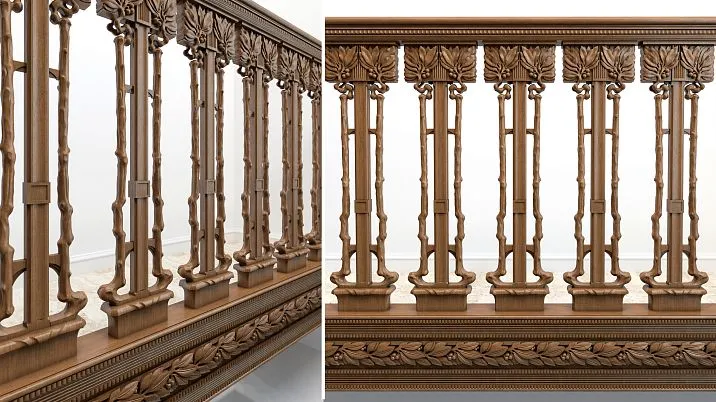
When you climb the stairs, have you ever thought about how every millimeter of its construction is calculated with mathematical precision? Baluster dimensions — this is not just technical parameters, but a code of safety encoded in wood and metal. Imagine: one calculation error can turn an elegant staircase into a source of danger, while properly chosen dimensions create a symphony of comfort and reliability.
In the world of architectural design, there is an unwritten rule: beauty without functionality is merely decoration. But when form perfectly complements content, a true work of art is born. Such a work of art becomes the staircase, where every detail is precisely calibrated to the millimeter, and baluster dimensions correspond not only to aesthetic requirements but also to the strictest safety standards.


Anatomy of Perfection: Breaking Down the Baluster by Parts
What makes an ordinary wooden post a work of engineering art? The secret lies in understanding its anatomy. Each baluster consists of three key zones, and the dimensions of each play a critically important role in the overall functionality of the structure.




Base: Foundation of Reliability
The lower part of the baluster is its anchor in the world of staircase architecture. The standard base has a square cross-section from 40×40 to 80×80 millimeters, but these numbers are not merely the result of tradition. They have been verified over decades of practical experience and engineering calculations. The greater the load on the railing, the more substantial the base must be.
Round bases vary in diameter from 30 to 77 millimeters. Choosing between a square and round cross-section is not just an aesthetic question. A square base provides a larger contact area with the mounting, increasing the stability of the entire structure. A round base, on the other hand, creates smoother lines and is suitable for interiors where visual lightness is important.
Our factory also produces:


Central Section: Territory of Creativity
It is here that baluster dimensions become a tool for artistic expression. The central part can expand up to 60-70 millimeters in the most decorative elements or narrow down to 20-25 millimeters in elegant transitions. These variations create a play of light and shadow, giving the structure dynamism and expressiveness.
Master turners know: every expansion and narrowing must be justified not only by beauty but also by strength. Too thin sections become vulnerable spots, while overly massive sections disrupt the overall harmony of proportions.
Get Consultation
Upper Part: Connection Point
The upper section of the baluster is the zone of responsibility. It is here that the handrail connects, and the dimensions of this part must ensure maximum secure fastening. The standard height of the upper part is 80-120 millimeters, and its cross-section usually corresponds to the base or slightly exceeds it.
Standards Tested by Time
Why exactly 900 millimeters became the standard height of a baluster? This figure is the result of centuries of construction experience and modern ergonomic research. At this height, the handrail is positioned at the optimal level for an average-height person — 850–900 millimeters from the step.
Height Parameters: The Mathematics of Comfort
Baluster heights vary in the range from 650 to 1500 millimeters, but the most comfortable values are considered to be 800–1000 millimeters. These parameters take into account anthropometric data and ensure ease of use for people of different ages and heights.
Special standards are applied for children’s facilities: the height of the railing should not exceed 1200 millimeters, and baluster dimensions are calculated to exclude the possibility of injuring small users.
Sections: From Miniature to Monumental
Square balusters are available in a wide range of sizes: 40×40, 45×45, 50×50, 60×60, 70×70, 80×80 millimeters. Each size has its own area of application. Thin balusters of 40×40 millimeters are suitable for lightweight structures and modern interiors where visual lightness is important. Massive 80×80 millimeters are chosen for classic interiors and structures with increased loads.
Round balusters with diameters from 30 to 47 millimeters create a softer visual impression and are suitable for interiors where smooth lines and absence of sharp angles are important.
Material Science: How Wood Species Affect Dimensions
The choice of wood significantly affects which baluster dimensions will be optimal for a specific project. Each species has unique characteristics in terms of strength, density, and workability.
Spruce: Democracy and Functionality
Spruce balusters are a genre classic. Their baluster dimensions are standardized and available in a wide range: from 50×50×900 to 100×100×1200 millimeters. Spruce is easy to process, allowing for complex decorative forms without significant cost increases.
The density of spruce is about 500 kg/m³, providing sufficient strength with relatively low weight of the structure. This is especially important for long stair runs, where every kilogram matters.
Oak: Aristocracy of Strength
Oak balusters are chosen by those unwilling to compromise on quality and durability. Oak baluster dimensions can be more compact while maintaining high strength. The density of oak reaches 700 kg/m³, allowing for elegant structures with thin sections without sacrificing reliability.
Oak balusters of 50×50×900 millimeters are equivalent in strength to spruce balusters of 60×60×900 millimeters. This opens up additional possibilities for design solutions.
Larch: Siberian Reliability
Larch combines the strength of oak and the workability of spruce. Baluster dimensions from larch can vary from 40×40×900 to 100×100×1200 millimeters. A distinctive feature of this species is its natural resistance to moisture and biological influences, making it an ideal choice for staircases in saunas, baths, and other high-humidity areas.
Ash: Flexibility and Elegance
Ash balusters are distinguished by exceptional flexibility and impact resistance. Their baluster dimensions usually correspond to oak standards, but due to their unique fiber structure, ash allows for creating thinner and more elegant elements without losing strength.
Calculative Magic: How to Determine Optimal Dimensions
Designing a stair railing is an art of precise calculations. Baluster dimensions are not chosen arbitrarily; they are the result of complex engineering calculations taking into account numerous factors.
Safety Formula
The main principle for calculating baluster dimensions is based on safety requirements. The distance between balusters should not exceed 120–150 millimeters, and in children’s facilities — 100 millimeters. These restrictions determine the minimum number of balusters per linear meter of railing.
For a span of 3000 millimeters using balusters with a cross-section of 50×50 millimeters and maximum spacing of 120 millimeters, the following is required: (3000 - 50×n)/(n-1) ≤ 120, where n is the number of balusters. Solving this inequality, we get n ≥ 18 balusters.
Aesthetic Proportions
The beauty of a stair railing largely depends on the correct proportion of baluster dimensions to the overall dimensions of the structure. The classic rule states: the height of the baluster should relate to its maximum cross-section as 10:1 or 12:1. This ratio creates a visually harmonious composition.
For a baluster height of 900 millimeters, the optimal maximum cross-section is 75–90 millimeters. If the central part has decorative extensions, they should not exceed these values.
Load-bearing characteristics
Baluster dimensions must ensure perception of normative loads. Building codes require railings to withstand horizontal loads of 0.8 kN/m for residential buildings and 1.5 kN/m for public buildings. These requirements directly affect the minimum allowable cross-sections of balusters.
For spruce balusters, the minimum cross-section at standard height of 900 millimeters is 40×40 millimeters. For oak balusters, this value can be reduced to 35×35 millimeters without loss of strength.
Technological features of manufacturing
Modern technologies allow creating balusters with dimensions that were once considered unattainable. High-precision turning machines with numerical control provide processing accuracy down to 0.1 millimeter.
Turning: the classic of the genre
Traditional manufacturing of balusters on a lathe allows creating elements with smooth transitions and complex profiles. Baluster dimensions during turning are limited only by the capabilities of the equipment and the lathe operator’s skill.
Modern turning machines allow processing blanks with a diameter up to 300 millimeters and a length up to 3000 millimeters. This opens up wide possibilities for creating unique architectural elements.
Milling Processing: Precision and Reproducibility
CNC milling machines allow creating balusters with dimensions that repeat with absolute accuracy. This is especially important for large projects where the manufacturing of hundreds of identical elements is required.
Milling also allows creating balusters with square and rectangular cross-sections featuring decorative elements that cannot be achieved on a turning machine.
Combined technologies
Modern manufacturers often use a combination of various technologies to achieve the optimal result. The basic shape is created on a turning machine, while decorative elements are added using milling or hand carving.
Mounting solutions and their impact on dimensions
The method of fixing balusters significantly affects their dimensions and the overall structure of the railing. Each mounting method has its own characteristics and requirements for the dimensions of the elements.
Mounting with dowels
The traditional method of fixing wooden balusters involves using wooden dowels with a diameter of 8-12 millimeters. For such fixation, the base dimensions of the baluster must provide sufficient area for placing the dowel without weakening the structure.
The minimum cross-section of the base when fixed with a dowel is 40×40 millimeters for square balusters and 35 millimeters in diameter for round ones. The depth of the socket hole is usually 30-40 millimeters.
Bolted connection
Bolted connection provides maximum joint strength, but requires increasing the base dimensions of the baluster. To accommodate an M8 bolt, the base must be at least 50×50 millimeters for square balusters or 45 millimeters in diameter for round ones.
The advantage of bolted connection is the ability to disassemble and reinstall elements without damaging them. This is especially important during staircase restoration or modernization.
Adhesive bonding
Modern adhesives allow creating joints stronger than the wood itself. With adhesive connection, baluster dimensions can be minimal, as the load is distributed over the entire contact area.
Adhesive connection requires ideal surface preparation and strict adherence to technology. However, the result is a practically monolithic structure with the highest strength characteristics.
Adaptation to Russian climate
Baluster dimensions must consider the climatic conditions of operation. In regions with sharp temperature and humidity fluctuations, wood undergoes significant deformation, requiring adjustment of element dimensions.
Northern regions: safety margin
In harsh climatic conditions, baluster dimensions must provide additional strength reserve. Low temperatures make wood more brittle, while humidity fluctuations cause significant deformation.
For northern regions, it is recommended to increase baluster cross-sections by 10-15% compared to standard dimensions. This compensates for possible material weakening and ensures the longevity of the structure.
Southern regions: combating shrinkage
In hot and dry climates, the main problem is wood shrinkage. Baluster dimensions must account for possible section reduction of 3-5% during operation.
To compensate for shrinkage, balusters with increased dimensions are used or wood with low shrinkage coefficient, such as larch or oak, is selected.
Humid regions: protection against swelling
In high humidity conditions, wood tends to swell and warp. Baluster dimensions must allow compensation for these deformations without compromising the overall geometry of the structure.
It is recommended to use balusters with moisture content not exceeding 8-10% and mandatory treatment with protective compounds.
Evenly
Baluster dimensions are not only technical parameters, but also a powerful tool for architectural expressiveness. Properly chosen proportions can dramatically alter the perception of space.
Visual Effects
Thin balusters create a sense of lightness and airiness, visually expanding space. Conversely, massive elements impart solidity and monumentality to the structure, but may visually weigh down the interior.
Baluster dimensions affect the play of light and shadow in stairwell space. Frequent placement of thin elements creates rhythmic glint patterns, while sparsely placed massive balusters form large light patches.
Stylistic solutions
Classic style implies using balusters with traditional proportions: height 900-1000 millimeters, maximum cross-section 70-80 millimeters. Decorative elements should be restrained and symmetrical.
Modern style allows more flexible interpretation of dimensions. Balusters can be extremely thin (30×30 millimeters) or deliberately massive (100×100 millimeters and more).
Proportional systems
Professional designers use classical proportional systems to determine baluster dimensions. The golden ratio, Le Corbusier’s Modulor, Japanese proportions — all these systems help create harmonious compositions.
Application of proportional systems is especially important when designing unique staircases, where each element must be part of a single architectural concept.
Economic aspects of selecting dimensions
Baluster dimensions directly affect project cost. Understanding this relationship allows optimizing expenses without compromising quality and safety.
Material consumption
The volume of wood required to manufacture a baluster increases proportionally to the square of linear dimensions. Increasing the cross-section from 50×50 to 60×60 millimeters raises material consumption by 44%. This significantly affects the overall project cost.
Baluster dimensions should be optimized based on actual loads. Unjustified increases in cross-section lead to unnecessary cost escalation of the structure.
Processing Complexity
The more complex the baluster profile, the more time is required for its fabrication. Baluster dimensions with multiple decorative elements may increase processing costs by 2-3 times compared to simple forms.
The optimal solution is using standardized profiles with minimal modifications for a specific project.
Transportation costs
Baluster dimensions affect transportation costs. Baluster dimensions must consider transportation vehicle and packaging material constraints.
The standard length of 900 millimeters was chosen deliberately — it allows efficient use of standard packaging and transportation.
Correct selection of baluster dimensions is an art of balancing safety, aesthetics, and economic feasibility. Every millimeter matters, and each proportion affects the overall impression of the staircase. Understanding all nuances and subtleties allows creating structures that serve not only functional purposes but also become interior decor.
Modern technologies and materials open new creative possibilities, but fundamental principles remain unchanged. Baluster dimensions must ensure safety, meet aesthetic requirements, and be economically justified. Only when all these conditions are met does the staircase become a true work of architectural art.
For professional consultation on selecting optimal parameters and to familiarize yourself with the full range of quality products, we recommend contacting baluster dimensions from trusted manufacturers.
STAVROS is a recognized leader in the production of staircase elements, offering clients a wide selection of balusters in various sizes and configurations. Years of experience, use of modern equipment, and strict quality control allow STAVROS to guarantee that all products meet the highest standards. By contacting STAVROS specialists, you receive not only quality products but also professional support at every stage of project implementation — from selecting optimal dimensions to final installation.





