Article Contents:
- 1. Why are wooden planks so popular in modern interiors?
- 1.1. Warmth and coziness, bestowed by nature
- 1.2. Ecological safety and non-toxicity
- 1.3. Versatility and variety
- 1.4. Ease of installation and maintenance
- 2.1. Wood species
- 2.2. Cross-section and profile
- 2.3. Processing quality and grade
- 3.1. Accent wall
- 3.2. Zoning and partitions
- 3.3. Partial cladding
- 3.4. Decorative solutions
- 4.1. Construction markets and fairs
- 4.2. Large construction hypermarkets
- 4.3. Specialized lumber stores and online stores
- 4.4. Direct manufacturers (sawmills, wood processing plants)
- 4.5. Classified ads and "from individuals"
- 6.1. Surface and substructure preparation
- 6.2. Mounting methods
- 6.3. Temperature and humidity regime
- 6.4. Final finishing
- 10.1. Scandinavian interior
- 10.2. Loft
- 10.3. Classic
- 10.4. Eco-style
- Summary of key steps:

Natural wood is one of the most versatile and sought-after materials used in construction and decoration. It imparts warmth, coziness, and natural beauty to a space, which cannot be replicated by artificial substitutes. In recent years, there has been a resurgence in popularity of wooden planks, which have become a striking accent in residential, commercial, and public interiors, as well as widely used in exterior building cladding. But before you go Where to buy wooden planks for wallsIt is necessary to understand why this material is relevant, what variants exist, where it can be used, and how to care for it so that it lasts for many years.


1. Why are wooden planks so popular in modern interiors?




1.1. Warmth and coziness, gifted by nature
Wood is one of those materials capable of transforming space, imbuing it with a sense of warmth and 'living' energy. On a subconscious level, people are drawn to natural elements, as even the minimal presence of wood in a room adds a feeling of safety and comfort.
Our factory also produces:


1.2. Ecological safety and health
The trend toward eco-design is a response to the overabundance of plastics and synthetic finishing materials. Natural wood contains no harmful components, does not emit toxic vapors, regulates the microclimate in a room, and supports a healthy atmosphere. That is why architects, designers, and homeowners who value ecological purity often choose wooden planks.
Get Consultation
1.3. Versatility and variety
Wooden planks are suitable for creating various interior elements: from decorative wall panels and partitions to furniture and architectural accents. They can take various forms, be narrow or wide, thin or voluminous, painted or retaining their natural grain. This allows for creative design fantasies and harmoniously integrates wooden elements into any style — from classic to high-tech or boho.
1.4. Ease of installation and maintenance
With a reasonable approach, planks are easy to install even without extensive professional experience, and with proper treatment and timely care, they retain their original appearance for many years. This balance of 'not too difficult to install, not too difficult to maintain' makes wooden planks an optimal solution for a wide range of projects.
2. Types of wooden planks: what to know before purchasing?
Before decidingWhere to buy wooden planks for wallsIt is useful to study the main parameters that distinguish one type of plank from another. This will allow selecting a material that perfectly matches the tasks and expectations.
2.1. Wood species
- Coniferous species (pine, spruce)
○ Advantages: affordable cost, easy to process, pleasant light shades, good choice for interior spaces.
○ Disadvantages: require additional protection from moisture, better to impregnate with special antiseptics when used outdoors or in damp areas (bathrooms, saunas).
- Larch
○ Advantages: high resistance to rot, moisture, temperature fluctuations, beautiful texture with distinct growth rings.
○ Disadvantages: higher price compared to pine, sometimes harder to process due to density and resin content.
- Hardwood species (oak, beech, ash)
○ Advantages: increased strength, durability, noble grain, luxurious appearance.
○ Disadvantages: significant cost, require more careful handling during processing and installation.
- Exotic species (merbau, teak, iroko, etc.)
○ Advantages: exceptional resistance to moisture, stunning shades, exotic texture.
○ Disadvantages: extremely high price, difficulty in finding a reputable supplier.
The choice of wood species depends on budget, style, and usage conditions. For most interior tasks, pine or spruce are sufficient, especially if considering the budget segment. Larch or oak are suitable for those seeking a reliable and luxurious solution, willing to invest in premium finishing.
2.2. Cross-section and profile
● Thickness Thickness (usually from 10 to 30 mm) affects the strength of the product and its ability to withstand physical loads.
● Width Width (often varies from 20 to 100 mm) determines how 'transparent' the surface will be if you plan to install boards with gaps.
● End Shape: Straight, rounded, beveled, decorative edges. Each option provides its own aesthetic effect.
● Presence of Grooves and Ridges: Some boards (especially for facades and outdoor use) are produced with interlocking joints to facilitate installation.
2.3. Quality of Processing and Grade
● Degree of Sanding. Boards can have rough, planed, or finished surfaces. For interior work, more refined products are more appropriate.
● Knots, Cracks, Resin Pockets. The number and size of knots affect the appearance and, to some extent, the strength. Grade 'extra' implies minimal defects, while grades 'B' or 'C' allow for more natural wood characteristics.
Thus, before going and pondering,Where to buy wooden planks for walls, you should estimate the desired cross-section, species, and appearance. Only then should you look for the appropriate option at relevant retail outlets.
3. Where and how to use wooden boards on walls?
The versatility and aesthetics of boards allow for implementing various tasks in interior design.
3.1. Accent Wall
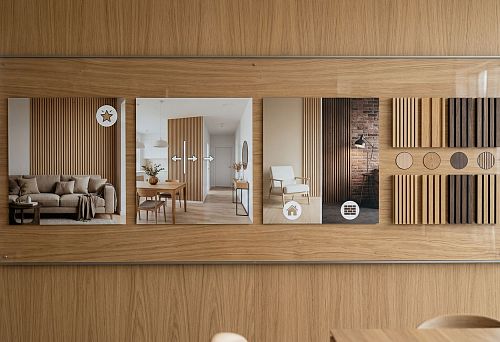
Designers often recommend covering one room wall with board panels — this adds character to the space. Vertical boards create a sense of height, while horizontal boards 'stretch' the space. You can combine several wood tones to achieve a complex and dynamic pattern.
3.2. Zoning and Partitions
In studio apartments, offices, and spatial stores, it is often desirable to divide functional zones without erecting bulky partitions. Board structures that allow light and air to pass through are an excellent solution for light zoning.
3.3. Partial Cladding
If you do not want to fully cover the wall, you can install board inserts in niches, around doorways, or as panels above a table, sofa, or bed. This technique adds texture and uniqueness while maintaining overall balance.
3.4. Decorative Solutions
Boards can serve purely decorative purposes — transforming into complex geometric compositions, modules for hanging pictures or photographs, or lighting elements (when mounted at a distance from the wall for recessed LED strips).
4. Where to buy wooden boards for walls? Main channels
Now that it is clear which boards are needed, it is necessary to understand,Where to buy wooden planks for walls. The market offers several options:
4.1. Construction Markets and Fairs
● Pros: Wide selection, opportunity to personally inspect the material, sometimes possible to negotiate.
● Disadvantages: different quality levels, no guarantee of proper storage conditions, risk of encountering unscrupulous sellers offering substandard goods as grade 'A'.Disadvantages: different quality levels, no guarantee of proper storage conditions, risk of encountering unscrupulous sellers offering substandard goods as grade 'A'.
4.2. Large construction hypermarkets
● ProsAdvantages: standard size assortment, stable quality, return and exchange system provided.
● Disadvantages: different quality levels, no guarantee of proper storage conditions, risk of encountering unscrupulous sellers offering substandard goods as grade 'A'.Disadvantages: selection may be limited to typical items, prices may be higher than those of specialized suppliers.
4.3. Specialized lumber stores and online stores
● ProsAdvantages: wide assortment, usually high processing quality, ability to order exact size and species needed. Often provide certificates, delivery available.
● Disadvantages: different quality levels, no guarantee of proper storage conditions, risk of encountering unscrupulous sellers offering substandard goods as grade 'A'.Disadvantages: if the store format is oriented toward wholesalers, there may be minimum order restrictions. Sometimes you have to wait for delivery or drying of a specific batch of wood.
4.4. Direct manufacturers (sawmills, wood processing plants)
● ProsAdvantages: possibility to buy large quantities without middleman markup, control over manufacturing process, obtain custom solutions (special profiles, lengths).
● Disadvantages: different quality levels, no guarantee of proper storage conditions, risk of encountering unscrupulous sellers offering substandard goods as grade 'A'.Disadvantages: requires experience in selecting raw material and checking quality, logistics (loading, delivery) may fall on the customer. Again, not all enterprises work with private clients, sometimes there is a minimum order volume.
4.5. Advertisement platforms, 'from hand'
● ProsAdvantages: sometimes you can find leftovers or well-preserved materials at a good price.
● Disadvantages: different quality levels, no guarantee of proper storage conditions, risk of encountering unscrupulous sellers offering substandard goods as grade 'A'.Disadvantages: no quality guarantees, no information about origin and proper storage of the wood.
Each channel has its own features, so the appropriate platform largely depends on budget, required volume, and quality requirements. If it's a large-scale project in the luxury segment, it's better to contact reputable stores or manufacturers with good reputations. If it's a small DIY project, you can start with local markets or construction supermarkets.
5. How to assess the quality of boards before purchase?
Since we are talking about this,Where to buy wooden planks for wallsit's important to be able to quickly determine whether a particular product is worth your attention. A few tips:
- Inspect the appearance
○ Surface should be smooth, without overly rough scratches, delamination, deep cracks.
○ Knots are acceptable, but they should not be 'protruding' or too large, disrupting the structure.
- Check the geometry
○ Stack several boards together and check if they fit tightly (without gaps or wobbling).
○ Ensure the item does not 'propeller' — i.e., does not rotate diagonally.
- Feel the ends and edges
○ If the wood is overly fibrous or has burrs, this indicates rough processing. Additional sanding may be required.
- Check the moisture content
○ Ideally — 8–12%. If the board is 'wet', it may behave unpredictably after installation (bend, crack).
○ Ask the seller to show a moisture meter or at least explain how the wood was dried.
- Ask about certificates, origin
If quality confirmation is needed, reliable stores and manufacturers will readily provide supporting documentation.
An important aspect: review seller reviews if possible. Modern technologies allow quickly checking a company's reputation — simply visit relevant forums or social networks.
6. Installing Boards on Walls: Key Points
6.1. Surface and Framing Preparation
● Boards are usually mounted not directly on walls, but on special beams (framing) or metal profiles leveled with a level.
● This creates a ventilation gap, simplifies leveling, and hides utilities. Particularly relevant in older homes with uneven walls.
6.2. Mounting Methods
- Self-tapping screws, nails. The simplest and most reliable method. Screw heads can be masked with putty or wooden plugs.
- Climbers or concealed mounting. Ideal when aiming for a smooth, seamless surface. Fasteners are screwed into the framing, and the board 'clicks' into place.
- Adhesive. For light-weight boards and perfectly flat walls, use a specialized wood adhesive. However, this method is not always convenient if repair or replacement is needed.
6.3. Temperature and Humidity Regime
● Before installation, wood should be 'acclimated' in the room where it will be used for 2–3 days.
● If installing in rooms with potential humidity fluctuations (kitchens, bathrooms, laundries), ensure waterproofing and regular ventilation to prevent wood from absorbing moisture from the air.
6.4. Final Finishing
● Lacquer: Creates a protective film on the surface, simplifies maintenance. Available in glossy, semi-gloss, and matte finishes.
● Oil, wax: Penetrates deeply, enhances texture, provides a matte finish. Needs periodic reapplication.
● Paint: Allows achieving any color, but hides the natural wood grain.
The choice of final finish depends on interior style and usage conditions (cleaning frequency, humidity, etc.). However, in any case, conduct a test on scrap pieces before final finishing to see the actual effect.
7. Caring for Wooden Walls: How to Extend Service Life
- Regular Dry Cleaning. Dust and minor dirt are best removed with a soft cloth or brush. Hard brushes and abrasive cleaners may scratch the finish.
- Wet Cleaning. If using a slightly damp cloth, immediately dry the surface. Avoid excessive wetting to prevent damage to the lacquer or oil layer.
- Reapplication of TreatmentsCheck the lacquer/oil condition every few years or as needed. If noticeable wear or scratches occur, sand the top layer and apply new protection.
- Microclimate ControlIdeally, the relative humidity in the room should be 40–60%. Too dry air may cause wood cracking, while overly humid air can lead to swelling and rot.
- Protection from Mechanical ImpactsIf the wall made of boards is located in an area where frequent collisions are possible (e.g., a hallway where bags are placed), it is better to provide additional protection or choose a harder wood species.
Thus, proper care of wooden walls does not require excessive effort but allows maintaining their attractive appearance and strength for many years.
8. Budget and Premium Solutions: What to Choose?
Price often becomes a decisive factor. If you are looking for an economical option, coniferous species (pine, spruce) are usually cheaper. Their color can be toned to achieve the look of more expensive materials. However, do not forget the need for quality impregnation to protect against moisture and mold.
For those who wish to emphasize status and refined taste, hardwoods such as oak or beech are suitable. They look noble even in their natural color, and oiling further enhances the texture. However, the price here is correspondingly higher.
9. Mistakes to Avoid When Working with Wooden Boards
- Incorrect Assessment of HumidityUsing 'green' wood means ensuring yourself problems in the form of cracks and warping.
- No Gap During InstallationWood 'breathes', so tight installation without compensating gaps may lead to swelling and deformations.
- Poor Finishing FinishNeglecting primer or antiseptic treatment. This is especially critical in damp rooms and outdoors.
- Incorrect FasteningToo short self-tapping screws, use of inappropriate adhesives — all of this reduces the reliability of the structure.
- Ignoring Maintenance RecommendationsEven the highest quality solid wood requires regular inspection and updating of impregnation.
10. Examples of Successful Solutions with Wooden Boards
10.1. Scandinavian Interior
White walls, light furniture, and one wall clad with vertical pine boards impregnated with transparent oil. This fills the room with warmth and emphasizes minimalist aesthetics.
10.2. Loft
Combination of brickwork and dark wooden boards (dyed in deep walnut tone). Gaps between boards are illuminated by soft LED lighting, creating an effect of 'floating' lines on the wall.
10.3. Classic
Oak boards in office wall cladding: panels up to half the height, combined with moldings. Luxurious, solid appearance, perfectly matching leather furniture and brass fittings.
10.4. Eco Style
Walls clad with larch featuring natural knots and brushed surface (soft fibers removed to emphasize texture). Additional elements: potted plants, natural fabrics, abundant light. Atmosphere of freshness and closeness to nature.
11. Conclusion: Why Hire Professionals?
Of course, you can assemble it yourself by studying the necessary instructions and acquiring basic tools. However, if you're dealing with a large-scale project or complex design, consulting and working with professionals will save you from many mistakes. They will help:
● choose the optimal species;
● calculate the required amount of boards and fasteners;
● consider all mounting nuances (subframe, ventilation, thermal gaps);
● select the finish based on the room's style and usage.
This will save you time, energy, and nerves, and the result will delight you with its quality and durability.
12. Conclusion: Where to Buy Wooden Boards for Walls and How to Make the Right Choice
So, you now have a general understanding of what to pay attention to when selecting wooden boards, the available species and finishes, as well as the basic stages of installation and maintenance. If you are interested in,Where to buy wooden planks for wallsthe answer lies in analyzing the construction materials market in your region. Choose between construction markets, hypermarkets, specialized online stores, or direct manufacturers — depending on your budget, desired quality level, and willingness to invest time in searching.
Summary of key steps:
- Define goals and budget. Decide how premium the material should be, and what amount is allocated for purchase.
- Choose the species (such as pine, larch, oak, etc.) and determine the grade. The higher the grade, the fewer defects and the more noble the appearance.
- Determine the dimensions
(thickness, width) and profile shape. The coverage area and desired visual effect are important.
- Calculate the required volume. Add a 5–10% reserve for trimming, defects, and complex areas.
- Select a supplier. Evaluate the assortment, reviews, and presence of required certificates. Arrange delivery if necessary.
- Check the quality. Carefully inspect the boards, test the geometry, and confirm drying conditions.
- Organize proper installation. Use appropriate tools, follow mounting techniques, and leave gaps for ventilation and compensation.
- Regularly maintain. Renew finishes, monitor humidity, protect from impacts and water.
By following these recommendations, you will create a stylish, long-lasting, and eco-friendly space where it will be pleasant to be. Natural wood can infuse your interior with heartfelt warmth and natural harmony, while careful installation and meticulous finishing will ensure an impeccable appearance for many years.
Let each board installed on your wall become a testament to your taste, love for natural materials, and pursuit of comfort. And even if you are encountering such a project for the first time, do not be afraid to try — the secret to success lies in proper preparation and attention to detail.
13. Epilogue: A Step Toward Aesthetics and Well-being
In an era of high technology and fast-paced life, we increasingly seek ways to create cozy and peaceful corners in our homes or workspaces. Wooden boards on walls are one of the ways to bring nature’s beauty into the interior, making the environment more 'alive' and soulful. We hope this article helped you understand the nuances of selection and answered the question,Where to buy wooden planks for wallsNow it's up to you — bring your ideas to life and enjoy the result that will warm not only your body but also your soul.