Article Contents:
- Where to buy furniture handles in Moscow and what to check before ordering
- What else is important to check before ordering
- What types of wooden furniture handles exist and where they are used
- Cabinet handles
- Dresser handles
- Handles for kitchens and facades
- How to choose the size of a furniture handle
- Key parameter: center-to-center distance
- How to match handle length to facade size
- Long or compact furniture handles?
- Coated or uncoated handles: what to choose
- Coated handles
- Uncoated handles
- What's important when coating by hand
- Which wooden handles are suitable for classic furniture
- What characterizes a classic furniture handle
- Drawer handles for a classic interior
- Handles for library cabinets and display cases
- Minimalist wooden handles for modern furniture
- What does 'minimalist wooden handle' mean
- Where are minimalist wooden handles used
- Wooden handles for light and dark furniture
- How to choose furniture handles for kitchen, wardrobe and chest of drawers without mistakes
- Algorithm for choosing furniture handles
- Combining different types of handles in one project
- Common mistakes when choosing furniture handles
- Mistake 1: too small handle on a massive facade
- Mistake 2: too active decor for a minimalist interior
- Mistake 3: wrong coating choice for kitchen
- Mistake 4: ignoring facade thickness
- Mistake 5: mixing too different forms in one piece of furniture
- Mistake 6: choosing a handle from a photo without checking the size
- Mistake 7: saving on quantity
- FAQ: frequently asked questions about wooden furniture handles
- Conclusion: the furniture handle as the finishing touch

A furniture handle is a detail that is touched by hand dozens of times a day. It might seem simple: buy something wooden, screw it on, done. But this is exactly how interiors are born where good furniture looks unfinished, and an expensive kitchen set loses half its dignity due to incorrectly chosen hardware.
Today, you can buy furniture handles in Moscow in hundreds of places. The problem is not availability, but choice: a huge market has mixed cheap plastic, faux wood, and truly high-quality solid wood products—with no visible difference at first glance. How to figure it out? How to find exactly wooden furniture handles in Moscow that will suit your cabinets, dressers, or kitchen—in style, size, finish, and interior logic?
In this article—a detailed professional breakdown: what types ofFurniture Handleswooden handles exist, where and how they are used, how to correctly choose the size, select the finish, and avoid typical mistakes.



Where to buy furniture handles in Moscow and what is important to check before ordering
Let's be direct and honest: not every online store offering 'wooden furniture handles in Moscow' sells what you imagine under that phrase. Under 'wood,' MDF with film, pressed chipboard, or veneered blanks are often hidden. Real solid wood—oak, beech, ash—behaves differently: it feels heavier, warmer to the touch, has a living texture, and holds its shape for decades.
Therefore, the first thing to check before ordering furniture handles in Moscow is the material. Not just 'wood,' but the specific species. Beech and oak are the most common in professional furniture decor. Oak is heavier, denser, and more expressive in texture. Beech is more uniform, allowing for finer relief and delicate processing.




What else is important to check before ordering
Assortment by styles and shapes. A good catalogwooden handlesshould offer products for different interior tasks: minimalist models for modern kitchens, classic carved forms for dressers and display cabinets, functional pulls for work zones. If the catalog has only five items—that's not a choice.
Availability of standard sizes. For the same style, a handle can exist in several length options: 64 mm, 96 mm, 128 mm, 160 mm, and more. This is the so-called 'center-to-center size'—the distance between the centers of the mounting holes. It is this that determines whether the handle will fit your cabinet front without additional drilling.
Coated or uncoated. Handles can be supplied already painted or stained—or without any finish, for subsequent painting to match the furniture color or varnishing to a natural tone. Both options are in demand, and the right store offers both.
Compatibility with solid wood fronts. A wooden handle on a wooden front is not just beautiful, it's organic. But the textures must be coordinated: oak on oak, beech on beech, or neutral tones that don't clash with the wood grain pattern.
Designer furniture handles in Moscow. If you're working on an individual project—a studio, a country house, a commercial object—it's important that the supplier offers not only a standard assortment but also non-standard models with an original profile, carving, or non-standard center-to-center size.
Our factory also produces:


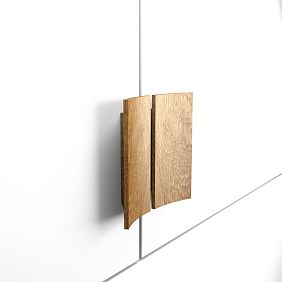


What types of wooden furniture handles exist and where are they used
The market for wooden furniture handles is significantly richer than it seems at first glance. Behind the word 'handle' lies several structural types—each with its own area of application, its own logic of proportions, and its own stylistic context.
By construction, wooden furniture handles are divided into:
-
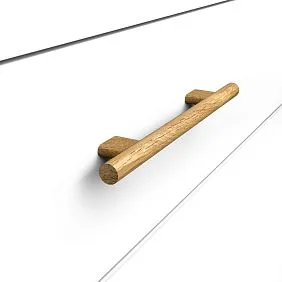
Brackets (arches) — a classic type of crossbar handle that is held by two mounting points. The most universal option: suitable for cabinets, kitchen fronts, and dresser drawers.
-
Knobs (point overlays) — small round or polygonal elements attached at a single point. Used for small doors, cabinet drawers, and accessory cabinets.
-
Rail handles (profiled) — elongated profiles that are attached at multiple points and can be of significant length. Popular in kitchens with long fronts for ovens and tall cabinets.
-
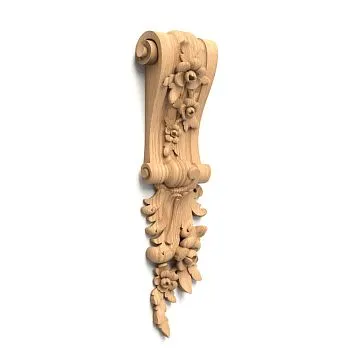
Brackets with decoration — brackets with carved or relief overlays, often in classic styles. Used in furniture with solid wood fronts, classic dressers, and library cabinets.
Understanding this typology is the first step toward making the right choice.furniture hardware.
Get Consultation
Cabinet handles
Cabinet handlesmade of wood solve two tasks at once: functional and decorative. A cabinet is a large piece of furniture with a large front plane, and the handles on it are constantly visible. This is not a minor detail—it is a full-fledged part of the visual image.
For hinged cabinets with classic proportions (door width 400–600 mm, height 1800–2200 mm), brackets with a center-to-center size of 96–128 mm are optimal. They do not get lost on a large front, provide a comfortable grip, and are visually proportionate to the plane.
For sliding door wardrobe systems, traditional wooden handles are not used—instead, recessed profile rails are employed. However, for hinged wardrobe sections, it's a different story: wooden brackets with a neutral profile work perfectly here, creating a calm, natural accent.
wooden cabinet handlesUncoated handles are good because they can be painted exactly to match the furniture—resulting in an 'invisible' decor where the handle is discernible but does not stand out.
Dresser handles
A chest of drawers is a fundamentally different piece of furniture. Here, the front system consists of drawers or small doors, often in several rows. Furniture handles for a chest of drawers function differently than those for a wardrobe.
First, handles on a chest of drawers are visible as a group: if there are five drawers—five handles stand in a row, and their rhythm and proportion shape the entire piece's appearance. A mistake in size or shape is even more noticeable here than on a wardrobe.
Second, more decorative forms are often chosen for chests of drawers—especially in classic and neoclassical interiors. A bracket with carved ornamentation, a knob with a relief center, a point overlay in the shape of a leaf—all of these work on a chest of drawers as an accent decorative element.
Wooden handles for a chest of drawersCoated handles are a good solution specifically for this piece of furniture: factory finishes like 'walnut', 'gold', 'patina' immediately provide the desired classic tone without additional painting.
Handles for kitchens and fronts
Furniture handles for the kitchenare a special topic. The kitchen is the most heavily used area: handles here are opened and closed a hundred times a day, they come into contact with grease, steam, water. Therefore, the requirements for kitchen handles are higher.
Wooden handles in the kitchen are not an exception, but a conscious choice. Solid oak and beech withstand everyday wear well with proper coating. The main thing is not to use them without coating: unprotected wood in the kitchen quickly darkens and absorbs moisture. For kitchen handles, choose models with varnish or oil coating — it creates a barrier against dirt and simplifies maintenance.
Handles for solid wood fronts— is a separate story. A kitchen with natural wood fronts requires handles of the same level: no cheap metal, no plastic. A solid wood handle paired with a solid wood front is a complete stylistic ensemble where every detail supports the overall tone.
How to choose the size of a furniture handle
This is the most technically precise question in the topic of furniture handles, and this is where mistakes are most often made.
Key parameter: center-to-center distance
Center-to-center distance (the distance between the centers of two mounting holes) is a standardized parameter. Most manufacturers work within the standard range: 32, 64, 96, 128, 160, 192, 256, 320 mm. This distance must match the already drilled holes in the front — or you must drill for the chosen size.
Practical advice: if you are buying handles for already finished furniture — first measure the center-to-center size of the existing handles and look for new ones with the same parameter. If the front has no holes — choose based on proportions.
How to match the handle length to the front size
This is a question of proportions, not just standards. An approximate matching table:
| Facade width | Recommended center-to-center distance | Handle type |
|---|---|---|
| up to 200 mm | 32–64 mm | Button or short lever |
| 200–400 mm | 64–96 mm | Medium-length lever |
| 400–600 mm | 96–128 mm | Standard lever |
| 600–900 mm | 128–192 mm | Long lever |
| over 900 mm | 256–320 mm | Rail handle |
For dresser drawers, an additional guideline is the drawer height: the handle should occupy at least 20–25% of the drawer front height. A handle that is too small on a tall drawer looks out of place.
Long or compact furniture handles?
Long profile handles are very popular in modern kitchens today: they create a horizontal rhythm and emphasize the horizontal structure of the cabinet. For fronts with a width of 600 mm or more, they work excellently.
Compact brackets and knobs are for classic, neoclassical, and furniture with a pronounced panel system. They do not compete with the front decor but complement it.
Wooden handles in compact forms (center-to-center 64–96 mm) are the most versatile choice: they work on drawers of any size, do not disrupt proportions, and are perceived without emphasis.
Handles with or without coating: what to choose
This is not only an aesthetic question—it is a matter of technology and usage scenario.
Handles with coating
Handles with Finish— items that have undergone finishing treatment in production. The coating can be:
-
Varnish (clear or tinting) — preserves the natural wood texture, adds gloss or matte. A universal option.
-
Oil or wax — creates a matte surface with emphasized texture. Looks most 'lively' and natural.
-
Toning — changes the color of the wood, creating shades like 'walnut', 'wenge', 'bleached oak', etc. Allows matching the handle to an existing furniture color.
-
Metal-like coating (gold, bronze, patina) — decorative coating for classic and baroque styles.
Handles with coating are ready for use immediately after installation. This is convenient when assembling a finished project and when replacing hardware without repainting.
Handles without coating
handles without coating— 'raw' wood, ready to accept any finish. This is the optimal choice when:
-
Handles need to be painted exactly to match the cabinet color (tone-on-tone)
-
A non-standard shade is required, which is not available in the ready-made assortment
-
You work with paints and varnishes independently and want to control the result
-
Facade made of white painted MDF, and handles should also be white
buy wooden handlesWithout coating — this is not an 'unfinished product', but a high-quality semi-finished product that gives you complete freedom in finishing.
What is important when coating manually
If you finish the handles yourself:
-
Before painting, lightly sand the surface with sandpaper of 180–240 grit
-
Apply primer (water-based for acrylic paints, alkyd for alkyd paints)
-
Paint in 2–3 thin coats with intermediate sanding
-
Finish varnish will protect the coating from abrasion — especially important for kitchen handles
Which wooden handles are suitable for classic furniture
Classical furniture — cabinets with profiled fronts, chests of drawers with drawers on cartouches, display cabinets with arched inserts, secretaries — requires handles with a pronounced character. Here, a neutral straight bracket without decoration will look out of place. It needs a worthy pair.
What characterizes a classical furniture handle
Profile shape. A classical bracket has a figured curve — not straight, but with a smooth transition. The base of the handle at the mounting points is decorated with rosettes or ornamental heels.
Ornament on the holders. Acanthus leaves, rosettes, garlands, diamond-shaped inserts — all these are classical motifs that organically fit into the context of a cabinet with molding frames and carved cornices.
Correspondence to the front decor. If the cabinet front has applied wooden elements — cartouches, medallions, corner overlays — the handle's ornament should belong to the same ornamental program. A small floral pattern on the handle and large geometry on the overlay create a conflict that is immediately visible.
Finish. For classical styles, often chosenDesigner handleswith a walnut or bronze patina finish. This adds 'age' and nobility to the furniture piece.
Handles for a chest of drawers in a classical interior
A chest of drawers in a classical living room or bedroom is one of the most critical pieces in terms of handles. Compact brackets with a figured profile and ornamental holders are appropriate here. Center-to-center size 64–96 mm for small drawers, 96–128 mm for wide ones. Finish — walnut or dark oak.
Spot overlay knobs with relief ornamentation are also a classical option for small-sized drawers. They look monumental and complete.
Handles for library cabinets and display cases
Wooden handles are particularly suitable for glass-fronted display cases and library cabinets: glass and wood form an organic pair in any classic interior. Here, elongated vertical brackets with decorative holders work well—they provide a comfortable grip when opening tall glass fronts.
Minimalist wooden handles for modern furniture
Modern interior and natural wood are not a contradiction but a dialogue. The strict geometry of Scandinavian minimalism, the straight lines of modern classicism, the neutral tones of loft style—all of these pair excellently with wooden handles, provided the correct form is chosen.
What does 'minimalist wooden handle' mean
Minimalist wooden handles are not merely 'simple.' They are products in which the form is reduced to pure geometry without superfluous elements:
-
Straight cylindrical profile without tapers or ornamentation
-
Square or rectangular bracket profile
-
Flat button overlay with minimal relief
-
Long rail profile with end mounting
The wood grain is what makes such a handle feel alive and warm despite its maximally neutral form. This is why minimalist wooden handles feel more organic than metal ones in modern interiors with wooden elements.
Where are minimalist wooden handles used
Modern kitchens. A kitchen in a gray-white or natural color palette, with plain MDF fronts — here, a straight wooden bracket or an oak rail handle creates the only warm accent that doesn't disrupt the order but rather emphasizes it.
Wardrobes and storage cabinets. In storage systems with many identical fronts, the rhythm of the handles is very important. Identical straight wooden brackets create a clear rhythm without monotony.
Chests of drawers and bedside tables. In a bedroom, where minimal details and maximum tranquility are desired, a wooden overlay knob or a small straight bracket is the perfect solution.
Children's rooms. Natural wood in a child's room is safe, pleasant to the touch, and stylistically versatile. Small wooden knob handles suit children's furniture of any style.
Wooden handles for light and dark furniture
Light furniture — cabinets in 'white', 'cream', 'vanilla' colors — benefits from wooden handles in a natural tone. Unfinished oak or beech, or finished with clear varnish or oil, creates a warm, natural contrast with the white surface.
Dark furniture — 'wenge', 'black', 'graphite' — requires a more careful approach. Here, either light wooden handles (whitewashed oak, white oil) that provide contrast, or dark tinted ones that blend into a single, strict system work well.
For furniture handles for modern furniture, a finish in a natural tone is the safest and most reliable choice.
How to choose furniture handles for kitchen, wardrobe, and dresser without mistakes
This is an applied block — conclusions gathered from everything discussed above.
Algorithm for selecting furniture handles
Step 1: determine the type of furniture item.
Kitchen set, wardrobe, dresser, bedside table — each has its own logic for handle application.
Step 2: determine the interior style.
Classic requires decorative shapes. Modern furniture — simple geometric ones. Neoclassical — forms with light relief. Scandinavian style — minimalism with warm texture.
Step 3: measure the fronts.
Front width → recommended center-to-center size. Drawer height → optimal type (knob or pull). Front thickness → mounting screw length.
Step 4: choose the finish.
Kitchen and other 'working' areas → must have a finish. For painting to match the cabinet color → without finish. Classic furniture → tinting or patina.
Step 5: order with a surplus.
Cabinet handles are details that sometimes break or get lost during moves. Reordering after a year can be problematic if the model is discontinued. A 10–15% surplus is good practice.
Combining different types of handles in one project
In large projects (kitchen + living room + bedroom), there is a temptation to choose different handles for different rooms. This is not a mistake — but only if there is a common ornamental logic.
Different center-to-center sizes for different items are fine. Different ornamentation in different styles is already a problem. AllFurniture hardwarein one house should belong to one 'family' — in material, tone, and ornamental character.
Common mistakes when choosing cabinet handles
Mistake 1: too small a handle on a massive cabinet front
A cabinet 2.2 m high with doors 600 mm wide — and a handle with a 64 mm center-to-center distance. It looks as if it got lost on the front. Rule: the larger the cabinet front, the larger the handle should be. For cabinets with standard proportions, the minimum comfortable size is 96 mm.
Mistake 2: overly active decor for a minimalist interior
A carved Baroque bracket with an acanthus ornament in a Scandinavian minimalist kitchen is not an 'interesting accent,' it's a style conflict. The handle should support the style, not fight against it.
Mistake 3: wrong choice of finish for the kitchen
Unfinished wooden handles in the kitchen are a common mistake. Unprotected solid wood in the kitchen quickly darkens from grease, absorbs odors, and warps from steam. Only with varnish, oil, or another protective finish.
Mistake 4: ignoring the thickness of the cabinet front
The standard mounting screw is designed for a specific cabinet front thickness—usually 16–22 mm. If you have a non-standard front (e.g., solid wood 30+ mm)—you need extended mounting bolts. It's a small detail, but without it, the handle won't sit properly or won't attach at all.
Mistake 5: mixing too many different shapes in one piece of furniture
On a chest of drawers with five drawers—three bracket-shaped handles and two knobs. It creates a feeling of randomness and incompleteness. All handles on one piece of furniture should be of the same model.
Mistake 6: choosing a handle from a photo without checking the size
A photo on a website doesn't convey scale. A handle that 'looks normal' in the picture can turn out to be unexpectedly small or large in reality. Always check the actual dimensions in the description before ordering.
Error 7: Saving on quantity
Kitchen handles typically require 20–40 units in a standard project. Trying to save by ordering fewer to 'see if it's enough' is a trap. Reordering additional handles to match already installed ones may result in color variation if the batches were different.
FAQ: Frequently asked questions about wooden furniture handles
Where to buy furniture handles in Moscow?
The best option is directly from a manufacturer with their own catalog, featuring both coated and uncoated handles. This guarantees material quality (real solid wood, not imitation), full assortment availability, and the possibility of reordering from the same batch.
Which wooden handles are suitable for a cabinet?
For hinged cabinets with classic proportions – brackets with a center-to-center distance of 96–128 mm. Style: neutral straight shape for modern interiors, figured bracket with holders – for classic. Coating – depends on the material and color of the facade.
How to choose the size of a furniture handle?
The starting point is the center-to-center size (distance between holes in the facade). Standard range: 32, 64, 96, 128, 160, 192, 256 mm. Guideline for choosing length: the handle should occupy 20–30% of the facade width.
What's better: handles with coating or without coating?
For kitchens and work areas — definitely with a coating. For finishing to match the facade color — without coating, with subsequent painting. In other cases — depends on readiness to work with the coating independently.
Which handles to choose for classic furniture?
Brackets with a shaped profile, decorative holders, and ornamental rosettes. Coating — walnut-toned tinting or bronze patina. Center-to-center size — 64–96 mm for small drawers, 96–128 mm for cabinet fronts.
Are wooden handles suitable for the kitchen?
Yes, provided the coating is correct. Solid oak or beech — a durable enough material for kitchen loads. Varnish or oil coating protects against moisture and grease. Without coating in the kitchen — not recommended.
Which furniture handles are better for modern furniture?
Minimalist wooden handles with a straight profile — brackets without ornaments, long railings, flat buttons. Material — oak or beech in natural or bleached tone. Shape — clean geometry without decorative elements.
Is it necessary for the wood species of the handle and furniture to match?
Ideally — yes. But it's not a strict rule. Matching the tone is more important: a beech handle with an 'oak-like' coating looks good on an oak facade. Sharp discrepancies in color or texture will be a conflict.
Can wooden handles be ordered to a custom center-to-center size?
In the professional catalog — yes. Non-standard center-to-center dimensions (e.g., 112 mm or 144 mm) are encountered when replacing old hardware in existing furniture. Manufacturers with their own production facilities typically fulfill such requests.
How do wooden handles differ from metal ones?
Tactilely — warmer, softer to the touch, don't chill the hand in winter. Visually — a more natural, lively appearance. In terms of load — when properly made from solid wood, they are comparable to metal. In terms of care — require careful treatment of the finish.
Conclusion: the furniture handle as the finishing touch
There are things that go unnoticed as long as they are right — and become very noticeable when they are wrong. A furniture handle is precisely such a detail. It doesn't shape the interior on its own, but it completes it. Or fails to complete it — if chosen without a system.
Solid oak and beech wooden handles are a conscious choice in favor of natural material, durability, and tactile quality. For a wardrobe in a classic living room, a chest of drawers in a bedroom, a solid wood kitchen set — they are not just appropriate, they are the only logical answer.
Correctly selectedFurniture Handles— is not a minor budget item. It is the point where the designer's qualification is visible or invisible.
The company STAVROS manufactures wooden furniture handles from solid oak and beech —with a finishandwithout a finishin a wide range of forms, sizes, and ornamental programs — from strict minimalism to rich classicism. Made from properly dried wood, high-precision 3D milling, delivery across Moscow, Russia, and CIS directly from the manufacturer.
STAVROS is not an intermediary or an aggregator. It is a manufacturer responsible for every product from the blank to shipment.