Article Contents:
- Philosophy of wooden ceiling: where coziness is born
- Psychology of perception of wooden ceilings
- Traditions of Russian architecture
- Technical features of ceiling installation
- Features of mounting to plank
- Moisture deformations: enemy of wooden ceiling
- Temperature stresses
- Choice of wood species: harmony of materials
- Coniferous species: classic of the genre
- Hardwood Species: Nobility and Refinement
- Exotic solutions
- Dimensions and Proportions: The Mathematics of Beauty
- Influence of ceiling height
- Accounting for plank scale
- Profile complexity
- Profiles for plank ceilings: from simplicity to elegance
- Simple profiles: functionality and elegance
- Complex molding profiles: luxury of details
- Functional profiles: beauty and practicality
- Installation: The Art of Precision
- Preparation work: foundation of quality
- Methods of fastening: reliability above all
- Corner treatment: the pinnacle of craftsmanship
- Final finishing: protection and beauty
- Protective coatings for ceiling applications
- Decorative techniques
- Care and maintenance: preserving beauty
- Regular maintenance
- Preventive maintenance
- Stylistic solutions: from Russian izba to modern loft
- Russian Traditional Style
- Scandinavian minimalism
- Provence and Country Style
- Modern classicism
- Loft and Industrial Style
- Economic aspects: investments in longevity
- Initial costs
- Savings on maintenance
- Impact on property value
- Modern Trends and Innovations
- Ecological innovations
- Technological Solutions
- Customization
- Supplier Selection: Quality Criteria
- Production base
- Certification and Guarantees
- Technical Support
- STAVROS: craftsmanship proven by time
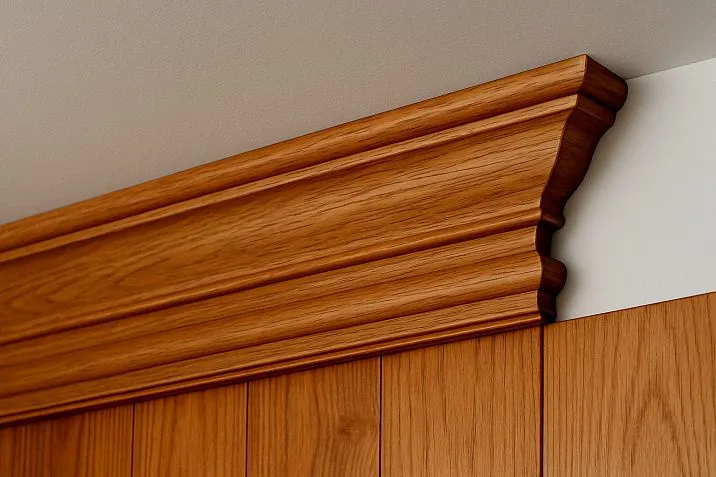
When sunlight gently glides across the wooden ceiling made of plank, and your gaze involuntarily stops at the elegant transition to the walls, you realize — here is the true beauty of the Russian home! Ceiling wooden molding on paneling It is not just a decorative element, but the soul of the interior that unites all space, creating a sense of completion and harmony.
Plank on the ceiling — a solution proven by centuries of Russian architectural tradition. From peasant izbas to noble estates, from modern suburban homes to city apartments in eco-style — wooden ceilings invariably create an atmosphere of warmth and coziness. But it is precisely the quality ceiling molding that transforms simple finishing into a masterpiece of carpentry.
Why does this seemingly insignificant element play such an important role? Because the devil is in the details, and perfection is born from careful attention to every square centimeter of space. A poorly chosen or poorly installed molding can spoil the impression even of the most expensive finishing. Conversely, a well-chosen element will become an elegant crown of the entire interior.


Philosophy of wooden ceiling: where coziness is born
Wood on the ceiling — it is a return to the roots, to the time when humans lived in harmony with nature. Each plank carries the memory of the forest, of sun and rain, of seasonal changes. And the ceiling molding becomes the connecting link between this natural beauty and the architecture of human dwellings.




Psychology of perception of wooden ceilings
Modern research confirms what our ancestors intuitively understood: wood above the head creates a special psychological state of safety and comfort. Natural wood has the ability to regulate air humidity, absorb sound, and create a healthy microclimate in the room.
But all this effect can be ruined by one detail — an unskillful transition between the ceiling and walls. It is precisely here that the magic manifests. woodenwhich creates visual and psychological completeness of the space.
Our factory also produces:



Traditions of Russian architecture
In Russian architecture, transitional elements always had a sacred meaning. They symbolized the boundary between earthly and heavenly, between inner and outer space. The ceiling cornice on wainscoting continues this tradition, creating a sense of protection and unity with nature.
Master craftsmen of the past intuitively understood the importance of correct proportions. They never used cornices that visually "pressed" on the space or, conversely, disappeared against the backdrop of a massive wooden ceiling. Each element was carefully calibrated and harmoniously integrated into the overall composition.
Get Consultation
Technical features of ceiling installation
Installing a cornice on a wainscoted ceiling has its specific features, which fundamentally distinguish it from installation on smooth surfaces. Here, every detail matters, and every decision affects the final result.
Features of mounting to wainscoting
Unlike gypsum board or plastered surfaces, wainscoting has a textured structure. Each board creates a micro-step that must be considered when selecting the profile and method of mounting the cornice. Wooden ceiling molding must fit tightly to the surface, masking these irregularities and creating a perfectly smooth transition line.
Standard wainscoting has a thickness of 12.5–16 mm, creating a noticeable protrusion relative to the wall. This fact must be considered when selecting the cornice dimensions — it must cover this protrusion with a margin, creating a beautiful visual transition.
Humidity deformations: enemy of wooden ceilings
Wood is a living material that constantly reacts to changes in the surrounding environment's humidity. Wainscoting on the ceiling, especially in rooms with variable humidity, may exhibit noticeable linear dimensional changes. Jointing of wooden moldings must account for these deformations; otherwise, over time, gaps or, conversely, bulges will appear.
Professional craftsmen always leave compensatory gaps during installation — no more than 1–2 mm per every 3 meters of length. These gaps are masked by the cornice but allow the structure to "breathe" without damaging the finish.
Temperature stresses
The ceiling is the warmest zone in the room, where temperature may differ from the floor by 5–10 degrees. This creates additional stresses in the wood, which must be compensated for by proper material selection and installation technique.
Cornices made from the same wood species as the wainscoting will deform synchronously, minimizing the formation of gaps. Using contrasting species requires special care and a professional approach to installation.
Choosing wood species: harmony of materials
The principle "like with like" works reliably when selecting wood species for ceiling cornices. However, there are nuances that can significantly affect the final result.
Coniferous species: genre classic
Spruce is the most popular choice for wainscoting, and cornices made from the same species create ideal harmony. The natural resinous quality provides additional protection against moisture, and the characteristic texture with contrasting annual rings adds expressiveness to the ceiling zone.
Modern technologies allow removing excess resin without compromising the protective properties of the wood. wooden cornice From properly processed spruce, even under elevated ceiling zone temperatures, there are no issues with resin leakage.
Larch has a more calm, uniform texture and a light, almost white color. It is ideal for creating Scandinavian interiors or rooms where the ceiling is planned to be painted in light tones.
Larch is a premium choice for rooms with high humidity. Its natural biostability surpasses even oak, and its dense structure ensures minimal deformation under changes in the microclimate.
Deciduous species: nobility and elegance
Using deciduous species for ceiling cornices requires a special approach. Oak baseboard on a spruce ceiling can create an interesting contrast but requires careful tone selection and overall stylistic development of the interior.
Oak adds solidity and respectability even to the simplest wainscoted ceiling. However, its high density and tendency to crack require a professional approach to drying and processing.
The board, with its uniform structure, is ideal for creating complex crown molding profiles. Beech baseboard Capable of transforming simple planks into elements of a palace interior.
Exotic Solutions
Using exotic species — wenge, merbau, teak — for ceiling moldings is rare, but can create truly exclusive interiors. The main condition — all wooden elements in the room must be executed in a unified style.
Dimensions and Proportions: The Mathematics of Beauty
Choosing the size of ceiling molding is an art requiring understanding of visual perception laws and architectural proportions. Wooden molding dimensions which should harmonize with ceiling height and room scale.
Ceiling Height Impact
In rooms with standard ceilings of 2.5–2.7 meters, moldings of 40–60 mm height are optimal. Larger sizes will visually "press" on the space, creating a sense of confinement.
Ceilings of 3 meters and higher allow using moldings up to 100–120 mm in height. Here, it is important to maintain proportion: the molding size should be approximately 1/40–1/30 of the room's height.
Considering the Scale of Planks
Standard planks have a width of 88–96 mm, which must be considered when choosing molding. Too thin a molding will be lost against wide planks, while too bulky will dominate over the main finish.
Optimal ratio: the height of the molding should be 1/2–2/3 of the plank's width. This creates visual balance and harmony of proportions.
Profile Complexity
Simple quarter-round profiles can be used in smaller sizes — their simplicity compensates for modest dimensions. Complex crown molding profiles require larger sizes to fully reveal the beauty of forms and play of light and shadow.
Molding Profiles for Plank Ceilings: From Simplicity to Elegance
Choosing a molding profile is determined not only by aesthetic preferences but also by technical features of installation on a relief plank surface.
Simple Profiles: Functionality and Elegance
Quarter-round molding — a classic solution that never goes out of style. The simple concave shape perfectly masks the transition between planks and walls, without drawing excessive attention to itself. This is the choice for those who appreciate restrained elegance.
Half-round moldings create a softer, "streamlined" transition. They are especially suitable in rooms with curved elements or where maximum safety is important — children's rooms, sports halls.
Rectangular profiles meet the requirements of modern design with its inclination toward clear geometric forms. Such moldings transform traditional planks into elements of a modern interior.
Complex Crown Molding Profiles: Luxury of Details
When simplicity seems dull, complex crown molding profiles come to the rescue. Grooves, ovals, beads, stepped transitions — all this turns the ceiling molding into a work of decorative art.
Profiles with grooves create play of light and shadow, especially effective with side lighting. Vertical grooves visually increase the room's height.
Stepped profiles with multiple levels are suitable for classic interiors, where the richness of decorative elements is valued. However, they require a perfectly flat base for quality installation.
Plant ornaments — the pinnacle of carpentry art. Carved leaves, grapevines, floral motifs transform the molding into a true masterpiece. Such items are made exclusively by hand and require special care.
Functional Profiles: Beauty and Practicality
Modern technologies allow creating moldings with additional functions without losing aesthetic appeal.
Profiles with channels for wiring solve the problem of placing electrical communications in wooden houses. Hidden channels allow laying lighting, internet, and alarm wires while preserving the beauty of the wooden ceiling.
Moldings with built-in lighting create a "floating" ceiling effect. LED strips integrated into the profile provide soft contour lighting, highlighting the plank texture.
Installation: the art of precision
Installing crown molding on paneling is a process requiring special skill and understanding of working with wood. Each installation stage affects the final result and the longevity of the structure.
Preparation work: the foundation of quality
Material acclimatization — the first and most important stage. Both paneling and crown molding must adapt to the room’s microclimate over 48–72 hours. During this time, the wood will reach equilibrium moisture, preventing deformation after installation.
Checking the ceiling’s geometry is especially important for paneling structures. Even minor deviations from horizontal will be noticeable at wall junctions. Use a laser level to check the ceiling’s flatness.
Marking the installation line must consider not only the room’s geometry but also the direction of the paneling boards. The crown molding should overlap the board ends with sufficient allowance.
Fastening methods: reliability above all
Fastening to paneling has specific characteristics due to the material’s limited thickness. Screws must penetrate into the load-bearing structure — the joist or drywall ceiling. Screws only into the paneling will not provide the necessary fastening strength.
Adhesive bonding can be used as an additional, but not primary, fastening method. Polyurethane adhesives provide good adhesion to wood and retain elasticity under temperature deformations.
Hidden fastening through the groove or back flange of the crown molding ensures a perfect appearance without visible fasteners. However, this method requires precise profile manufacturing and high installer skill.
Corner processing: the pinnacle of craftsmanship
Ceiling corner joints are especially noticeable, so their quality is critically important for the overall impression.
Internal corners are formed using the "on the edge" method with 45° beveling. However, room corners are rarely perfectly straight, so each corner must be measured individually.
External corners in ceiling structures occur with beams, niches, or multi-level ceilings. Their processing requires special skill and precision.
Pre-fabricated corner elements significantly simplify the installation of complex profiles and guarantee perfect joint quality.
Final finishing: protection and beauty
Ceiling mounting creates special operating conditions for crown molding — higher temperatures, possible exposure to moisture, and limited access for maintenance.
Protective coatings for ceiling applications
UV-filtered varnishes are especially important for ceiling crown moldings, which may be exposed to direct sunlight through dormer windows or skylights.
Breathable coatings allow wood to "breathe," which is critically important under varying humidity. Natural-based oils and waxes provide protection without forming an impermeable film.
Fire-retardant impregnations increase the safety of wooden structures. Modern formulations do not alter the appearance of wood but significantly reduce the material’s flammability.
Decorative techniques
Toning to match the paneling creates a unified surface, where the crown molding becomes a natural extension of the ceiling finish. This is a classic, time-tested solution.
Contrasting toning highlights the crown molding as a standalone decorative element. A dark crown molding on a light ceiling or vice versa creates a striking architectural detail.
Patina and brushing add a sense of age and nobility to crown moldings. Particularly effective in vintage or Provence-style interiors.
Care and Maintenance: Preserving Beauty
Ceiling mounting complicates crown molding maintenance, so it is especially important to properly organize care from the very beginning of operation.
Regular Maintenance
Dust removal should be performed regularly using a soft brush or special anti-static cloths. Dust accumulation not only damages the appearance but may also contain abrasive particles.
Controlling room humidity will help prevent wood deformation. Optimal relative humidity — 40–60%.
Visual inspection of the coating condition will allow timely detection of problems and prompt corrective action.
Preventive maintenance
Ceiling crown moldings require less frequent re-coating than floor elements, but neglecting this is not an option. The frequency depends on the coating type and operating conditions.
Minor defects — scratches, chips, scuffs — should be addressed immediately before they cause more serious damage.
Fastening control is especially important for heavy, complex-profile beams. Loosening of fasteners may lead to structural collapse.
Stylistic solutions: from Russian izba to modern loft
wooden molding The wagonboard ceiling can support various stylistic directions thanks to the richness of profiles and finishing options.
Russian traditional style
Simple quarter-round beams made of pine or spruce, coated with transparent lacquer or tinted in natural wood tones, create an authentic atmosphere of a Russian izba. No excess — only functionality and the natural beauty of the material.
Scandinavian minimalism
White or light-gray beams of simple forms on whitewashed wagonboard create a sense of purity and freshness characteristic of northern interiors. The key is to avoid visual heaviness and clutter with details.
Provence and country
Beams artificially aged with patina and wear on warm-toned wagonboard create an atmosphere of French or American country style. Here, more complex profiles and decorative elements are appropriate.
Modern classicism
Beams of medium-profile complexity, tinted in noble tones of oak or walnut, transform the wagonboard ceiling into an element of modern classic interior. A balance of tradition and current trends.
Loft and Industrial Style
Even in brutal loft interiors, there is room for wooden ceilings. Roughly processed beams in dark tones with emphasized texture create contrast with industrial elements.
Economic aspects: investment in longevity
wooden crown molding buy For a wagonboard ceiling — an investment in long-term beauty and functionality of the interior.
Initial costs
The cost of ceiling beams depends on the type of wood, profile complexity, and finish quality. Simple pine profiles cost 200–400 rubles per linear meter, oak beams may cost 2000 rubles and more.
Savings on maintenance
High-quality wooden beams, when properly installed and maintained, serve for decades without replacement. This is significantly cheaper than periodic replacement of synthetic alternatives.
Impact on property value
Professional wooden finishing increases the market value of real estate. Wagonboard ceilings with quality beams are a sign of attention to detail and high-quality finishing.
Modern Trends and Innovations
The market for ceiling beams for wagonboard is constantly evolving, offering new solutions and technologies.
Ecological Innovations
FSC-certified wood is becoming standard for premium segments. Buyers increasingly pay attention to ecological and sustainable forestry practices.
Technological solutions
Integration of LED lighting, sensors, and "smart home" elements transforms traditional beams into high-tech interior components.
Customization
Advancements in technology allow manufacturing beams according to custom sketches, creating unique interior solutions.
Choosing a supplier: quality criteria
When selecting a supplier Buy wooden moldings in St. Petersburg In any city, it is important to pay attention to several key factors.
Production base
Having an in-house production facility ensures quality control at all stages and the ability to fulfill non-standard orders.
Certification and warranties
Serious manufacturers provide quality certificates and warranty obligations for their products.
Technical support
The ability to receive qualified consultation on selection, installation, and maintenance is an important advantage of professional suppliers.
STAVROS: craftsmanship proven by time
In the world of wooden products, there are companies that do not merely follow the market but set quality standards for the entire industry. STAVROS belongs to such leaders — companies for which each product is a manifestation of decades of experience, deep understanding of wood properties, and pursuit of absolute perfection.
What makes STAVROS products special for homeowners with wagonboard ceilings? Primarily — a deep understanding of the specific application. The company’s engineers and technologists have thoroughly studied the specifics of installing beams on textured surfaces, the effects of temperature and humidity deformations, and requirements for fastening strength in ceiling zones.
The STAVROS production complex is equipped with the most modern equipment, enabling the creation of gallets of any complexity with unparalleled surface quality. However, technology is merely a tool in the hands of true masters. Every employee of the company has undergone years of training in working with wood, understands its quirks, and knows the secrets of revealing the natural beauty of the material.
STAVROS pays special attention to the ecological safety of its products. All wood is supplied from certified suppliers who adhere to sustainable forestry principles. Finishes and stains undergo strict testing for compliance with ecological standards — since ceiling elements are located in areas of elevated temperatures, where material safety is especially critical.
STAVROS's quality control system includes checking each batch of products against dozens of parameters. Moisture content of wood, dimensional accuracy, surface quality, coating durability — all are subject to careful inspection. Only products that pass all stages of testing are permitted to bear the STAVROS mark.
The company's service support does not limit itself to selling materials. STAVROS specialists are ready to provide detailed consultations on selecting the optimal profile, calculating material requirements, and installation techniques. If necessary, a technical specialist can be dispatched to the site for consultations and quality control.
STAVROS's logistics service ensures careful delivery of products to any point in the country. Special packaging protects gallets from mechanical damage and moisture, while controlled storage conditions on warehouses guarantee the preservation of material quality.
Choosing STAVROS for your home means you are not just getting quality gallets — you are gaining confidence that your board ceiling will be adorned with items crafted with love for wood and an understanding of its unique properties. This is an investment in beauty that will delight you and your loved ones for many years.