Article Contents:
- Hinges: Invisible Joints of Perfection
- Hidden Hinges: Invisible Luxury
- Surface-mounted Hinges: Classic in Modern Execution
- Guides: The Art of Smooth Movement
- Ball-bearing Guides: Reliability in Motion
- Hidden Guides: The Aesthetics of Minimalism
- Handles and Hooks: Tactile Perfection
- Furniture Handles: Ergonomics and Aesthetics
- Decorative Hooks: Functionality in Details
- Supports and Legs: Stability and Style
- Furniture Legs: Architecture in Miniature
- Adjustable Supports: Precision in Every Millimeter
- Transformation Systems: Engineering Art
- Mechanisms for Tables: Space on Demand
- Mechanisms for Sofas: Comfort in Motion
- Fastening Systems: Invisible Strength
- Conformers and Eccentrics: Reliability of Connections
- Furniture Plugs: Aesthetics in Details
- Where to Buy Hardware: Supplier Selection Strategy
- Specialized Stores: Expertise and Assortment
- Online Platforms: Convenience and Wide Selection
- Direct Supplies from Manufacturers: Quality from the Source
- Innovations in Furniture Hardware
- Smart Technologies: Furniture in the Digital Age
- Eco-friendly Solutions: Responsibility Toward the Future
- Ergonomic Innovations: Comfort in Every Movement
- Practical Tips for Choosing and Using Hardware
- Component Compatibility: Systemic Approach
- Load Calculations: Engineering Approach
- Installation and Adjustment: Precision in Details
- Conclusion: Hardware as the Art of Functionality
Touch the cabinet door with your fingers. Pull the drawer handle. Look down at the table legs. In each of these moments, you interact not just with furniture, but with its unsung heroes—the hardware components that define comfort, durability, and aesthetic perfection of interior items. The question of where to buy high-quality hardware becomes crucial for those striving to create a space where every detail contributes to overall harmony and functionality.
Hardware is not simply metal or plastic elements. It is engineering masterpieces embodying centuries of furniture art evolution, modern technologies, and design thinking. From flawless operating hinges to exquisite decorative handles—each element has its own history, technical specifications, and role in creating furniture that serves not just years, but decades.


Hinges: Invisible Joints of Perfection
Hinges are the heart of any swing system, determining the smoothness of movement, durability, and functionality of doors. Modern hinges are high-tech devices where every millimeter is meticulously designed down to the smallest details.




Hidden Hinges: Invisible Luxury
Hidden hinges represent the pinnacle of engineering thought in the world of furniture hardware. Fully recessed into the door and frame, they remain invisible when the door is closed, creating an effect of a monolithic surface without disrupting harmonious elements.
The technical specifications of these masterpieces impress even seasoned professionals:
- Opening angle up to 165° (vs. standard 110°)
- Load capacity up to 40 kg per pair of hinges
- Three-dimensional adjustment with precision to 0.1 mm
- Integrated damping systems with adjustable closing force
- Service life up to 200,000 open/close cycles
Hinges with Push-to-open function are especially valuable, allowing doors to be opened with a simple press on the facade—ideal for minimalist interiors without handles. The system activates with a force of only 2–3 N (equivalent to 200–300 grams), making furniture use incredibly comfortable.
Solving, where to buy hardware For such a level, pay attention to manufacturers specializing exclusively in premium solutions with full production and quality control cycles.
Our factory also produces:


Surface-mounted Hinges: Classic in Modern Execution
Surface-mounted hinges are a classic solution that, thanks to modern technologies, has gained new life. Today, they are not just functional elements but also decorative accents capable of highlighting the style of furniture.
Modern surface-mounted hinges are made from high-quality materials:
- Brass with various finishes (chrome, bronze, patina)
- Stainless steel with PVD coating, resistant to abrasion
- Zinc alloys with decorative antiqued finish
For classic furniture, hinges with decorative caps—"crown," "bulb," "acorn"—are especially valuable, transforming a functional element into a work of art. These hinges are cast and subsequently hand-finished, ensuring clear relief and long-lasting decorative finish.
Get Consultation
Guides: The Art of Smooth Movement
Drawer guides are the technological heart of any storage system, the quality of which determines the ease of use and durability of furniture. The modern market offers an impressive variety of solutions, each with its own unique advantages.
Ball-bearing Guides: Reliability in Motion
Ball-bearing guides consist of two or three telescopic profiles with ball bearings, ensuring smooth sliding. This is the optimal solution for most household and office applications due to the ideal price-to-quality balance.
Key characteristics of quality ball-bearing guides:
- Load capacity from 25 to 45 kg per pair
- Full extension (100% access to drawer contents)
- Galvanized coating with corrosion protection
- Integrated dampers with hydraulic or pneumatic mechanism
- Self-closing function on the last 40–50 mm of travel
Guides with synchronizers are especially valuable, ensuring even movement even under uneven load or when force is applied to one side of the drawer. This is critically important for wide drawers (from 600 mm), where misalignment can lead to jamming.
When choosing, where to buy hardware For this type, pay attention to the thickness of the profile metal (optimally 1.5-2.0 mm) and the quality of the ball bearings - these parameters determine the longevity of the system.
Hidden guides: the aesthetics of minimalism
Hidden guides are an innovative solution that completely changes the perception of pull-out systems. Installed under the drawer base, they remain invisible, creating a "floating" drawer effect and ensuring the cleanest lines.
Technical specifications of premium hidden guides are impressive:
- Load capacity up to 80 kg per pair
- Smooth movement even when fully loaded
- Integrated soft-close mechanisms with adjustable closing force
- Three-dimensional adjustment of the facade position
- Minimal side clearance (only 10-12 mm on each side)
A special category are Push-to-open systems with synchronizers, which allow opening drawers with a light press on any point of the facade. The mechanism activates with a force of 5-7 N and provides drawer extension of 40-50 mm, sufficient for comfortable gripping.
For kitchen furniture, waterproof-coated and aggressive-medium-resistant systems are indispensable. Such guides maintain flawless performance even under high humidity and when in contact with food products.
Handles and hooks: tactile perfection
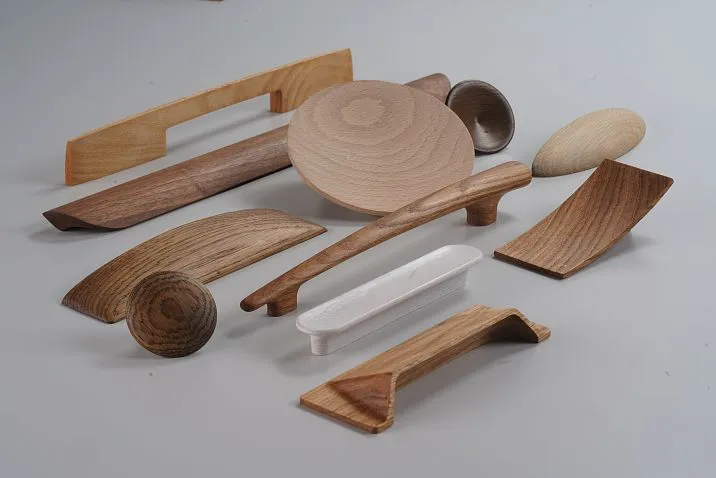
Handles are not just functional elements for opening doors and drawers. They are points of tactile contact with furniture, determining ease of use and creating important visual accents in design.
Furniture handles: ergonomics and aesthetics
Modern furniture handles are a blend of ergonomics, engineering thought, and designer vision. They must be not only beautiful but also comfortable to use, durable, and resistant to intensive use.
Materials used determine both aesthetic and functional properties of handles:
- Zinc alloys provide the ideal balance of strength, weight, and possibilities for complex decoration
- Aluminum creates a sense of lightness and modernity, ideal for minimalist interiors
- Brass, with its noble luster and ability to patina, is indispensable for classic furniture
- Stainless steel combines strength, hygiene, and resistance to aggressive environments
For kitchen furniture, optimal handles are those with antibacterial coating based on silver ions, which suppress bacterial growth on the surface. Such coatings maintain effectiveness for up to 10 years even with intensive use and regular cleaning.
Ergonomics of the handle is determined by several key parameters:
- Grip diameter (optimally 16-20 mm for an adult hand)
- Grip depth (at least 25 mm for comfortable grip)
- Cross-section shape (slightly oval or with finger recesses)
- Surface texture (matte or with micro-relief to prevent slipping)
Decorative hooks: functionality in details
Decorative hooks are multifunctional elements that can be used for hanging items as well as for decorative accents. In modern design, they are experiencing a true renaissance, becoming important elements of stylistic solutions.
For wardrobes and entryways, ideal hooks have reinforced mounting, with load capacity up to 10-15 kg. They are made of steel 3-4 mm thick with a multi-layer coating that provides protection against corrosion and mechanical damage.
For children's rooms, popular are theme-design hooks - in the form of animals, fairy tale characters, geometric shapes. They are made from safe materials (often with silicone elements) and have rounded edges to prevent injuries.
Solving, where to buy hardware For decorative purposes, pay attention to the quality of casting and finishing - absence of burrs, uniform coating, clarity of relief. It is precisely these parameters that distinguish premium items from the mass segment.
Legs and Supports: Stability and Style
Legs and supports are not just functional elements ensuring furniture stability. They are important stylistic accents capable of completely transforming the appearance of an item and highlighting its character.
Furniture Legs: Architecture in Miniature
Furniture legs can be considered as architectural elements in miniature, with their own proportions, stylistic features, and construction solutions. From massive carved supports in the Baroque style to minimalist metal constructions in the loft style - the choice of legs determines the character of the entire piece of furniture.
The materials used determine not only aesthetics, but also functional characteristics:
- Solid hardwoods (oak, beech, ash) provide the optimal combination of strength and aesthetics
- Aluminum alloys create a sense of lightness while maintaining high structural strength
- Steel with powder coating combines industrial aesthetics with resistance to damage
- Cast iron provides maximum stability and solidity
For sofas and chairs, legs of height 120-150 mm with cross-sections designed to support up to 150 kg per support point are optimal. They should have protective pads made of polyurethane or felt, preventing damage to flooring and reducing noise during furniture movement.
For tables, the critical factor is the rigidity of leg attachment to the tabletop. The optimal solution is metal plates 3-4 mm thick with threaded bushings embedded into the leg's solid wood. Such a construction withstands not only vertical but also lateral loads that occur during table movement.
Adjustable Supports: Precision in Every Millimeter
Adjustable supports are an engineering solution ensuring perfect furniture leveling even on uneven surfaces. This is especially important for kitchen and office furniture, where even a slight misalignment may lead to functional issues.
Modern adjustable supports are complex mechanisms with impressive characteristics:
- Height adjustment range up to 25-30 mm
- Load capacity up to 200 kg per support
- Resistance to aggressive cleaning agents
- Protection against accidental unscrewing
- Integrated locking systems in the selected position
For wet areas, non-removable supports made of stainless steel or composite materials with sealed threaded connections are indispensable. They maintain functionality even with direct water contact and are resistant to household chemicals.
A special category are supports with integrated baseboard mounting systems, which create a "floating" furniture effect while maintaining full functionality. These systems include special clips that allow quick removal and installation of the baseboard for access to adjustment components.
Transformation Systems: Engineering Art
Transformation systems are complex mechanisms that allow changing furniture configuration according to user needs. From sliding tables to sofa-beds - these engineering solutions make modern furniture truly functional.
Table Mechanisms: Space on Demand
Sliding mechanisms for tables are complex engineering systems ensuring easy transformation and secure locking in the working position. They must be not only functional but also durable, capable of withstanding multiple transformation cycles.
Modern mechanisms include several key components:
- Guides with ball bearings for smooth movement
- Synchronizers ensuring even extension
- Locks for secure locking in the working position
- Dampers for smooth operation and impact prevention
For tables with a central insert, butterfly mechanisms are optimal, allowing the insert to be stored inside the table and automatically extended to working position upon sliding. Such systems withstand up to 100 kg of distributed load on the insert and maintain functionality after 5000–7000 transformation cycles.
Furniture mechanisms: comfort in motion
Mechanisms for sofas: comfort in motion
Transformation mechanisms for soft furniture are complex engineering systems, the quality of which affects not only functionality but also user safety. They must ensure easy transformation, secure locking, and durability during daily use.
Main types of mechanisms differ by construction and functionality:
- "Book" - compact mechanism for small spaces, transformation is achieved by lifting the seat and lowering the backrest
- "Eurobook" - reliable mechanism with a sliding seat and lowering backrest, forming a flat sleeping surface
- "Dolphin" - mechanism for corner sofas, where the sleeping surface is formed by extending part of the seat from under the main body
- "Accordion" - three-section mechanism, unfolding like an accordion, providing a large sleeping surface
For daily use, mechanisms with a metal frame made of profiled tube with a 40×20 mm cross-section and 1.5–2.0 mm wall thickness are optimal. Such systems withstand up to 200 kg of distributed load and maintain functionality after 5000–7000 transformation cycles.
Mechanisms with gas dampers are especially valuable, as they compensate for the weight of movable parts, making transformation easy even for people with limited physical capabilities. The activation force for such mechanisms is only 30–40 N (equivalent to 3–4 kg).
Fastening systems: invisible strength
Fastening systems are the invisible heroes of the furniture world, ensuring the strength of connections and structural stability. The quality of fasteners affects not only the longevity of furniture but also its safety of use.
Conformers and eccentric bolts: reliability of connections
Conformers and eccentric bolts are the main types of fasteners for cabinet furniture, each with its own advantages and application specifics.
Conformers are special screws with coarse thread and concealed head, ensuring strong connection of particleboard and MDF parts. Their key characteristics:
- Diameter 6.4–7.0 mm for optimal strength-to-risk ratio of material splitting
- Length 50–70 mm for connecting parts with thickness 16–25 mm
- Thread pitch 3.5–4.0 mm for maximum material grip
- Pull-out force up to 1200–1500 N (120–150 kg)
Eccentric bolts are disassemblable connectors consisting of an eccentric and a rod, ensuring tight connection with the possibility of multiple assembly/disassembly. Their advantages:
- Invisibility of connection from the front side
- Ability to adjust tightening force
- Compensation for manufacturing tolerances
- Tensile strength up to 800–1000 N (80–100 kg)
Premium-class furniture uses Confirmat Pro systems with a conical core, which ensures self-centering and prevents material splitting even when installed close to the edge of the part (minimum distance of only 12–15 mm versus standard 25–30 mm).
Furniture plugs: aesthetics in details
Furniture plugs are decorative elements that conceal technical holes and fasteners. They not only serve an aesthetic function but also protect fasteners from dust and moisture, extending their service life.
Modern plugs are made from various materials, each with its own characteristics:
- Plastic plugs are available in a wide color range (up to 50 standard colors) and precisely match the decor of laminate panels from leading manufacturers
- Solid wood plugs create a sense of continuity in furniture made of natural wood
- Self-adhesive plugs with 3D effect mimic wood texture not only in color but also in relief
For hinges, plugs with a diameter of 12-13 mm are used, secured by snap-fit or adhesive. Premium-class plugs have beveled edges that ensure perfect surface fit and minimal gap (less than 0.1 mm).
For eccentric bolts, plugs with a diameter of 15-18 mm with flat or convex surfaces are used. An innovative solution are magnetic plugs, which ensure perfect fit without gaps and can be easily removed when access to fasteners is required.
Where to buy hardware: supplier selection strategy
The question of where to buy hardware High quality is crucial for the success of any furniture project. Choosing the right supplier ensures not only component quality, but also service, technical support, and warranties.
Specialized stores: expertise and assortment
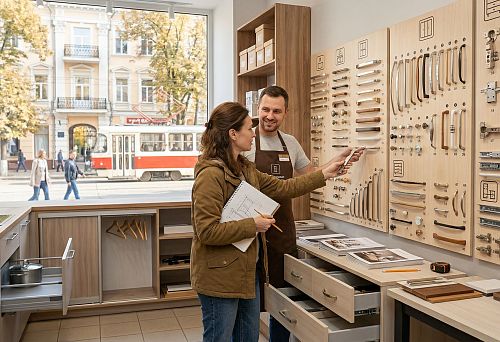
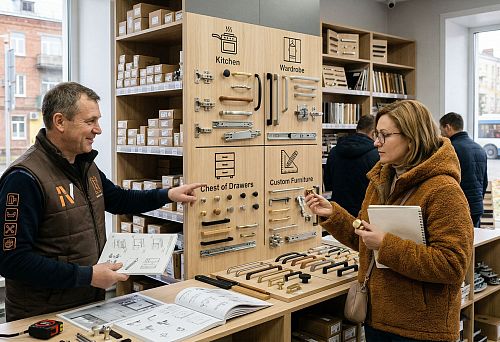
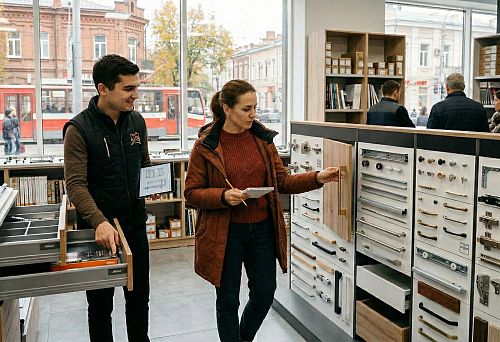
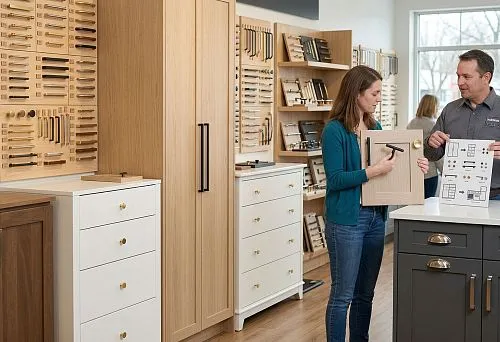
Specialized furniture hardware stores offer the optimal combination of wide assortment, professional consultation, and additional services. They are oriented toward professionals in the furniture industry and demanding private clients.
Advantages of specialized stores:
- Deep assortment in each category (up to 20-30 variants of one type of product)
- Availability of samples for tactile assessment of quality and functionality
- Consultations with specialists experienced in furniture manufacturing
- Technical documentation and installation templates
- Warranty and post-warranty service
When choosing a specialized store, pay attention to the presence of authorization from leading hardware manufacturers — this guarantees product authenticity and access to full technical support.
Online platforms: convenience and wide selection
Online platforms offer an impressive assortment of furniture hardware with delivery to your door. This is especially convenient for those who value their time or are located in regions with limited availability of specialized stores.
Advantages of online platforms:
- 24/7 access to catalogs with detailed descriptions and technical specifications
- Ability to compare different models by key parameters
- Reviews from real customers with photos and descriptions of usage experience
- Convenient filtering system by technical parameters and price range
- Regular promotions and special offers
When choosing an online supplier, pay attention to the detail of product descriptions, availability of technical drawings and installation instructions, and the possibility of obtaining samples before large purchases.
Direct deliveries from manufacturers: quality from the source
Direct deliveries from furniture hardware manufacturers are the optimal solution for professional furniture makers and large projects. They ensure not only guaranteed quality, but also access to new products, technical support, and customization options.
Advantages of direct deliveries:
- Guarantee of product authenticity and full compliance with stated specifications
- Access to the full product line, including specialized and niche solutions
- Technical support from the manufacturer's engineers
- Ability to customize products for specific projects
- Optimal prices without intermediary markups
Direct relationships with manufacturers typically require a certain volume of purchases, but many companies work through authorized dealers who provide the same level of service and support.
Innovations in furniture hardware
The world of furniture hardware is constantly evolving, offering new solutions that expand design possibilities and enhance furniture functionality.
Smart Technologies: Furniture in the Digital Age
Integration of electronics and digital technologies transforms traditional hardware into interactive systems that adapt to user needs:
- Electronic opening systems with touch or gesture recognition
- Integrated lighting systems with adjustable brightness and color temperature
- Wireless charging stations built into table and cabinet surfaces
- Biometric access systems (fingerprint, facial recognition) for cabinets and drawers
Systems capable of integration into "smart homes" via Bluetooth, Z-Wave, or Zigbee protocols. They allow controlling furniture via voice commands, smartphone, or scheduled automation.
For kitchen furniture, a revolutionary solution is the electronic opening system Servo-Drive, activated by a light touch on the facade and providing smooth opening even for heavy drawers and doors. The system consumes minimal energy (less than 0.5 W in standby mode) and can operate on batteries for up to 2 years without replacement.
Eco-friendly solutions: Responsibility toward the future
Growing environmental awareness stimulates the development of hardware that minimizes environmental impact without compromising quality or aesthetics:
- Hardware made from recycled materials (up to 80% recycled aluminum and steel)
- Non-toxic water-based coatings instead of galvanic coatings
- Energy-efficient manufacturing technologies reducing carbon footprint
- Biodegradable packaging made from recycled paper and cardboard
Special niche is occupied by hardware made from sustainably grown materials — bamboo, cork, bio-composites based on plant fibers. Such items are not only eco-friendly but also bring natural warmth and unique texture into the interior.
Ergonomic innovations: comfort in every movement
Modern hardware increasingly focuses on ergonomics and ease of use, taking into account the specifics of human biomechanics and psychology:
- Opening systems that adapt to the force of press and speed of movement
- Handles with anti-slip coating and optimal profile for different types of grip
- Transformation mechanisms requiring minimal force (up to 30% less than standard)
- Intuitive control systems without the need to study instructions
Special series of hardware are developed for elderly people and people with disabilities, featuring larger sizes, contrasting colors, tactile indicators, and mechanisms requiring minimal effort to activate.
Practical tips for choosing and using hardware
Choosing and using furniture hardware is not only a technical but also a creative process, requiring understanding of both functional requirements and aesthetic aspects.
Component compatibility: systematic approach
When selecting hardware, it is critically important to consider compatibility between different components and with furniture materials:
- Dimensional compatibility — correspondence of mounting dimensions and tolerances
- Functional compatibility — correct operation of components within a single system
- Stylistic compatibility — harmonious combination in design, color, texture
- Material compatibility — absence of chemical or electrochemical reactions between components
For complex systems (drawers, lifting mechanisms), it is recommended to use components from one manufacturer, ensuring full compatibility and correct operation.
Load calculation: engineering approach
Correct calculation of loads on hardware is the guarantee of furniture safety and longevity:
- For hinges, consider not only the door's weight but also its dimensions, which create additional leverage
- For guides, calculate not only static load (weight of contents) but also dynamic load (force during opening/closing)
- For fastening systems, consider not only vertical but also horizontal loads that occur during operation
- For support elements, incorporate a safety factor of 1.5–2.0 to compensate for unexpected loads
For critical structures, it is recommended to consult with an engineering designer who will help correctly calculate loads and select optimal hardware.
Installation and adjustment: precision in details
The quality of hardware installation is no less important than the quality of the components themselves:
- Use specialized tools recommended by the manufacturer (drilling guides, marking templates)
- Observe recommended tightening torques for fasteners (typically 3–5 Nm for cam locks, 1–2 Nm for eccentric locks)
- Perform adjustments in the sequence specified in the instructions (typically height first, then horizontally, and finally depth)
- Check the smooth operation of movable elements and adjust settings if necessary
For complex mechanisms, it is recommended to record the assembly and adjustment process via video — this will help in case of future reconfiguration.
Conclusion: hardware as the art of functionality
Hardware is not just technical components of furniture — it is elements that define its character, functionality, durability, and aesthetic value. From hinges ensuring smooth door movement to decorative handles creating stylistic accents — each element plays an irreplaceable role in creating furniture that pleases the eye and serves faithfully for many years.
Choosing hardware is not just a technical question — it is a creative process requiring understanding of both functional requirements and aesthetic aspects. It is a balance between engineering precision and artistic vision, between practicality and beauty.
In a world where mass production has become the norm, quality hardware is the opportunity to create furniture with character — furniture that not only serves its functional purpose but also tells a story, creates an atmosphere, and shapes space.
Regardless of whether you are a professional furniture maker or an enthusiast creating furniture for your own home, the question of where to buy hardware high quality deserves your closest attention. After all, it is the quality of hardware that determines whether your furniture will be merely a functional item or a work of art capable of enduring generations and telling a story about craftsmanship, taste, and attention to detail.
In a world where authenticity has become luxury and mass production is the norm, choosing the right hardware is not just a practical decision — it is a philosophical choice in favor of quality, durability, and authenticity. And this choice begins with understanding where to buy hardware that will be a worthy completion of your furniture project.