Article Contents:
- Psychology of Perceiving Picture Frame Forms
- Evolution of Styles Through the Centuries
- Revival of Traditions in the 21st Century
- Anatomy of a Carved Newel Post: Structure and Proportions
- Base: The Foundation of Beauty
- Shaft: The Center of Decoration
- Top Section: Completion of the Composition
- Manufacturing Technologies: From Sketch to Finished Product
- Design and modeling
- Material preparation
- Turning processing
- Decorative Finishing
- Wood Species: Choosing Material for Perfection
- Exquisite Hardwoods
- Exotic species
- Native Species
- Stylistic directions in design
- Classic style
- Baroque Style
- Modern and Art Deco
- Modern minimalism
- Technical Aspects of Installation and Mounting
- Preparatory work
- Mounting methods
- Features of mounting different types of balusters
- Care and maintenance: Preserving beauty for years
- Daily care
- Periodic maintenance
- Restoration and repair
- Conclusion
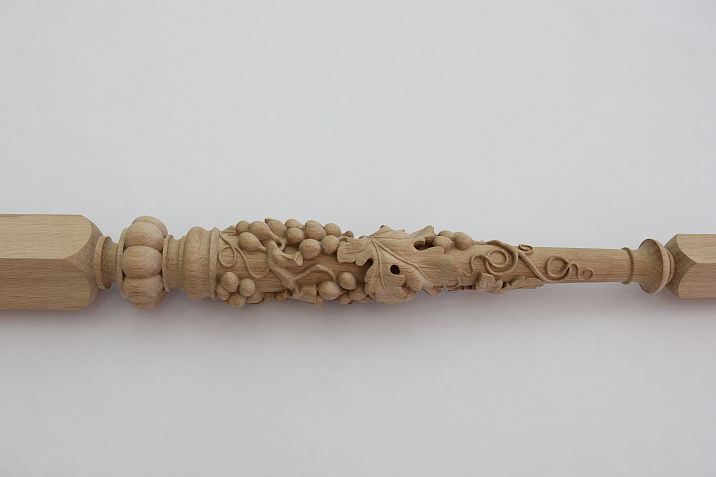
When you ascend a staircase and your hand glides along the elegant handrail supported by graceful vertical posts, you are touching a true work of art. Carved newel posts are not merely functional elements of staircase construction; they are embodiments of centuries-old woodworking traditions, where every detail emerges from the union of the craftsman’s skill and the natural beauty of wood.
In the world of modern architecture, where glass and metal dominate, wooden carved elements of staircases become islands of warmth and coziness. They carry the genetic memory of times when every object was crafted by hand, with soul and love for the material. Today, these items are experiencing a true renaissance, combining traditional techniques with modern manufacturing technologies.
What makes carved newel posts so attractive to modern designers and homeowners? The answer lies in their unique ability to transform an ordinary staircase into an architectural masterpiece, creating an atmosphere of luxury and refinement without excessive pomp.


Historical heritage and modern interpretation
The art of creating carved newel posts traces its roots to deep antiquity. The first decorative posts appeared in the architecture of ancient Mesopotamia, where craftsmen adorned palaces and temples with elegant miniature columns. The term 'newel post' derives from the ancient Greek word 'balaustion,' meaning 'pomegranate flower' — this comparison arose due to the distinctive shape of these architectural elements.




Evolution of Styles Through the Centuries
The Renaissance gifted the world with classical newel post forms, still considered the epitome of elegance. Italian masters of the 15th-16th centuries created works that astound with their perfection of proportions and refinement of decoration. Each newel post was a miniature architectural composition with a base, decorative shaft, and capital.
Baroque introduced theatricality and dynamism into newel post design. Masters of this era were not afraid to experiment with forms, creating pieces resembling frozen dance movements in wood. Spiral scrolls, floral ornaments, complex geometric patterns — all became characteristic features of Baroque newel posts.
Classicism restored strictness and symmetry, yet did not deprive newel posts of decorative appeal. Masters of this period achieved an astonishing balance between functionality and beauty, creating pieces that looked equally well in grand palace halls and cozy private living rooms.
Our factory also produces:


Revival of Traditions in the 21st Century
Modern carved newel posts represent a synthesis of historical traditions and innovative technologies. Today’s masters have access to high-precision equipment, enabling them to realize the boldest design concepts in wood while preserving the soul of handcrafted work.
Computer modeling allows creating three-dimensional models of future products, calculating their strength characteristics, and optimizing the production technology. However, final processing, sanding, and polishing still require human hands and the eye of the craftsman.
Get Consultation
Anatomy of a Carved Newel Post: Structure and Proportions
A classical carved newel post consists of three main parts, each performing its own function and possessing specific proportions. Understanding this structure is critically important for creating a harmonious piece.
Base: The Foundation of Beauty
The lower part of the newel post, called the base or pedestal, ensures secure attachment to the step or sub-newel. It usually has a square or rectangular cross-section, providing maximum contact area with the base. The height of the base constitutes 15-20% of the total height of the newel post.
In carved newel posts, the base is often adorned with decorative elements: chamfers, recesses, relief patterns. These details not only give the piece a finished appearance but also serve a practical purpose — concealing mounting points and creating a smooth transition to the decorative section.
The base material must possess high strength, as it is the part that bears all loads from the handrail and transmits them to the staircase’s load-bearing structures. Therefore, hardwoods such as oak, beech, and ash are used for manufacturing bases.
Body of the baluster: the center of decoration
The central part of the baluster is the canvas for the master carver's creativity. Here, the main decorative elements are concentrated, defining the style and character of the piece. The body of the baluster can have the most diverse shapes: from simple geometric forms to complex sculptural compositions.
Classic forms include vase-like expansions, spherical elements, cylindrical sections with varying surface textures. Modern designers are not limited to traditional solutions, creating avant-garde forms inspired by natural motifs or abstract compositions.
Proportions of the baluster body are critically important for the perception of the entire piece. An overly massive central part creates a sense of heaviness, while an excessively thin one suggests fragility. Masters follow the principle of the golden section, creating harmonious proportions pleasing to the eye.
Upper part: completion of the composition
The upper part of the baluster, or capital, serves as a support for the handrail and completes the composition of the piece. Like the base, it usually has an enlarged cross-section to ensure secure attachment of the handrail. The height of the capital is 10-15% of the total height of the baluster.
In ornamental balusters, the capital is often decorated with decorative elements that echo the ornamentation of the body. This creates visual unity and completeness of the composition. Some masters make the capital removable, which simplifies installation and allows replacing damaged elements if necessary.
Manufacturing technologies: from sketch to finished product
Creating ornamental balusters is a complex technological process requiring highly skilled craftsmen and modern equipment. Each stage of production affects the quality of the final product.
Designing and modeling
The process begins with creating a sketch of the future product. The designer takes into account the architectural style of the room, the dimensions of the staircase, the client's preferences, and production technical constraints. Modern CAD systems allow creating detailed three-dimensional models, viewing the product from different angles, and making adjustments before production begins.
Computer modeling also allows calculating the strength characteristics of the future baluster, determining optimal cross-sectional dimensions, and identifying potential structural weaknesses. This is especially important for ornamental pieces with complex geometry, where traditional calculation methods may be insufficiently accurate.
During the design phase, the manufacturing technology is determined: will the product be fully turned, combined (turning + milling), or carved. Each method has its own characteristics and limitations that must be considered during design.
Material Preparation
The quality of the wood is critically important for ornamental balusters. The material must be carefully dried to a moisture content of 8-12%, free of knots, cracks, and other defects. For manufacturing ornamental balusters, square-section blanks with dimensions exceeding the maximum diameter of the future product are typically used.
The blanks undergo preliminary processing: end-cutting, sizing, and checking for internal stresses. Special attention is paid to the direction of the wood grain — it must be aligned strictly along the axis of the future baluster to ensure maximum strength.
Some masters prefer using glued wood, which has increased dimensional stability and is less prone to cracking. However, for elite products, solid wood from premium species is still used.
Turning Processing
The main shaping operation for most ornamental balusters is turning on specialized lathes. Modern CNC turning centers allow reproducing complex profiles with high precision and repeatability.
The process begins with installing the blank in the lathe spindle and centering it. Then, using various cutting tools, the general contour of the product is formed. Experienced turners can create complex profiles using only hand tools, but for mass production, automated equipment is preferred.
Special skill is required to create transitions between different profile elements. Smooth transitions, characteristic of high-quality ornamental balusters, are achieved through precise control of feed rate and cutting speed.
Decorative processing
After turning, many ornamental balusters undergo additional decorative processing. This may include hand carving, milling of ornaments, or creating textured surfaces. Each type of processing requires special tools and high skill from the craftsman.
Hand carving is the most labor-intensive but also the most expressive method of decoration. The master carver creates unique ornaments using traditional tools: chisels, gouges, and carving knives. Each piece becomes individual, with distinctive characteristics of the craftsman's style.
Machine carving using milling machines allows creating complex repeating ornaments with high precision. Modern multi-axis machines can process products of complex shapes, creating three-dimensional reliefs and patterns.
The choice of wood species for manufacturing ornamental balusters is determined not only by aesthetic preferences but also by technical requirements. Different species have unique properties that affect the processing technology and operational characteristics of the finished products.
Oak remains the king among materials for manufacturing ornamental balusters. Its high density (700-800 kg/m³) ensures exceptional strength and durability of the products. Oak balusters can withstand significant loads without deformation, which is especially important for heavily used staircases.
Noble hardwoods
Oak remains the king among materials for making ornamental balusters. Its high density (700-800 kg/m³) ensures exceptional strength and durability of the finished products. Oak balusters can withstand significant loads without deformation, which is especially important for heavily used staircases.
The texture of oak with distinct annual rings creates a unique pattern on the surface of the products. During turning, this texture becomes especially prominent, creating a natural decorative effect. Oak is easily stained, allowing a wide range of shades — from light golden to dark brown.
Ash does not fall short of oak in mechanical properties, but has a lighter shade and less pronounced texture. This species is ideal for creating ornamental balusters in modern interiors, where restraint and elegance are valued. Ash is easy to process, allowing the creation of products with complex profiles and fine details.
Beech is distinguished by exceptional uniformity of structure, making it an ideal material for carved work. The pinkish hue of beech wood gives products a warm, cozy character. Beech is easily steam-bent, allowing the creation of curved elements for spiral staircases.
Exotic species
Wenge is an African species with dark brown, almost black wood. Its high density and hardness make it a difficult material to process, but the result justifies the effort. Ornamental balusters made of wenge look luxurious and solid, ideally suited for classic interiors.
Teak is a tropical species known for its resistance to moisture and temperature fluctuations. The golden-brown color and oily texture make teak popular for elite products. Natural oils in the wood structure provide inherent protection against rot and insects.
Padauk is one of the most valuable wood species, distinguished by its unique purplish-brown color with dark veins. Products made of padauk are considered works of art and require special craftsmanship in processing.
Walnut — a traditional material for Russian master carpenters. Its beautiful grain with wavy lines and noble brown color make walnut a popular choice for decorative balusters. The wood is easy to work with and polish, achieving a silky sheen.
Maple — a light-colored wood with a fine, uniform grain. Maple balusters are ideal for Scandinavian or Provence-style interiors. Maple wood stains easily, allowing for various color solutions.
Cherry — a wood with a beautiful reddish-brown tone that deepens over time. Cherry balusters give interiors a warm, cozy character and are especially popular in American and English styles.
Modern decorative balusters are presented in a wide range of stylistic solutions, from strict classicism to avant-garde forms. Each style has its own distinctive features and area of application.
Stylistic directions in design
Classic decorative balusters are characterized by strict proportions, symmetrical forms, and restrained decoration. The composition is based on geometric elements: spheres, cylinders, cones, combined into a harmonious whole. Decorative elements, if present, have an architectural character: flutes, moldings, astragals.
Classic style
The color palette of classic balusters is usually restrained: natural wood tones, white, cream, gray. Such items are universal and suitable for most interiors, not drawing attention to themselves, but giving the staircase a noble appearance.
Classic balusters are often manufactured in series with minor variations in details. This creates rhythmic composition and emphasizes the architectural character of the railing.
Classic balusters are often produced in series with minor variations in details. This creates rhythmic composition and emphasizes the architectural character of the railing.
Baroque style
Baroque decorative balusters are a triumph of ornamentation and plasticity of forms. Characteristic features: complex curved profiles, abundance of decorative elements, dynamic composition. Baroque masters were not afraid to experiment with forms, creating items resembling frozen wooden dance movements.
The modern style brought natural motifs and asymmetrical compositions to baluster design. Characteristic elements: plant ornaments, images of flowers, leaves, stems. Forms become more free, moving away from the strict geometry of classicism.
Modern interpretations of Baroque style are more restrained, yet retain key characteristics: plasticity of forms, richness of decoration, theatricality of composition.
Modern and Art Deco
Minimalist decorative balusters are characterized by extreme simplicity of forms and absence of decorative elements. The beauty of such items lies in perfect proportions, surface finish quality, and the nobility of the material.
Art Deco, on the contrary, leans toward geometric forms, but interprets them in a modern context. Key features: stepped profiles, zigzag ornaments, contrasting material and color combinations.
Modern balusters in the styles of modern and Art Deco often combine wood with metal, glass, stone, creating unique compositions.
Modern minimalism
The color palette of minimalist balusters is usually monochromatic: white, gray, black, natural wood tones. Emphasis is placed on the material's texture and play of light and shadow on the surface of the items.
Such balusters are ideal for modern interiors in high-tech, loft, Scandinavian minimalism styles.
Such balusters are ideally suited for modern interiors in high-tech, loft, and Scandinavian minimalist styles.
Technical aspects of installation and mounting
Correct installation of decorative balusters is critically important for ensuring the safety and longevity of the staircase structure. The process requires precision, care, and knowledge of working with different materials.
Preparation Work
Installation begins with careful marking of baluster mounting locations. According to building standards, the distance between axes of adjacent elements should not exceed 150 mm in clear span. This ensures the safety of staircase use, especially in homes with small children.
Marking is done using a laser level or taut string. Each mounting point is marked with precision to 1 mm, since even small deviations can lead to disruption of the entire railing's geometry.
Special attention is paid to checking the horizontal alignment of steps and vertical alignment of load-bearing structures. Deviations exceeding 2 mm per meter require correction or compensation during installation.
Methods of mounting
Decorative balusters are mounted using various methods, the choice of which depends on the material of the base, the size of the items, and the requirements for connection strength.
Mounting on threaded rods is considered the most reliable method. A central hole is drilled to a depth of 50–70 mm at the bottom of the baluster, into which a metal rod is inserted with adhesive. A corresponding hole is drilled into the step or under the baluster.
Dowel connections provide hidden mounting and the possibility of disassembly. Wooden dowels with a diameter of 12–16 mm are made from the same wood species as the balusters. Adhesive connection creates a monolithic structure.
Bolted connections are used for particularly critical structures. The bolt passes through the entire thickness of the step and is secured with a nut on the opposite side. Such mounting allows for tightening the connection if necessary.
Features of installing different types of balusters
Installation of turned balusters is relatively simple due to their symmetrical shape. The main task is to ensure strict verticality of each element and uniform spacing between them.
Carved balusters require a more careful approach. Asymmetric decorative elements must be oriented identically relative to the direction of movement along the staircase. This creates visual harmony and highlights the craftsmanship of production.
Combined balusters with metal inserts require special care during installation. Different coefficients of thermal expansion of materials may create additional stresses in the joints.
Care and Maintenance: Preserving Beauty for Years
Proper care of decorative balusters ensures their longevity and preservation of their original appearance. Wooden items require regular, but not complicated, maintenance.
Daily Care
The basis of care for wooden balusters is regular dust and dirt removal. This is done using a soft dry cloth or special wood cleaning cloths. Wet cleaning is performed with a well-wrung cloth using special non-aggressive chemical-free cleaning agents.
Special attention should be paid to recesses and protrusions of decorative elements, where dust may accumulate. For cleaning hard-to-reach areas, soft brushes or special brushes are used.
Upon discovering stains or dirt, they should be immediately removed, preventing absorption into the wood. Most household dirt is easily removed with a mild soapy solution.
Periodic maintenance
It is recommended to treat balusters once a month with special polishing compounds that nourish the wood and create a protective film on the surface. Polishes are applied in a thin layer and rubbed in until fully absorbed.
Seasonal maintenance includes inspecting all connections, checking the strength of fastenings, and identifying possible defects. Special attention is given to areas of maximum load — baluster bases and handrail attachment points.
If weakening of fastenings is detected, immediate measures must be taken to reinforce them. Timely maintenance prevents serious problems and extends the service life of the structure.
Minor damage to oak balusters can be repaired yourself using special wax pencils or wood putty. It is important to select the material to match the wood tone precisely for an undetectable repair.
Minor surface damage — scratches, dents, chips — can be repaired independently using special repair compounds. For each type of wood, corresponding materials are selected that exactly match the color and texture.
Serious damage requires professional intervention. Cracks in the wood, damage to decorative elements, moisture damage — all of this requires specialized knowledge and tools for quality restoration.
Complete coating renewal is performed every 5-7 years depending on usage intensity. The old coating is removed by sanding, after which a new coating is applied in full volume.
Conclusion
Figurative balusters represent a unique combination of functionality and artistic value. These items can transform an ordinary staircase into a work of architectural art, creating an atmosphere of elegance and comfort in the home.
Modern manufacturing technologies allow creating balusters of any complexity, embodying the most daring design concepts in wood. At the same time, the best traditions of craftsmanship, passed down from generation to generation, are preserved.
Choosing figurative balusters is an investment in the beauty and comfort of your home. Well-made and properly installed items will delight the eye and serve faithfully for decades, becoming family heirlooms passed down through generations.
For those who appreciate true quality and beauty, we recommend exploring the collection figurative balusters, where the best examples of modern woodworking craftsmanship are presented.
For many years, the company STAVROS has been recognized as a leader in creating exclusive wooden items for staircases. Our masters combine centuries-old traditions with modern technologies, creating artworks that will adorn any interior and become a source of pride for owners.