Article Contents:
- Moscow Market for Wooden Balusters: Analysis of Offers and Trends
- Geographical Features of the Capital Market
- Pricing Policy and Market Segmentation
- Material Aspects of Choosing Wooden Balusters
- Coniferous species: accessibility and practicality
- Hardwood species: elite solutions
- Technological aspects of production and processing
- Modern Wood Processing Methods
- Protective Treatment and Finishing Coatings
- Design solutions and stylistic directions
- Classic styles in modern interpretation
- Modern design trends
- Practical aspects of selection and purchase
- Criteria for assessing quality
- Calculating needs and planning purchase
- Installation and Mounting of Wooden Balusters
- Preparatory work
- Mounting methods
- Care and Maintenance of Wooden Balusters
- Regular maintenance
- Preventive maintenance
- Economic aspects of purchase
- Cost of Ownership Analysis
- Cost Optimization
- Market development trends
- Technological Innovations
- Ecological trends
- Conclusion
The capital of Russia offers a wide range of architectural solutions for creating unique interiors. When it comes to staircase structures, buy wooden balusters in Moscow it becomes a task requiring a deep understanding of quality, style, and functionality. These elegant vertical supports transform an ordinary staircase into a work of art, where every detail contributes to creating an atmosphere of luxury and safety.
The Moscow market for wooden balusters impresses with its variety of offerings — from budget solutions made of coniferous species to exclusive items crafted from rare types of wood. The right choice of balusters determines not only the appearance of the staircase, but also its durability, safety of use, and compatibility with the overall interior style.


Moscow Market for Wooden Balusters: Analysis of Offers and Trends




Geographical Features of the Capital Market
Moscow, as the largest metropolis in the country, concentrates the best manufacturing capacities and trading platforms for implementing wooden staircase elements. Main trading clusters are located in industrial zones: the "Slavianski Mir" construction complex on the 41st kilometer of the MKAD, shopping centers "Mega" and "Leroy Merlin", as well as specialized wood-processing enterprises in the Moscow region.
Logistical advantages of the capital region ensure rapid delivery of materials from various regions of Russia. Karelian birch, Siberian larch, Far Eastern oak — all these premium materials are available to Moscow buyers in the shortest possible time. Developed transportation infrastructure allows delivering orders to any point in the city and region on the day of request.
The competitive environment of the Moscow market stimulates manufacturers to continuously improve product quality and expand their product range. Customers gain access to the most advanced wood processing technologies, innovative protective coatings, and exclusive design solutions.
Our factory also produces:


Pricing Policy and Market Segmentation
The Moscow market for wooden balusters is clearly segmented by price categories. The economy segment features products made of pine and spruce costing from 250 to 500 rubles per piece. These balusters are characterized by simple shapes and basic surface treatment, but provide necessary functionality within a limited budget.
The mid-price segment covers balusters made of larch, beech, and ash, priced from 600 to 1500 rubles per unit. Here, customers receive an optimal price-to-quality ratio: durable materials, variety of shapes and decorative elements, and quality surface treatment.
The premium segment features exclusive items made of oak, exotic wood species, and works by master carvers. The cost of such balusters can reach 5000–10000 rubles per piece, but they become true works of art capable of dramatically transforming the interior.
Get Consultation
Material Aspects of Choosing Wooden Balusters
Coniferous species: accessibility and practicality
Common pine remains the most popular material for manufacturing balusters in the Moscow region due to its accessibility and good operational characteristics. Pine density of 520–540 kg/m³ ensures sufficient strength for most applications, while its soft structure facilitates processing and allows creating complex decorative elements.
Pine’s natural resinous nature provides additional protection against moisture and biological damage. Modern drying technologies allow reducing the moisture content of pine logs to 8–10%, ensuring dimensional stability of finished products. The contrasting texture with alternating light sapwood and darker heartwood creates an attractive decorative effect.
Spruce has a more uniform structure and lighter color, making it an ideal material for subsequent toning or painting. Lower resin content simplifies surface preparation for finishing coatings. Spruce balusters are especially popular in Scandinavian interior style.
Siberian larch represents the premium segment among coniferous species. Its density of 650–700 kg/m³ approaches that of hardwoods, and its natural resistance to rot exceeds that of most other wood types. The beautiful texture with distinct annual rings and natural reddish hue makes larch balusters especially attractive.
Oak rightfully ranks as the king among materials for manufacturing stair elements. Its exceptional strength, beautiful texture, and noble appearance make oak balusters a symbol of reliability and respectability. The density of oak allows performing delicate carving work while preserving the clarity of details for decades.
Oak rightfully ranks as the king among materials for manufacturing staircase elements. Its exceptional strength (density 700–800 kg/m³), beautiful texture, and noble appearance make oak balusters symbols of reliability and respectability. High content of tannins provides natural protection against pests and fungal damage.
A distinctive feature of oak is its ability to patina — natural color change under the influence of time and light. Young wood has a light yellow hue, which gradually darkens to noble brown tones. This process can be accelerated with special compounds or slowed with protective coatings.
Beech is characterized by a uniform fine-pored structure, making it an ideal material for creating balusters with complex carved elements. Its neutral color serves as an excellent base for any type of decorative finish — from natural oils to bright paints.
Beech has a uniform fine-pored structure, making it ideal for creating balusters with complex carved elements. Its neutral color serves as an excellent base for any type of decorative finish. Beech is easily turned, which is important when manufacturing balusters with complex shapes.
Technological Aspects of Production and Processing
Modern wood processing methods
Turning remains the primary method for manufacturing balusters with complex shapes. Modern CNC machines allow reproducing the most intricate profiles with precision down to hundredths of a millimeter. Programmable cycles ensure identical elements in a series, which is critically important for creating a harmonious ensemble.
Milling opens up possibilities for creating flat balusters with carved ornaments and complex relief elements. Modern machining centers are capable of five-axis processing, creating volumetric compositions of any complexity. Laser cutting allows creating delicate elements with fine details.
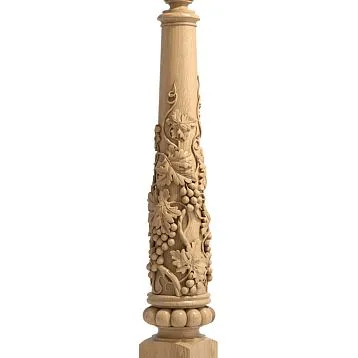
Hand carving remains the unmatched method for creating unique artistic works. Moscow master carvers continue the traditions of Russian wooden architecture, crafting balusters with floral ornaments, geometric patterns, and narrative compositions. Each piece becomes a unique work of art.
Protective Treatment and Final Coatings
Quality protective treatment determines the longevity of wooden balusters. Antiseptic impregnation protects wood from biological damage, fire-retardant treatment increases the fire resistance class of the structure. Modern compositions provide comprehensive protection with minimal impact on the wood's appearance.
Priming creates a base for high-quality application of finish coatings. Special primers for coniferous species block resin exudation, preventing stains on the surface. Primers for hardwoods improve coating adhesion and level the wood's absorption capacity.
Finish coatings not only protect wood but also highlight its natural beauty. Lacquer coatings create a durable protective film and provide surfaces with varying degrees of gloss. Oil-based coatings penetrate the wood structure, emphasizing texture and creating a natural look. Wax-based compositions offer pleasant tactile sensations and are easily repairable upon damage.
Design Solutions and Stylistic Directions
Classical styles in modern interpretation
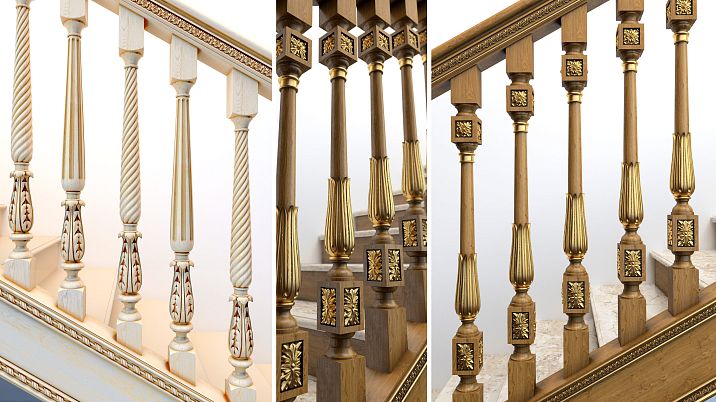
Classic style in wooden baluster design is based on principles of ancient architecture — proportionality, symmetry, and harmony. Moscow manufacturers offer a wide selection of balusters in classic style: from strict Doric forms to lavish Corinthian compositions with floral motifs.
Baroque balusters are characterized by exceptional expressiveness and dynamic forms. Complex profiles with alternating convex and concave elements create play of light and shadow, giving the items volume and expressiveness. Decorative elements — volutes, cartouches, garlands — transform each baluster into a miniature work of art.
Empire style is characterized by strict forms and grand composition. Balusters in Empire style feature clear geometry, symmetrical proportions, and restrained decoration. Primary motifs include laurel wreaths, torches, eagles, and other symbols of power and victory.
Modern design trends
Minimalist approach to baluster design implies maximum simplification of forms while preserving functionality and aesthetic expressiveness. Simple geometric cross-sections — square, rectangular, cylindrical — create a strict vertical rhythm. Beauty is achieved through perfect proportions and surface finish quality.
Scandinavian style is characterized by minimalist forms and functionality. Light-colored woods — birch, maple, beech — create a sense of purity and freshness. Simple shapes, natural colors, and minimal decorative elements define this style. Special attention is paid to surface finish quality and material eco-friendliness.
Loft style brings industrial aesthetics into interiors. Balusters may combine wood with metal, feature intentionally rough surface finishes, or imitate aged materials. Contrasting combinations of different textures create expressive compositions.
Practical aspects of selection and purchase
Criteria for quality assessment
Wood moisture is the first criterion for evaluating baluster quality. Properly dried wood has a moisture content of 8–12%, ensuring dimensional stability of finished products. Exceeding these values may lead to deformation, cracking, and weakening of joints during use.
Geometric accuracy of products is controlled by specialized measuring tools. Linear dimension deviations must not exceed ±1 mm, straightness deviations — no more than 1 mm per meter of length. Surface quality is assessed by roughness parameter, which must not exceed 1.25 microns for items intended for transparent finish.
Absence of wood defects is critically important for structural safety. Knots, cracks, rot, and insect damage may become stress concentrators and lead to element failure under load. Quality balusters are manufactured only from first-grade wood without visible defects.
Calculate requirements and plan procurement
The number of balusters is calculated based on the length of the staircase and requirements for maximum spacing between elements. Building codes set the maximum distance between baluster axes at 150 mm, but for families with young children, it is recommended to reduce this distance to 120 mm.
When planning procurement, it is important to account for a technological reserve for potential damage during transportation or installation. It is recommended to order 5–10% more than the calculated quantity. For complex carved items, this reserve may be increased to 15%.
Manufacturing lead times vary depending on product complexity and production load. Standard turned balusters are manufactured in 3–7 working days, complex carved compositions may require 2–3 weeks. When planning repairs, these lead times must be considered and orders should be placed in advance.
Installation and mounting of wooden balusters
Preparation Work
Quality installation begins with careful preparation of the base. The surface of steps or the baluster base must be flat, clean, and dry. Any irregularities may lead to poor element fit and gaps. Base moisture must not exceed 12%.
Marking installation locations is performed with high precision. Laser levels, rulers with millimeter divisions, squares, and other precision tools are used. Each mark is checked twice to eliminate cumulative measurement errors.
Preparation of mounting holes requires use of quality tools and adherence to technology. Drill bits must be sharp and match the fastener diameter. Hole depth is controlled by special limiters or marks on the drill bits.
Methods of mounting
Mounting on wooden dowels is a traditional joinery method. Dowels with diameters of 8–12 mm are made from hardwoods and installed with adhesive. Such a connection ensures high strength and durability when properly executed.
Metal dowels with diameters of 6–10 mm provide secure mounting with the possibility of adjusting element positions. Threaded dowels are screwed into the baluster end using wood glue, and the protruding part is secured in the base.
Hidden mounting with self-tapping screws is performed at an angle through the end surfaces of balusters. This method does not compromise the aesthetics of the product but requires high skill from the installer. Screw locations are masked with wooden plugs or putty.
Care and maintenance of wooden balusters
Regular Maintenance
Daily care for wooden balusters involves removing dust with a dry soft cloth or vacuum cleaner with a soft attachment. Special attention should be paid to carved elements and recesses where dust may accumulate. Use of anti-static agents prevents rapid re-dusting.
Weekly wet cleaning is performed with slightly damp cloth without using aggressive cleaning agents. Excessive moisture may cause wood deformation and coating damage. After wet cleaning, the surface should be wiped dry and the room should be well ventilated.
Monthly inspection allows identifying possible coating defects, loosening of fasteners, cracks, or other damage. Timely detection of problems enables their elimination with minimal time and cost.
Preventive Maintenance
Updating protective coating is performed as needed, typically every 3–5 years depending on usage intensity and environmental conditions. Before applying a new coating, the surface must be thoroughly cleaned and, if necessary, lightly sanded with fine abrasive.
Fastener connections are checked annually. Loose connections are tightened, damaged fasteners are replaced. Special attention is paid to connections subjected to high loads — support posts and handrail mounting points.
Protection against pests includes regular treatment of wood with special compositions. Modern preparations provide long-term protection against insects and fungal damage with minimal impact on humans and the environment.
Economic aspects of purchasing
Analysis of ownership cost
When selecting wooden balusters, it is important to consider not only initial cost but also operating expenses over the entire service life. High-quality items made from hardwoods require higher initial investment but provide significant savings on maintenance and repairs.
Maintenance costs include expenses for regular cleaning, coating renewal, and replacement of worn elements. For wooden balusters, primary expenses are associated with renewing lacquer coatings every 3–5 years. High-quality coatings last longer and require less maintenance expenditure.
Residual value of quality wooden balusters remains high due to their longevity and aesthetic qualities. During reconstruction or relocation, such items may be dismantled and reused, partially offsetting initial costs.
Cost Optimization
Purchasing balusters directly from the manufacturer allows saving 20–30% compared to retail prices. Many Moscow manufacturers offer flexible discount systems depending on order volume. When ordering a complete set of staircase elements, discounts may reach 40%.
Choosing optimal price-to-quality ratio requires careful analysis of market offers. Not always the most expensive items offer the best value for consumer properties and cost. It is important to consider manufacturer reputation, warranty obligations, and service quality.
Planning purchases during seasonal sales allows additional savings. Many manufacturers offer discounts during winter when demand for construction materials decreases. Advance planning of repairs allows taking advantage of such offers.
Market Development Trends
Technological Innovations
The integration of digital technologies into the production of wooden balusters opens up new possibilities for creating unique items. CNC machines allow for reproducing the most complex shapes with perfect accuracy. Laser cutting and engraving create opportunities for personalizing items.
3D modeling allows the client to see future balusters in the interior even before production begins. Virtual reality enables one to "walk" along a staircase with installed balusters and assess their conformity to the overall style of the room.
Automation of production processes improves quality and reduces the cost of items. Robotic systems ensure consistent surface processing quality, dimensional accuracy, and repeatability of shapes. This is especially important when manufacturing large batches of items.
Ecological trends
Growing attention to ecological issues stimulates the use of wood from sustainably managed forests. FSC certification guarantees that the material is obtained in accordance with strict ecological and social standards. Moscow manufacturers are increasingly offering certified products.
Water-based, non-toxic coatings gradually replace traditional compositions with organic solvents. They do not emit harmful substances, dry quickly, and provide quality wood protection. This is especially important for residential spaces with children and allergy sufferers.
Waste recycling technologies allow using almost all wood received for production. Shavings and sawdust are used to produce fuel briquettes, while small offcuts are used for making glued blanks. This approach reduces environmental impact and product cost.
Conclusion
Moscow's market offers exceptional opportunities for those who have decided buy wooden balusters in MoscowThe variety of offerings, high product quality, and competitive prices make the capital an ideal place to purchase staircase elements of any complexity. From simple turned items to exclusive carved compositions — every buyer will find a solution that meets their needs and budget.
Choosing wooden balusters requires a comprehensive approach, taking into account not only aesthetic preferences but also technical characteristics, usage conditions, and installation specifics. Quality items from reputable manufacturers ensure the longevity, safety, and beauty of the staircase structure for many years.
Investing in premium wooden balusters pays off not only through durability and functionality, but also through the unique atmosphere of comfort and elegance they create in the home. Each baluster, crafted with an understanding of traditions and utilizing modern technologies, becomes part of an architectural heritage passed down to future generations.
The future of the wooden baluster market in Moscow is linked to further development of technologies, expansion of the range of eco-friendly materials, and improvement of service quality. Customers gain access to the most modern solutions in woodworking and design, enabling the creation of unique interiors of world-class quality.
STAVROS holds leading positions in the Moscow market for wooden staircase elements, offering clients a wide range of quality products and professional services. Years of experience, modern equipment, and a team of highly skilled specialists enable STAVROS to create items that surpass the highest customer expectations in terms of quality, beauty, and durability.