












































































Article Contents:
- Comparison with alternative materials
- Phytopolymer vs MDF
- Phytopolymer vs PVC
- Phytopolymer vs Ordinary Polyurethane
- Phytopolymer vs Gypsum
- Price per Linear Meter: Real Cost
- Factors affecting the price
- Price List for Standard Hi Wood Profiles
- Cost Calculation for a Typical Apartment
- Labor Costs for Installation: Time and Money
- DIY Installation vs Professionals
- Cost of Professional Installation
- Complex Cases Increasing Labor Costs
- Repairability: Replacement vs Restoration
- Local Repair of Damage
- Replacing Damaged Sections
- Repainting for Refreshment
- Restoration of Relief
- Lifespan: Investment for Decades
- Warranty Period vs Actual Lifespan
- Factors affecting durability
- Material Degradation Over Time
- Moral Deterioration vs Physical
- TCO of Interior: Calculating for 20 Years
- Scenario 1: PVC (Budget)
- Scenario 2: MDF (Mid-Budget)
- Scenario 3: Phytopolymer (Optimal)
- Scenario 4: Premium Phytopolymer (Classic)
- Conclusions from TCO Analysis
- Hidden Factors of Savings
- No Secondary Repairs Required
- Versatility for Different Styles
- Moisture Resistance = No Risk of Replacement
- Ecological = Healthy
- Recommendations for selection
- For a limited budget
- For a medium budget
- For a high budget
- For humid rooms
- For families with children
- FAQ: Economic Questions
- Advantages of Purchasing Through STAVROS
- Conclusion
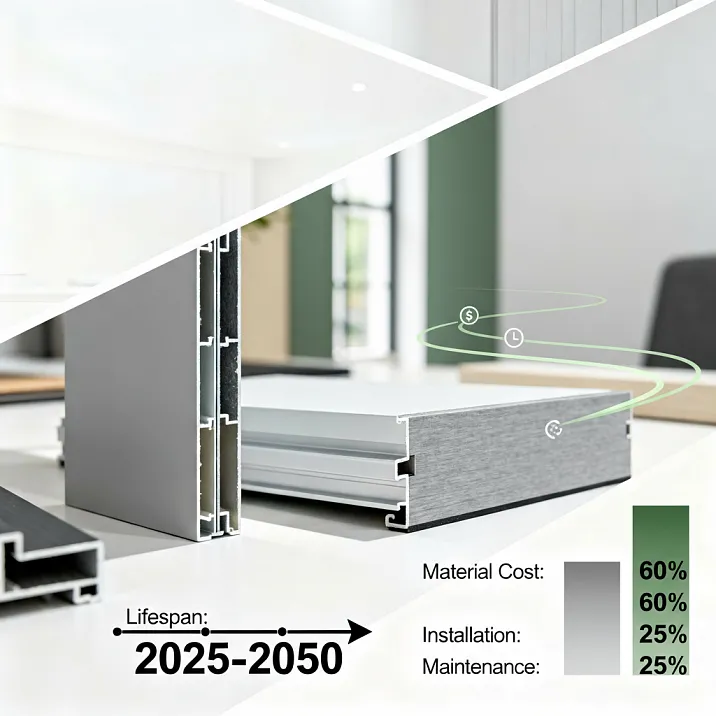
Choosing decorative profiles for interior design is not only an aesthetic question, but also an economic calculation. An inexpensive material may turn out to be costly to repair after several years, while the apparent cost of a quality profile pays off over decades of flawless service. The concept of TCO (Total Cost of Ownership - Total Cost of Ownership) applies not only to cars and appliances, but also to interior elements.
Baseboard made of fitopolymer pricewhich, at first glance, appears more expensive than alternatives made of MDF or PVC, turns out to be a more cost-effective solution upon detailed analysis. Fitopolymer profiles from STAVROS's partner, Hi Wood manufacturer, combine reasonable cost with exceptional durability, ease of installation, and minimal maintenance requirements.
In this article, we will conduct a detailed comparison of fitopolymer with alternative materials, analyze the actual cost including installation and operation, assess repairability, and calculate the total cost of ownership over a 10-20 year horizon. Residents of Moscow, the Moscow region, St. Petersburg, and Leningrad Oblast can obtain precise calculations and commercial proposals from STAVROS specialists for their specific projects.



Comparison with alternative materials
Several main materials are available on the market for decorative profiles, each with its own advantages and disadvantages. An objective comparison requires consideration not only of the initial price, but also of characteristics affecting durability and operation.




Fitopolymer vs MDF
MDF (fine wood particle) - a common material for baseboards and moldings.Comparison of fitopolymer and MDFshows significant differences in key characteristics.
Moisture resistance: MDF, even moisture-resistant, swells, deforms, and delaminates at the ends upon prolonged contact with water. Fitopolymer is completely moisture-resistant - does not absorb water, retains its geometry even when fully submerged. This is critical for bathrooms, kitchens, and ground-floor rooms with a risk of leaks.
Mechanical strength: MDF is relatively brittle - easily chips upon impact, especially at corners and ends. Fitopolymer is elastic, does not crack under impact, and is resistant to mechanical damage. This is important in hallways, children's rooms, and high-traffic areas.
Geometric stability: MDF may deform due to temperature and humidity fluctuations, especially long profiles. Fitopolymer maintains its geometry over a wide range of conditions - from +5°C to +80°C, at humidity levels of 0-100%.
Processing capabilities: MDF can be cut, but it is difficult to process ends - they are loose and require putty and careful sanding. Fitopolymer cuts cleanly, ends are dense and require no additional processing. This simplifies and speeds up installation.
Ecological safety: MDF contains formaldehyde resins (E1 or E0 emission class) that may be released into the air. Fitopolymer is ecologically neutral, holds Korea Eco-Label class A+ certification, and is safe for living spaces and children's rooms.
Price: MDF baseboards cost 150-350 rubles per linear meter depending on height and decor. Hi Wood fitopolymer profiles - 280-650 rubles per meter. Initial price is 30-50% higher, but considering durability, fitopolymer is more economical.
Conclusion: MDF is suitable for dry rooms with low mechanical load. For all other cases, fitopolymer is preferable due to its moisture resistance, strength, and durability.
Our factory also produces:





Fitopolymer vs PVC
PVC (polyvinyl chloride) - the most budget-friendly material for decorative profiles. Comparison with fitopolymer shows why low price is not always advantageous.
Appearance: PVC profiles often have a cheap plastic look, especially noticeable on glossy surfaces. After painting, fitopolymer is indistinguishable from plaster molding - noble matte surface, clear relief.
Decorative possibilities: PVC is usually produced in ready-made colors (white, wood-like), repainting is difficult - paint does not adhere well to smooth plastic surfaces. Fitopolymer is designed for painting - paint adheres excellently and lasts for decades, allowing any color solution to be implemented.
Mechanical strength: PVC is rigid but brittle - cracks under impact, especially at low temperatures. Fitopolymer is elastic, absorbs impacts without breaking. In practice, this means fewer damages during operation.
Ecological safety: PVC may release chlorine-containing compounds when heated. Fitopolymer is ecologically neutral at any operating temperature.
Profile variety: PVC is limited to simple shapes - complex reliefs are technically difficult. Fitopolymer allows creating profiles of any complexity - from simple rectangles to richly decorated classic profiles.
Jointing: PVC profiles are often connected with plastic connectors, which are visible and spoil the appearance. Fitopolymer is glued edge-to-edge with sealing of joints — connections after painting are not noticeable.
Price: PVC skirting boards cost 80-200 rubles per meter. Fitopolymer — 280-650 rubles. The difference is significant, but quality and appearance are incomparable. PVC is suitable for temporary budget repairs, while fitopolymer is for quality interiors lasting decades.
Conclusion: PVC is justified only in cases of extremely limited budget and absence of aesthetic requirements. For all other cases, fitopolymer is preferable.
Get Consultation
Fitopolymer vs. regular polyurethane
Regular polyurethane (low-density foam) — a common material for decorative profiles. Fitopolymer — an improved version of polyurethane with the addition of natural fillers.
Density: Regular polyurethane has a density of 400-500 kg/m³, fitopolymer — 680 kg/m³. Higher density means greater strength, better dimensional stability, and sharper relief detail.
Surface quality: Polyurethane may have micro-pores on the surface, requiring spackling before painting. Fitopolymer has a dense, uniform structure, ready for painting after light sanding.
Detail clarity: On polyurethane profiles, fine relief details may be blurred and indistinct. Fitopolymer retains even the finest ornament details due to its high density.
Resistance to deformation: Polyurethane, under prolonged load (e.g., heavy wide cornice), may slightly sag. Fitopolymer is stiffer and maintains geometry even over large spans.
Ecological properties: Regular polyurethane has a mild chemical odor, especially noticeable when unpacked. Fitopolymer is virtually odorless due to natural fillers and has the highest ecological class.
Price: Regular polyurethane costs 200-450 rubles per meter. Fitopolymer — 280-650 rubles. The difference is 20-30%, which is justified by significantly better performance.
Conclusion: Regular polyurethane is a good solution, but fitopolymer surpasses it in all parameters. A small additional cost yields a noticeable quality improvement.
Fitopolymer vs. gypsum
Gypsum molding — a traditional material with a centuries-long history. Comparison with fitopolymer shows why modern material is preferable in many aspects.
Weight: Gypsum is heavy — a 150 mm wide cornice per meter weighs 5-8 kg. Fitopolymer of the same size weighs 0.8-1.2 kg. This simplifies installation, reduces wall load, and eliminates the risk of heavy profiles detaching.
Brittleness: Gypsum is brittle — easily cracks under impact and crumbles at corners. Fitopolymer is elastic and resistant to mechanical damage. During transportation and installation, gypsum has a significantly higher defect rate.
Moisture resistance: Gypsum absorbs moisture and deteriorates in damp areas, developing mold. Fitopolymer is completely moisture-resistant and suitable for any conditions.
Installation: Gypsum elements require professional installation — heavy parts are mounted with self-tapping screws and additional adhesive, joints are carefully spackled. Fitopolymer is easily installed with adhesive and can be handled even by a non-professional.
Cost: Gypsum molding costs 800-2500 rubles per linear meter depending on complexity. Fitopolymer — 280-650 rubles. Gypsum is 2-4 times more expensive with worse performance characteristics.
Gypsum's advantage: Only one — authenticity for restoring historical interiors. In modern conditions, fitopolymer surpasses gypsum in all practical parameters.
Conclusion: For new interiors, fitopolymer is preferable to gypsum — lighter, stronger, cheaper, and easier to install. Gypsum is justified only for restoration or special aesthetic requirements.
Price per linear meter: real cost
Understanding pricing for fitopolymer profiles helps correctly plan the repair budget and avoid unjustified overpayments.
Factors affecting price
Profile size: The wider (for cornices and moldings) or taller (for skirting boards) the profile, the higher the price. A 80 mm skirting board costs 280-350 rubles per meter, 120 mm — 400-500 rubles, 160 mm — 550-650 rubles. Price increases proportionally to material volume.
Relief complexity: Smooth profiles without decoration are cheaper than ornate ones. A simple rectangular 100 mm skirting board costs 320-380 rubles, a profile of the same height with classic ornament — 450-550 rubles. Complex relief requires more expensive molds and greater material consumption.
Manufacturer brand: Hi Wood — a premium manufacturer with strict quality control, reflected in the price. Hi Wood profiles cost 15-25% more than unnamed Chinese analogs, but quality is incomparable — material density, relief clarity, absence of defects.
Profile length: Standard length — 2 or 2.4 meters. 2.4 m profiles are usually 5-10% more expensive per meter due to more complex production and transportation, but more economical during installation — fewer joints.
Special features: Flexible profiles for curved surfaces, profiles with grooves for LED lighting, moisture-resistant profiles with increased density cost 20-40% more than standard ones due to special manufacturing technology.
Hi Wood standard profile price list
Buy fitopolymer cornicein the following price range (prices per linear meter):
-
Smooth cornice 60-80 mm: 320-420 rubles
-
Cornice 90-110 mm with light relief: 450-580 rubles
-
Cornice 120-150 mm with classic decoration: 650-850 rubles
-
Cornice 160-200 mm with rich ornament: 950-1400 rubles
Cost of polyurethane moldingis:
-
Smooth molding 20-30 mm: 180-250 rubles
-
Molding 40-60 mm with light decoration: 280-380 rubles
-
Molding 70-100 mm with classic relief: 420-580 rubles
-
Flexible molding for arches: +30-50% to the price of similar straight molding
Baseboards:
-
Baseboard 60-80 mm smooth: 280-350 rubles
-
Baseboard 90-110 mm with light relief: 380-480 rubles
-
Baseboard 120-140 mm with decoration: 500-620 rubles
-
Baseboard 150-180 mm with rich ornament: 680-850 rubles
These prices are valid for Moscow and St. Petersburg when purchased through an official STAVROS partner. Prices include VAT but do not include delivery and installation.
Cost calculation for a standard apartment
Consider a two-room apartment of 60 sq.m with a wall perimeter of 40 meters and ceiling height of 2.7 m.
Variant 1 - minimalism (simple profiles):
-
Baseboard 80 mm: 40 m × 320 rubles = 12,800 rubles
-
Cornice 70 mm: 40 m × 380 rubles = 15,200 rubles
-
Total materials: 28,000 rubles
Variant 2 - neoclassicism (medium profiles):
-
Baseboard 110 mm: 40 m × 450 rubles = 18,000 rubles
-
Cornice 100 mm: 40 m × 520 rubles = 20,800 rubles
-
Molding for accent wall: 12 m × 350 rubles = 4,200 rubles
-
Total materials: 43,000 rubles
Variant 3 - classic (large profiles with decoration):
-
Baseboard 140 mm: 40 m × 580 rubles = 23,200 rubles
-
Crown 130 mm: 40 m × 720 rub. = 28,800 rub.
-
Molding on panels: 60 m × 450 rub. = 27,000 rub.
-
Corner elements, outlets: 8,000 rub.
-
Total materials: 87,000 rub.
The cost of materials must include adhesive (1,500–2,500 rub.), sealant (800–1,200 rub.), paint (3,000–5,000 rub.). The total cost of materials for a standard apartment ranges from 33,000 to 97,000 rubles depending on style and complexity.
Installation labor: time and money
Installation cost is often comparable to material cost, so this factor is critically important for the overall budget.
DIY vs. professionals
Hi Wood polymeric profiles are relatively easy to install — a person with basic repair skills can handle them. Required tools: circular saw or miter gauge, tape measure, pencil, adhesive, sealant, putty knife, sandpaper.
Installation time for a standard two-room apartment (40 meters of profiles):
Baseboards and crowns without moldings:
-
Marking, trimming, installation: 6–8 hours for a non-professional
-
Sealing joints, patching defects: 2–3 hours
-
Painting in 2 coats: 4–5 hours (including drying time — 2 days)
-
Total: 12–16 working hours over 3–4 days
With moldings and panels:
-
Marking complex composition: 2–3 hours
-
Installing profiles: 12–15 hours
-
Sealing: 3–4 hours
-
Painting: 6–7 hours
-
Total: 23–29 working hours over 5–6 days
When installing yourself, you save 100% of labor cost, but you need time, tools, and willingness to accept possible mistakes. For the first time, it is recommended to start with simple profiles in a small room.
Cost of Professional Installation
Installation rates in Moscow and St. Petersburg:
-
Baseboard installation: 200–300 rub./m
-
Crown installation: 250–350 rub./m
-
Molding installation: 220–320 rub./m
-
Trimming corners at 45°: +50 rub./corner
-
Outlet and corner element installation: 300–500 rub./piece
-
Profile painting: 150–250 rub./m
For a standard two-room apartment:
Minimalist variant:
-
Installation of 80 m profiles: 18,000–24,000 rub.
-
Painting: 12,000–20,000 rub.
-
Total work: 30,000–44,000 rub.
Neoclassical variant:
-
Installation of 92 m profiles: 21,000–29,000 rub.
-
Painting: 14,000–23,000 rub.
-
Total work: 35,000–52,000 rub.
Classic variant:
-
Installation of 140 m profiles + elements: 34,000–48,000 rub.
-
Painting: 21,000–35,000 rub.
-
Total work: 55,000–83,000 rub.
Professional installation guarantees quality, saves time, ensures perfect joints and angles. For complex compositions with many elements, professionals are preferred.
Complex cases increasing labor costs
Uneven walls: If walls have deviations exceeding 5 mm per meter, additional leveling or flexible adhesive compensating for unevenness is required. This increases installation time by 30–50%.
Curved elements: Arches, bay windows, columns require flexible profiles and special installation techniques. The cost of work increases 1.5–2 times compared to straight sections.
Complex multi-level compositions: Coffered ceilings, multi-tiered wall panels require precise marking and a large number of cuts. Work time increases 2–3 times.
Tensioned ceilings: Installing cornices on walls with already installed tensioned ceilings requires special care. The cost of work increases by 20–30%.
Repairability: replacement vs. restoration
The ability of decorative elements to be repaired and restored affects long-term costs.
Local repair of damage
Phytopolymer profiles are easily repairable. Small scratches are filled with acrylic putty, sanded, and repainted — after repair, damage is not noticeable. Repair time for one scratch — 30–40 minutes, material cost — 50–100 rubles.
Corner chips are also repaired with putty. For deep damage, two-component epoxy putty is used, which after curing is stronger than the phytopolymer itself. Repairing a chip — 1–1.5 hours, material cost — 150–200 rubles.
MDF is harder to repair — chipped areas are loose, putty doesn’t hold well. Often, it’s easier to replace the damaged section than repair it. PVC is practically unreparable — cracks cannot be filled, only replacement is possible.
Replacement of damaged sections
If damage is too extensive for repair, a section of the profile can be replaced. The damaged section is cut out, a new piece is glued in its place, seams are sealed, and the section is painted.
Cost of replacing 1 meter of profile includes:
-
Material: 300–700 rub. (depends on profile)
-
Work (if done by yourself is not possible): 800–1200 rub.
-
Total: 1100–1900 rub.
Important advantage of phytopolymer: you can purchase an identical profile years later — manufacturers support collections for decades. With MDF and PVC, it’s more difficult — designs change, finding an identical profile after 5–7 years is problematic.
Repainting for refresh
The simplest way to update the interior is to repaint the profiles. Fitopolymer repaints well multiple times. The old paint is lightly sanded (grit 220-240), the surface is primed, and new paint is applied in two layers.
PVC repaints poorly - the smooth surface requires a special plastic primer, and the paint adheres worse. MDF repaints well, but if the finish was laminated, the laminate must be removed.
PVC is difficult to repaint — the smooth surface requires a special plastic primer, and the paint adheres poorly. MDF repainting works well, but if the finish was laminated, the laminate must be removed.
Relief Restoration
The cost of restoring 1 meter of profile with complex relief is 300-500 rubles for labor plus materials. This is still cheaper than full profile replacement.
The cost to restore 1 meter of profile with complex relief — 300–500 rubles for labor plus materials. This is still cheaper than full profile replacement.
Service life: an investment for decades
Durability is the key factor of economic efficiency. A material that lasts twice as long is twice as cost-effective, all else being equal.
Warranty period and actual service life
Hi Wood provides a 25-year warranty on the preservation of the physical properties of fitopolymer. This means the material will not lose strength, deform, or crack within a quarter of a century under normal operating conditions.
Actual service life is significantly longer. With proper installation and painting with quality paints, fitopolymer profiles last 40-50+ years, comparable to the lifespan of the building itself.
For comparison:
-
MDF: 10-15 years in dry rooms, 5-8 years in humid areas
-
PVC: 8-12 years (yellowing, becoming brittle)
-
Standard polyurethane: 15-20 years
-
Gypsum: 30-50 years (but brittle, requires careful handling)
-
Fitopolymer: 40-50+ years
Factors affecting longevity
Installation quality: Properly installed profiles with sealed joints last the longest. Poor installation with gaps and no sealing reduces service life by 30-50%.
Painting quality: Good paint protects profiles from dirt, mechanical impacts, and UV radiation. Cheap paint fades and flakes after 3-5 years, requiring repainting. Quality latex paint lasts 10-15 years.
Operating conditions: In dry, heated rooms, profiles last the longest. In humid areas, with temperature fluctuations and heavy mechanical loads, service life is slightly reduced, but fitopolymer still outperforms alternatives.
Maintenance: Regular dust cleaning and timely removal of dirt extend service life. Profiles that are neglected look worse and require more frequent repainting.
Material degradation over time
Fitopolymer: Almost no degradation. After 20-30 years, profiles look the same as after installation (provided timely repainting). Density, strength, and relief clarity are preserved.
MDF: After 10-15 years, may begin to delaminate, especially ends. Degradation is faster in humid areas. Requires replacement every 12-18 years on average.
PVC: Yellowing from UV radiation after 5-8 years, becomes brittle. After 10-12 years, often cracks and requires replacement.
Gypsum: Does not degrade, but is brittle - gradually accumulates chips and cracks. Requires periodic restoration.
Moral aging vs. physical
Important point: Fitopolymer profiles may become outdated aesthetically before they physically degrade. After 15-20 years, you may want to change the interior style, while the profiles remain in excellent condition.
Solution: repaint in a different color, replace decorative profiles with minimalist ones (or vice versa). The cost of such modernization is 30-50% of the cost of full replacement, while main profiles (baseboards, cornices) can remain unchanged.
TCO of interior: calculated over 20 years
Total Cost of Ownership (TCO) - the most objective metric for comparing materials. Let's consider the TCO for a two-room apartment over a 20-year horizon.
Scenario 1: PVC (Budget)
Initial Costs (Year 0):
-
Materials: 15,000 rub.
-
Installation: 20,000 rub.
-
Total: 35,000 rub.
Replacement (Year 10):
-
Materials: 18,000 rub. (inflation-adjusted)
-
Installation: 24,000 rub.
-
Demolition of old profiles: 5,000 rub.
-
Total: 47,000 rub.
Local Repairs:
-
Replacement of damaged sections (Years 5, 15): 2 × 3,000 = 6,000 rub.
TCO over 20 years: 88,000 rub.
Average annual costs: 4,400 rub.
Scenario 2: MDF (Mid-range budget)
Initial Costs (Year 0):
-
Materials: 22,000 rub.
-
Installation: 28,000 rub.
-
Total: 50,000 rub.
Replacement (Year 12):
-
Materials: 28,000 rub.
-
Installation: 35,000 rub.
-
Demolition: 6,000 rub.
-
Total: 69,000 rub.
Local Repairs:
-
Replacement of damaged sections (Years 6, 18): 2 × 4,000 = 8,000 rub.
TCO over 20 years: 127,000 rub.
Average annual costs: 6,350 rub.
Scenario 3: Fitopolymer (Optimal)
Initial Costs (Year 0):
-
Materials: 43,000 rub.
-
Installation: 40,000 rub.
-
Total: 83,000 rub.
Repainting (year 12):
-
Materials (paint, primer): 5,000 rub.
-
Labor (can be done by yourself): 0-15,000 rub.
-
Total: 5,000-20,000 rub.
Local Repairs:
-
Minor damages (years 7, 15): 2 × 500 = 1,000 rub.
TCO over 20 years: 89,000-104,000 rub.
Average annual costs: 4,450-5,200 rub.
Scenario 4: Premium Phytopolymer (classic)
Initial Costs (Year 0):
-
Materials: 87,000 rub.
-
Installation: 68,000 rub.
-
Total: 155,000 rub.
Repainting (year 12):
-
Materials: 7,000 rub.
-
Labor: 0-25,000 rub.
-
Total: 7,000-32,000 rub.
Local Repairs:
-
Minor damages: 2,000 rub.
TCO over 20 years: 164,000-189,000 rub.
Average annual costs: 8,200-9,450 rub.
Conclusions from TCO analysis
-
PVC is cheaper only on a very short horizon. Over 20 years, its TCO is comparable to phytopolymer but with incomparably worse quality.
-
MDF is more expensive than phytopolymer due to the need for replacement after 12 years. The initial savings (28,000 rub.) are offset by recurring costs.
-
Phytopolymer is optimal in terms of price/quality/durability ratio. With moderate initial costs, it provides low TCO due to its longevity.
-
Premium phytopolymer with rich decor has a high TCO, but this is the cost of an exclusive appearance. For those who prioritize aesthetics, these are justified expenses.
-
DIY repainting reduces TCO by 15-20%. This is a real opportunity to save without compromising quality.
Hidden cost-saving factors
In addition to direct costs, there are indirect factors affecting economic efficiency.
No secondary repairs
Poor-quality MDF or PVC profiles often require replacement after 8-12 years. Replacing profiles is not just buying and installing — it is:
-
Clearing the room of furniture
-
Removing old profiles (dust, debris)
-
Possible damage to wall finishes during demolition
-
Repainting walls in demolition areas
-
Installation of new profiles
-
Cleanup after repair
The actual cost of such a mini-repair, taking into account all inconveniences, is 1.5-2 times higher than simply replacing the profiles. Phytopolymer eliminates this for 40-50 years.
Versatility for different styles
Phytopolymer profiles are easily repainted in any color. Want to change the interior style? Simply repaint the profiles, and they look fresh. No need to replace the profiles themselves.
MDF with a laminate surface 'wood' cannot be repainted without removing the laminate. Colored PVC profiles are also difficult to repaint. In practice, changing the style will require a full replacement. This adds an additional 50-80 thousand rubles.
Moisture resistance = no risk of replacement
Leak from upstairs neighbors, pipe burst - in such situations, MDF profiles swell and deform, requiring replacement. The cost of replacing profiles in one room is 15-25 thousand rubles.
Phytopolymer is absolutely moisture-resistant. After a leak, simply wipe the water away - the profiles remain in perfect condition. Savings on force majeure insurance.
Ecological safety = health
Ecologically clean materials reduce health risks. Formaldehyde from MDF, chlorine-containing compounds from PVC may cause allergies, respiratory problems, especially in children.
Phytopolymer with Korea Eco-Label A+ certification is absolutely safe. It's hard to quantify in money, but family health is priceless.
Selection recommendations
For a limited budget
If your budget is strictly limited, do not compromise on material quality - instead, simplify the design. Choose simple, smooth, minimal-sized phytopolymer profiles, install them yourself, and paint them yourself.
Initial costs will be comparable to MDF or PVC, but you will get the durability and quality of phytopolymer. Over 15-20 years, this is the most economical solution.
For a medium budget
The optimal choice is medium-sized, non-classical profiles with moderate decoration. You can hire professionals for installation, and do the painting yourself - this will save 15-20 thousand rubles while guaranteeing quality installation.
Total cost for a two-room apartment - 80-110 thousand rubles. Result - an elegant interior for 40+ years.
For a high budget
With a high budget, choose classic profiles with rich decoration, and entrust the entire process to professionals. Use complex compositions with molding panels, outlets, pilasters.
Cost - 150-250 thousand rubles for an apartment. Result - an exclusive interior that will delight for decades and remain fashionable.
For humid rooms
For bathrooms, kitchens, balconies, definitely choose phytopolymer. Saving on MDF or PVC will result in replacement every 5-8 years. Phytopolymer will last 40+ years under any conditions.
For families with children
Choose phytopolymer due to its strength and ecological safety. Children often hit profiles with toys, bicycles - phytopolymer will withstand it. And ecological safety is critical for children's rooms.
FAQ: Economic questions
Is it worth paying extra for phytopolymer if you can buy MDF twice as cheap?
Over 15-20 years, phytopolymer is more economical than MDF due to its durability. The 'extra cost' is offset by the absence of replacements. Plus, moisture resistance, strength, and ecological safety.
Is it advisable to save money by purchasing an inexpensive fiber polymer from an unknown manufacturer?
Not recommended. Inexpensive fiber polymer often has low density (400-500 kg/m³ versus 680 kg/m³ for Hi Wood), unclear relief, surface defects. Saving 20-30% will result in problems during installation and operation.
What portion of the renovation budget should be allocated to decorative profiles?
Usually 3-5% of the total renovation budget. For an apartment with a renovation budget of 2 million rubles, it is reasonable to allocate 60,000 to 100,000 rubles for quality profiles.
When is it justified to save money on DIY installation?
For simple profiles (baseboards, cornices without complex compositions) in rooms with straight walls. Saving 30,000-40,000 rubles for a two-room apartment. For complex compositions, it is better to hire professionals.
Is it worth saving on paint for profiles?
No. Quality latex paint lasts 10-15 years, while cheap paint requires repainting every 3-5 years. The price difference is 1,000-1,500 rubles, and in the long run, quality paint is more economical.
How often should fiber polymer profiles be repainted?
When using quality paint — every 10-15 years. It can be done less frequently if the appearance is satisfactory. This is much less frequent than repainting walls (usually every 7-10 years).
Does the color of profiles affect durability?
Dark colors fade faster than light colors under intense sunlight. However, quality lightfast paints minimize this effect. Overall, the impact is insignificant.
Can fiber polymer profiles be installed in an apartment for rental?
Yes, it is reasonable. Fiber polymer is durable, resistant to careless handling, easy to clean and repair. Over 5-7 years of rental, the profiles will retain their appearance and not require replacement.
Advantages of purchasing through STAVROS
STAVROS, as an official Hi Wood partner in Moscow, the Moscow region, St. Petersburg, and Leningrad region, offers the optimal price-to-quality ratio.
Direct deliveries from the manufacturer without intermediary markup. Prices are 10-15% lower than in retail stores, with a guarantee of original quality.
Flexible discount system: 5% discount for orders over 50,000 rubles, 7% for orders over 100,000 rubles, 10% for orders over 200,000 rubles. Special partner terms for designers and contractors.
Free delivery for orders over 30,000 rubles in Moscow and St. Petersburg. Delivery to the region at preferential rates.
Accurate calculation of quantities by STAVROS specialists minimizes leftovers and overpayment. Calculations are performed based on room plans, taking into account all features.
Assistance in selecting complementary materials: adhesive, sealant, paint, primer. Recommendations for proven brands optimal for fiber polymer.
Quality guarantee on all Hi Wood products — 25 years for preservation of physical properties. Free replacement if defects are found.
Installation consultations: detailed instructions, video tutorials, answers to questions. Recommendations for proven installation crews if needed.
Conclusion
Economic analysis unequivocally shows:Baseboard made of fitopolymer pricewhich is 30-50% more expensive than budget alternatives, but when calculating TCO over 15-20 years, it proves more cost-effective due to exceptional durability and minimal operating costs.
Buy fitopolymer cornice— meaning investing in quality for decades ahead. One-time costs for material and installation are offset by the absence of replacements, ease of repair, and the possibility of multiple repaints for interior updates.
Cost of polyurethane molding— fully justified by a complex set of advantages: moisture resistance, mechanical strength, eco-friendliness, and aesthetic qualities.Comparison of fitopolymer and MDFor other alternatives demonstrates the superiority of the first option in all critical parameters.
The correct economic approach is to look not at the initial price, but at the total cost of ownership. Fiber polymer profiles from Hi Wood, available through the official partner STAVROS in Moscow, the Moscow region, St. Petersburg, and Leningrad region, represent an optimal balance of reasonable costs and exceptional quality, serving for more than a decade.
Invest in quality that pays off over time — choose fiber polymer profiles from reputable manufacturers with professional support.


