Article Contents:
- Design geography: features of the capital market
- Moscow: dynamics and status
- St. Petersburg: aesthetics and sophistication
- Showrooms: where to see and touch
- Moscow: Kutuzovsky Prospekt
- St. Petersburg: Obvodny Canal Embankment
- What to look for in a showroom
- Modern designer furniture: 2026 styles
- Minimalism: Less Means More
- Scandinavian style: coziness and light
- Modern: Smoothness and Organic Design
- Eco-style: nature in the city
- Industrial and loft: urban aesthetics
- Author's collections for city apartments
- Compactness without compromise
- Space zoning
- Personalization of standard housing
- 2026 designer furniture trends: what's relevant
- Return to naturalness
- Individualization and customization
- Multifunctionality and transformation
- Bold colors and textures
- Return to classics in new interpretation
- Consultations with designers: how it works
- Initial consultation
- Concept development
- Detailing and production
- Online consultations for regions
- How to buy and order delivery
- Furniture selection
- Order Placement
- Production
- Delivery
- Assembly and Installation
- Frequently Asked Questions
- Conclusion
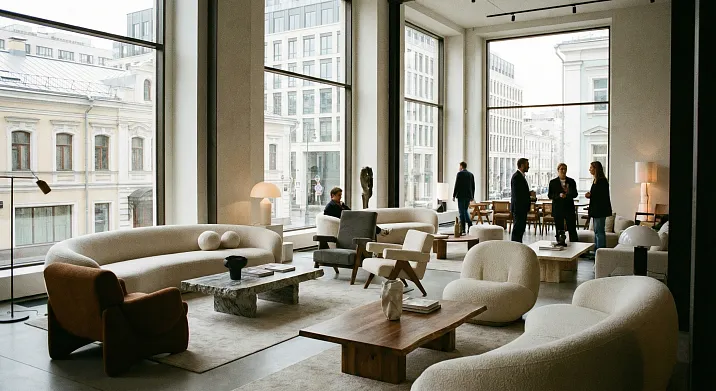
Moscow and St. Petersburg are capitals where culture, architecture, and design thought are concentrated. People with developed taste live here, demanding quality of their surrounding space.designer furniture moscowanddesigner furniture st. petersburg— requests reflecting the need for exclusive solutions beyond the mass market.
Standard furniture from hypermarkets satisfies basic needs but doesn't create atmosphere. An interior is made of details, each of which must be thought through, felt, and integrated into the concept.designer furniture buy in Moscow— means investing in uniqueness, rejecting clichés, creating a space that reflects individuality.
Why do metropolis residents choose designer furniture? Fatigue from uniformity. Standard apartments, standard offices, standard cafes — everywhere the same IKEA tables, chipboard chairs, faceless sofas. People want to stand out, surround themselves with objects that please the eye, evoke emotions, become conversation topics.
Modern designer furnitureresponds to the spirit of the times. Minimalism of forms, functionality, use of innovative materials, eco-friendliness. It doesn't shout, doesn't overload the space, but delicately complements, creating harmony. In city apartments where every meter counts, such furniture is especially relevant.




Design Geography: Features of the Capital Market
Moscow and St. Petersburg are cities with different energy, architecture, and mentality. This is reflected in interior design preferences.




Moscow: Dynamics and Status
Moscow is a city of contrasts. A historic center with imperial palaces, Stalinist skyscrapers, modern high-rises. Interior preferences range from luxurious classicism to urban loft.
Stalin-era apartments. High ceilings of 3-4 meters, enfilades of rooms, stucco. Owners of such apartments often choose classic or neoclassical furniture that emphasizes the historicity of the space. Massive dining tables, carved armchairs, solid oak display cabinets.
Premium-class new builds. Spacious apartments with open floor plans, panoramic windows. Modern style reigns here — minimalism, high-tech, Scandinavian. Furniture is light, transformable, with an emphasis on functionality.
Lofts and apartments. Converted industrial buildings, open spaces, brick walls. Furniture is industrial — a combination of wood and metal, rough textures, vintage elements.
The Moscow client is dynamic, values time. Wants something fast, high-quality, and expensive-looking. Status is important — furniture should convey success, taste, awareness of trends.
Our factory also produces:


St. Petersburg: Aesthetics and Refinement
St. Petersburg is the cultural capital. Palaces, canals, European atmosphere. Interior preferences lean towards classicism, modernism, eclecticism.
Old housing stock. Apartments in historic buildings — parquet floors, stucco, high windows. Furniture is selected with respect for the architecture — classic, modern, art deco.
New developments. Modern residential complexes on the outskirts. Scandinavian style is popular here — light tones, natural wood, simple forms.
Communal apartments and small-sized apartments. The historical heritage of St. Petersburg. Owners transform them into studios using compact, transformable furniture.
The St. Petersburg client is an aesthete. Values not so much status, but authenticity, historicity, artistic value. Willing to wait to get exactly what they want. Respects craftsmanship, handmade work, traditions.
Get Consultation
Showrooms: Where to See and Touch
Online catalogs are convenient, but furniture is a tactile item. You need to see the wood texture, feel the smoothness of the finish, sit on a chair, assess the table height. Showrooms solve this problem.
Moscow: Kutuzovsky Prospekt
The address of the showroom in Moscow is Kutuzovsky Prospekt, 12. A prestigious district, convenient transport accessibility. Nearby is Kievskaya metro station, parking for cars.
Showroom format. The exhibition presents collections of different styles. Classic zone — dining sets, armchairs, chests of drawers made of solid oak and walnut. Modern zone — tables in Scandinavian style, chairs of minimalist design, light shelving units.
What you can do at the showroom:
-
See furniture in person, assess proportions, colors, textures
-
Consult with a designer, discuss a project
-
Examine material samples — wood species, types of finishes, hardware
-
Order custom manufacturing according to an individual project
-
Pick up an item from the warehouse, if in stock
Working hours. Daily from 10:00 to 20:00. Advance booking is recommended — this allows the designer to prepare and give maximum attention.
Contacts. Phone +7 (495) 663-72-44. You can call to check the availability of items of interest, arrange a meeting.
St. Petersburg: Obvodny Canal Embankment
The address of the showroom and production facility in St. Petersburg is Obvodny Canal Embankment, 134, building 12. An industrial district, but with good accessibility. Narvskaya metro station, 15 minutes on foot. Parking on site.
Showroom format. This is not just an exhibition space, but also a production facility. You can see how furniture is created — workshops, machines, craftsmen at work. This builds trust — the client sees that behind the beautiful words there is real production.
Features of the St. Petersburg showroom:
-
More classic models — St. Petersburg loves traditions
-
Factory tour option — see the creation process
-
Technologist consultations — explain wood processing and coating nuances
-
Samples of different wood species — from familiar oak to exotic teak
Working hours. Monday-Friday 9:00-18:00, Saturday 10:00-17:00, Sunday closed. The production schedule is stricter than at the Moscow showroom.
Contacts. Phone +7 (812) 309-49-35. Advance booking is mandatory, especially if you want a factory tour.
What to look for in the showroom
Processing quality. Run your hand over the tabletop — it should be perfectly smooth, like silk. No burrs, roughness, or waves. This indicates quality sanding.
Joints and connections. Look at how parts are joined. Gaps are unacceptable. Elements should fit tightly, without cracks. Table apron to legs, chair back to seat — perfect fitting everywhere.
Coating. Uniform color, no drips, runs, or matte spots on gloss. The coating should be flawless — this is the factory's hallmark.
Functionality. Open dresser drawers — they should move smoothly, without sticking, quietly. Quality hardware — soft-close mechanisms, ball-bearing slides — is a sign of a serious manufacturer.
Stability. Try wobbling the table or chair. The construction should be rigid, without play or creaks. Solid wood furniture has substantial weight but should be stable.
Wood texture. Examine the grain. Oak has expressive annual rings, large pores. Beech has a uniform fine-pored structure. Walnut has a wavy, shimmering grain. Natural wood is unique — each piece is one-of-a-kind.
Modern designer furniture: 2026 styles
designer furniture modern style— a collective concept encompassing several directions. Let's examine current trends.
Minimalism: less is more
Minimalism philosophy — rejection of excess. Clean lines, simple forms, no decoration. Functionality above all.
Characteristics of minimalist furniture:
-
Geometric forms — rectangular tabletops, cubic cabinets, cylindrical legs
-
Neutral colors — white, gray, black, natural wood without tinting
-
No decorations — no carving, patina, gilding
-
Hidden fasteners — screws, bolts not visible, creating a monolithic impression
-
Integrated storage systems — handleless drawers, open with a push
Materials. Light-colored woods — ash, beech, birch. Oil finishes preserving natural grain. Wood-metal combinations — chrome-plated table legs, steel shelving frames.
For which interiors. Minimalism is ideal for small urban apartments. Lack of visual clutter expands space. Suits people who value order, conciseness, functionality.
Scandinavian style: coziness and light
Scandinavia gave the world the philosophy of hygge — coziness, warmth, comfort.Modern Furniture in this style embodies these values.
Characteristics of Scandinavian furniture:
-
Light wood — pine, birch, whitewashed oak
-
Simple but not primitive forms — tapered legs, rounded chair backs
-
Natural fabrics — linen, cotton, wool for upholstery
-
White color as a base — walls, ceilings, part of the furniture is white, wood is accent
-
Textile elements — blankets, pillows, rugs add coziness
Materials. Solid pine, birch, ash. Oil-wax coating that preserves naturalness. Avoid dark stains — wood should be light.
For which interiors. Universal. Suitable for apartments of any size, creating a sense of space and light. Especially relevant for northern cities with little sun — light tones compensate for lack of lighting.
Modern: smoothness and organic forms
Early 20th century Art Nouveau is experiencing a renaissance. Flowing lines, botanical motifs, asymmetry are returning to modern furniture.
Characteristics of Art Nouveau style furniture:
-
Curved lines — chair backs, table legs are not straight but with smooth curves
-
Organic forms — imitation of natural objects, plants
-
Decorative elements — but not overloaded, delicate
-
Combination of materials — wood, glass, metal in one piece
-
Elegant proportions — furniture is graceful but not fragile
Materials. Walnut, mahogany, stained ash. Varnish coating — gloss emphasizes the smoothness of lines. Inserts of colored glass, brass hardware.
For which interiors. Spacious apartments with high ceilings. Art Nouveau requires space to unfold. Suitable for aesthetes who value elegance, artistry, non-conformity.
Eco-style: nature in the city
Urbanization has intensified the craving for nature. Eco-style in interiors is a way to compensate for detachment from the natural environment.
Characteristics of eco-furniture:
-
Natural materials — solid wood without veneer, without plastic
-
Unprocessed textures — brushed wood with emphasized relief
-
Natural colors — all shades of wood, green, brown, beige
-
Eco-friendly coatings — plant-based oils, waxes without chemicals
-
Live edges — slab tabletops preserve natural edges with bark
Materials. Oak, ash, elm — species with expressive texture. Minimal processing — brushing, oil. Knots, cracks are not masked but become decoration.
For which interiors. Country houses, lofts, studio apartments. Eco-style combines with plants, natural materials in finishes — stone, brick.
Industrial and loft: urban aesthetic
Industrial aesthetics is reinterpreted in residential interiors. Rough textures, exposed structures, combination of wood and metal.
Characteristics of industrial furniture:
-
Massive forms — tables made of thick boards, heavy legs
-
Metal elements — frames of black steel, visible rivets, screws
-
Rough processing — wood is brushed, stained in dark tones
-
Wheels — mobility, the ability to move furniture
-
Vintage — artificial aging, patina
Materials. Oak, pine, reclaimed wood. Metal — matte black or rusty. Finish — oil that highlights the grain, or dark-toned staining.
For which interiors. Lofts, studios, spacious apartments with open floor plans. Industrial style requires high ceilings, open spaces.
Author's collections for city apartments
A city apartment is a special environment. Limited area, standard layout, specific tasks. Furniture should not just be beautiful, but maximally functional.
Compactness without compromises
Transformers. Folding tables that expand when hosting guests. Beds with a lift mechanism, hiding storage space. Console tables that turn into dining tables.
Modular systems. Shelving units whose configuration changes. Add a shelf — you get a bookcase. Remove one — free up space.
Multifunctionality. A coffee table with storage drawers. An ottoman with a flip-up seat, inside — a shoe rack. Every item performs several functions.
Space Zoning
Studios and studio apartments require visual zoning. Furniture helps achieve this.
Shelving-partitions. Open shelving divides space while remaining transparent. They don't eat up square footage, don't weigh down the interior.
Bar counters. Separate the kitchen from the living room. Simultaneously a dining area, work surface, breakfast spot.
Consoles behind the sofa. A narrow table behind the sofa back marks the boundary of the living area, serves as a surface for lamps, books, decor.
Personalization of standard housing
Standard apartments resemble each other. Furniture is a way to make them unique.
Custom design. A table based on your sketch. A dresser with a non-standard configuration. A shelving unit that fits perfectly into a niche.
Unusual materials. A tabletop made from a slab with live edges. Dresser fronts with inlay. Legs made from unfinished metal.
Accent pieces. One bright element transforms a standard interior. A designer chair with an unusual shape. An exclusive coffee table. A hand-carved mirror.
Trends in designer furniture 2026: what's relevant
Fashion is cyclical, but each year brings nuances. What's relevant in 2026?
Return to naturalness
Fatigue from plastic, synthetics, artificial materials. Consumers are returning to natural wood, stone, textiles.
Solid wood instead of veneer. Solid wood is more expensive but valued higher. Clients are willing to pay for naturalness.
Unfinished textures. Brushing that highlights the wood grain. Slabs with natural edges. Knots, cracks are not defects, but decorations.
Eco-friendly finishes. Plant-based oils and waxes are displacing chemical varnishes. The smell of natural oil, the tactile feel of wood are valued.
Individualization and customization
Mass production is giving way to individual orders. People want uniqueness.
Custom furniture. Not from a catalog, but based on a sketch. Dimensions, materials, details — the client chooses everything.
Participation in the process. Clients want to be involved — visit the production, see how their furniture is being made, make adjustments.
Limited editions. Collections with a run of 10-50 pieces. Exclusivity without the status of a one-off piece, a more moderate price.
Multifunctionality and transformation
City apartments aren't getting any bigger. Furniture must serve multiple purposes.
Transformable furniture. Sofa beds are nothing new. Today, it's tables with adjustable height that function as both dining and work surfaces. Beds that fold into wardrobes.
Integrated technology. Tables with built-in wireless charging. Beds with adjustable headboards, built-in outlets, USB ports, and lighting.
Modularity. Systems whose configuration can be changed as desired. Shelving units where sections can be added or removed. Tables with variable lengths.
Bold colors and textures
The grayness of recent years is giving way to bright accents.
Colored wood. Toning in unusual shades—blue, green, even pink. Not an opaque enamel, but a transparent tint that preserves the wood grain.
Contrasting combinations. A black tabletop with white legs. Light wood with dark metal. Playing with contrasts draws attention.
Textural diversity. Smooth lacquered surfaces are combined with brushed ones. Matte areas neighbor glossy ones. A variety of textures enriches perception.
A return to classicism in a new interpretation
Classical forms are reinterpreted in a modern key.
Neoclassicism. The silhouettes of classic armchairs and tables are simplified. Excessive ornamentation is removed, leaving clean proportions.
Classic + modern. A carved bed headboard is paired with a minimalist frame. A classic dining table on modern metal legs.
Monochrome. Classic furniture is painted in a single color—white, black, gray. Carving and patterns are preserved, but the monochrome lends a contemporary feel.
Consultations with designers: how it works
Choosing furniture is a process where it's easy to make a mistake. It's difficult for a non-professional to assess proportions and visualize how a piece will fit into an interior. Designers solve this problem.
Initial consultation
Format. A meeting at the showroom or an online call. Duration 30-60 minutes. Free of charge.
What is discussed:
-
The object—apartment, house, office
-
Square footage, room layout
-
Existing interior or a project from scratch
-
Stylistic preferences
-
Budget—approximate range
-
Timeline—when the finished furniture is needed
Result. The designer forms an understanding of the task, provides preliminary recommendations, and outlines possible options.
Concept development
Format. The designer visits the site (Moscow, St. Petersburg) or works from photos and drawings (regions). Takes measurements, notes the room's features.
What is created:
-
Furniture layout plan
-
Selection of items from the catalog or development of custom pieces
-
Moodboard—visualization of style, colors, textures
-
Preliminary Estimate
Timeline. 5-10 days for concept development.
Cost. Depends on complexity. A simple consultation is free. A full design project starts from 30,000 rubles. If you order furniture worth over 500,000 rubles — the project is free.
Detailing and Production
Concept Approval. The client reviews the proposal, makes edits. The designer makes adjustments.
Detailing. Exact dimensions, materials, finish, hardware. Production drawings. Final estimate.
Production Order. 50% advance payment. Production begins. Timeline 4-10 weeks depending on complexity.
Support. The designer monitors the process. Photo and video reports on progress. If the client wants to make changes during production, this is discussed.
Delivery and Installation. Finished furniture is delivered, assembled (if required). The designer can be present to oversee placement.
Online Consultations for Regions
Not everyone can come to Moscow or St. Petersburg. Online consultations solve this problem.
Video Call. Zoom, Skype, WhatsApp — choose what's convenient. The designer shows samples via camera, discusses details.
Sample Shipment. Wood samples of different species, with different finishes, are sent by mail. The client examines them at home, in their own lighting.
Remote Measurements. The client takes photos of the room, measurements with a tape measure. Sends them to the designer. The designer creates a layout remotely.
Effectiveness. 80% of projects are successfully implemented remotely. 20% require an in-person meeting — usually complex exclusive orders.
How to Buy and Order Delivery
The furniture buying process is logical but has nuances.
Furniture Selection
Catalog. Browse online on the website. Filters by style, material, price. 3D visualizations show furniture in interiors.
Showroom. Come visit, see in person. Consult with a designer on-site.
Custom Order. If you don't find a suitable item in the catalog, order a unique piece based on your sketch or design project.
Order placement
Detail Coordination. Dimensions, material (wood species), finish (oil, varnish, tint), hardware. Everything is recorded in the specification.
Estimate. Transparent cost calculation — materials, labor, delivery. No hidden fees.
Contract. A contract is signed, outlining the obligations of both parties, timelines, cost, guarantees.
Advance Payment. 50% is paid to start production. The remainder upon receipt of the finished furniture.
Production
Timelines. Ready items in stock — shipping within 3-7 days. Custom production — 4-8 weeks. Complex individual projects — 8-12 weeks.
Monitoring. The manager informs about production progress. Upon request — photos and videos.
Adjustments. If questions arise during production, the manager contacts you to coordinate solutions.
Delivery
Moscow and St. Petersburg. Own logistics. Delivery to the entrance is free for orders over 50,000 rubles. Carrying up to the floor, bringing into the apartment — from 2,000 rubles depending on floor and dimensions.
Russian Regions. Transport companies — Delovye Linii, PEK, SDEK. Delivery to the terminal in your city. Cost depends on weight, volume, distance. On average 2,000-8,000 rubles.
CIS and non-CIS countries. Delivery is possible, calculated individually.
Packaging. Furniture is packed in protective materials — film, cardboard, pallets. Fragile elements in wooden crates.
Assembly and installation
Simple items. Chairs, small tables, dressers are delivered ready-made. Assembly is not required.
Large furniture. Large tables, beds, wardrobes are delivered disassembled. Assembly on site.
Assembly services. In-house craftsmen or partner team. Cost 10-20% of furniture price.
Self-assembly. Possible if you have skills. Instructions included, fasteners included.
Frequently asked questions
How is designer furniture different from regular furniture?
Unique design, quality of materials and craftsmanship, individual approach. Designer furniture is created in small series or as one-offs, while mass-produced furniture is stamped in thousands.
How much does designer furniture cost?
Depends on materials, complexity, size. Simple beech chair — from 15,000 rubles. Oak dining table for 8 persons — from 120,000 rubles. Exclusive living room set — from 800,000 rubles.
What are the production timelines?
Ready-made items in stock — 3-7 days. Made-to-order — 4-8 weeks. Individual projects — 8-12 weeks.
Can furniture be ordered from regions?
Yes. Online consultations, delivery by transport companies throughout Russia.
Is there a warranty?
Yes, 3-year warranty on structural defects. On hardware — according to manufacturer's warranty (usually 1-2 years).
Can the dimensions of furniture from a collection be changed?
Yes, most items can be adapted to required sizes. Table can be made longer, wider, higher or lower.
Which wood is best to choose?
For dining table, intensively used — oak. For bedroom — beech, ash. For study — walnut. Depends on tasks and budget.
How to care for solid wood furniture?
Wipe dust with dry cloth. Protect from heat and moisture. Periodically renew coating — oil once a year, lacquer every 5-7 years.
Can furniture be returned?
Serial production — yes, within 14 days, if packaging is intact. Individual orders are non-returnable.
How to book a consultation?
Call by phone or submit request on website. Administrator will contact you, coordinate time.
Conclusion
Russia's capitals — Moscow and St. Petersburg — are cities where culture, taste, purchasing power are concentrated.designer furniture moscowanddesigner furniture st. petersburg— requests reflecting the need of metropolis residents for quality, unique furnishings that distinguish their interiors from standard ones.
designer furniture buy in Moscowtoday is easier than it seems. Showrooms of leading manufacturers present collections of different styles. Designer consultations help navigate. Custom production implements individual projects.
Modern designer furnitureresponds to the spirit of the times. Minimalism, Scandinavian style, modern, eco — directions popular in 2026. They are united by common principles — functionality, naturalness of materials, purity of forms, rejection of excess.
designer furniture modern styleis ideal for city apartments. Compactness, transformability, multifunctionality solve limited space problems. At the same time, aesthetics are not lost — furniture is beautiful, expressive, becomes interior decoration.
Company STAVROS — one of the market leaders in designer furniture in Russia. 24 years of impeccable work, own production, showrooms in Moscow and St. Petersburg, delivery throughout the country.
STAVROS showroom in Moscow is located at Kutuzovsky Prospekt, 12. Prestigious address, convenient transport accessibility, spacious exhibition. Here are presented collections of classic and modern furniture — tables, chairs, beds, dressers, shelves made of solid oak, beech, ash, walnut.
STAVROS showroom and production in St. Petersburg are located at Obvodny Canal Embankment, 134 building 12. Here not only exhibition, but also opportunity to see furniture creation process — workshops, craftsmen, machines. Production tours build trust, show scale and culture of production.
STAVROS production is equipped with modern European equipment. German and Italian CNC machines ensure processing precision. Drying chambers bring wood moisture to 8-10%, preventing further deformation. Painting chambers create perfect coatings without drips and dust.
Materials are an array of valuable wood species. Oak, beech, ash, and walnut are sourced from trusted suppliers. Each board is inspected—only perfect wood without knots, cracks, or rot goes into production.
The STAVROS assortment includes ready-made collections in various styles and custom production. Classic dining sets with carving and patina. Modern tables in Scandinavian style. Minimalist shelving units. Exclusive pieces based on client sketches.
STAVROS designers assist at all stages—from concept to installation. Free consultations, on-site visits, layout development, 3D visualization, and production supervision. The result is furniture perfectly integrated into the interior, matching the client's tastes and needs.
STAVROS delivery covers all of Russia and the CIS. In-house logistics in Moscow and St. Petersburg ensure promptness. Partnerships with transport companies guarantee delivery to regions. Professional packaging protects furniture during transit.
STAVROS guarantees—quality without complaints, adherence to deadlines, transparent pricing. 3-year warranty on structural defects. After-sales service—care consultations, assistance with problem-solving.
Choosing STAVROS means choosing reliability proven over decades. World-class quality at a reasonable price. Individual approach, respect for the client. Furniture that serves for decades, preserving beauty and functionality.
Create interiors that inspire. Surround yourself with items crafted with skill and love. Invest in quality, receiving not just furniture, but artifacts that shape living spaces. Choose STAVROS—choose perfection.