Article Contents:
- Scandinavian style: principles in floor and skirting board finishing
- Where this style came from and what is its main essence
- Skirting board in Scandinavian space: a detail that 'isn't there'
- What Scandinavian style requires from a skirting board: specifically
- White wooden skirting board: the main choice of Scandinavian interior
- Why white is not a 'lack of choice'
- Shades of white: the nuance that decides everything
- White skirting board with natural wooden floor: the perfect pair
- Flat straight profile: why Scandinavians avoid molding
- Historical and philosophical context
- Straight profile: what it means technically
- Why not molding and not a figured profile
- Thin skirting board 20–30 mm in white: inconspicuous finishing
- When the skirting board is almost nothing
- Technical characteristics of thin skirting board 20–30 mm
- Installation of thin skirting board: features
- Alternative: skirting board-skirting board or 'skirting board from drywall'
- Combination of white skirting board with natural wooden floor
- Classic pair: light oak + white skirting board
- White board + white skirting board: monochrome
- Dark parquet (walnut, smoked oak) + white skirting board
- Laminate 'under light wood' + white skirting board
- Combination table: floor + skirting board + wall
- Painting wooden skirting board white: primer, enamel, finishing layer
- Why painting a skirting board is not 'just painting'
- Step 1: Surface Preparation
- Stage 2: Priming
- Stage 3: First layer of enamel
- Stage 4: Interlayer sanding
- Stage 5: Second coat and finish coat
- Choosing enamel for white skirting boards: specific brands and characteristics
- Painting after installation: finish coat in place
- Complete Scandinavian ensemble: skirting board as part of the system
- What else is included in Scandinavian finishing
- Furniture and skirting board: how they interact
- What to do with problem areas in Scandinavian interiors
- Heating pipes against the wall
- Uneven walls: how to conceal
- Corners: joining white skirting boards
- FAQ: Answers to Popular Questions
- About the Company STAVROS
There is a Scandinavian word — lagom. It doesn't translate exactly into any language, but it means roughly 'just the right amount.' Not more, not less. Enough. Just right.
This word best describes the Scandinavian design approach to interior details — and to skirting boards in particular.white wooden skirting boardIn Scandinavian interiors — it's not decoration or an accent. It's a detail that should be present exactly as much as necessary: to cover the gap, maintain shape, not distract the eye. Lagom in its pure form.
No heels, scrolls, flutes, or shelves. No golden patina on the profile. Only a straight line. Only white color. Only honest wood under a layer of enamel.
In this article — everything about howwhite wooden skirting boardworks in Scandinavian interiors: why exactly it, what sizes, how to paint correctly, and what to combine it with.





Scandinavian style: principles in floor finishing and skirting boards




Where this style came from and what's most important in it
Scandinavian design is not a fashion trend of the last decade. It's a philosophy that formed in Norway, Sweden, Denmark, and Finland throughout the entire 20th century. It was a response to the climate: long dark winters, polar nights, limited daylight. Under such conditions, interiors had to reflect light as much as possible, not absorb it with decorative 'noise.'
Hence — white walls. White ceilings. Light wooden floors. And — a key point — minimal decoration on walls and at their base.
Scandinavian interiors follow several principles:
-
Functionality before decoration. Every element is practically justified. If something doesn't serve a function — it's removed.
-
Natural materials. Wood, linen, wool, ceramics. No plastic in visible elements.
-
White as the base color. Not because it's 'fashionable,' but because white reflects scarce northern light maximally.
-
Wooden floor as the 'warmth' of the space. Contrast to white walls — light or medium-toned oak, birch, or ash boards.
-
No stucco or baroque. Clean lines, geometry, simplicity of forms.
Our factory also produces:
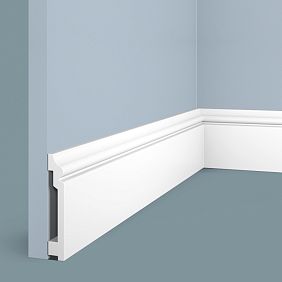
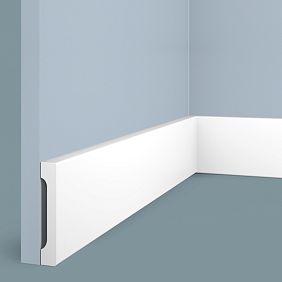
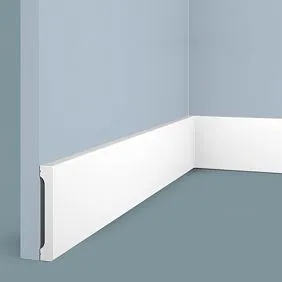
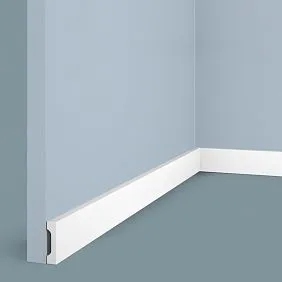
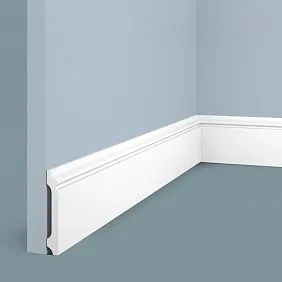
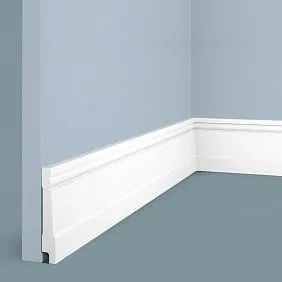
Skirting board in Scandinavian space: a detail that 'isn't there'
A Scandinavian designer doesn't ask 'which skirting board will emphasize the interior.' They ask 'how to make the skirting board not interfere.'
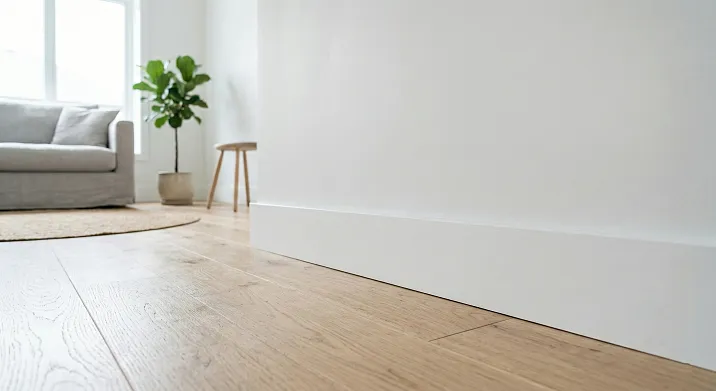
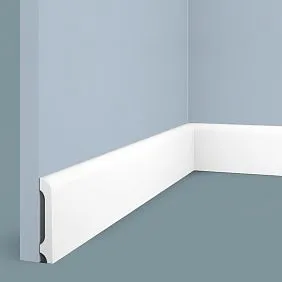
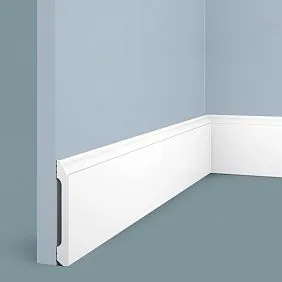
Flat wooden skirting boardwithout profile, white, matching the wall color — this is a solution where the skirting board practically disappears. The eye glides from the white wall over the white skirting board to the wooden floor — without stopping, without delay. The space is perceived as a whole.
It is precisely this 'invisibility' that represents the highest professionalism in Scandinavian aesthetics. The baseboard exists—but it's 'not there'.
Get Consultation
What Scandinavian style demands from a baseboard: specifics
Color: white. RAL 9003, NCS S 0500-N, or warm white RAL 9010—depending on the wall tone.
Profile: rectangular (no radii, no heel, no bevels—only a straight rectangle in cross-section) or with a minimal top bevel of 3–5 mm.
Height: 40–70 mm. Depends on ceilings: for 2.5 m ceilings—40–50 mm, for 2.7 m ceilings—50–60 mm, for 3 m ceilings—up to 70 mm.
Thickness: 12–18 mm. A thin profile is an important aesthetic signal: the baseboard is 'light,' not imposing.
Material: wood. Solid oak, beech, or birch. PVC in Scandinavian style is a compromise that professional designers avoid.
White wooden baseboard: the main choice for Scandinavian interior
Why white is not a 'lack of choice'
When people say 'white baseboard'—some hear 'no ideas' or 'the cheapest option.' This is a profound misconception. White in Scandinavian interior is a conscious, thoughtful choice that works on several levels simultaneously.
First level: optics. A white baseboard on a white wall creates an 'endless' wall—from ceiling to floor without a visible transition. The room appears taller and more spacious. For a typical apartment with 2.5–2.7 m ceilings—this is a crucial technique.
Second level: material.White wooden baseboardsunder white enamel—are still wood. Beneath the paint lies the living structure of a material that breathes, reacts to humidity, and feels warm to the touch. PVC under white paint is dead plastic. The tactile and physical quality is different.
Third level: durability. A white wooden baseboard, when properly painted, lasts 15–20 years unchanged. If the wall color changes—repaint the baseboard in a new shade of white or another color. PVC cannot be repainted.
Fourth level: cohesion. A white baseboard creates a lower 'frame' for the space, linking white walls with a natural wooden floor. This is a visual bridge between two key surfaces in Scandinavian interior.
Shades of white: the nuance that decides everything
White is not one color. It's an entire spectrum, and in Scandinavian interior, the choice of a specific shade matters.
Cool white (RAL 9003, NCS S 0500-N): maximally neutral, slightly 'sterile.' Suitable for interiors with gray and cool tones. Works well with dark gray or charcoal accents.
Warm white (RAL 9010, 'ivory'): softer, cozier. For interiors with warm wooden floors (light oak, birch)—a warm white baseboard is more organic than a cool one.
'Broken' white (Off-white, 'vanilla,' 'melted milk'): slightly creamy, very warm. For interiors in 'Scandinavian cottage' style—wooden ceilings, linen curtains, simple furniture.
Gray-white (NCS S 0300, 'cloudy'): almost gray, very neutral. For interiors with gray-beige walls, where pure white would be too contrasting.
Rule: the baseboard should be either exactly the same tone as the wall, or 1–2 tones lighter. Darker than the wall—violates the Scandinavian principle of 'invisibility.'
White baseboard with natural wooden floor: the perfect pair
It is precisely the combination 'white baseboard + natural wooden floor' that is the hallmark of Scandinavian interior. The white line at the base of the wall and the warm wooden planks of parquet—this is a contrast that works unfailingly.
White wooden baseboard, straight50–60 mm high next to birch or light oak parquet—this is 'real Scandinavia' in a Russian apartment. No expensive materials, no complex installation—but the result looks designer and expensive.
Key condition: the parquet or laminate should be light or medium in tone. Dark wenge + white baseboard—too harsh a contrast that disrupts Scandinavian harmony.
Flat straight profile: why Scandinavians avoid molding
Historical and philosophical context
In 18th–19th century Europe, a skirting board with a shaped profile—a torus, a scotia, or fillets—was a status marker. Wealth was expressed through the complexity of decoration. The more radii on the profile, the more expensive the product and the wealthier the owner.
Scandinavia took a different path. In the 1950s, Scandinavian design consciously rejected ostentatious luxury in favor of democratic functionality. Expensive does not necessarily mean complex. Expensive means precise, honest, made from the right material.
Flat wooden skirting boardwithout a profile is a manifesto. No historical references, no attempts to imitate palace finishes. Only honest, straight geometry.
Straight profile: what it means technically
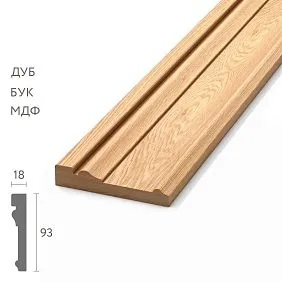
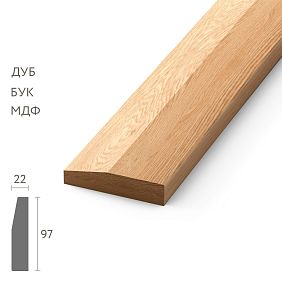
A 'straight' or 'flat' skirting board is a profile with a rectangular cross-section. There are no convex or concave curves. The front surface is a flat plane. The transition to the wall is either a 90° right angle or a minimal chamfer (3–5 mm).
Straight profile options for Scandinavian style:
| Profile | Description | Character |
|---|---|---|
| Rectangle without chamfer | Perfect rectangle, all angles 90° | Strict, architectural |
| With top chamfer 3–5 mm | Top corner slightly cut | Softer, 'cleaner' |
| With top chamfer 10–15 mm | Noticeable diagonal at the top | Modern, technological |
| Euro-profile with undercut | Lower undercut + straight upright | Floating, weightless |
All of them are straight. None have radius transitions. And it is precisely this unity of geometry that creates Scandinavian purity.
Why not molding or a shaped profile
A logical question: what's wrong with a shaped profile with a torus? Nothing, if we're talking about a classic or eclectic interior. But in a Scandinavian one, a shaped profile creates 'noise'.
Every radius on a profile is an additional shadow, an additional light line, an additional visual element that the eye must 'process'. Scandinavian design strives for the eye to move freely, without lingering on details. A shaped skirting board makes it linger. A straight one does not.
Moreover, moldings and complex profiles carry historical connotations: they refer to classicism, baroque, empire. Scandinavian style is devoid of historical quotes—it is fundamentally timeless.
Thin skirting board 20–30 mm in white: inconspicuous finish
When the skirting board is almost nothing
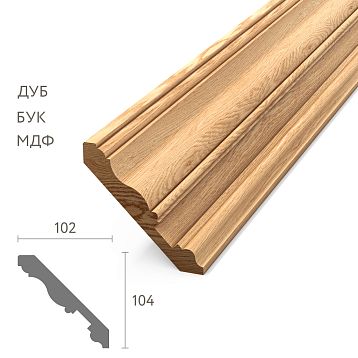
ThinWooden baseboard20–30 mm high is extreme minimalism. A strip of white wood two to three centimeters wide at the base of the wall. It's barely visible—but it creates a neat transition between the wall and the floor.
Such a skirting board is used in two cases:
Case one: ceilings below 2.5 m. Attic floors, small city apartments, studios. With ceiling heights of 2.3–2.4 m, a 50 mm skirting board is already 'too much'. A thin skirting board of 25–30 mm is 'just right'.
Case two: radical minimalism. An interior where everything superfluous is deliberately removed. No cornices, no architraves, no decorative elements. A thin skirting board of 20–25 mm is the only detail at the floor, and it is so small that the space reads as 'without a skirting board'.
Technical specifications of thin skirting board 20–30 mm
Height: 20, 22, 25, 30 mm
Thickness: 8–12 mm
Cross-section: rectangle
Mounting: only mounting adhesive (MS-polymer, polyurethane). A thickness of 8–12 mm does not allow mounting with dowels — the shelf splits.
Wood species: beech, oak (hardwoods are preferable — fewer dents and scratches during use)
Finish: white acrylic enamel — 2–3 coats
Installation of thin skirting board: specifics
With a thickness of 8–10 mmThin wooden baseboardit is mounted differently than a standard one. No hammer drill, no dowels.
Installation technology:
-
Cut the strips with a 45° miter cut at the corners (miter box + fine-toothed saw or miter saw)
-
Degrease the wall and the back side of the skirting board with isopropyl alcohol
-
Apply MS-polymer adhesive in a zigzag pattern over the entire back surface
-
Press the skirting board against the wall, hold for 20–30 seconds
-
Secure with painter's tape in a 'zigzag' pattern every 25–30 cm
-
Allow to cure for 24 hours without load
-
Remove the tape. Apply a thin bead of acrylic sealant along the top edge, smooth with a finger
Critical point: the wall must be perfectly even (deviation no more than 1–2 mm). A thin 8 mm skirting board does not 'hide' irregularities — it emphasizes them. If the wall is uneven — plaster first.
Alternative: skirting-to-skirting or 'drywall skirting'
In radical Scandinavian minimalism, the skirting board as a separate element is sometimes abandoned altogether. Instead, the lower part of the drywall wall is designed as a 'built-in skirting board': at a distance of 10–15 mm from the floor, a horizontal step is created in the drywall (similar to a windowsill, but at the bottom). This technique is called a 'shadow gap' or 'concealed skirting'.
But this is an expensive solution — it requires an additional layer of drywall and precise plastering. A 25–30 mm white wooden skirting board provides a similar visual effect with incomparably lower costs.
Combination of white skirting board with natural wood flooring
Classic pairing: light oak + white skirting board
Light oak parquet (Osmo Natural oil, Osmo White Oil, Rubio Monocoat Cotton) +White wooden baseboard, straight50–60 mm — this is a basic, proven, flawless combination. The warm yellow-beige tones of oak and the cool white skirting board create a soft contrast that is not irritating, but calming.
Visually: the floor reads as 'warm', the walls as 'cool'. The skirting board is the boundary between them, clear and calm.
White floorboard + white skirting board: monochrome
When the floorboard is painted white (whitewashed oak, white oil) — the skirting board is also white. Full monochrome from floor to ceiling. The space 'expands' — especially in small rooms.
This is a bold technique: it requires accents (dark furniture, patterned textiles, green plants), otherwise the space becomes sterile and cold.
Dark parquet (walnut, smoked oak) + white baseboard
Clear contrast: the dark floor goes down, the white wall stretches upward, with a white baseboard line between them. This works but requires precise balance: the dark floor must be balanced by light walls and sufficient lighting. In a dark room with a dark floor, a white baseboard creates an unpleasant 'glowing' effect at the base of the wall—the eye involuntarily catches it.
Laminate 'under light wood' + white baseboard
For most Russian apartments—this is the exact option. Laminate 'under ash' or 'under oak' in light tones +white wooden skirting board45–55 mm. Affordable material + proper finishing = a result that looks significantly more expensive than its cost.
Selection tip: if the laminate has a warm tone (yellowish, beige ash)—choose baseboard RAL 9010 (warm white). If the laminate has a cool tone (gray oak, gray-beige)—RAL 9003 or neutral white.
Combination table: floor + baseboard + wall
| Floor covering | White baseboard (tone) | Walls | Visual effect |
|---|---|---|---|
| Natural light oak | RAL 9010 warm white | White or warm gray-beige | Classic Scandinavian |
| Whitewashed oak | RAL 9003 pure white | White | Monochromatic, airy |
| Gray ash | RAL 9003 or gray-white | Gray-white, light gray | Cold Scandinavian |
| Laminate 'honey oak' | RAL 9010 | White or cream | Warm, cozy |
| Dark walnut | RAL 9010 or RAL 9003 | White (must be light) | Contrasting, bold |
| Natural pine | RAL 9010 warm white | White or light beige | Rustic Scandinavian |
Painting a wooden skirting board white: primer, enamel, topcoat
Why painting a skirting board is not 'just painting'
Painting a wooden skirting board is a separate skill. A skirting board is a detail viewed up close. Drips, unpainted spots, brush bristle marks, uneven surface—all of this is visible in a way that isn't on walls.
Additionally, the skirting board receives mechanical impacts: kicks, chair legs, vacuum cleaner. The coating must be durable.
Correct sequence: preparation → primer → first coat → sanding → second coat → topcoat. Five stages, and none can be skipped.
Stage 1: Surface preparation
Start with P120 sanding—remove all milling irregularities, raised grain, tool marks. Then P180—final sanding 'to zero'.
Dust—wipe with a slightly damp cloth or use an electrostatic cloth. Let dry for 15–20 minutes.
Skirting board ends (especially cross-cuts) are the most hygroscopic. Apply the first coat of primer to the ends separately, before overall priming. This 'seals' the end grain.
Stage 2: Priming
Primer is the foundation of quality painting. It:
-
Equalizes surface absorbency
-
Raises and fixes the grain
-
Creates adhesion for the topcoat enamel
-
Prevents enamel 'sinking' into pores
Primer choice for a white skirting board:
-
Acrylic antiseptic primer (Tikkurila Otex, Dulux Aquanamel Primer): suitable for subsequent application of acrylic enamel
-
Shellac primer (Zinsser BullsEye 123): for wood with tannins (oak) that can 'bleed through' white enamel with yellow stains. Oak—must use shellac primer or a special isolating primer.
Apply primer with a brush in a thin layer, along the grain. Let dry for 2–3 hours.
Stage 3: First coat of enamel
After the primer dries, the surface is sanded again with P220 (very lightly, 'remove the grain')—the primer raised the grain, and it must be removed before applying enamel.
First coat of enamel—'working coat'. Brush—flat brush 30–40 mm or small roller (microfiber, pile 4 mm). Application: long strokes along the skirting board. No cross strokes—they leave marks.
The first coat doesn't need to be perfect—it builds the base. Let dry completely (acrylic: 3–4 hours, alkyd: 12–16 hours).
Stage 4: Intercoat sanding
P220–P280—very light sanding. Goal: remove irregularities from the first coat, create 'tooth' for the second.
This is a short stage (5 minutes per 2.2 m strip), but critically important. Without it, the second coat will apply unevenly and won't adhere as well.
Stage 5: Second coat and topcoat
Second coat—main coat. Apply thinly, evenly. Let dry. Light sanding with P320.
Topcoat—if necessary (some enamels provide full coverage in 2 coats). The topcoat is applied to the already installed skirting board—it hides dowel points, small gaps in joints, putty marks.
Enamel choice for a white skirting board: specific brands and characteristics
Water-based acrylic enamel:
-
Tikkurila Helmi 30 (semi-matte): an excellent choice for Scandinavian style — doesn't shine, a 'matte-clean' surface. High wash resistance.
-
Tikkurila Pika-Teho: an economical option, good coverage, 2 coats are sufficient
-
Dulux Aquanamel: a hard acrylic enamel, sands well between coats
Alkyd enamel:
-
Tikkurila Paneeli-Assa: specifically for interior wooden parts. Hard, very resistant to scratches and impacts. Long drying time — 16 hours between coats.
-
Sadolin Extra (alkyd): traditional, durable. Smells during application, ventilation is needed.
Gloss advice: for Scandinavian style — semi-matte (30–40 gloss) or matte (up to 20 gloss) finish. A glossy baseboard in a Scandinavian interior is a dissonance: it 'shouts' too much, attracts unnecessary attention.
Painting after installation: final coat on site
Professional approach: apply primer + 1–2 coats of enamel before installation. After installation — final coat on site. This allows to:
-
Paint the ends before installation (they are already in joints and inaccessible afterwards)
-
Hide dowel points with the final coat
-
Fill and paint corner joints as a single surface
Complete Scandinavian ensemble: baseboard as part of the system
What else is included in Scandinavian finishing
A white flat baseboard is a detail of the system. For a full-fledged Scandinavian interior, it does not exist separately.
Door architraves.carved wooden architraves STAVROSin a straight profile (without figured relief), painted the same white color as the baseboard. Baseboard and architrave are one family, one breed, one tone.
Window reveals. Wooden or drywall in white — a single surface with the wall. No plastic reveals in a Scandinavian interior.
Cornice. A debatable issue for Scandinavian style: traditional Scandinavian design does without a cornice under the ceiling. If a cornice — then of minimal cross-section (20–30 mm), straight, white, matching the baseboard tone.Minimal profile cornices STAVROS— in the same system of wooden decor.
Furniture and baseboard: how they interact
In a Scandinavian interior, furniture stands on legs. This is not accidental — furniture 'above the floor' visually lightens the space. And the baseboard is fully visible: the white strip at the base of the white wall is continuous except for the legs.
This effect of the 'clean line' of the baseboard is one of the signs of a professional Scandinavian interior. Cabinets without legs, 'grounded' furniture — interrupt this line and destroy unity.
What to do with problem areas in a Scandinavian interior
Heating pipes by the wall
In a Russian apartment — a radiator under the window and pipes along the wall. How to run a white baseboard past the pipe?
Two solutions:
-
Pipe bypass: the baseboard is cut to the shape of the pipe (template cutting, for a thin baseboard — not difficult). Gap at the pipe — acrylic sealant.
-
Pipe in sleeve (thermal protection box): the pipe is concealed in a decorative box, the baseboard runs continuously behind the box.
Uneven walls: how to conceal
White baseboard on an uneven wall — gaps are especially visible precisely because white color does not 'hide' the shadow in the gap but emphasizes it.
Solution: mounting adhesive over the entire back surface + acrylic sealant along the top edge of the baseboard + smooth quickly. Sealant conceals gaps up to 4–5 mm. After drying — paint with a finishing coat; sealant is painted together with the baseboard.
Corners: joining white baseboards
In a white Scandinavian interior, the corner joint of baseboards is a point of special attention. A perfect 45° miter creates an invisible joint. A small gap — acrylic sealant in matching tone.
Important: after the sealant dries — be sure to paint the joint with a finishing coat of enamel. Unpainted sealant has a different texture and sheen — this will be noticeable.
FAQ: Answers to popular questions
White wooden baseboard — is it better than white PVC?
In terms of aesthetics and durability — yes. A white wooden baseboard can be repainted after 10 years and look like new. White PVC yellows after 7–10 years — and replacement is inevitable. Moreover, in Scandinavian interiors, natural materials are a fundamental choice. PVC is a compromise.
Which enamel to choose: acrylic or alkyd?
For hallways and kitchens — alkyd (Tikkurila Paneeli-Assa): it is harder, more resistant to impacts and scratches. For bedrooms, living rooms, children's rooms — acrylic (Tikkurila Helmi 30 or equivalent): dries faster, odorless, more eco-friendly.
Thin baseboard 25 mm — won't it look cheap?
No, if made of wood and properly painted. A thin wooden baseboard 25–30 mm in high-quality matte enamel is a conscious designer choice. PVC baseboard 25 mm — looks cheap. Wood — does not.
How to combine white baseboard with colored walls in Scandinavian style?
Scandinavian style allows colored accent walls (pastel pink, soft blue, gray-green 'sage'). White baseboard works with any of these colors — it creates a neutral 'frame' at the base of the colored wall. The main thing: the baseboard remains white even next to a colored wall.
Flat or with minimal bevel — what to choose for Scandinavian style?
Both options are correct. Flat rectangle — stricter and more architectural. Flat with a top bevel of 5 mm — slightly softer, perceived as 'cleaner'. Depending on whether you are creating a more strict or more cozy Scandinavian style.
Is it necessary to paint the back side of the baseboard?
Do not paint the back side (adhesive adheres worse to paint). Ends — treat with primer and 1–2 coats of enamel. This protects the most vulnerable areas from moisture.
About the company STAVROS
White wooden baseboard in Scandinavian style— simple on the outside and precise on the inside. This is exactly the precision that STAVROS provides: chamber-dried oak and beech solid wood with 8–10% moisture, P180 sanding, dimensional tolerance ±0.2 mm. The straight profile remains straight — without twisting or deformation during installation.
Straight profiles of the K-series STAVROS — from 30 to 80 mm in height — specifically for Scandinavian and minimalist interiors. Smooth surface without nap accepts acrylic or alkyd enamel without additional preparation. Each plank is ready for priming straight from the packaging.
In a unified system: straight baseboard +straight STAVROS architraves + minimal cornice KZ-series— one wood species, one tone, one manufacturer. This is the Scandinavian principle of lagom in wooden decor: exactly as much as needed.
Samples of straight profiles: 180 rub./set. Consultation on profile selection and white shade for your interior: 8 (800) 555-46-75.
STAVROS — wooden baseboard that knows how to be silent. And does it beautifully.