Article Contents:
- Where to buy wooden skirting board in Moscow and what to check before ordering
- How to distinguish solid wood from veneer
- What to check in the catalog
- Why solid wood skirting is chosen for apartments and houses
- How to choose wooden skirting by wood species: oak or beech
- Oak skirting board
- Solid beech skirting board
- Where each option is more appropriate
- Which wooden skirting board is better for parquet and engineered board
- Skirting board for parquet
- Skirting board for engineered board
- Matching or contrasting
- Wide wooden skirting board: when it is appropriate
- Classic Interior
- Neoclassicism
- High ceilings
- When a wide skirting board works against the interior
- Solid wood or MDF skirting board: what to choose
- When solid wood is the right choice
- When MDF skirting board is a reasonable solution
- Comparison Summary
- How to choose a wooden skirting board to match the interior style
- Classic
- Neoclassicism
- Calm modern interior
- Light floor
- Dark parquet
- Common mistakes when choosing a wooden skirting board
- Mistake 1: mismatch of wood species with the parquet
- Mistake 2: too narrow a skirting board in a high room
- Mistake 3: raw wood
- Mistake 4: inconsistency with doors
- Mistake 5: selection without considering the flooring
- Mistake 6: ignoring the profile
- FAQ: frequently asked questions about wooden skirting boards
- Conclusion

There are interior details that seem insignificant—until they are chosen incorrectly. Wooden skirting boards belong precisely to this category. On a floor with natural parquet, in a classic living room with oak doors, in a country house with wooden paneling—here, the right solid wood skirting board determines whether the space will look cohesive or 'pieced together from different parts.'
Buying a wooden skirting board in Moscow today is not a problem. But choosing the right wood species, the correct profile, and the appropriate width is a task that requires understanding. This article is written precisely for that purpose.
Wooden baseboardSolid wood is a product made from a solid (or finger-jointed) blank of natural wood. Unlike MDF, it has a living grain, an expressive texture, and—with proper care—serves for decades, only gaining character over time.
This article provides a complete breakdown: how to choose a solid wood skirting board by wood species, height, profile, and compatibility with the floor covering. Plus—an honest answer to the question 'solid wood or MDF?'.





Where to buy wooden skirting boards in Moscow and what is important to check before ordering
The Moscow market offers wooden skirting boards in a wide range—from budget pine to elite oak. But not every product labeled 'wood' is genuine solid wood. Most often, a 'wooden' skirting board hides veneered MDF—visually similar but fundamentally different in characteristics.




How to distinguish solid wood from veneer
A genuine solid wood skirting board has:
-
Solid wood on the cut—without layers, without a glued core
-
A living grain that slightly differs in pattern on each piece
-
Characteristic smell of wood when sawing
-
Higher weight than MDF
Solid wood floor skirting in Moscow is the right choice for those who need natural texture, long service life, and organic combination with parquet or engineered board.
Our factory also produces:


What to check in the catalog
Wood species. The most common are oak and beech — more about the difference in the next block. Ash, pine, and larch are also found. The species affects color, density, and texture character.
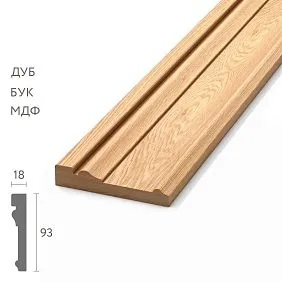
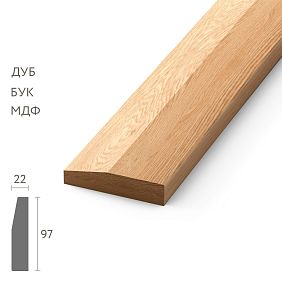
Profile and dimensions. Skirting width (height when installed), thickness, run length. Standard — 2400 mm and 2800 mm. Wide wooden skirting starts from 100–120 mm in height.
Workpiece moisture. Properly dried solid wood (moisture 8–12%) will not deform after installation. Raw wood — will definitely deform. Clarify the drying regime with the supplier.
Availability of finishing options. Unpainted solid wood, tinted, with varnish coating — these are different products with different installation scenarios.
Get Consultation
Why solid wood skirting is chosen for apartments and houses
Skirting made of solid wood— is a natural product in the most precise sense. No binders, no films, no imitation. That is why it is chosen in projects where the naturalness of the material is a fundamental criterion.
Living texture. Each linear meter of oak skirting board is unique—the grain pattern, arrangement of annual rings, slight natural irregularities. This is precisely what distinguishes solid wood from any imitation.
Organic combination with parquet. Oak parquet flooring + oak skirting board—this is a unified natural system. Such a combination is perceived as organic, not 'matched.' MDF tinted to resemble oak next to genuine parquet will always look slightly different—under certain lighting, the difference is visible.
Durability with proper care. Solid oak wooden floor skirting lasts as long as the parquet itself—30, 40, 50 years with timely refinishing. MDF cannot be restored after mechanical damage.
Appropriateness in classic interiors. A classic living room with wooden doors, a library with oak bookcases, a study with herringbone parquet—here, wooden skirting is not just suitable, it is essential.
Combination with engineered board.Pogonazh iz massivaWorks correctly with engineered board—especially when the wood species matches. Oak engineered board + oak skirting = a complete flooring system.
How to choose wooden skirting by wood species: oak or beech
This question is one of the key ones when choosing solid wood skirting. Oak and beech are the two most common options, but they are fundamentally different.
Oak skirting board
oak baseboard—the most popular choice for residential interiors. Oak:
-
Has a pronounced grain pattern with a coarse texture
-
Provides a warm, rich tone — from light golden (natural) to dark brown (stained)
-
Very hard and resistant to mechanical loads
-
Takes oil, wax, and varnish well
-
Complements oak parquet, engineered oak flooring, oak doors
Oak is a versatile wood species that works in classic, neoclassic, modern classic, and natural (japandi, biophilic) styles.
Solid beech skirting board
Oak skirting board— more uniform texture, a slightly more neutral and light tone.
-
Fine, uniform grain without a pronounced pattern
-
Light pinkish or creamy natural tone
-
Takes well to tinting in any shade — that's why beech is often used for 'neutral' solutions under paint
-
Slightly softer than oak, but still significantly harder than MDF
-
Pairs organically with beech parquet, light flooring, Scandinavian and neutral interiors
Where each option is more appropriate
| Criterion | Oak | Beech |
|---|---|---|
| Pronounced texture | Yes | No (uniform) |
| Warm tone without tinting | Yes | Neutral, slightly pinkish |
| Under dark parquet | Good | Through tinting |
| Under the light floor | Through bleaching or oil | Excellent |
| Classic | Ideally | Good |
| Scandinavian style | With bleached oil | Ideally |
| Price | Higher | Below |
Which wooden baseboard is better for parquet and engineered board
This is an applied question that requires a systematic answer. A floor baseboard must be coordinated with the flooring — not only in color but also in wood species, tone, and overall visual logic.
Baseboard for parquet
Piece parquet made of oak is one of the most common flooring options in Moscow apartments and houses. The best choice here is Solid oak skirting board of the same wood species and the same tone as the flooring.
Coordination principle: the baseboard can be:
-
In the tone of the parquet — for a unified homogeneous system (smooth transition from floor to wall)
-
Darker than the parquet - for an accent bottom line
-
Lighter than the parquet - matching the walls, for a 'floating' floor effect
The most common mistake is buying a baseboard of 'just a similar color' without considering the wood grain pattern. Two oak baseboards of the same shade but different cuts (radial and tangential) will look mismatched when placed side by side.
Baseboard for engineered wood flooring
Engineered wood flooring is a multi-layer product with a natural wood veneer top layer made from valuable wood species. For it, a wooden floor baseboard is the most organic choice, especially when the baseboard is made from the same wood species as the top layer of the flooring.
Baseboard for oak engineered flooring - oak. For ash - ash or neutral beech. The principle of 'species to species' works flawlessly.
Matching tone or contrast
Matching tone - a baseboard of the same shade as the floor. Works in calm, natural interiors where there is no desire to accentuate the transition.
Contrast - a baseboard darker or lighter than the floor. Creates a pronounced line, 'draws' the lower perimeter of the room. Works well in classical and neoclassical spaces.
Wide wooden baseboard: when it is appropriate
A wide baseboard— is a baseboard with a height of 100–120 mm and above when installed. It's not just 'beautiful' — it's an architectural tool with clear application logic.
Classic interior
In a classic interior, a wide wooden baseboard is a mandatory element of the architectural system. It forms the lower belt, which is coordinated with the horizontal moldings on the walls and ceiling cornices. Without it, the system looks incomplete.
Classic rule: the baseboard occupies approximately 1/6–1/8 of the room's height. With a 3 m ceiling — a 400–500 mm baseboard? No, that's already excessive. With a 3 m ceiling — a 100–150 mm baseboard — that's correct.
Neoclassicism
In neoclassicism, a wide baseboard is part of a simplified, yet still structured architectural system. Here it can be 100–160 mm in height, with a shaped profile — a cavetto or a straight transition.
High ceilings
With ceilings of 3 m and above, a narrow baseboard gets lost.Wide wooden baseboard in Moscowfor such spaces — is practically mandatory: it proportionally corresponds to the scale of the room.
When a wide baseboard works against the interior
In small rooms with a ceiling of 2.5–2.6 m, a wide baseboard 'lowers' the ceiling and creates a oppressive feeling. The rule of proportions works both ways.
Solid wood or MDF skirting board: what to choose
This is one of the most relevant comparative questions when choosing floor finishing. The honest answer is not 'solid wood is always better' and not 'MDF is cheaper and more practical'. Each material has its own niche.
When solid wood is the right choice
-
Parquet floor.Skirting made of solid woodnext to parquet — the only organic solution. MDF, even well-tinted, can reveal its imitation under certain lighting.
-
Classical or natural interior. Where wood is a style-defining material, solid wood is fundamental.
-
Long-term project. With proper care, a wooden skirting board can be renewed by sanding and repainting — just like parquet.
-
High-end segment. In 'luxury' and 'premium' class interiors, MDF is perceived as a compromise.
WhenMDF Skirting Boardis a reasonable solution
-
Modern interior without wooden flooring
-
Requires exact color matching (painting)
-
Budget is limited
-
Space with unstable humidity (basement, kitchen, adjacent bathroom)
Comparison Summary
Solid wood wins in naturalness and durability. MDF wins in affordability and geometric stability. For a country house with parquet — solid wood. For a city apartment with laminate and white walls — MDF is quite sufficient.
How to choose a wooden baseboard to match the interior style
Classic
Wide baseboard with shaped profile, oak or ash, dark stain or natural tone with varnish. Coordinates with herringbone parquet or Versailles rosette block parquet. The baseboard is part of a system along with wooden architraves, doors, and moldings.
Neoclassicism
Medium-wide baseboard (80–120 mm), shaped profile of medium saturation, oak or beech with stain. Coordinates with engineered wood flooring, light or warm-toned parquet. Principle: classical proportions — modern scale.
Calm modern interior
the wooden floor baseboardStraight profile, height 60–80 mm, beech or oak with neutral oil. Coordinates with light-toned engineered wood flooring, ash or birch parquet.
Light floor
Beech with white oil — perfect. Oak with natural oil or 'whitewashed oak' — good. Baseboard lighter than walls or matching wall color — for a light effect.
Dark parquet
Oak in 'coffee', 'wenge', or 'mocha' finishes—organically harmonious. A baseboard darker than the walls creates an expressive lower band.
Common mistakes when choosing wooden baseboards
Mistake 1: Mismatched wood species with the parquet
Oak parquet + beech baseboard with a different finish—they'll look like 'different woods' side by side. With natural finishes, the wood species should match or neutrally complement each other.
Mistake 2: Too narrow a baseboard in a high-ceilinged room
A 40 mm baseboard with a 3.2 m ceiling—it's a 'lost' detail. In a tall space, the baseboard should be proportionate—at least 100–120 mm.
Mistake 3: Unseasoned wood
Baseboards made from unseasoned solid wood will warp after installation—especially in heated rooms. Always check the moisture content of the blank: 8–12% is acceptable.
Mistake 4: Lack of coordination with doors
A dark-toned wooden baseboard next to white doors—not a mistake in itself, but it requires skillful accent placement. If the baseboard is dark and the door casing is white—the transition between them must be clearly thought out (end cap, corner element).
Error 5: Choosing without considering the flooring
Buying a baseboard 'in the store, without looking at the floor' is a typical mistake. Baseboards for parquet and baseboards for engineered boards can be fundamentally different in tone and profile.
Error 6: Ignoring the profile
Classic herringbone parquet + straight minimalist baseboard is a stylistic dissonance. A classic floor needs a baseboard with an architectural profile.
FAQ: Frequently Asked Questions about Wooden Baseboards
Where to buy wooden baseboards in Moscow?
From a manufacturer with its own production and properly dried solid wood. It is important to have several wood species, profiles, and finishing options. Check: whether the wood moisture content and species are indicated in the product description.
How to choose a solid wood baseboard for an apartment?
Determine the wood species (to match the parquet or coordinate with the interior), select the height to suit the ceilings, choose a profile to match the style, and coordinate the tone with the floor and doors.
What is better for parquet: solid wood or MDF?
Solid wood — definitely. Natural wood parquet deserves a solid wood skirting board made from the same wood species. MDF next to real parquet under certain lighting reveals its imitation.
Which wooden skirting board to choose for engineered board?
The same species as the top layer of the board. For engineered board made of oak — an oak skirting board, tinted to the same shade or a complementary one.
When should you choose a wide skirting board?
For ceilings from 3 meters, in classic and neoclassical interiors, when there are moldings on the walls, in large-area rooms. For low ceilings — a wide skirting board is contraindicated.
What's better: oak skirting board or beech skirting board?
Oak — for warm, rich interiors with pronounced texture. Beech — for neutral, light, and Scandinavian styles. Both — high-quality solid wood.
How to properly store wooden skirting board before installation?
In a horizontal position, in a dry room with temperature and humidity close to operating conditions. At least 48 hours of acclimatization in the room before installation.
Conclusion
Wooden baseboardSolid wood skirting is not just a finishing detail. It is an element that completes the flooring system, supports stylistic logic, and adds that very naturalness to the interior that cannot be reproduced by any technology. Oak skirting next to herringbone parquet, a wide profile with a bead at the base of a classic wall with moldings, beech under light engineered board — in each of these combinationsSkirting made of solid woodworks flawlessly precisely because it is made from the same material as the interior itself.
A complete linear system — skirting boards, moldings, cornices, solid wood architraves — is in the catalog.molding productsEverything from one source, one wood species, one level of quality.
STAVROS is a manufacturer of wooden linear products, skirting boards, moldings, and decorative items made from solid oak and beech. Own production with proper drying technology, precision processing, and strict geometry control. Delivery to Moscow, Russia, and CIS countries directly from the manufacturer — without intermediaries, with the possibility of ordering from one linear meter.
STAVROS — wooden decor, done right.