Article Contents:
- When wooden skirting board is appropriate: geography of application
- Apartments: classic living space
- Private houses: territory of wood
- Public spaces: durability and prestige
- Types and profiles: from simplicity to complexity
- Straight skirting board: minimalist graphics
- Sapog (European skirting board): classic elegance
- High skirting board (100-150 mm): architectural dominance
- Narrow skirting board (40-50 mm): delicacy
- Skirting board with cable channel: functionality
- Paintable skirting board: clean canvas
- Dimensions and Proportions: The Mathematics of Harmony
- Skirting board height: rule 1:20
- Skirting board thickness: from wall to floor
- Length: standards and reality
- Joints on long walls: art of invisibility
- Installation: three mounting technologies
- Installation with adhesive: cleanliness without traces
- Installation with self-tapping screws: reliability of classic
- Installation with decorative caps on anchors: aesthetics of fastening
- Angles: precision solves everything
- Internal angle: 45-degree bevel cut
- External angle: visible precision
- Complex angles: bay windows, columns
- Connection nodes: joints with other elements
- Connection with door: three options
- Connection with panels: horizontal boundary
- Connection with lath walls
- Operation: problems and solutions
- Gaps: causes and removal
- Uneven walls: working with reality
- Painting wooden skirting board: updating and changing color
- Removing wooden skirting board: keep or replace
- Budget: transparent economy
- Price per meter: range of materials
- Work: price per linear meter
- Typical estimate: room 4×5 meters
- Regional purchases: where and how
- Buy wooden skirting board in Moscow
- Buy wooden skirting board in St. Petersburg
- Regions: Yekaterinburg, Novosibirsk, Kazan
- Minsk and other CIS countries
- Conclusion: skirting board as philosophy of details

Skirting board is the final touch that turns renovation into a finished interior. You can spend a million on parquet made of mahogany, install designer doors, paint walls in the perfect color. But without skirting board—or with cheap plastic—one’s efforts become meaningless.Wooden baseboardIt is not just a strip covering the gap between floor and wall. It is an architectural element that sets the tone, emphasizes style, and creates visual completeness. Solid oak or beech, correct profile, flawless installation—we’ll cover every nuance so your skirting board serves for decades and delights the eye.


When is wooden skirting board appropriate: geography of application
Wooden skirting board is not a universal solution for any room. There are scenarios where it is indispensable, and cases where alternatives are more sensible.




Apartments: classic residential space
In apartments with parquet, parquet flooring, or quality laminatewooden baseboard— a logical, organic solution. Material unity — floor and skirting board made of the same wood — creates visual harmony and a sense of completeness.
Especially important is wooden skirting board in apartments with high ceilings (3+ meters). Here, a wide skirting board (100–150 mm) visually 'grounds' the space, creating proper proportions. A narrow plastic skirting board in such a room will disappear, looking short and out of scale.
In apartments with complex layouts (bay windows, niches, columns), wooden skirting board shows its versatility. It can be precisely cut to any angle, bent (when steamed) to a radius, and perfectly fitted to architectural features.
But in humid zones of apartments (bathrooms, combined bathrooms), wood is risky. Even oak with quality lacquer coating may deform or swell under constant humidity of 70–80%. For bathrooms, better alternatives are recommended (tile skirting, polyurethane, special moisture-resistant MDF).
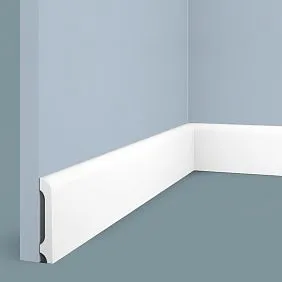
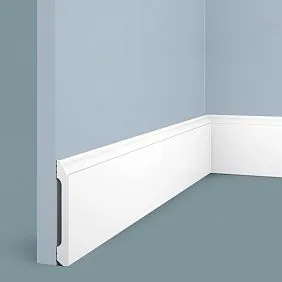
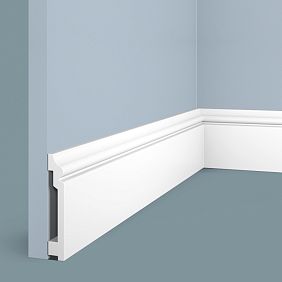
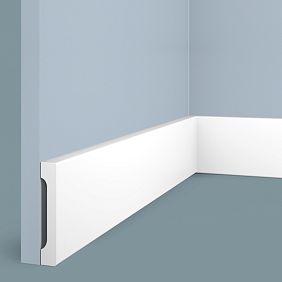
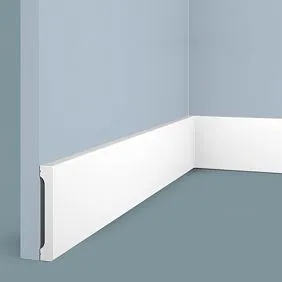
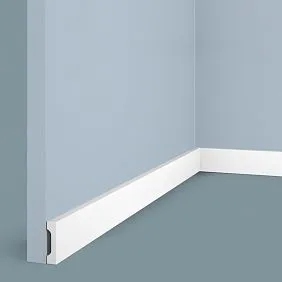
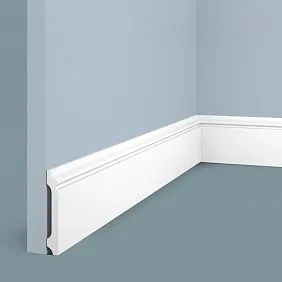
Our factory also produces:

Private homes: territory of wood
In country houses and cottages, wooden skirting board is practically mandatory. Wood in private homes is a connection to nature, ecological friendliness, atmosphere of coziness and solidity.
For wooden houses (log or timber frame), skirting board made of the same wood is a natural continuation of architecture. A pine house — pine skirting board. Oak beams — oak skirting board. Material unity.
In stone houses (brick, gas concrete) with wooden floors, skirting board adds warmth and softens the coldness of stone. A wide oak skirting board 120–150 mm high in a house with high ceilings (3.5–4 meters) is a classic architectural element, adding solidity.
An important nuance for private homes — seasonal fluctuations in temperature and humidity. In winter, with heating, humidity drops to 30–35%, and in summer, without heating, it rises to 60–70%. Wood reacts to this — slightly dries in winter, expands in summer. Therefore, in private homes, it is critical to use well-dried wood (moisture content 8–10%) and provide compensatory gaps during installation.
Get Consultation
Public spaces: durability and prestige
In offices, restaurants, hotels, salons, and medical centers, wooden skirting is a matter of status and durability.
Plastic skirting in a Class A office looks cheap and lowers the overall impression of the interior. Oak skirting, especiallyWide Wooden Skirting Boardat 100 mm height with a decorative profile, speaks to attention to detail and the solidity of the company.
In restaurants and hotels, wooden skirting is subjected to intensive use — cleaning several times a day, impacts from carts and furniture. Oak and beech, thanks to their high hardness, withstand these loads for years. Plastic quickly scratches, flakes, and loses its appearance.
In public spaces with high foot traffic and strict sanitary requirements (hospitals, kindergartens, food production facilities), materials allowing washing with chlorine-containing agents may be required. Here, wood is not always appropriate — special moisture-resistant coatings or alternative materials are needed.
Types and profiles: from simplicity to complexity
with a classic profile creates a sense of solidity, reliability.— this is not a monolithic category. There are numerous profiles, each with its own aesthetics, functionality, and manufacturing complexity.
Straight skirting: minimalist graphics
The simplest profile — rectangular cross-section without milling. Simply a straight plank 60-100 mm wide and 15-20 mm thick. Produced by simple planing on a four-sided machine.
Aesthetics: minimalism, Scandinavian style, loft, Japanese style. Clear graphic lines without decorative excesses. Emphasis on material and wood texture, not on profile shape.
Advantages: the most affordable price (no milling costs), easy installation (easy to cut and join), versatility (compatible with any floor covering).
Disadvantages: visual simplicity may appear "unfinished" in classic interiors, absence of a recess for wall fitting (any wall irregularities will appear as gaps).
Application: modern apartments and houses with minimalist design, Scandinavian interiors, lofts, high-tech style offices.
Boot skirting (European skirting): classic elegance
Profile with a characteristic rounded top resembling a boot toe. The lower part may be straight or have a small fillet. The rounded top creates a smooth transition from skirting to wall.
Aesthetics: classic, neoclassic, traditional European interiors. Soft lines, absence of sharp angles, visual "luxury".
Advantages: the rounded top hides micro-gaps on uneven walls (skirting "forgives" irregularities up to 2-3 mm), pleasant to the touch (relevant in areas where skirting contacts feet or furniture), classic profile suitable for most styles.
Disadvantages: more complex to manufacture (requires milling), 30-50% more expensive than straight skirting; on severe wall irregularities (5+ mm), the rounding does not help — gaps are visible.
Application: classic apartments, country houses in traditional style, offices, hotels in classic design.
High skirting (100-150 mm): architectural dominance
Wide skirting — a trend of recent years. If standard height is 60-80 mm, high skirting starts at 100 mm and can reach 200-300 mm (in mansions with 4-5 meter ceilings).
Aesthetics: luxury, classicism, palace interiors, American classic. High skirting is an architectural element that visually emphasizes the base of the wall, creating a sense of solidity.
Advantages: visually raises ceilings (paradoxically, but true — wide skirting creates a clear boundary from which the eye is drawn upward), hides significant wall irregularities at the bottom, allows hiding thick cables and pipes, creates prestige (high skirting is perceived as an element of elite finishing).
Disadvantages: high cost (more material, more complex milling), visually "eats up" room area (in small rooms may create a feeling of confinement), requires perfectly flat floors (on uneven floors, high skirting emphasizes defects).
Application: apartments and houses with high ceilings (3+ meters), classic interiors, spacious living rooms, halls, executive offices.
Narrow skirting (40-50 mm): delicacy
Opposite to high — narrow, minimalist skirting 40-50 mm high. Thin plank, barely noticeable boundary between floor and wall.
Aesthetics: modern minimalism, Japanese style, Scandinavian lightness. Skirting does not attract attention, does not distract, creates an effect of seamless transition from floor to wall.
Advantages: visual expansion of space (the less skirting, the more the floor appears), suitable for low ceilings (2.4-2.5 m), does not overload the interior with details.
Disadvantages: does not hide wall irregularities (requires perfect geometry), hard to find (most manufacturers produce standard 60-80 mm), not suitable for classic interiors (looks unfinished).
Application: modern apartments with perfectly flat walls, minimalist interiors, small rooms with low ceilings.
Baseboard with cable channel: functionality
Profile with a special groove or removable strip on the back side, where wires (electrical, internet, TV) are laid.
Construction: the main part of the baseboard is mounted to the wall, cables are laid into the groove, and a decorative strip is snapped on top, concealing the wires.
Advantages: safe and aesthetic wiring (no need to notch walls), easy access to wires (remove the strip — access for replacement or adding cables), compliance with fire safety norms (wires are isolated from flammable materials).
Disadvantages: greater baseboard thickness (cable channel adds 5-10 mm), removable strip may be noticeable (joint between main part and strip), limitation on cable diameter (standard channel accommodates 3-5 wires with diameter 5-7 mm).
Application: offices (many wires from computers, phones), home theaters (wires to speakers, projector), apartments with exposed wiring (retro style, loft).
Baseboard for painting: clean canvas
Wooden baseboard delivered without finish coating, primed, ready for painting in any color.
Material: usually pine or beech (species with fine-grained structure, well-suited for paint). Oak for painting is used less often (it’s a pity to hide its beautiful texture).
Advantages: ability to paint in exact wall or floor color (perfect color match), flexibility in changing color (repainting is easier than replacing baseboard), hiding imperfections in texture (knobs, color unevenness are concealed by covering paint).
Disadvantages: requires painting (additional time and cost), hides wood texture (loses the main advantage of wooden baseboard — natural beauty).
Application: interiors with white or colored walls, where baseboard must match, design projects with color schemes, budget projects (pine for painting is cheaper than oak for lacquer).
— a critically important parameter determining comfort of use. Standard dining table height — 75 cm from floor to top of tabletop. The base, with a tabletop thickness of 3–4 cm, should be 71–72 cm high.
Wooden Skirting Board SizesThis is not arbitrary choice. There are proportion rules that determine which baseboard will look harmonious in a specific room.
Baseboard height: rule 1:20
Classic design rule: baseboard height should be approximately 1/20 of room height.
For standard ceilings 2.5-2.7 meters:
Optimal baseboard height = 2500 mm / 20 = 125 mm... But this is theoretical. Practically, for typical apartments, comfortable height is 60-80 mm. A 125 mm baseboard will look too bulky.
For high ceilings 3.0-3.5 meters:
Optimal height = 3000 mm / 20 = 150 mm. Here the rule works more accurately — a 120-150 mm baseboard truly looks harmonious.
For very high ceilings 4.0+ meters:
A 180-250 mm baseboard — not luxury, but necessity. Standard 80 mm will disappear, making the room look unfinished.
Adjustment for style:
-
Minimalism, high-tech: can reduce height by 20-30% from calculated (lightness, lightness)
-
Classic, neoclassic: can increase by 20-40% (substantiality, solidity)
Baseboard thickness: from wall to floor
Standard wooden baseboard thickness — 15-20 mm. This is the optimal balance between strength, weight, and material consumption.
Thin baseboard 10-12 mm — rarity, used in specific minimalist projects. Disadvantage — fragility, easily breaks during installation or impact.
Standard 15-18 mm — universal solution for 90% of projects. Sufficient strength, moderate weight, does not protrude excessively from the wall.
Thick 22-25 mm — for high baseboards (120+ mm) and classic interiors. Heaviness, solidity, but greater weight (complicates installation).
Length: Standards and Reality
Wooden skirting boards are sold in standard-length planks:
2000 mm — short, convenient for transport by a passenger car, suitable for rooms with many corners (less waste when trimming).
2400-2500 mm — the most common standard, optimal balance between convenience and minimizing joints.
3000 mm — long, for rooms with long walls (fewer joints on straight sections), require cargo transport or a special trunk.
4000-6000 mm — extra-long, custom-made, for special cases (long corridors, galleries). Expensive, difficult to transport and install.
Jointing on long walls: the art of invisibility
If the wall is longer than the standard skirting board plank, a joint is required.
Straight butt joint: two skirting boards are cut perfectly flush at 90 degrees, joined end-to-end. The joint is glued with carpenter’s glue. After painting or varnishing, the joint is barely noticeable on a flat surface, but visible on decorative profiles (pattern mismatch).
45-degree angled joint (miter joint): both skirting boards are mitered at 45 degrees and joined. The joint is less noticeable but requires precise cutting.
Joint through a connector element: a decorative strip (of another color or with ornament) is inserted between two skirting boards. The joint becomes a decorative element. Used rarely, mostly in classic interiors with active decoration.
Golden rule: joints should be placed in the least noticeable locations — behind furniture, in room corners, in shadowed zones. Never place a joint in the center of a long open wall.
Installation: three mounting technologies
How to install wooden skirting boards— a question whose answer determines longevity and aesthetics.
Installation with adhesive: cleanliness without traces
Technology: adhesive ("liquid nails", polyurethane glue) is applied in dots or in a zigzag pattern to the back of the skirting board. The skirting board is pressed against the wall and secured with painter’s tape or light supports until the adhesive sets (2–4 hours).
Advantages:
-
No visible fasteners (no nail heads, screws)
-
Fast installation (no drilling or screwing required)
-
Suitable for fragile walls (gypsum board, aerated concrete)
Disadvantages:
-
Requires a perfectly flat wall (if unevenness exceeds 3–5 mm, the adhesive won’t hold, creating voids)
-
Difficult to remove (a glued skirting board can only be removed with damage)
-
Not suitable for heavy wide skirting boards (120+ mm, solid oak)
Application: light skirting boards (60–80 mm) on flat walls, modern interiors where clean lines are important.
Installation with screws: classic reliability
Technology: pre-drilled holes are made in the skirting board at 40–60 cm intervals. The skirting board is placed against the wall, and holes are drilled into the wall (for concrete, brick) or screws are directly driven in (for wooden walls). 4×60 mm or 5×80 mm screws are driven in, and screw heads are countersunk 1–2 mm below the skirting board surface. Holes are filled with wood putty in matching color, then sanded.
Advantages:
-
Maximum reliability (skirting board firmly fixed)
-
Suitable for uneven walls (screws pull the skirting board to the wall, compensating unevenness up to 5–7 mm)
-
Possibility of removal (unscrew and remove skirting board)
-
Suitable for heavy wide skirting boards
Disadvantages:
-
Visible fasteners (after puttying, fastener locations are barely noticeable, but visible up close)
-
Labor intensity (need to drill, screw, and spackle)
-
Risk of baseboard cracking (if drilling close to the edge or not pre-drilling)
Application:How to nail wooden baseboard to the floor- main method for most projects, especially with wide and decorative baseboards.
Installation with decorative caps: fastener aesthetics
Technology: similar to screw installation, but uses special decorative-head screws orEnd cap for wooden skirting boardwhich remain visible as decorative elements and do not require spackling.
Types of caps:
-
Wooden in baseboard color (almost invisible)
-
Metallic (brass, bronze, chrome) - become decorative accents
-
Contrasting wooden (dark caps on light baseboard)
Advantages:
-
Reliability similar to screws
-
Aesthetics (caps can be a stylish design element)
-
No need for spackling and touch-up
Disadvantages:
-
Additional cost for caps
-
Caps may fall out over time (requires periodic inspection)
Application: classic interiors (brass caps on oak baseboard), lofts (metal caps), rustic-style interiors.
Corners: precision determines everything
How to connect wooden baseboard at corners- the most complex and critical part of installation.
Inside corner: cut at 45 degrees
Inside corner of room (90-degree angle) is finished by cutting both baseboards at 45 degrees and then joining them.
How to properly cut wooden baseboards:
-
Measure exact wall length from corner to corner
-
Mark length on baseboard accounting for cut (wall length minus approximately half the baseboard width)
-
How to cut wooden baseboard at cornersUse a miter gauge (angle guide for precise cuts) or a miter saw set to 45 degrees
-
Cut both baseboards (left and right) at opposing 45-degree angles
-
Fit against the corner, check joint tightness
-
If necessary, adjust with a rasp or sandpaper
-
Mount and glue the joint with carpenter's glue
Typical mistakes:
-
Inaccurate cut angle (even a 1-degree deviation creates a visible gap)
-
Failure to account for wall angle curvature (real angles rarely are perfectly 90 degrees)
-
Cutting "backwards" (confused left and right bevel)
Solution for non-ideal wall angles: if the angle is not 90 degrees, for example 88 or 92, divide it in half. For an 88-degree angle, cut at 44 degrees; for 92 degrees, cut at 46. Measure the wall angle with a small protractor (angle gauge).
External angle: visible precision
External angle (projecting wall corner) - more noticeable area, requires special precision.
Technology is similar to internal angle: cut at 45 degrees, join. However, errors are more noticeable here—the angle is visible, any gap is obvious.
Alternative -Corner for wooden skirting boarda ready-made wooden element that is mounted on the corner. Baseboards fit against it with straight ends, no bevel. Easier to install, but the corner element is visible and may not always fit the design.
Complex angles: bay windows, columns
In rooms with complex geometry (bay windows with 120-135-degree angles, octagonal columns, curved walls) special techniques are required.
For obtuse angles (over 90 degrees): cut at the corresponding angle (for a 120-degree angle - cut at 60 degrees).
For acute angles (under 90 degrees): cut at a small angle; sometimes a compound angle made from several boards is required.
For curved walls: wooden baseboard can be bent over a small radius (minimum 2-3 meters) by steaming or soaking, then bending over a template. For small radii (columns) - a set of short straight segments with small bevels.
Connection nodes: joining with other elements
Baseboard does not exist in isolation - it connects with doors, panels, rails, forming nodes that must be technically correct and aesthetically clean.
Connection with door: three options
Option 1: Baseboard extends under the door casing
Baseboard is cut flush with the edge of the door frame, end hidden under the casing. Visually clean, no visible ends. Requires that the casing be installed after the baseboard or that there is sufficient gap under the casing.
Option 2: Baseboard joins with the casing
Baseboard is cut precisely along the casing line, joined flush with it. The joint is filled with colored acrylic sealant. Visually, a seam is visible, but with careful execution, it looks natural.
Option 3: Baseboard does not reach the door
Baseboard ends 3-5 cm from the door opening, end covered with a cap. Between baseboard and door - a section of wall without baseboard. Simplifies installation, but visually less cohesive.
Connection with panels: horizontal boundary
If wooden panels (boiserie) 80-120 cm high are installed on the wall, the floor baseboard becomes part of this system.
Solution 1: Baseboard is the lower element of the panel system. Panels rest on the baseboard and are attached to it. Visually, the baseboard, panels, and horizontal layout above the panels form a unified structure.
Solution 2: Baseboard and panels are independent. Panels are mounted on the wall, stopping short of the floor by the height of the baseboard. Baseboard is mounted separately under the panels. Easier to install, allows independent replacement of baseboard or panels.
Joining with Lath Walls
If a lath structure (vertical laths from floor to ceiling) is installed on the wall, the question arises of how to join it with the skirting board.
Option 1: Laths stop at the height of the skirting board
Laths do not reach the floor by 8-12 cm (skirting board height). The skirting board runs under the laths. The laths appear to 'float' above the skirting board.
Option 2: Laths reach the floor, skirting board is interrupted
Laths run from floor to ceiling. The skirting board is interrupted in the lath zone. Visually, the laths are integrated into the architecture 'from floor to ceiling', but the skirting board on other walls does not continue onto the lath wall.
Option 3: Special lath skirting board
A skirting board is made with the same rhythm and profile as the laths. The skirting board becomes a continuation of the lath wall. Complex, expensive, but elegant.
Operation: Problems and Solutions
After installation, operation begins, which inevitably brings questions and problems.
Gaps: Causes and Remedies
Gap between skirting board and wall — the most common problem. Causes:
-
Uneven wall (height differences exceeding 5 mm, which the skirting board cannot compensate for)
-
Insufficient number of mounting points (skirting board sags between them)
-
Skirting board shrinkage (if installed with insufficiently dry material, it will dry out over time and detach from the wall)
How to fill gaps in wooden skirting boards:
-
Acrylic sealant in skirting board color (for gaps up to 3 mm) — applied as a thin stripe, smoothed with a wet finger, excess wiped immediately
-
Wood putty (for gaps 3–7 mm) — fills the gap, after drying is sanded and coated with varnish or paint in skirting board color
-
Decorative cord or rope (for very large gaps and in ethnic styles) — glued into the gap, becomes a decorative element
Gap between skirting board and floor — less common, but also occurs. Causes:
-
Uneven floor (height differences)
-
Too thin or flexible skirting board
-
Incorrect installation (skirting board mounted to wall, not to floor, and wall is sloped)
Solution: Try to pull the skirting board closer to the floor with additional fasteners (screws angled downward); if that doesn't help, fill the gap with sealant or putty.
Uneven Walls: Working with Reality
Perfectly flat walls are rare. Height differences of 5–10 mm over a 3-meter length are normal even for apartments with finished interiors.
Strategy for installing on uneven walls:
-
Find the most protruding point on the wall (using a level)
-
Start installation from this point, running the skirting board along the wall
-
In recessed areas (where the wall curves inward), place thin shims (pieces of plywood or cardboard) under the skirting board to ensure it runs straight
-
Secure the skirting board with screws at the shims' locations
-
Fill the formed gaps with sealant
Alternative - wall leveling: if the height differences are very large (15+ mm), it is more sensible to level the lower part of the wall with plaster or putty up to 15-20 cm from the floor before installing the skirting board. This will create a flat base for the skirting board.
Painting wooden skirting board: updating and changing color
After 10-15 years of use, the skirting board may require updating - the varnish coating wears out, scratches appear, and the color becomes outdated.
Repainting technology:
-
Light sanding of the surface (abrasive 240-320 grit) to remove the gloss of the old coating and to level minor defects
-
Dust removal (vacuum cleaner, damp cloth)
-
Priming (if covering paint is planned) - adhesive primer improves adhesion of the new paint
-
Painting in 2-3 coats (acrylic enamel, 4-6 hours interval between coats)
-
Light sanding between coats (400-600 grit) for smoothness
-
Final coating with matte or semi-gloss varnish (optional, for additional protection)
Can you paint without removing the skirting board? Yes, but it is more difficult to protect the floor and wall from paint splashes. Use wide painter's tape on the floor and wall right up to the skirting board, paint carefully with a brush (for recesses) and a small roller (for smooth areas).
Removing wooden skirting board: keep or replace
Sometimes it is necessary to remove the skirting board (floor replacement, wiring repair behind the skirting board, renovation).
Removing skirting board with screws:
-
Locate the mounting points (usually visible as plugs or spackle)
-
Carefully unscrew the screws (if spackle interferes - scrape it off with a putty knife)
-
Lift the skirting board with a chisel or putty knife, detach from the wall
-
With careful work, the skirting board can be reinstalled
Removing skirting board with adhesive:
-
Cut through the adhesive layer with a thin blade or string (pulling between the skirting board and the wall)
-
Lift the skirting board with a crowbar or pry bar
-
Peel off from the wall (often breaks in the process) - reinstallation is usually not possible
Tip: if you plan to change the floor or wiring in the future, install the skirting board with screws, not adhesive. This will allow removal without damage.
Budget: transparent economy
Wooden skirting board price per meter- this is not the whole truth. The budget includes materials, labor, consumables, and delivery.
Price per meter: range of materials
Prices for the beginning of 2025, approximate, for Russia:
Spruce (kiln-dried, 1st grade):
-
Simple profile 60 mm: 150-250 rub/m
-
Decorative profile 80 mm: 250-400 rub/m
-
Wide profile 100+ mm: 400-600 rub/m
Beech:
-
Simple profile 60 mm: 400-600 rub/m
-
Decorative profile 80 mm: 600-900 rub/m
-
Wide profile 100+ mm: 900-1400 rub/m
Oak (Oak wooden skirting board):
-
Simple profile 60 mm: 600-900 rub/m
-
Decorative profile 80 mm: 900-1400 rub/m
-
Wide profile 100+ mm (wooden skirting 80 mm): 1400-2200 rub/m
White Wooden Baseboard(spruce for painting):
-
60-80 mm, primed: 200-350 rub/m
-
Painted (white enamel, 2 coats): 350-550 rub/m
Work: price per linear meter
Installation cost depends on region, profile complexity, and room condition.
Moscow, Saint Petersburg:
-
Installation of simple skirting: 150-250 rub/m
-
Installation of decorative skirting: 250-400 rub/m
-
Installation of wide skirting 100+ mm: 400-600 rub/m
Regions (medium-sized cities):
-
Installation of simple skirting: 100-180 rub/m
-
Installation of decorative skirting: 180-300 rub/m
-
Installation of wide skirting: 300-450 rub/m
Additional work:
-
Skirting varnishing (if not painted): 120-200 rub/m
-
Painting with enamel: 150-250 rub/m
-
Sealing gaps with sealant: 50-100 rubles/m
Typical estimate: room 4×5 meters
Initial Data:
-
Room 4×5 meters, one door 90 cm wide
-
Perimeter: (4+5)×2 = 18 meters
-
Minus door: 18 - 0.9 = 17.1 meters of clean perimeter
-
Allowance 15%: 17.1 × 1.15 = 19.7 meters, rounded to 20 meters
Option 1: Economy (spruce, simple profile 60 mm)
Materials:
-
Spruce skirting 60 mm: 20 m × 200 rub = 4000 rub
-
Self-tapping screws, anchors: 300 rub
-
Spackle, sealant: 200 rub
-
Finish (if not painted): 800 rub
-
Total materials: 5300 rub
Works:
-
Installation: 20 m × 150 rub = 3000 rub
-
Finishing: 20 m × 150 rub = 3000 rub
-
Total works: 6000 rub
TOTAL economy: 11300 rubles
Option 2: Optimal (beech, decorative profile 80 mm)
Materials:
-
Beech skirting 80 mm: 20 m × 750 rub = 15000 rub
-
Self-tapping screws, anchors: 400 rub
-
Spackle, sealant: 250 rub
-
Finish: 1000 rub
-
Total materials: 16650 rub
Works:
-
Installation: 20 m × 250 rub = 5000 rub
-
Finishing: 20 m × 180 rub = 3600 rub
-
Total works: 8600 rub
TOTAL optimal: 25250 rubles
Option 3: Premium (oak, decorative profile 100 mm)
Materials:
-
Oak skirting 100 mm: 20 m × 1800 rub = 36000 rub
-
Self-tapping screws, anchors, caps: 800 rub
-
Putty, sealant: 400 rub
-
Wood oil: 1500 rub
-
Total materials: 38700 rub
Works:
-
Installation: 20 m × 500 rub = 10000 rub
-
Oil coating: 20 m × 200 rub = 4000 rub
-
Total work: 14000 rub
TOTAL premium: 52700 rubles
Difference between economy and premium: 41400 rubles (4.7 times)
Regional purchases: where and how
Buy wooden skirting board in Moscow
Moscow - the widest selection and competitive prices due to numerous suppliers.
Where to buy:
-
Specialized companies for wooden trim (maximum selection, consultations, delivery, installation)
-
Construction hypermarkets (Leroy Merlin, OBI) - medium assortment, affordable prices, self-pickup
-
Logging yards and sawmills - only simple profiles, but low prices, possibility of custom cutting
Delivery: usually free in Moscow or 1000-2000 rub depending on distance from MKAD.
Buy wooden skirting in St. Petersburg
Saint Petersburg - the second largest market by volume, prices comparable to Moscow.
Feature: in St. Petersburg, there are strong traditions of restoring historical buildings, so many companies specialize in producing vintage skirting with carving and patina for restoring apartments in historic houses.
Delivery: usually free in St. Petersburg and nearby suburbs.
Regions: Yekaterinburg, Novosibirsk, Kazan
In major regional centers, the selection of wooden skirting is limited, prices are 10-20% higher due to logistics.
Purchase strategy:
-
Look for local manufacturers (cheaper, no logistics markup)
-
Consider ordering from Moscow/St. Petersburg (if volume is large and price difference covers delivery)
-
Use marketplaces (Wildberries, Ozon) - surprisingly, some wooden trim items are available with delivery to regions
Minsk and other CIS countries
For Belarus and Kazakhstan, local manufacturers and imports from Russia are relevant.
Notes:
-
Customs clearance for imports from Russia (for commercial shipments)
-
Long delivery (7-14 days by road transport)
-
Risk of damage during transportation
Alternative: look for local analogs.
Conclusion: skirting as a philosophy of details
Wooden skirting is not just a functional strip. It is the final touch that transforms a set of finishing materials into an interior. It is the boundary between the floor and the wall, which can be unnoticed or dominant, simple or complex, cheap or luxurious. The choice of material (pine, beech, oak), profile (straight, shoe, high), method of installation (glue, self-tapping screws, caps), finish (oil, varnish, enamel) — each decision affects the final perception, durability, and cost.
Main conclusion of this workshop: do not economize on skirting. The difference between cheap plastic and quality wooden skirting across the entire apartment is 20-40 thousand rubles. But the visual difference is colossal. Wooden skirting elevates the interior's class, creates a sense of quality, attention to detail, and respectability. After 5 years, plastic skirting will yellow, get scratched, and lose its appearance. Wooden skirting will look the same after 5 years, after 15 years it can be renewed, and after 30 years it will still be serving.
Company STAVROS has been specializing in the production of elite wooden skirting for more than 15 years, offering a wide range of skirting options made from solid oak, beech, and ash for any interior tasks. The catalog features more than 50 skirting profiles of various heights (from compact 40 mm to prestigious 200 mm), shapes (straight, decorative, with cable channel), and finishes (unpainted, varnished, paintable).
Own high-tech production on European CNC equipment ensures ideal geometry of each strip (tolerance ±0.2 mm), smoothness of all edges, and profile accuracy. Kiln-dried wood to 8-10% moisture content guarantees material stability and absence of deformation during use in heated rooms. Multi-stage quality control at all stages excludes defective products from shipment.
Custom manufacturing services allow obtaining skirting with non-standard profiles according to the customer's drawings. CNC routers reproduce any profiles with accuracy up to 0.1 mm. Services for toning, varnishing, patination, and gilding allow obtaining skirting fully ready for installation, in the desired color and finish.
STAVROS professional installation teams (master experience from 10 years) perform installation with jewel-like precision. Each corner is perfectly milled, each joint is invisible, and each self-tapping screw is filled and sanded.How to Cut Wooden Baseboard— it is an art mastered perfectly by STAVROS masters.
Material warranty — 5 years, work warranty — 3 years. Post-sales support includes advice on care, assistance with local repairs (scratch filling, finish renewal), and the option to purchase an identical skirting 5-10 years later (STAVROS retains samples of all produced profiles).
Delivery across Russia by professional transport companies in rigid packaging, preventing damage. For Moscow and St. Petersburg — own courier service with delivery at a convenient time. Choosing STAVROS, you invest in that very detail which transforms renovation into an interior, creates completeness, and highlights quality. Skirting — the last to be installed, but the first to catch the eye upon entering the room. Let this detail work for you, creating an impression of perfection that is remembered and cherished for decades.