Article Contents:
- Tall wooden skirting board: what rooms it's designed for
- Space that requires weight
- Specific room types for tall skirting boards
- Where tall skirting boards are a mistake
- 70 mm skirting board: balance between visibility and modesty
- Why 70 mm is a special position in the size range
- Ceilings and 70 mm skirting board: perfect height
- Wooden skirting board 70 mm: profiles and their character
- Application of 70 mm wooden skirting board: specific interiors
- Wooden skirting board 80–100 mm: ceiling architecture from 3 meters
- When skirting board becomes an architectural element
- Wooden skirting board 80 mm: technical parameters
- Wooden skirting board 100 mm: monumental scale
- Tall wooden skirting board installation: reinforced mounting
- How skirting board height affects room perception
- Skirting board optics: three effects
- How skirting board affects perceived ceiling height
- Impact of skirting board height on furniture: practical connection
- Proportion rule: skirting board height and ceiling height
- Classic 1/40 rule
- 1/10 rule from wall width
- Triple system: skirting board, cornice, panels
- 70–100 mm profiles: shaped, straight, euro
- Shaped profiles: classic that never ages
- Straight (rectangular) profiles 70–100 mm high
- Euro-profiles: modern view on tall skirting boards
- Tall skirting board color: three strategies for classic style
- White — eternal choice of classic style
- Natural wood under oil
- Dark tones: anthracite, wenge, graphite
- Wooden decor ensemble: skirting as part of the system
- Skirting doesn't live alone
- Corner rosettes: an elegant solution for corner joints
- FAQ: answers to popular questions about tall wooden skirting
- About the Company STAVROS
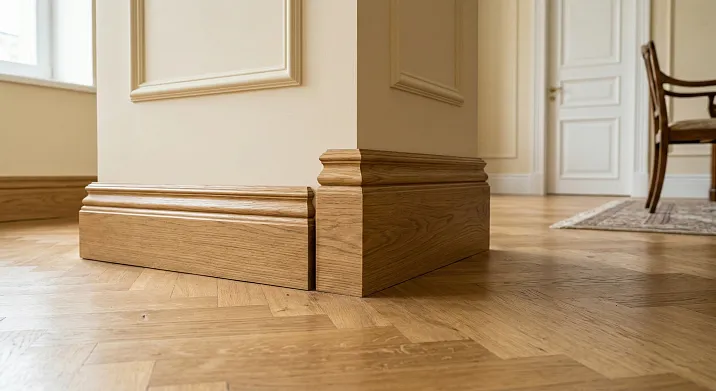
There are architectural solutions that require no explanation—they are simply correct. A tall wooden skirting in a room with three-meter ceilings, oak parquet, and a plaster cornice is one of them. This is not fashion, not a trend, and not a particular designer's personal taste. It is proportion. The very one that architects calculated back in the Vitruvian era and which remains unchanged no matter how styles and materials change.
high wooden baseboard—from 70 mm and above—this is a conversation about space, about the weight of the wall, about how the lower boundary of a room defines the character of the entire interior. This article is about why size matters, how the rule of proportions works in practice, and what profiles are available today to create an interior that will stand the test of time.


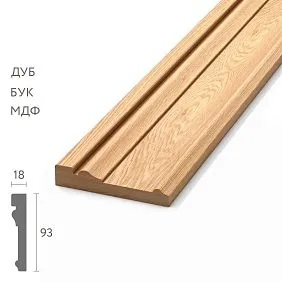


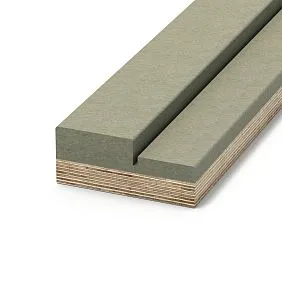

Tall wooden skirting: what spaces it is designed for




Space that demands weight
Try to imagine a room with 3.2 m ceilings, wide oak parquet, heavy floor-length curtains—and a thin 40 mm skirting at the base of the wall. Something will be off. The walls will appear 'light'—they will seem unreal, like a theater set. The skirting is too small to 'anchor' such space to the ground.
This is not a metaphor—it's optics. The skirting serves as the visual foundation of the wall. The higher the ceiling and the wider the space, the more substantial this foundation must be. That is precisely whywooden skirting 70 mmand above—is not a luxury but an architectural necessity in certain spaces.
Our factory also produces:
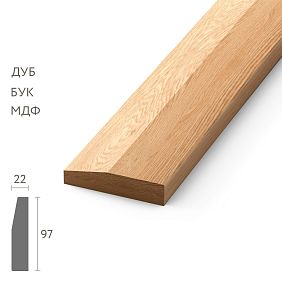
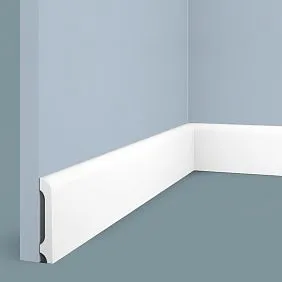
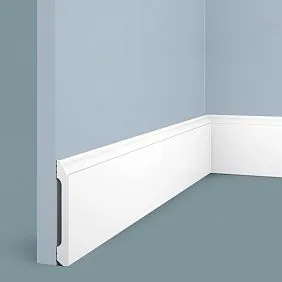
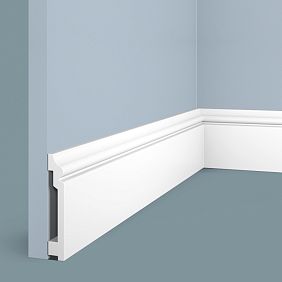
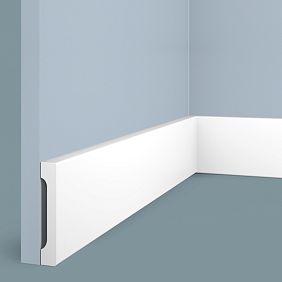
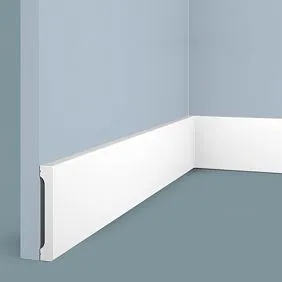
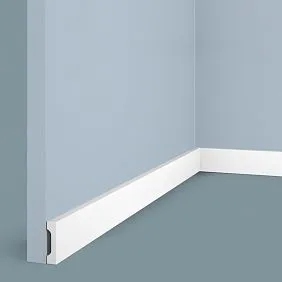
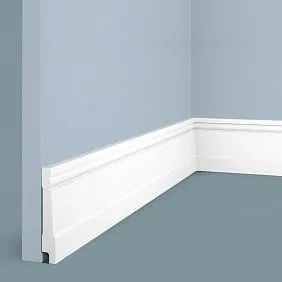
Specific types of spaces for tall skirting
Stalin-era apartments (ceilings 3.0–3.5 m). A Stalinist apartment is history. Plaster moldings, herringbone parquet, wide windowsills, paneled doors. Here, a 70–90 mm skirting is a natural part of the architecture. Restoring or renovating a Stalinist interior with a thin modern skirting is an architectural mistake.
Country houses with high ceilings. Houses with ceilings 2.9–3.5 m are common in private construction. The space is large, the furniture is bulky.Tall solid oak skirting80–100 mm here is not only proportional—it also conceals technical gaps at the base of the wall, which in wooden houses can be significant.
Premium new-build apartments with ceilings 2.9–3.2 m. Today, premium segment developers design apartments with increased ceiling heights precisely to create a sense of palatial spaciousness. To realize this potential without a tall skirting means leaving the job unfinished.
Studies, libraries, formal living rooms. Spaces with a 'serious' function—where guests are received, work is done, books are stored—require a weighty interior. An 80–100 mm skirting with a figured profile in such rooms is a statement: this place matters.
Banquet halls, representative offices. Where the interior must make an impression from the first second—a tall skirting works as a silent argument for the seriousness of the space.
Get Consultation
Where tall skirting is a mistake
It is equally important to understand where tall skirting is inappropriate. If ceilings are 2.5 m and the skirting is 100 mm—the space 'squats'. The skirting occupies almost 4% of the room's height—that's a lot. Walls appear shorter, the ceiling lower, the room tighter.
Rule: do not use tall skirting where ceilings are standard (2.6–2.7 m) or lower, unless you specifically want to create a 'cozy grotto' effect (which can also be a deliberate design technique but is rarely applied).
70 mm skirting: balance between prominence and modesty
Why 70 mm is a special position in the size range
70 mm wooden skirtingoccupies a unique place in the size hierarchy. It is tall enough to be 'noticeable'—to create a real visual accent at the base of the wall. And modest enough not to 'shout' in a space with ceilings 2.8–3.0 m.
This is a borderline size: on one hand, it already belongs to the 'tall skirting' category; on the other, it is not yet monumental. It is precisely this 'middleness' that makes it the most versatile of the tall profiles.
Ceilings and 70 mm skirting: the ideal height
A 70 mm skirting board is optimal for rooms with ceiling heights:
-
2.8–3.0 m — an absolute hit on proportion (70/2800 = 1/40 of the room height)
-
2.7 m — acceptable if the profile is not too visually 'heavy' (thin figured or rectangular without complex relief)
-
3.0–3.2 m — good, especially if there is a cornice under the ceiling
70 mm wooden skirting board: profiles and their character
At a height of 70 mm, the profile gains possibilities unavailable at smaller sizes. At 40–50 mm — a complex figured profile simply 'doesn't fit'. At 70 mm — there is space for expression.
Rectangular 70 mm. A strict rectangle: modern classic, loft, neoclassical without ornament. A width of 70 mm gives the 'rectangle' monumentality without additional decorative elements. Most often — white enamel or dark oil.
Figured 70 mm with one radius (ogee). The lower part is straight, the upper part has a characteristic 'ogee' (a protruding radius transition to the wall). The classic Soviet skirting board had a similar geometry, but a smaller size. At 70 mm, this profile gains dignity — as an architectural element.
Figured 70 mm with two radii. Lower radius + upper ogee = neoclassical profile. Pairs well withcarved wooden architraves STAVROSandKZ-series cornices— creates an ensemble.
Euro-profile 70 mm (stepped). Lower shelf 15–20 mm + vertical post 50 mm + upper bevel 3–5 mm. A modern interpretation of the classic skirting board — strict, architectural, without the 'old-fashioned' softness of radii.
Application of 70 mm wooden skirting board: specific interiors
| Interior style | 70 mm Profile | Finish | Additional Element |
|---|---|---|---|
| Modern Classic | Double-radius figured | White enamel | Cornice + architrave |
| Neoclassical | Euro-stepped | Ivory enamel | Columns, pilasters |
| Scandinavian with an accent | Rectangular | White or grey-beige enamel | Accent wall |
| English style | Ogee with radius | White enamel + tinting | Panels, moldings |
| Loft with high ceilings | Rectangular | Dark oil, anthracite | Without additions |
Wooden skirting board 80–100 mm: ceiling architecture from 3 meters
When a skirting board becomes an architectural element
Wooden skirting board 80–100 mm— this is no longer 'finishing', it's 'architecture'. At this height, the skirting board occupies a significant part of the wall and forms a low horizon of the space, just as a cornice forms the upper one.
In the European architectural tradition, an 80–100 mm skirting board is standard for rooms with ceilings of 3–4 m. In palaces and mansions of the 18th–19th centuries, skirting boards reached 120–150 mm and higher, organically combined with high molded cornices under the ceiling.
Today, country houses and premium-class apartments reproduce this proportion in modern materials.Wooden skirting board 100 mmmade of solid oak with a shaped profile in such a space is not an excess, but an exact hit in scale.
Wooden skirting board 80 mm: technical parameters
Height: 80 mm — a clear boundary between 'high' and 'very high' skirting board.
Thickness: from 18 to 25 mm depending on the profile. A shaped profile with a protruding 'heel' requires a greater initial thickness of the workpiece.
Plank length: standard 2.2 m. For rooms where straight long runs are needed (enfilades, long corridors) — planks of 2.5–3.0 m are ordered (non-standard length).
Wood species: oak, beech — main ones. Oak is preferable for shaped profiles: hard, holds milling well, does not dent under mechanical impact.
Weight per linear meter: 0.9–1.4 kg — depending on the wood species and thickness. Such weight requires reliable fastening: dowels + mounting adhesive are mandatory.
Wooden skirting board 100 mm: monumental scale
Wooden skirting board 100 mm— this is already the scale of architectural decor. With ceilings of 3.0–3.5 m, it occupies 3–3.3% of the room's height — this is the correct ratio according to the classical rule of proportions.
Profiles for 100 mm skirting board:
Classical multi-radius. Three-four changes in curvature along the height of the profile: lower straight shelf → concave radius (cavetto) → small shelf → convex radius (ovolo/heel) → transition to the wall. This is exactly the profile seen on skirting boards of 19th-century noble houses. Reproducing it today in solid oak means creating authentic classicism.
Euro-skirting 100 mm with one step. A modern interpretation of a monumental skirting board: lower shelf 20 mm + high upright 75 mm + chamfer 5 mm. Strict, architectural, without sentimentality. For neoclassicism and modern classic.
Rectangular 100 mm. The boldest option — a perfect rectangle 100×20 mm. It seems simple, but at such a height — it makes a strong impression. Especially with contrasting painting (dark skirting board on a light wall).
Fastening a high wooden skirting board: reinforced installation
The heavier the skirting board, the more important the correct installation. For an 80–100 mm skirting board made of oak or beech:
-
Dowels: 6×60 mm (concrete wall) or 6×50 mm (brick). Spacing — 35–40 cm. Dowels are driven through drilled holes, heads — flush or slightly below.
-
Mounting adhesive: mandatory along the entire back surface. Polyurethane (e.g., Soudal Fix All) or MS-polymer. The adhesive compensates for gaps on an uneven wall and reduces the load on the dowels.
-
Doweling spacing near ends: 5–7 cm from the end. This prevents the end from 'pulling away' from the wall — a typical problem with heavy skirting boards.
How skirting board height affects the perception of a room
Optics of a skirting board: three effects
A skirting board is a horizontal line at the base of a wall. According to the laws of visual perception, horizontal lines influence the perception of spatial proportions. Three effects:
Effect 1: "Landing." A high baseboard "lowers" the wall, bringing it closer to the floor. The room appears more stable, "weighty," and solid. This effect is desirable in formal rooms (living room, study) — and undesirable in small rooms with low ceilings.
Effect 2: "Frame." A high baseboard creates a lower "frame" for the space — similar to how a frame creates a painting. Furniture in a room with a high baseboard appears more "placed," the interior — more finished.
Effect 3: "Scale." A high baseboard sets the scale for the entire space. When there is a 100 mm detail at the base of the wall, and it looks "right," — it means everything else in the room is also scaled correctly. A small detail in a large space destroys the sense of scale.
How a baseboard affects the perceived height of ceilings
Paradox: a high baseboard can both "raise" and "lower" the ceiling — depending on its color and proportion.
A baseboard matching the wall color (white on a white wall) at any height — does not affect the perceived height: it is simply "invisible." This technique is used when one wants to maximally "stretch" the wall.
A contrasting, dark baseboard — creates a clear horizontal line at the base. The gaze "stops" at the baseboard, registers its height, then moves upward. The effect depends on the baseboard height: at 70–100 mm a dark baseboard "leads" the gaze upward — the ceiling appears higher. With a very large baseboard (150+ mm) in a small room — the ceiling appears lower.
A baseboard with vertical elements (like some Euro-profiles with a vertical post) — slightly "stretches" the space.
The influence of baseboard height on furniture: a practical connection
The baseboard height sets the lower horizontal line — and furniture must respond to it. In classical interiors, there is a rule: the legs of chairs and tables should not be lower than the baseboard height. Otherwise, the furniture "sinks" against the wall, its legs are hidden behind the baseboard.
With a 100 mm baseboard — chair legs should be from 120–130 mm. With a 70 mm baseboard — from 90–100 mm. This rule is rarely explicitly stated, but interior photographers know it: the baseboard and furniture legs are always checked first.
Rule of proportions: baseboard height and ceiling height
The classical 1/40 rule
In classical architecture, a rule applies: the baseboard height is approximately 1/40 of the room height.
It works like this:
-
Room 2.5 m → baseboard 62 mm (practically — 60–65 mm)
-
Room 2.7 m → baseboard 67 mm (practically — 65–70 mm)
-
Room 3.0 m → baseboard 75 mm (practically — 70–80 mm)
-
Room 3.2 m → baseboard 80 mm (practically — 80–90 mm)
-
Room 3.5 m → baseboard 87 mm (practically — 85–100 mm)
-
Room 4.0 m → baseboard 100 mm (practically — 100–120 mm)
This is not a strict standard, but a guideline. Plus or minus 10 mm from the calculated value — is acceptable and often appropriate.
The 1/10 of wall width rule
The second approach — is to focus not on ceiling height, but on wall width. Baseboard height — 1/10 of the wall width. This approach is used in enfilades and long corridors, where the height hasn't changed, but the wall length is significant.
Wall width 5 m → baseboard 50 cm? Of course not — the rule works in the range of 3–6 m wall width (a baseboard of 30–60 cm by this calculation already looks like a "panel," not a baseboard). Used as an additional corrector: if the calculation by ceiling height gives 70 mm, but the wall is wide — one can take 80 mm.
Triple system: baseboard, cornice, panels
In a classical interior with ceilings from 3 m, the baseboard does not exist by itself. It is the lower element of a triple architectural system:
-
Cornice (at the ceiling): height 70–150 mm
-
Panels (optional): if present — a horizontal line at a height of 80–100 cm from the floor
-
Baseboard (at the floor): height 70–100 mm
Ideally, all three elements are made from the same wood species and have the same finish.KZ-series cornices STAVROS + K-series skirting board— a unified system of wooden decor specifically for such interiors. The cornice height and skirting board height are selected in a 1.5:1 ratio (the cornice is always higher — otherwise the hierarchy is disrupted).
Profiles 70–100 mm: figured, straight, Euro
Figured profiles: classic that never ages
A figured profile is a profile with several changes in curvature: convex elements ('heel', 'shelf') and concave elements ('ogee', 'scotia') alternate, creating chiaroscuro. It is precisely the chiaroscuro that makes the figured skirting board 'alive' — it changes as the lighting angle changes.
Profile K-009 (STAVROS, 80 mm). Lower straight shelf 15 mm + gentle ogee + straight upright 30 mm + heel + transition to the wall. Moderately classic — suitable for modern classic without excessive ornamentation.
Profile K-018 (STAVROS, 90 mm). More complex: lower shelf + scotia + shelf + convex radius + upper chamfer. Closer to a traditional academic profile. For interiors with a pronounced classic program.
Profile K-066 (STAVROS, 100 mm). A three-radius profile with a pronounced heel in the upper part. Monumental character — for rooms with ceilings from 3.2 m. Pairs withcarved wooden rosetteson the corners — creating a full-fledged architectural decor.
Straight (rectangular) profiles with a height of 70–100 mm
Rectangularhigh wooden baseboard— is an oxymoron in the best sense. The simplest form in a monumental size. At 100 mm, a rectangle makes a stronger impression than a medium-complexity figured profile.
Where a rectangular profile 70–100 mm is used:
-
Modern neoclassicism ('dry classic')
-
Japanese minimalism with high ceilings
-
Loft with ceilings from 3.5 m
-
Contrasting dark skirting board as an architectural line
Characteristics of a rectangular profile by height:
| Height | Thickness | Visual effect | Recommended style |
|---|---|---|---|
| 70 мм | 15–18 mm | Noticeable horizontal line | Scandinavian, minimalism, loft |
| 80 мм | 18–20 mm | Architectural stripe | Neoclassicism, modern classic |
| 100 мм | 20–22 mm | Monumental base | Loft with ceilings 3.5+ m, Japanese minimalism |
Euro-profiles: a modern take on high skirting boards
Euro skirting board (euro skirting) — a profile with an undercut at the bottom: the lower edge does not fit tightly to the floor but 'overhangs' it. There is a gap of 8–12 mm between the lower part of the skirting board and the floor.
This is a functional solution: the gap conceals floor irregularities, accommodates laminate expansion joints, and creates a 'floating' effect. When installing an LED strip in this gap, the bottom lighting transforms the skirting into a luminous element.
Euro-profile 70 mm (K-034 equivalent): lower shelf 15 mm with undercut + vertical post 50 mm + top bevel. Crisp, architectural. Popular in Germany and Scandinavia.
Euro-profile 80–90 mm: taller post + slightly deeper undercut (12–15 mm). Allows hiding the LED strip cable inside the gap. For interiors emphasizing technological sophistication.
Euro-profile 100 mm with decorative groove: vertical post with a horizontal groove in the middle — creates the impression of two wooden elements, though it's a single piece. More complex to execute, more impressive result.
Color of high skirting: three strategies for classic interiors
White — the timeless classic choice
White skirting in a classic interior is a tradition rooted in an era when all architectural details were painted white to imitate marble. For 70–100 mm skirting, white enamel remains the most common choice.
Nuances of white for high skirting:
-
Pure white (RAL 9003, NCS S 0500): maximum contrast with parquet. An architecturally strong technique.
-
Warm white (RAL 9010, 'ivory'): slightly warmer, less sharp contrast. A more 'residential' option.
-
Gray-white ('cloudy', 'misty'): for interiors in gray-beige tones — the skirting integrates into the overall color scheme without creating contrast.
Natural wood under oil
high wooden baseboardunder natural oil — this is completely different. You see the oak's texture, feel the material. In interiors where wood is a key element (wooden floor, wooden doors, wooden panels) — solid wood skirting under oil, matching the parquet tone, creates organic cohesion.
Oil for 70–100 mm skirting: Osmo Polyx-Oil in parquet tone, Rubio Monocoat, Saicos. With the same wood species and batch of oil — the skirting and parquet achieve the same tone.
Dark tones: anthracite, wenge, graphite
For bold interiors with contrast: dark skirting 80–100 mm on a light wall. This is an architectural gesture with confidence — a strong visual accent at the base of the wall.
Specific combinations:
-
White wall + anthracite skirting 90 mm + light oak parquet: Scandinavian neoclassicism
-
Light gray wall + wenge skirting 100 mm + dark oak parquet: dark modern classic
-
Sage wall (gray-green) + white skirting 80 mm: British classic
Wooden decor ensemble: skirting as part of a system
Skirting doesn't exist alone
A professional designer never chooses skirting separately from the rest of the wooden decor. Skirting is the first element of the ensemble. It is followed by:
-
Door architraves:carved wooden architraves STAVROSin the same wood species and finish
-
Ceiling cornice:KZ-series cornice STAVROS— completes the ensemble from above
-
Wooden rosettes in corners:rosettes STAVROS— treat skirting board corner joints as a decorative element
-
Furniture handles to match:wooden STAVROS handles— complete the 'wooden ensemble' in furniture details
It is precisely the unity of the ensemble that creates the feeling of 'expensive', 'serious', 'well-thought-out'. Not each element individually, but their combined work.
Rosettes in corners: an elegant solution for corner joints
A high skirting board of 80–100 mm requires precise corner cuts. With a shaped profile, a 45° cut is technically complex: the radii must be aligned precisely. The alternative iswooden STAVROS corner rosettes.
The rosette is installed in the corner, the skirting board from both sides is trimmed at 90° and butts against the rosette. No complex cutting, no risk of radius mismatch. And an additional decorative element in the corner — a tradition of classic interiors.
STAVROS rosettes are available in the same wood species and sizes as the skirting boards. For an 80 mm skirting board — an 80×80 mm rosette. For 100 mm — 100×100 mm. Perfect height matching.
FAQ: answers to popular questions about high wooden skirting boards
Is an 80 mm skirting board in an apartment with 2.7 m ceilings too high?
According to the rule of proportions — yes, slightly above the optimum (the 1/40 rule gives 67 mm). But in interiors with a classic character, 80 mm with 2.7 m ceilings is acceptable if the skirting board is painted the same color as the wall (then it visually 'doesn't work' as a separate element) or if the design includes other vertically elongated elements (tall doors, vertical panels).
Wooden 100 mm skirting board or polyurethane molded one — which is better for classic style?
Depends on the task. Polyurethane skirting board is cheaper, easier to install, and has more complex profiles (polyurethane is cast, wood is milled — different capabilities). A 100 mm wooden skirting board is a natural material with a living texture that does not yellow after 5 years (polyurethane yellows), can be repainted, and is tactilely 'real'.
High skirting board — only white or are other colors possible?
Any colors. Dark tones work especially expressively on a high profile — 80–100 mm of dark anthracite on a white wall creates a strong architectural accent. Natural oil on a high-profile oak skirting board — warmth and luxury simultaneously. White is classic, but not the only choice.
How to join a high 100 mm skirting board with a door architrave in a corner?
If the architrave is already installed, and the skirting board meets it at the bottom point — the skirting board end is cut at 90° and butts against the side face of the architrave. The joint is sealed with acrylic sealant. For a neater solution — purchaseSTAVROS corner joining blockto match the skirting board.
Is reinforced fastening needed for a 100 mm oak skirting board?
Absolutely. A 100×22 mm oak skirting board weighs about 1.5–1.8 kg per linear meter. For a 20 m² room (perimeter ≈16 lm) — that's almost 25 kg of wooden trim on the walls. 6×60 mm dowels spaced 35–40 cm apart + polyurethane adhesive — minimum. For aerated concrete walls — chemical anchors or special dowels for porous substrates.
Can a 70–80 mm skirting board be used in a children's room?
Yes, if the ceilings allow (from 2.8 m). Ecological requirement: the finish — water-based acrylic enamel or natural oil without solvents. In a children's room, wood with natural oil is one of the best solutions: no volatile compounds, warm material, pleasant to the touch.
About the company STAVROS
A classic interior is not an imitation of the past. It is an understanding of proportion, choosing the right material, and precision in execution.Wooden high skirting board STAVROS K-series— from 70 to 170 mm — made from kiln-dried solid oak and beech with 8–10% moisture content. Milling accuracy ±0.2 mm: shaped profiles with multiple radii match in corner joints without adjustment.
Complete ensemble for a classic interior: high skirting board +Carved Mouldings + KZ-series cornices + rosettes for corners— one breed, one batch, one tone. This is the only way to create a true architectural ensemble, not a set of similar details.
Profile samples: 180 rub./set with delivery. Selecting baseboard height for your ceiling height — specialist consultation: 8 (800) 555-46-75.
STAVROS — a wooden baseboard that knows what proportion is and knows how to maintain it.