Article Contents:
- Wooden Molding and Carved Trim: What to Choose for Your Task
- What is wooden molding
- What is Carved Molding
- What's the Difference Between Molding and Trim
- When You Specifically Need Molding, and When You Need Trim or Decorative Molding
- Where Wooden Molding Is Used in Interior Design
- Wooden Molding for Walls
- Wooden Molding for Mirrors and Panels
- Wooden Molding for Furniture
- Wooden Molding for Decorating Door and Window Openings
- Wooden molding for cornice and frieze lines
- How to choose wooden molding by profile, width, and pattern
- Smooth or carved profile
- Geometric or floral ornament
- Narrow or wide profile
- Restrained or accent profile
- Which material to choose: oak or beech
- Oak: texture as the main advantage
- Beech: plasticity and surface purity
- Solid wood molding for classic and modern interiors
- Classic Interior
- Neoclassicism
- Modern Interior
- Furniture and wall compositions
- Wooden molding for mirrors, panels, and furniture
- How to choose molding for a mirror
- How to choose molding for a panel or painting
- Wooden molding for furniture fronts
- Carved moldings and trims: when they are better than standard molding
- For an accent wall
- For friezes and decorative belts
- For furniture fronts
- For complex interior compositions
- How to select molding to fit project dimensions
- Profile width and room height
- Relief height
- Length and joints
- Selection for the room and wall scale
- What determines the price of a wooden molding
- Material
- Profile complexity
- Depth and fineness of carving
- Profile width
- Order volume
- Custom individual manufacturing
- Finishing
- Molding by the linear meter: when this wording is appropriate
- How to buy wooden molding and carved solid wood trim
- Wholesale and retail
- Order for a project
- Delivery
- How to choose from the catalog
- Consultation
- Wooden moldings and interiors: why details matter more than trends
- About the Company STAVROS
- FAQ: answers to common questions about wooden picture frame molding

There are details that don't catch the eye at first glance in a room. But they are precisely what determine whether a space will look complete or remain something unfinished—functional but not alive. Wooden picture frame molding is one such detail. A narrow strip of profile along the wall, a mirror frame, an accent belt above panels—and the room acquires a character that's impossible to explain but instantly felt.
If you're currently renovating, designing an interior, or looking for something to frame a mirror, painting, or furniture facade—this article is for you. We'll break it down specifically: what wooden picture frame molding is, how it differs from carved moldings and trim, where and how it's used, which profile and material to choose, how not to make mistakes with dimensions, and how much it all costs.



Wooden picture frame molding and carved moldings: what to choose for your task
Before moving on to selection, it's worth clarifying the concepts. The market actively mixes the terms 'picture frame molding', 'molding', and 'trim', and it's easy to get lost in this confusion.




What is wooden molding
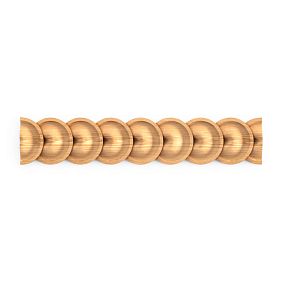
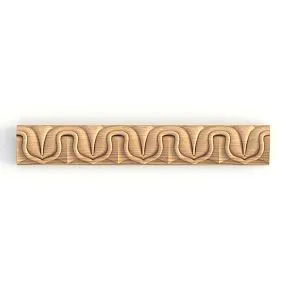
Picture frame molding is a profile strip with decorative relief, originally intended for framing paintings, mirrors, and panels. Today, the scope of wooden picture frame molding is significantly broader: it's used to form decorative frames on walls, accent lines along the perimeter of ceilings, and outlining door and window openings. Essentially,Wooden Picture Frame—it's a concise decorative tool with a clear profile and specific aesthetic purpose.
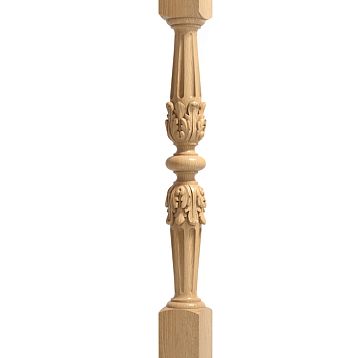
The STAVROS range of wooden moldings is available in a wide variety of profiles: from the simplest flat strips (series K-034 from 230 rub./m) to complex carved pieces with multi-level relief (series K-104 from 6,060 rub./m). Each item is made from solid oak or beech, which fundamentally distinguishes it from cheap alternatives made of pressed MDF or polyurethane foam.
Our factory also produces:




What is Carved Molding
Carved Trim— is a broader concept. It encompasses the entire range of decorative wooden profile products: baseboards, casings, friezes, glazing beads, moldings, cornices, battens, and the picture frame molding itself as a specific type. They are united by a common principle: a long product with a small cross-section, used for decorating and structuring space—walls, ceilings, furniture, openings.
To put it very simply: a picture frame molding is a type of millwork. Millwork is a class of products that includes picture frame moldings alongside moldings, baseboards, and other decorative profiles.
Get Consultation
What is the difference between a picture frame molding and a molding?
The boundary here is conventional but functional. Molding is a broader concept, meaning any decorative profile that forms a line or frame. Picture frame molding is traditionally associated with framing (frame application) and often features more pronounced relief. In practice, the line is blurred: the same STAVROS profile can be used both as a wall molding and as a picture frame molding for a mirror—it all depends on the installation task.
When is a picture frame molding specifically needed, and when is millwork or molding needed?
| Task | What to choose |
|---|---|
| Framing a mirror, painting, panel | Wooden picture frame molding |
| Decorative wall band | Molding or cornice |
| Ceiling frieze decoration | Carved molding / cornice |
| Doorway trim | Casing / molding |
| Furniture front decoration | Cornice or molding |
| Accent wall frame | Wooden picture frame molding |
| Baseboard with decoration | Carved molding |
Where is wooden molding used in interior design?
The list of uses for wooden molding is much longer than it seems at first glance. And this is precisely its value: one profile can work in completely different contexts, changing the character of the space.
Wooden molding for walls
Perhaps the most common modern application. Wooden molding is mounted on the wall in rectangular frames, creating a panel structure. This is a technique with a long history—it is found in interiors of French Empire, English Regency, and St. Petersburg classicism—and at the same time, one of the most relevant in contemporary design.
Frames made of wooden molding on the wall do several things simultaneously: they break up a monotonous plane, create rhythm and depth, and highlight architectural zones. At the same time, the costs are minimal: a few linear meters of profile and an hour of work—yet the result visually elevates the interior to a completely different level.
For walls, it is better to choose profiles of medium width—from 25 to 60 mm. Narrow molding (up to 20 mm) gets lost on a large plane. Wide molding (from 80 mm) requires high ceilings, otherwise it will 'weigh down' the space.
Wooden molding for mirrors and panels
This is the classic application for which the word itself was invented.Wooden molding for mirrors and panels—is a separate story, requiring attention to proportions. The rule is simple: the larger the object, the wider and more massive the profile can be. For a small bathroom mirror—a narrow, elegant profile of 20–30 mm. For a floor mirror in a bedroom or living room—50–80 mm with a figured relief.
When choosing a frame for a painting, consider not only the canvas size but also the technique: watercolor requires a light profile, while oil painting with dark tones calls for heavier and warmer wood.
Wooden molding for furniture
Decorating furniture fronts with wooden molding is a technique well-known to kitchen and cabinet furniture craftsmen. A simple MDF panel with glued or nailed wooden molding looks many times more expensive. Frame fronts, imitation of classic carving, accent lines on doors—all are achieved using wooden molding or trim.
For furniture, narrow profiles up to 35 mm with clear geometric relief are especially valuable: they do not visually overload the front but create the desired effect of texture and depth.
Wooden molding for framing door and window openings
In combination with architraves or on its own, wooden molding forms the framing of openings. This is a separate architectural element: a wide frame profile around a door in a classic interior is no longer just an architrave—it's a portal. It looks especially expressive in high-ceilinged spaces (from 3 m) and in projects with rich wooden finishes.
Wooden molding for cornice and frieze lines
A frieze is a horizontal band between the wall and ceiling, one of the key architectural lines in a classic interior. Carved molding as a frieze gives a sense of completeness to the upper zone of a room. The combination of a solid wood cornice, a frieze band of wooden molding, and ceiling molding creates a three-layer structure that makes the interior truly rich.
How to choose wooden molding by profile, width, and pattern
Selection begins with understanding the task. But even when the task is clear, the catalog can be overwhelming: dozens of profiles, different widths, different reliefs. Let's break it down by key parameters.
Smooth or carved profile
A smooth molding with a clear rectangular or beveled profile is modernity, minimalism, Scandinavian style. No decoration, only line and form. Works well in monochrome interiors, pairs with white walls, light furniture, matte surfaces.
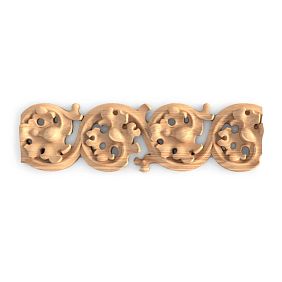
Carvedsolid wood molding— that's a completely different story. Ornaments, acanthus leaves, geometric weaves, volutes, twists — each pattern carries a stylistic load. A carved profile requires a classical or neoclassical context, rich finishes, appropriate furniture. Putting it in a loft is almost a guaranteed failure. But in a study with leather armchairs, in a living room with ceiling stucco, or in the hallway of a country house — that would be the only right decision.
Geometric or floral ornament
Geometric ornament (meanders, grids, rhombuses, zigzags) — strict, rational, well-readable from a distance. It is appropriate in interiors with symmetrical architecture, in modern classicism and neo-Renaissance.
Floral ornament (leaves, grapevines, flowers, swirls) — lively, dynamic, warm. It is associated with Baroque, Rococo, Art Nouveau. In modern interiors, it works as an accent: one wall with a floral wooden molding in a richly decorated space is already an author's statement.
Narrow or wide profile
-
Up to 20 mm — a miniature glazing bead profile; for thin frames, furniture fronts, inserts.
-
20–40 mm — the standard working range for most tasks: wall frames, small mirrors, furniture decor.
-
40–70 mm — wide molding; for large mirrors, accent frames on large walls, openings.
-
From 80 mm — architectural scale; friezes, cornices, complex decorative structures.
Restrained or accent profile
A restrained profile is minimal plasticity, a neutral relief that works as a 'background' for other interior elements. An accent profile is a statement in itself: deep carving, complex patterns, expressive shadow in the relief. The first is appropriate everywhere. The second requires an understanding of context and confidence in the result.
Which material to choose: oak or beech
STAVROS specializes in two species: oak and beech. This is not a random choice — both species are ideal for producing decorative moldings, but each in its own way.
Oak: texture as the main advantage
Oak features a pronounced annual ring pattern, wide medullary rays, dark pores, and contrasting texture. Oaksolid wood millwork looks powerful, noble, and substantial. It is associated with reliability and status. Under oil or clear varnish, oak reveals its full potential: every cell, every fibrous transition is visible. This is a material for those who want the wood to be readable — as texture, as a natural object, as a value in itself.
Oak takes stains well: it can be finished in dark walnut, wenge, cognac, or, conversely, lightened to a light ash. The texture does not disappear — it only changes its mood.
Beech: plasticity and surface purity
Beech has a different character. Fine-pored structure, uniform color, almost no pronounced grain pattern. Beech is a material for fine milling: it holds fine relief better than oak, doesn't 'blur' on sharp carving edges. Beech molding in white enamel is a classic of classics. Beech is most often used for painting because its surface provides an perfectly even base.
At the same time, beech under transparent finish is also beautiful - it carries warmth, a soft pinkish hue, a feeling of coziness. It's simply more restrained in character than oak.
| Parameter | Oak | Beech |
|---|---|---|
| Texture | Expressive, contrasting | Fine, uniform |
| For painting | Worse (pores) | Excellent |
| For tinting | Excellent | Good |
| Carving plasticity | Good (large profiles) | Excellent (fine relief) |
| Feeling | Status, powerful | Warm, refined |
| Durability | Very High | High |
Conclusion: oak — if you want to see the wood. Beech — if you want shape, relief, white or colored finish.
Solid wood molding for classic and modern interiors
One of the main myths: wooden molding and carved trim are only for classic styles. In reality, the profile works in a wide variety of styles — it all depends on which one you choose and how you apply it.
Classic interior
In classic style, wooden molding is a mandatory element, not an option. Wall panels divided by wooden frames, a frieze belt under the ceiling, framing of mirrors and paintings — all this creates that very 'palatial' rhythm that is so attractive in classic projects.
For classic styles, choose wide carved profiles with floral or volute-like ornamentation made of solid oak. Finish — walnut or wenge stain, or white enamel with gilding on carved details. Profile width — from 50 to 100 mm and above.
Learn more about the application and selection of profiles for classic styles with materials in the section wooden molding in the interior.
Neoclassicism
Neoclassicism is classical proportions with modern technologies and materials. Here, wooden molding is used more restrainedly: less carving, cleaner lines, less gilding. But the very idea of frame structuring of walls and accent belts remains. A good choice is profiles with geometric relief or restrained plasticity without ornament. Material — beech or oak under light enamel.
Modern interior
Yes, wooden molding works in modern interiors. You just need to know how. A simple rectangular smooth beech profile on a white wall is not 'classic,' it's a minimalist design technique. Wall frames made of thin wooden profiles in the wall color create a subtle, yet very fine texture. Contrasting dark profiles on light walls are a clear geometric pattern in the spirit of laconic high-tech.
Furniture and wall compositions
The most interesting application is when wooden molding works as a connecting link between the wall and furniture. Kitchen fronts with applied wooden profiles, built-in cabinets with frame inserts, wall panels with wooden frames emphasizing the shape of a console — this is the level of design where a detail becomes a theme.
Wooden molding for mirrors, panels, and furniture
This block deserves special attention because it carries the highest conversion potential. A customer who is looking for molding for mirrors and panels, already knows what they want. They only need help choosing a specific profile.
How to choose molding for a mirror
The first parameter is the size of the mirror. For small mirrors (up to 60 cm diagonally), the optimal profile width is 20–35 mm. For large ones (from 80 cm) — 40–70 mm. For floor or accent mirrors in the interior — from 60 mm and above.
The second parameter is the style of the room. Bathroom in a modern style: smooth beech profile under white enamel. Bedroom in neoclassical style: figured carved oak profile under tinting. Living room with classic decor: wide, rich profile with ornament.
The third parameter is the joining angle. The frame for a mirror and a painting is joined at the corners at a 45-degree angle. It is important that the cut is precise—this depends on the tool and the craftsman's experience. When ordering a wooden frame, check with the manufacturer whether they provide cutting to size.
How to choose a frame for a panel and a painting
For painting—choose a profile with a 'lip' (a horizontal shelf on the inner edge) on which the canvas or stretcher rests. The depth of the lip should match the thickness of the stretcher. For photographs and prints—you can choose a flatter profile.
Wooden frame for furniture fronts
Here, not only the profile matters but also the mounting method. Furniture frames are most often glued with PVA or mounting adhesive. Choose profiles with a flat back side—they adhere better to the front. Width—up to 40 mm for most furniture applications. The carving should be deep enough to be readable from a distance of 1–1.5 m, but not so deep that it collects dust.
Carved moldings and trims: when they are better than a standard frame
There are tasks that a narrow frame simply cannot handle. That's whenDecorative wooden trimcomes into play in a wide range—moldings, cornices, frieze strips, shelf profiles.
For an accent wall
An accent wall in a classic interior is not just a differently painted surface. It is a structure: a lower panel zone, a frieze belt in the middle, and a finishing cornice. Each of these elements is a wooden molding of a specific profile. Here, a width from 50 to 120 mm is needed, rich relief, and solid wood is essential for the clarity of the carving.
For friezes and decorative belts
A frieze—a horizontal band on a wall—is one of the most striking interior design techniques. It divides the wall into zones, creates a horizontal rhythm, reduces the visual height in overly tall rooms, or, conversely, structures the space in spacious halls.Buy carved moldingfor a frieze means choosing a profile with symmetrical relief that reads equally from both sides.
For furniture fronts
Wooden molding on a furniture front works differently than picture frame molding. Molding often has more complex plasticity, carrying multiple levels of relief. It is an 'architectural' profile that creates the impression that the furniture is made of solid wood, even if the base is MDF or plywood.
For complex interior compositions
When an interior is built as a multi-layered decorative system—wall panels framed with wooden molding, plus frieze bands made of wide molding, plus a cornice around the ceiling perimeter—a unified line of profiles is important. That is why STAVROS produces the entire range of molding products in a single material and with a coordinated system of proportions.
How to choose molding to fit project dimensions
Size is not just the width of the profile. It is a system of proportions that must be observed; otherwise, even the highest-quality wooden molding will look out of place.
Profile width and room height
Basic rule: the width of the profile in millimeters should not exceed 1/30 of the room height in millimeters. For a ceiling height of 2,700 mm, the maximum profile width is about 90 mm. For 3,000 mm — 100 mm. For 3,500 mm — 115 mm. This is a soft rule, but it works.
Relief height
The height (depth) of the relief affects how the molding 'reads' under side lighting. A flat profile with minimal relief gets lost without direct overhead light. Deep relief creates expressive shadows even under diffused lighting. For rooms with bright side light — the relief can be minimal. For rooms with general overhead lighting — choose a deeper profile.
Length and joints
Standard product lengths in the STAVROS range are 2,400 and 3,000 mm. If the wall or frame length exceeds the profile length, joints are needed. For wall frames, joints are made at a 45° angle in the corners — this hides the connection. For horizontal bands, joints on a straight line are made at a 45° angle in the horizontal plane — also for masking.
Selection for the room and wall scale
Small room (up to 15 sq. m): narrow wooden molding 20–35 mm, restrained relief, light finish. Medium living room (20–35 sq. m): 40–70 mm, figured profile, wood-toned finish. Formal halls and large spaces: from 70 mm, rich carved ornament, dark toning or white enamel with gilding.
What determines the price of wooden molding
In the STAVROS catalog, prices start from 180 rubles per linear meter and reach 6,060 rubles and above. The range is large — and it is explained by several key factors.
Material
Oak is about 15–25% more expensive than beech, all else being equal. This is the price for a more pronounced texture, greater hardness, and higher raw material cost. Both materials are solid wood, both are durable. The difference is in character and price.
Profile complexity
A simple smooth profile with minimal milling is the most affordable option. Each additional level of relief, each decorative element adds to the cost: more time for milling, more tooling, higher requirements for the quality of the workpiece.
Depth and fineness of carving
Hand-carved work is a separate story in pricing. Machine 3D milling offers a wide range of ornaments at a reasonable price. Hand finishing or author's carving is already a piece product with a corresponding cost.
Profile width
Wider profile — more material consumption. A linear meter of an 80 mm wide oak profile contains twice as much wood as a 40 mm profile. This directly affects the price.
Order volume
STAVROS works both retail and wholesale. When ordering a large batch — the price per unit is lower. For designers and regular partners, there is a loyalty program. If you are managing several projects — a wholesale order for the entire range is more profitable than a series of single purchases.
Custom individual manufacturing
Non-standard profile, unique ornament, atypical cross-section — all this is possible under the condition of a production batch. The price for manufacturing according to individual drawings is calculated separately and depends on the complexity of the profile, volume, and finishing requirements.
Finishing
An untreated blank ('for painting') is cheaper than a product with factory tinting or varnish coating. If you have a painter and are ready to finish the product yourself — choose the basic option without coating.
Molding for picture frames: when this wording is appropriate
Let's separately dwell on a request that is often used in search — 'molding for picture frames'. Strictly speaking, this is a slightly inverted wording: not 'molding for picture frames', but 'wooden picture frame molding as a type of molding'. But it is precisely under this phrase that in the professional environment, frame profile is often implied, from which picture frames are assembled: narrow strips of solid wood for portrait frames, wide ones for mirrors, profile slats for making wall frames by hand.
All this range — from the simplest slats to complex carved profiles — is available in the STAVROS catalog in the section Wooden Picture FrameHere you can select a profile for any frame task, order retail from one linear meter or a batch for frame production.
How to buy wooden baguette and carved solid wood molding
Practical block for those who have already decided and are ready to order.
Wholesale and retail
STAVROS works with both formats. Retail — from a minimum quantity, relevant for private projects, one room, or several mirrors. Wholesale — for designers, construction companies, furniture manufacturers, and interior studios that need regular deliveries at a favorable price.
Order for a project
If you have a non-standard project — atypical room dimensions, an individual proportion system, unique ornaments — STAVROS manufactures custom products subject to a production run. This requires drawings or a detailed technical specification. The manager will advise on conditions and deadlines.
Delivery
Delivery across Russia and CIS countries. Pickup from warehouses in Moscow and St. Petersburg — fast, without waiting and transportation costs. Delivery conditions depend on order volume and region — check with the manager.
How to select from the catalog
CatalogBuy wooden picture frame moldingThe STAVROS website catalog is structured by product types (molding/molding), material (oak/beech/solid wood), collections, and ornaments. This allows you to quickly filter what you need: if you need a carved oak profile with a floral ornament 50 mm wide — you will find it in a few clicks.
Consultation
If you're having trouble choosing — write or call. STAVROS specialists will help select a profile for your specific interior, calculate the required linear meters, and advise on finishing. Phone: 8 (800) 555-46-75 (free within Russia).
Wooden Molding and Interiors: Why Details Matter More Than Trends
Trends in interior design change every 3–5 years. Scandinavian minimalism gives way to rich maximalism, dark tones yield to light ones, and then everything repeats. Wooden molding exists beyond these fluctuations. A solid oak profile made in 2024 using centuries-old technology will be just as good in 2040.
This is precisely what distinguishes natural materials from 'trendy' synthetic ones: they don't become outdated. They can be repainted, rearranged, used in new contexts. Wooden molding is an investment in your interior, not an expense on decor.
If you want to learn more about howwooden molding is applied in specific interior scenarios, we recommend exploring detailed materials on the topic in the articles section on the STAVROS website — there you'll find examples, advice, and practical solutions.
About the company STAVROS
STAVROS is a Russian manufacturer of decorative products from solid wood, operating since 2002. The company was founded by two artists who began with the restoration of palace interiors. Over the years, STAVROS has participated in finishing projects for the Hermitage, Alexander and Constantine Palaces, and hundreds of private projects across the country.
Today STAVROS is a full-cycle woodworking production in St. Petersburg: wood selection, drying to 8–12% moisture content, four-sided planing on German equipment, 3D milling, manual sanding, and finishing. Geometric tolerance — ±0.1 mm per linear meter. This isn't a marketing figure; it's a production standard.
STAVROS offers hundreds of items of wooden baguette, carved millwork, moldings, cornices, baseboards, architraves, and structural products made of oak, beech, and high-density MDF. Showrooms in Moscow and St. Petersburg, delivery across Russia and the CIS, working with designers, developers, and private clients.
FAQ: answers to popular questions about wooden baguette
What is better to choose: wooden baguette or decorative millwork?
It depends on the task. Wooden baguette is the optimal choice for framing mirrors, paintings, and creating wall frames. Decorative millwork is a broader concept: it includes cornices, moldings, friezes, and baseboards. If the task is to decorate a specific object (mirror, panel, wall frame), choose baguette. If you need a system for decorating a room, look at the entire range of millwork.
Where to buy solid wood baguette?
In the catalogSTAVROS— a wide selection of oak and beech profiles, retail from 1 linear meter, delivery across Russia, pickup from Moscow and St. Petersburg. Wholesale and custom manufacturing to individual sizes are also available here.
How to choose baguette for a mirror or panel?
Profile width — 1/20–1/15 of the smaller dimension of the object. The style of the room determines the relief: smooth — for modern interiors, carved — for classic. Be sure to consider the thickness of the stretcher or the thickness of the mirror glass when choosing the profile depth.
Which baguette is better for a classic interior?
Wide carved oak profile with floral or volute-like ornament. Width — from 50 to 100 mm. Finish — tinted to walnut, wenge, or white enamel. Series K-001, K-012, K-066 from the STAVROS assortment are good examples for classic style.
What is the difference between baguette and molding?
Traditionally, baguette is a profile for framing (picture frames, mirrors, panels), while molding is a decorative strip for structuring surfaces (walls, ceilings, furniture). In practice, the boundary is blurred: the same profile can be used in both roles depending on the task.
Can I order a wooden baguette in my own sizes?
Yes. STAVROS manufactures products according to individual drawings and technical specifications, provided there is a production run. This is relevant for non-standard openings, unique patterns, or specific cross-sections. Terms and deadlines are clarified with the manager.
What affects the price of a wooden baguette?
Material (oak/beech), complexity of the profile and carving, product width, type of finish (for painting / tinting / varnish), order volume (retail is more expensive than wholesale), and the need for custom manufacturing.
Is solid wood baguette suitable for furniture and walls?
Yes, this is one of the main applications. For furniture fronts — profiles up to 40 mm with a flat back side. For wall frames — 30–70 mm depending on the scale of the room.
Which baguette profile to choose for a modern interior?
Smooth or minimally milled profile with clear edges. Material — beech under white enamel or oak under clear varnish (light finish). Width — 20–40 mm. No floral ornament — only geometry and line.
How to care for wooden picture frames?
Dry cleaning with a soft cloth, wiping with a well-wrung damp cloth. Every 5–10 years — renew the protective coating (oil-wax or varnish). Avoid prolonged exposure to moisture and direct sunlight. Solid oak with proper care lasts several decades without losing its appearance.