Article Contents:
- What is a wooden slat panel
- Types of wooden slat panels
- By material
- By format
- By appearance
- Where wooden slat panels are used
- In the living room
- In the bedroom
- In the entryway
- In the study
- In commercial interiors
- Why wooden slat panels are popular in interior design
- How to choose wooden slat panels
- By material
- By size and format
- By slat width and spacing
- By color and texture
- By interior style
- By room and operating conditions
- What's better: ready-made slatted panel or individual slats
- How to combine wooden slatted panels with interior design
- Installation of wooden slatted panels
- Maintenance and Durability
- Mistakes in selection and installation
- Conclusion: five-step selection algorithm

There are things in interior design that just work. Without explanations, without lengthy reasoning—a wall with wooden slatted panels looks exactly how most people want: warm, rhythmic, architectural, authentic. That's why wooden slatted panels have transformed from a niche designer tool into one of the most in-demand finishing formats—from private apartments to restaurant halls and office receptions.
But 'I want it like in the picture' and 'it turned out right' are different stories. The slatted format, when chosen incorrectly, produces exactly the opposite effect: it oppresses instead of opening up space, overloads instead of accenting, clashes with the rest of the interior instead of pulling it together. This article provides a detailed breakdown: what wooden slatted panels are, how to choose the right format, material, spacing, and tint, how to integrate them into a specific interior, and how to avoid mistakes that cost money and time.


What is a wooden slatted panel
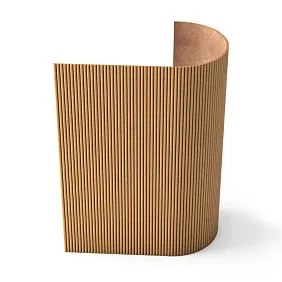
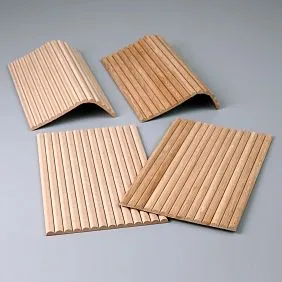
A wooden slatted panel is a ready-made wall product where parallel wooden slats (planks) are fixed to a common base—a substrate made of MDF, plywood, or fabric non-woven material. The result is a unified module with a defined geometric rhythm, ready for installation on a wall as a single structure.
How does it differ from a regular wall panel? A regular wall panel is a flat or profiled surface without a distinct slatted rhythm. A decorative wooden slatted panel is precisely a rhythmic three-dimensional relief made of parallel slats, which creates a play of light and shadow, architectural volume, and visual depth. This is a fundamentally different decorative effect: not just a 'covered wall,' but a 'living surface' with its own character.
How does it differ from individual decorative slats? This is a key question when purchasing. An individual slat is a plank without a base that is mounted on the wall one by one: each slat is installed independently with individual alignment, spacing control, and fastening precision. A finished wooden slatted panel is a pre-assembled module with fixed spacing and geometry. It is mounted as a single element: faster, more precise, and with lower skill requirements for the installer.
The core difference between these two approaches is not only speed but also the final geometric precision. In a finished panel, the spacing between slats is maintained by the production method. When installing individual slats by hand, achieving perfect precision is much more difficult, especially on long walls and with complex junctions.




Types of Wooden Slatted Panels
Our factory also produces:


By material
Solid wood. A living natural material with a unique grain pattern, natural tone, and tactile warmth. Two main options:
Oak — density 700–750 kg/m³, expressive natural grain, wide range of finishes from natural amber to graphite. Oak is the primary material for wooden slatted panels in the premium segment. Oil coating preserves matte finish and living texture, varnish adds depth and richness.
Beech — warm pinkish tone, uniform fine grain, very dense surface. Takes finishes well: in light Scandinavian shades, it works delicately and cozily.
MDF base. Fine-particle board with a density of 750–850 kg/m³ and a perfectly smooth surface.STAVROS MDF Slatted Panels— high-density composition with a finish or factory primer for painting. MDF slats offer maximum color freedom: any RAL shade without limitations. When using high-quality decorative paints — an excellent option for modern monochrome concepts.
Veneered panels. MDF backing with a 0.6–3 mm thick natural wood face veneer. The natural grain and hue of real wood species — combined with the technological stability of an engineered material. For wide, uniform surfaces, veneered slat panels allow for a 'book-matched' pattern — a mirror-symmetrical natural pattern.
Primed panels for painting. MDF slats with factory primer — fully ready for finish painting. The ideal option when you need to precisely match an interior color: to tile, furniture, countertops, or a specific project RAL.
Get Consultation
By format
Ready-made panels on a rigid backing — a module of slats on an MDF base. Standard height: 2400–2700 mm, width: 200–600 mm. Installed as a single element using adhesive or hidden fasteners. Maximum geometric precision.
Flexible panels on a fabric backing — slats on a non-woven backing that allows the panel to wrap around radius walls, columns, arches, and other curved surfaces. For complex architectural spaces — an indispensable solution.
Panels made of half-round battens — slats with a round or half-round cross-sectional profile. Feature: with side lighting, such a profile creates an especially soft and lively play of light and shadow — due to the smooth transition from the lit to the shaded side of the slat.
Individual slats without backing — installed piece by piece, offering complete freedom in placement, spacing, and junctions. Require more time and precision in execution.
By appearance
By slat width. Narrow slats 10–20 mm with tight spacing create a 'woven,' rich rhythm — an expensive, opulent, premium look. Medium slats 20–40 mm — the most versatile option for most modern interiors. Wide planks 40–80 mm with large spacing — an airy, Scandinavian, concise rhythm.
By tinting. Light shades (natural ash, whitewashed oak, gray-beige) — visually light, 'opening up' the space. Warm natural shades (natural oak, cognac, walnut) — create a spa-like feel, natural warmth. Dark shades (tobacco, wenge, anthracite, graphite) — maximum expressiveness and premium weight, require a large room and quality lighting.
Where are wooden slat panels used?
In the living room
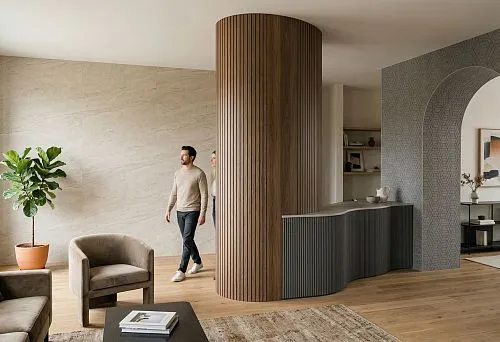
The living room is a space where wooden slat wall panels reveal their full potential. An accent wall behind the sofa with vertical oak slats under side lighting serves as an architectural axis, defining the character of the entire space.
In living rooms with 2.7 m ceilings, full-height vertical slats (floor to ceiling) create a monumental effect without structural intervention. In living rooms from 20 m², dark tints are possible—they work to add depth, not pressure. Built-in LED lighting in the grooves between slats turns the accent wall into a light object—completely changing the perception of the room in the evening.
The slat format additionally solves an acoustic task: the slats scatter sound waves, reducing reverberation in living rooms with parquet and large glazed areas. This is a useful effect that is rarely mentioned but regularly felt.
In the bedroom
In the bedroom, wooden slat panels are an intimate, natural, warm tool. The main focal point: the wall behind the bed headboard.
Panel width behind the headboard: bed width plus 200–400 mm on each side. For a 180 cm bed—a panel 2000–2600 mm wide. In a full-height format, vertical slats create a natural 'screen' behind the bed, which visually organizes the bedroom and adds an architectural axis to an otherwise neutral space.
Tints for the bedroom: natural oak, light beige, warm ash. Dark tones require quality directional lighting—bedside sconces or spotlights illuminating the slatted surface at an angle.
In the hallway
The hallway is the space of first impression, where wooden slat panels work in two roles at once: creating a stylish image for the entry zone and protecting the walls from mechanical damage.
A classic technique: vertical slats on a long wall of a narrow corridor, 1.5–2 m high or full height. The visual effect—the wall 'recedes upward,' the corridor becomes more spacious and taller. Material choice for the hallway: MDF with hard enamel finish or solid oak with lacquer coating—both options are resistant to mechanical loads.
If the hallway adjoins a room without a clear door boundary—wooden slat panels in a unified tone in both spaces create a sense of architectural flow, uniting different zones into one system.
In the study
The office requires a finish that speaks of seriousness, taste, and professional weight. Wooden slatted wall panels for the office are precisely such a tool. Dark oak, a dense slatted rhythm, directed task lighting—an image that is unambiguously understood.
The wall behind the desk or the office chair is the primary application point. Solid oak slatted panels in 'tobacco' or 'anthracite' finishes with LED lighting in the grooves create a professional visual backdrop for both work and video calls. It's an implicit but effective professional message.
In commercial interiors
Restaurants, cafes, hotels, office receptions, premium segment stores—wooden slatted panels are ubiquitous here. Reasons: natural warmth neutralizes the coldness of commercial spaces, the slatted rhythm creates depth without construction interventions, and the acoustic effect reduces noise levels in high halls with hard reflective surfaces.
For commercial interiors, the choice of finish is especially important: a hard polyurethane varnish with a hardness rating from 3H, maximally resistant to mechanical wear. Panels in commercial spaces are used more intensively than in residential ones—and the material must be prepared for that.
Why Wooden Slatted Panels Are Popular in Interior Design
Not because it's 'trendy'—that's a temporary argument. The popularity of the slatted format is sustained by specific aesthetic and practical merits.
Visual Rhythm and Depth Effect. Parallel slats create a structural rhythm on the surface—it ceases to be flat and becomes three-dimensional. The depth of the grooves between the slats creates a play of light and shadow that changes depending on the angle and intensity of lighting. The same panel under morning side light and evening accent lighting—two different objects.
Natural Warmth. No synthetic material reproduces the tactile warmth of wood and the natural grain pattern. Decorative wooden slatted panels add to a room what is commonly called 'liveliness'—a sense of natural presence that is perceived not by the mind but by the body.
Flexible Zoning. One slatted wall organizes space better than any furniture partition—without losing volume, without creating a physical obstacle. A living room with a dining area, a bedroom with a work corner, an entryway with storage—a slatted panel creates a visual boundary without a wall.
Acoustic Function. The slats scatter sound waves—reducing reverberation and improving acoustic comfort. This is especially valuable in high-ceilinged rooms with parquet and large glazing.
Compatibility with lighting. Slat format is an ideal construction for built-in lighting. LED strip in the grooves between slats creates uniform soft glow. This is an inexpensive technique with a very high design result.
How to choose a wooden slat panel
Our factory also produces:
By material
If maximum-level natural aesthetics are needed — solid oak or veneer on MDF base. If color freedom for a specific RAL is needed — paintable MDF. If a balance of natural look and technological stability is needed — veneered panels.
For wet areas (bathroom, kitchen) — only moisture-resistant MDF (HMR/MDFV) or solid dense wood species with varnish coating. Standard MDF swells and loses shape in wet conditions.
By size and format
Module size is selected based on room area and ceiling height. Full-height module 2400–2700 mm is ideal for living spaces — creates a monolithic continuous surface without horizontal joints. For rooms with non-standard height — check with the manufacturer about the possibility of custom sizing.
By slat width and spacing
Slat width 10–15 mm — dense rich rhythm, premium look, visually 'heavy' surface. Works well in large rooms and commercial spaces. Width 20–35 mm — universal range for most residential interiors. Width 40–60 mm — airy, concise rhythm, Scandinavian aesthetics.
Spacing between slats affects the ratio of 'wood' to 'void' in the pattern. Equal spacing (slat = gap) — even balanced rhythm. Narrow gap with wide slat — surface appears more monolithic. Wide gap with narrow slat — light 'transparent' structure.
By color and texture
Three reference points when choosing tinting: flooring, doors, key furniture. Wooden slat panel should either support the tonal theme of the interior or deliberately contrast. Random tone conflict is the most costly mistake when choosing without reference to the actual space.
Light shades in a small room are a must. Dark tints are only for sufficiently large spaces with well-planned lighting.
By interior style
Modern style: vertical oak slats in a natural tint on a neutral background. Concealed mounting. Directed accent lighting.
Minimalism: MDF painted to match the wall color — a monochrome architectural rhythm without color contrast. Only form, only the shadow from the slat.
Scandinavian interior: whitewashed ash, light oak, or a neutral gray-beige tone. Horizontal layout is a traditional solution.
Japandi: narrow slats 10–15 mm with uniform spacing, warm light or gray-beige oil tone. The space between slats is part of the design, not just a gap.
Neoclassicism: smooth decorative wall panels in a boiserie system,MDF and solid oak moldingsas framing — the slatted format here gives way to a smooth panel in an architectural frame.
Warm contemporary: oak in 'cognac' or 'warm walnut' tint, soft accent lighting, natural earthy background.
Based on the room and operating conditions
Wet rooms (bathroom, kitchen near the stove) — moisture-resistant MDF or solid wood with hard lacquer. High-traffic areas (entryway, hallway, commercial space) — hard lacquer or enamel coating with a hardness rating of 3H or higher. Living rooms with normal use — any material with oil or lacquer coating.
What's better: ready-made slatted panels or individual slats?
Honest comparison without bias:
| Parameter | Ready-made slatted panel | Individual slats |
|---|---|---|
| Installation speed | High — the module is installed as a whole | Low — each slat separately |
| Geometric precision | Manufacturing precision of spacing | Depends on the craftsman and tools |
| Flexibility in placement | Limited by modular spacing | Complete freedom |
| Complexity of junctions | Requires careful trimming | Easier to adapt to non-standard angles |
| Material Cost | Higher | Below |
| Installation cost | Lower (less time) | Higher (more time) |
| Final result | Predictably accurate | Depends on the craftsman's skill |
Practical conclusion: for standard rectangular rooms with even walls — ready-made wooden slat panels are more convenient, faster, and more predictable. For complex spaces with curved surfaces, non-standard angles, and arches — flexible fabric-based panels or individual slats with professional installation.
How to combine wooden slat panels with interior design
With paint. One slat wall + three painted walls in a neutral tone — a classic, fail-safe formula. The paint color should ideally be taken from the wood's tonal palette: cream with warm oak, cool gray with whitewashed ash, deep green or blue with dark graphite oak.
With decorative plaster. Natural plaster or micro-concrete + a slat panel — a powerful combination of natural textures. The rule: one active texture on the accent wall, the rest neutral. Slat panel + plaster on adjacent surfaces + mineral stone countertop — three natural materials in one space without overload.
With stone surfaces. Warm oak and neutral white marble are one of the most winning designer duos. Cold gray marble + bleached ash is the Scandinavian version of the same technique.
With doors and floors. The tone of slatted panels doesn't have to match doors and floors, but should 'converse' with them. 'Cognac' oak + 'tobacco' tone door + 'natural oak' parquet is a tonal family of natural tones that works. Light slats + dark parquet + white doors is a contrasting scheme that also works with conscious selection.
With lighting. LED strip in grooves between slats is not an 'additional option' but a full-fledged design tool. Warm light 2700–3000K in warm oak grooves creates a spa-like image. Cool neutral 4000K behind gray slats creates a modern architectural accent. When designing lighting, plan the LED profile in mounting grooves during panel installation — it's harder to do afterwards.
Installation of wooden slatted panels
Wall preparation is a mandatory first step. The surface must be level, dry, and degreased. Deviation from plane no more than 2–3 mm per 2 m. Base moisture — no higher than 5%. Unstable, crumbling, or damp walls — installation only after fixing the problem.
Two mounting methods. First — adhesive: MS-polymer based mounting compound without solvents. Applied to panel backing with notched trowel or in dots. Second — frame: metal profile or battening with subsequent hidden fasteners. Frame method creates an air gap (important for wet areas) and allows compensation for base irregularities.
Precise layout. Before starting installation, drawing panel layout on paper or in an app is mandatory, considering module width, joints, and adjacencies. Layout error at planning stage means on-site panel trimming without clean finish at corners and doorways.
Joints and adjacencies. Vertical joints between adjacent panels should align with slats — not grooves. Corner adjacencies are covered with special corner profiles or cut at 45°. Ceiling adjacency — ceiling cornice or matching molding. Floor adjacency — baseboard in same tonal system.
Do not: mount on damp base, ignore expansion gaps at adjacencies, glue panels without preliminary layout fitting, leave open ends unprotected in high-humidity areas.
Care and longevity
Regular cleaning. Soft brush with natural bristles or anti-static microfiber cloth. For slatted panels — brush removes dust from grooves. Once a week is sufficient in residential spaces, more often — in commercial ones.
Wet cleaning — spot treatment. For stubborn stains — slightly damp microfiber cloth with immediate drying. No standing water on wooden surfaces. Aggressive chemicals — prohibited: they damage the finish.
Room humidity control. Optimal conditions: 18–22°C, relative humidity 40–60%. During heating season if air dries below 30% — use a humidifier. Dry air causes micro-cracks and drying of wooden elements.
Finish renewal. Oil finish on solid wood — renew every 3–5 years with local application without panel removal. Lacquer finishes restored by spot restoration with matching composition. MDF under enamel — local repainting with exact color match.
Expected service life. With proper care and stable microclimate: solid oak — 20–30 years without loss of appearance; MDF under enamel — 15–25 years; veneer on moisture-resistant base — 15–25 years.
Errors in selection and installation
-
Choosing only by photo. Panel on a beautiful render in a spacious studio with perfect lighting — different context. Always order samples and view them in your room conditions with real lighting.
-
Confusing finished panel and individual slats. These are different products with different installation, work costs, and final precision. Clarify with the seller what exactly you're buying.
-
Ignoring base material. Drywall, gypsum fiber board, brick, foam and aerated concrete blocks, plastered wall — each requires its own adhesive and preparation method.
-
Too dark panels in a small room. Dark graphite or wenge in a 12–14 m² room with one window creates oppressive heaviness, not a luxurious effect.
-
Not considering style. Wide slats with large spacing in a classic interior with moldings — conflict of languages. Thin spacing in a 'heavy' classic room — confusion.
-
Not understanding spacing and slat width. 'Slatted panel' — not one product. Slat width of 15 mm and 50 mm create fundamentally different visual results.
-
Do not skip checking the finish. Oil and varnish are fundamentally different surfaces in terms of sheen, tactile feel, and maintenance. Ensure the finish meets your expectations for appearance.
-
Install in an unsuitable area. Using standard MDF in a wet zone like a bathroom or kitchen is a mistake that costs a full dismantling.
-
Not planning lighting in advance. Embedding an LED profile into grooves after panel installation is difficult. At the planning stage, it's simple.
-
Saving on installation. Crooked layout with unsightly joints and exposed ends ruins the designer result you paid for.
Conclusion: a five-step selection algorithm
Step 1. Define the task. Accent wall, zoning, TV area decor, bed headboard, hallway — each task has its own requirements for format and material.
Step 2. Assess the room. Area, ceiling height, lighting, humidity conditions. These parameters determine the choice of tint, slat width, and material.
Step 3. Choose the material. Natural look — solid wood or veneer. Precise color — MDF for painting. Wet zone — moisture-resistant MDF or lacquered solid wood of dense species.
Step 4. Select the format. Vertical slats — raise the ceiling. Horizontal — expand the space. Narrow, tight spacing — premium richness. Wide, airy spacing — Scandinavian lightness.
Step 5. Plan installation and lighting. Layout by module before ordering, mounting technique for the substrate type, LED lighting in grooves if planned — all this is decided before, not after.
STAVROS Wooden Slat Panels— made from solid oak and high-density MDF. Rigid panels on a backing, flexible panels on a fabric base for curved surfaces, panels made from half-round battens. Tones from natural bleached ash to deep graphite. Primed panels for painting — to match any RAL. Over 4,000 models and 20,000 modifications. STAVROS — wooden slat panels for interiors where the wall speaks for itself.