Article Contents:
- What Are MDF Wood Panels
- Types of MDF Wood-Look Panels
- Smooth panels
- Slatted panels
- Relief panels
- Modular panels
- Paint-ready panels
- Panels with Pronounced Wood Grain Texture
- Why MDF Wood-Look Panels Are So Popular
- How MDF Wood-Look Panels Differ from Solid Wood
- Visual effect
- Geometric Stability
- Flexibility in Finish Selection
- Application options
- What to Choose for a Specific Task
- Where MDF Wood Panels Can Be Used
- In the living room
- In the bedroom
- In the hallway and corridor
- In the study
- In the dining area
- In office and commercial interiors
- For TV zones, niches, and partitions
- How to choose wood-look MDF panels by format
- For an accent wall
- For background finishing
- For zoning
- For complex areas
- For small spaces
- For spacious interiors
- How to choose panels by color and texture
- How to choose panels to match the interior style
- Modern style
- Minimalism
- Scandinavian interior
- Jatoba
- Neoclassicism
- Warm, natural interior
- What to choose: smooth panels, slatted or textured
- How wood-look MDF panels are installed
- Foundation Preparation
- Mounting with adhesive
- Mounting on frame
- Panel joining
- Corners, niches and junctions
- How to care for wood-look MDF panels
- Common mistakes when choosing wood-look MDF panels
- What to choose for different tasks
- For an accent wall
- For zoning
- For a calm background
- For a modern style project
- For an interior with a warm wood palette
- For Apartments
- For Home
- For commercial premises
- Decision-making algorithm: how to make a choice
- FAQ: Answers to Popular Questions
- About the Company STAVROS

There is a paradox in the modern interior market: people search for 'wooden MDF panels' — and this is not a contradiction, but an accurate formulation of desire. They want the visual and tactile effect of wood, a warm living surface, natural texture on the wall — but in a material that is stable, easy to install, and allows for precise geometry. This is exactly where wood-look MDF panels find their place: they provide everything the user imagines when saying 'I want wood on the wall' — but without the whims of natural timber.
This article is a detailed breakdown for those who want to choose wood-look MDF panels consciously: understand the formats, grasp the differences from solid wood, select the right shade and texture, and avoid mistakes in application.

What are wood-look MDF panels
When someone searches for 'wooden MDF panels', they mean one of two things: either MDF panels with a wood visual effect — imitation texture, tinting, veneering — orbatten panels on an MDF substrate, where the battens are made of natural wood and the base is from an MDF board. Both options are grouped under this search query, and both have a right to exist.
MDF is a board made from fine wood particles, pressed under high pressure with binding agents. The material is homogeneous, stable, and lends itself well to milling, painting, veneering, and any finishing treatment. It is precisely these properties that make it an ideal base for decorative wall panels.
Wood-look MDF panels in interiors perform the same tasks as natural wood solutions:
-
create an accent plane with natural texture;
-
zone space without partitions;
-
add warmth and visual depth;
-
create a sense of expensive, well-thought-out interior;
-
hide utilities and wall irregularities.
The fundamental difference from solid wood is in the base. MDF does not react to humidity fluctuations like solid wood. It does not warp, crack, and maintains its shape under any room conditions. This is a key practical advantage.




What types of wood-look MDF panels are there
Before choosing, it's important to understand: 'wood-look MDF panels' are not one specific product, but a whole range of solutions. Different formats work differently and are suitable for different tasks.
Our factory also produces:


Smooth Panels
Smooth MDF board with an even surface is the basic and most versatile format. Such a panel can be:
-
for painting — white, primed, without texture;
-
with a veneered surface — a thin slice of natural veneer on an MDF base;
-
with decorative wood-grain film — imitating oak, walnut, ash, wenge textures.
Smooth panels create a clean, calm plane. They work well as a neutral backdrop in minimalist and Scandinavian interiors, and with moldings — as a base for classicboiserie wall systems.
Get Consultation
Rack panels
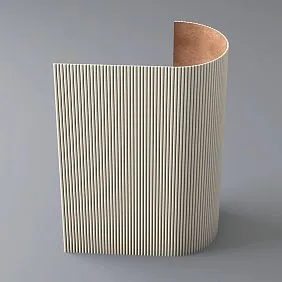
MDF slatted wood panels are currently the most popular format. Narrow wooden slats, mounted with a set spacing on an MDF backing, create a vertical or horizontal rhythm, a lively play of light and shadow, and a three-dimensional surface. The slats can be made from solid oak or beech, or from MDF that is painted or veneered.
The slatted rhythm is clearly perceptible in both daylight and evening lighting. Such panels are especially expressive with side lighting: each slat casts a shadow, and a flat wall transforms into a sculptural surface.
Relief panels
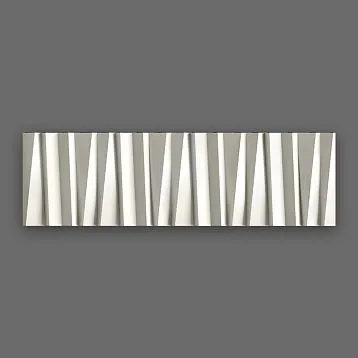
Relief MDF panels have a three-dimensional pattern on the face: geometric ornaments, waves, diamonds, coffers, abstract patterns. Such solutions create a striking decorative effect — especially with accent lighting. Relief panels look great in neoclassical, Art Deco, and contemporary interiors, but require measured application: it's easy to overload a space with them.
Modular Panels
Modular MDF panels are prefabricated systems where individual elements are mounted according to a set scheme, creating a unified composition. This approach allows for creating a unique layout: combining smooth and slatted zones, adding decorative inserts, forming a rhythm from several standard sizes.
Panels for painting
A separate and highly sought-after category. MDF panels with a clean, even surface are specifically designed for finish painting. No wood grain texture — only precise geometry of form. This is maximum freedom for the designer: the same set of panels can be painted white, blue, green, graphite — each time yielding a fundamentally different result.
Panels with pronounced wood grain texture
MDF panels with a veneered surface or with applied wood-grain film are the most 'wood-like' of all MDF formats. They provide a natural or very close visual effect: a lively grain pattern, shade variations, natural irregularity. The higher the quality of the veneer or film, the harder it is to distinguish such a panel from solid wood without tactile contact.
Why wood-look MDF panels are so in demand
There are several reasons, and all of them are practical.
The visual effect of wood is achieved without the limitations imposed by natural material. There's no need to worry about deformation, humidity, or installation complexity—MDF panels maintain their shape under standard residential operating conditions.
Accent finishing without extra weight and cost. One wall with a wood texture is all you need for a full effect. MDF panels allow you to create such an accent plane quickly, precisely, and with predictable results.
Space zoning.MDF wall panels—are one of the best tools for visual zoning in open layouts: living room with kitchen, work area in the bedroom, dining nook in a combined space.
Compatibility with all styles. From Scandinavian loft to neoclassicism—wood-look MDF panels adapt to any context. The choice of tone, texture, and format determines which style they will fit into.
Convenience for residential and commercial projects. In commercial interiors, the ability to replicate is especially important: producing and installing 20 identical sections with precise geometry is a task for MDF, but not for solid wood.
How wood-look MDF panels differ from solid wood
This is one of the most common questions, and the answer depends on what exactly you value.
Visual effect
Solid wood panels have a living grain pattern that cannot be fully reproduced artificially. Each board is unique. Veneered MDF panels come very close to this effect—especially with high-quality veneer that has a pronounced texture. Panels with decorative wood-grain film are a convincing imitation, but the difference is noticeable upon close inspection and with side lighting.
Geometric Stability
MDF is absolutely stable: it does not warp, crack, or react to seasonal humidity fluctuations. Solid wood 'lives'—it breathes with the room and may experience slight deformation during sudden changes. In spaces with unstable climates, wood-look MDF panels are a more predictable choice.
Flexibility in finish selection
MDF can be painted any color, covered with any veneer, have any film applied, or be milled into any shape. Solid wood is limited by the wood species and its natural shades. In terms of finish flexibility, MDF significantly surpasses natural material.
Application options
For classic systemsBoiserieand accent finishes with natural texture—solid wood or veneer. For clean geometry, painting, mass-produced projects, and commercial interiors—MDF. For slat systems with a modern rhythm—solid wood slats on an MDF backing as the optimal combination.
What to choose for a specific task
If the interior requires a living natural texture and the tactile feel of real wood—chooseSolid wood productsIf geometric precision, paintability, and stability under any conditions are needed, wood-look MDF panels will be the optimal solution.
Where can wood-look MDF panels be used?
In the living room
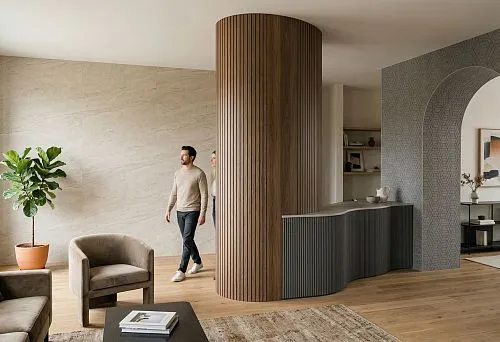
The living room is the most popular space for using wood-look MDF panels. Here, they serve as an accent wall behind the sofa, a backdrop for the TV area, or the visual centerpiece of the entire space. Slatted MDF panels in the living room create rhythm and depth; smooth veneered panels provide a noble and calm backdrop. In the living room, wood-look MDF panels unify furniture, flooring, and doors into a cohesive system.
In the bedroom
The bedroom is a place for warm, enveloping visual comfort. Here, wood-look MDF panels are primarily installed behind the bed headboard. Vertical slats create an accent zone and replace a separate headboard. Smooth veneered panels with a soft shade of light ash or warm oak are the perfect backdrop for a calm and cozy bedroom.
In the hallway and corridor
In the hallway, wood-look MDF panels are traditionally installed at wainscot height—90–120 cm. This serves both as decoration and protection: the lower part of the wall in the corridor experiences the most wear from contact and dirt. Smooth or slatted MDF panels with a durable lacquered finish will last long and remain tidy here.
In the study
The study requires a restrained, substantial interior. MDF panels in dark oak or walnut create an atmosphere of concentration and prestige. A classic option is a full system with moldings and decorative overlays; a modern one is slatted panels in a dark tone from floor to ceiling.
In the dining area
The dining area requires coziness and warmth. Wood-look MDF panels with a natural texture or wood grain create a 'cocoon' around the dining table—especially if the panels cover three out of four walls, leaving one open. The slatted rhythm adds dynamism and makes the area lively.
In office and commercial interiors
In offices and commercial spaces—restaurants, hotels, showrooms, reception rooms—wood-look MDF panels serve as a tool for creating prestigious, respectful environments. For commercial projects, MDF is preferable to solid wood precisely due to its ability for precise replication and resistance to operational loads.
For TV zones, niches, and partitions
The TV zone and the bed zone are the two most advantageous places for accent finishing with MDF panels. A niche lined with slatted or relief panels turns into an art object. A partition made of panels on a frame is functional zoning with a decorative effect. Fordecorative solutions in niches and on partitionssystems with precise joints and molding framing work especially well.
How to choose wood-look MDF panels by format
For an accent wall
The best option is slatted panels with a pronounced rhythm or relief panels with decorative volume. They create a self-sufficient plane that attracts the eye and holds interest. For an accent wall, it's important not to overload: one texture, one tone, one rhythm — without mixing.
For background finishing
Smooth MDF panels — for painting or with a calm veneer. They do not compete with furniture and decor, but add structure and depth to the space. For background finishing, neutral shades are optimal: white, cream, light beige, calm oak.
For zoning
Slatted panels on a partition or partial finishing of one of the walls in an open-plan layout is a classic zoning technique without physical barriers. Light and air pass through the gaps between the slats, while the space is clearly divided into zones.
For complex areas
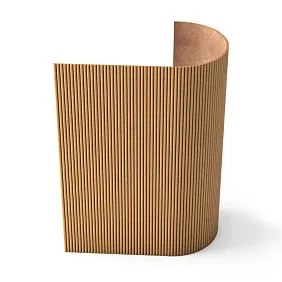
For columns, arches, and curved surfaces, flexible fabric-based slatted modules are needed. For niches—rigid panels cut to the size of the niche. For complex junctions—moldings and profiles from the same collection.
For small rooms
In small rooms, it's not advisable to cover all four walls with panels. One accent plane is enough. Choose light shades and a medium slat spacing—not too tight (creates visual crowding) and not too sparse (loses rhythm).
For spacious interiors
In a spacious area, you can work more broadly: several accent zones, a panel system on two adjacent walls, large-format modules. Here, dark tones and pronounced textures are appropriate—they don't overwhelm but fill the space.
How to choose panels by color and texture
Light wood tones—bleached oak, ash, birch—work well in white, cream, and light gray interiors. They add warmth without overloading the space.
Warm natural tones—honey oak, medium-saturation walnut, cherry—create a cozy, lively atmosphere. Good for bedrooms, living rooms, and studies with warm lighting.
Deep dark textures—wenge, dark walnut, merbau—give an expressive character. Work as a powerful accent on one wall. Require caution in small spaces.
Calm, even pattern—uniform texture without a pronounced wood grain pattern. Suitable for modern interiors and minimalism.
Pronounced wood character — panels with emphasized texture, swirls, and shade variations. They work as self-sufficient decor. It's important here for other interior elements to be restrained.
Combination with flooring, furniture, and doors: optimal when panels, door leaves, and flooring work in the same color scheme. Not necessarily the same species or shade — harmony of tones is important.Wood and MDF Productsare produced in a wide range of species and finishes, allowing for the formation of a unified system.
How to choose panels to match the interior style
Modern style
Modern interior is about clarity, conciseness, and control over details. Here, MDF slat panels with even rhythm, neutral shades, and no decorative overload work best. Tones — light oak, ash, beige, taupe. Finish — matte, without shine.
Minimalism
A minimalist interior requires maximum restraint. Smooth panels in the same tone as the wall, for painting or with a thin veneer without a pronounced pattern. Slats are acceptable, but with wide spacing and small thickness.
Scandinavian interior
Scandinavian aesthetics love natural light wood, natural texture, honest material without excessive processing. MDF panels under birch, ash, or light oak with a matte oil finish — a solution close to the original. Geometry is simple, rhythm is calm.
Japandi
Japandi — precision, silence, naturalness. Narrow vertical slats of ash or oak with natural toning, small spacing, no decorative excesses. Here, an MDF substrate with slats made of solid wood is the perfect combination: precise geometry of the base and the living texture of the slat.
Neoclassicism
Neoclassicism requires structured wall systems: moldings, coffers, cornices, decorative overlays. Here, MDF is the primary working material because it is easily milled into any profile, paints well, and perfectly holds its shape.Wall panels in the boiserie styleMDF with enamel — a classic neoclassical answer.
Warm natural interior
For a warm, natural interior — panels with veneered surfaces or solid wood slats on MDF. Shades: honey, walnut, terracotta, olive. Texture — pronounced, natural, non-uniform. It is in such an interior that MDF wood-look panels work most organically.
What to choose: smooth panels, slatted, or relief panels?
This is not a question of taste, but of purpose.
A smooth plane — for a neutral background, for painting, for classic systems with moldings, for rooms with rich furniture decor. A smooth panel does not compete with the interior; it is a silent participant.
Slatted rhythm — for an accent wall, for modern and Scandinavian interiors, for spaces where the play of light and shadow is important. Slatted panels are active and expressive; they 'make' the wall.
Decorative volume — for classic and neoclassical projects, to create a 'palatial' or Art Deco effect, for specific zones where visual weight is needed. Relief panels require careful dosing — they can easily overwhelm the space.
How to avoid overwhelming the interior: if you choose slatted or relief panels, limit them to one wall. The other surfaces should be calm. Wood works as an accent — and it is in this role that it is most convincing.
How are MDF wood-look panels installed?
Foundation Preparation
The base must be level, dry, degreased, and primed. The permissible deviation for adhesive installation is no more than 5 mm over 2 m. For larger irregularities, a metal profile frame is necessary. Priming is mandatory: it improves adhesive adhesion and reduces the likelihood of delamination.
Mounting with adhesive
Mounting adhesive or liquid nails are applied to the back surface of the substrate in zigzag strips. The panel is pressed against the wall, leveled, and secured. The first panel is installed strictly along the vertical zero line—it sets the entire subsequent geometry. Additionally, headless finishing nails can be used.
Mounting on frame
A metal profile frame is used for uneven walls, to hide utilities, or to create an air gap. Vertical studs are installed at 400–600 mm intervals, carefully leveled. Panels are attached to the studs with screws through the substrate or hidden via grooves.
Panel joining
Adjacent panels are joined end-to-end. In slat format, the key is to maintain rhythm continuity: slats should continue seamlessly from one module to another. Always perform a dry layout check before installation.
Corners, niches, and junctions
Internal corners—cut at 45° or use a corner profile. External corners—metal or wooden corner molding. Junctions with ceiling and floor are covered with molding or baseboard. Niches are installed from the back wall, then the sides—this allows hiding the ends behind the edges of the side panels.
How to care for wood-look MDF panels
Regular cleaning—use a soft dry or slightly damp cloth. No abrasives, stiff brushes, or aggressive detergents—they damage the surface coating.
Care for light textures—wipe especially carefully: light surfaces show dirt more noticeably. For living spaces, an additional matte varnish coating after installation is recommended—it increases practicality.
Care for dark textures—more visually resistant to dirt but require polishing to remove streaks. Soft dry flannel removes fingerprints.
What to avoid: direct water exposure, steam, prolonged moisture (especially relevant for hallways), scratching with sharp objects, contact with household chemicals.
How to maintain a neat surface appearance: choosing the right coating at the selection stage is the best prevention of problems during use. Matte varnish on MDF panels creates a protective layer that significantly extends the period of flawless appearance.
Common mistakes when choosing wood-look MDF panels
Knowing typical mistakes saves time and money:
-
Not understanding formats and choosing 'any wood-look MDF panels' — ending up with something different than expected
-
Choosing only by color — without considering format, rhythm, and compatibility with the interior
-
Not distinguishing between smooth, slatted, and textured solutions — they create fundamentally different visual effects
-
Using dark textures for a small room — this visually weighs down and compresses the space
-
Not coordinating panels with the floor, doors, and furniture — mismatched tones disrupt integrity
-
Not planning where the accent will be and where the background will be — panels on all walls without a system create visual chaos
-
Not considering lighting — panels look different under natural light and evening lighting; always check samples in real conditions
-
Buying panels before understanding the installation method leads to rework and material loss
-
Searching for 'wooden MDF panel' without understanding whether you need MDF material or a wood visual effect: the entire choice depends on the answer to this question
What to choose for different tasks
For an accent wall
MDF slatted panels with natural oak slats or veneered surface with pronounced texture. One tone, one rhythm, vertical direction.
For zoning
Slatted panels on a partial wall or partition. Light passes through the gaps — space is divided but not closed off.
For a calm background
Smooth MDF panels in a neutral tone — for painting or with a calm veneer without active pattern.
For a project in a modern style
Slatted panels with even medium spacing, light or natural oak shade, matte finish without shine.
For an interior with a warm wood color palette
Veneered smooth or slatted panels in honey oak, walnut, or cherry shades. Oil or wax coating emphasizes the natural character.
For apartments
Accent wall in the living room, bed area in the bedroom, lower section in the hallway. Three application points — and the interior gains integrity without overload.
For home
In a country house, MDF wood panels are more widely appropriate: a system in the living room, finishing in the study, an accent area in the bedroom. A unified material logic ties the space together.
For commercial premises
MDF with wear-resistant coating or veneered panels with additional varnishing. For offices and meeting rooms — a system with moldings in a neutral business tone. For restaurants and showrooms — slatted panels with a more expressive texture.
Selection algorithm: how to make a decision
If brief and to the point — here is a working scheme:
-
Define the task — accent, background, zoning, complex area
-
Choose the format — smooth, slatted, relief, modular
-
Choose texture and color — to match the style, lighting, and adjacent elements
-
Match with interior style — contemporary, Scandinavian, Japandi, neoclassical
-
Plan the installation — flat wall or frame, joints, corners, adjacencies
-
Proceed to specific panels — taking into account all previous steps
MDF wood panels are a material that forgives usage errors but requires precision at the selection stage. The better you understand what exactly your interior needs, the more precise and long-lasting the result will be.
FAQ: Answers to popular questions
What are MDF wood panels?
These are wall panels based on MDF board with decorative wood finish — veneer, decorative film with wood texture, or solid wood slats on an MDF backing.
Why are MDF panels called wooden?
Because they create a visual and tactile wood effect. Either through natural veneer on the surface or through solid wood slats. 'Wooden' in this context is a characteristic of appearance and aesthetics, not the composition of the base.
What's better: MDF panels with wood finish or solid wood?
Depends on the task. Solid wood — for maximum natural effect and longevity. MDF — for geometric precision, painting, and stability under any conditions. Veneered MDF — a compromise between aesthetics and practicality.
Are MDF panels suitable for living rooms and bedrooms?
Yes, and very well. For the living room — an accent wall or TV zone. For the bedroom — the headboard area of the bed.
Which MDF panels are better for an accent wall?
Slatted with a pronounced rhythm or veneered with natural texture. One tone, one direction of slats — without mixing formats.
What to choose: smooth, slatted, or relief panels?
Smooth — for a neutral background and painting. Slatted — for an accent plane and modern rhythm. Relief — for decorative zones in classic or neoclassical interiors.
Can MDF panels be used for zoning?
Yes. Slatted panels on a partial wall or partition — one of the best techniques for visual zoning.
How to choose the color of panels to match the interior?
Start from the floor and doors. Panels should work in the same color palette — not necessarily the same shade, but in the same color temperature.
Are MDF panels suitable for a modern style?
They are an excellent fit. Slatted panels with a uniform rhythm in a neutral tone are one of the most sought-after modern solutions.
How are wood-look MDF panels installed?
On mounting adhesive — for even walls. On a metal frame — for uneven surfaces or to conceal utilities. Additional fastening — finish nails or hidden fasteners.
How to care for such panels?
A soft dry or slightly damp cloth. No abrasives or aggressive cleaners. An additional matte lacquer coating after installation enhances practicality.
What mistakes are most commonly made when choosing?
Choosing based only on photo color, not considering lighting and format, not coordinating with furniture and flooring, overloading all walls with panels in a small room.
About the company STAVROS
If you are looking for high-qualitywooden MDF panelsfor walls — with precise geometry, reliable backing, and a wide choice of formats — pay attention to STAVROS products.
STAVROS is a Russian manufacturer with over 20 years of experience in creating wood and MDF products for interiors. The range includesslatted panels made of MDF and solid oak, boiserie wall systems, moldings, cornices, baseboards, decorative overlays, and millwork. Everything is produced to custom sizes with high detail and quality control at every stage.
STAVROS works with designers, architects, foremen, and direct clients. Showrooms in Moscow and St. Petersburg, full cycle — from measurement to installation, material samples for visual assessment before ordering.Wood and MDF Products— it's not just products, it's ready-made interior solutions that work as a unified system.