Article Contents:
- What are wooden table legs and why are they needed
- What wooden table legs can be bought in Moscow
- Straight wooden legs: clarity and versatility
- Tapered legs: movement and lightness
- Turned legs: profile as ornament
- Carved wooden legs: maximum decoration
- Massive supports for heavy tabletops
- Decorative legs for console and coffee tables
- For which tables wooden legs are suitable
- For dining table: power and style
- For writing desk: ergonomics and character
- For coffee table: delicacy and presence
- For console: height and elegance
- For dressing table: grace and style
- For decorative interior table
- How to choose wooden legs for a table: 8 main criteria
- By height: determines everything
- By shape: silhouette from a distance
- By table type
- By load capacity: safety does not tolerate beauty without strength
- By tabletop size and weight
- By material: oak or beech, for tinting or for enamel
- By mounting type: confirm before ordering
- By interior style: image integrity
- What table leg height is suitable for different tasks
- Height for dining table
- Height for writing desk
- Height for coffee table
- Console height
- How height affects the look
- Which materials are best for wooden table legs
- Why wood is the logical choice
- Oak: for load and texture
- Beech: for enamel finish
- Processing levels: Standard and Prestige
- How to choose wooden legs to match the table style
- For a classic table
- For neoclassical style
- For a modern table
- For Scandinavian interior
- For decorative interior solution
- Common mistakes when choosing table legs
- Mistake 1: calculating height without considering tabletop thickness
- Mistake 2: weak legs under a heavy tabletop
- Mistake 3: choosing based only on photographs
- Mistake 4: incompatible mounting
- Mistake 5: overly decorative legs for a simple table
- Mistake 6: disproportionate legs and tabletop
- Mistake 7: different wood species or finishes when replacing one leg
- Where to buy wooden table legs in Moscow
- STAVROS: catalog and warehouse
- What to clarify before ordering
- Pickup and delivery
- Showroom on Volokolamsk Highway
- Who are wooden table legs especially suitable for
- For private buyers
- For interior designers
- For furniture workshops
- For restorers
- For custom furniture manufacturers
- FAQ: answers to common questions
- What wooden table legs are the most popular in Moscow
- How to choose the height of table legs
- What legs are suitable for a heavy tabletop
- Are wooden legs suitable for a writing desk
- What legs to choose for a coffee table
- When to choose turned legs for a table
- Can old table legs be replaced with new wooden ones?
- How to understand if the mounting will fit?
- Where to buy wooden table legs in Moscow?
- How to avoid mistakes when choosing table supports?
- About the Company STAVROS

A table is not just a surface. It's the center of a space, a focal point, a place around which the life of a room is built. A dining table in the living room, a writing desk in the study, a coffee table between sofas — each carries its own function and its own visual meaning. And each has a base. Wooden table legs are not just what it stands on. They are how it looks, how it is perceived, how long it serves.
Buying wooden table legs in Moscow is a specific task. It has parameters: height, shape, load capacity, mounting, style. A mistake in any of them — and the result is disappointing. This article is a complete breakdown of all parameters, without generalities or filler.



What are wooden table legs and why are they needed
Wooden table legs are support elements made from solid natural wood, which are attached to the underside of the tabletop or apron and ensure the stability of the structure. But they have more tasks than might seem at first glance.
Structural task — to bear the load. A table carries a static load from the tabletop (5–80 kg depending on material and size) plus dynamic load from items on the surface and impact during use. For a dining table, this can be up to 150–200 kg at peak moments. The supports must withstand this without deformation.
Aesthetic task — to define the item's image. The same tabletop on straight square legs and on turned, shaped supports — these are two different tables, two different atmospheres, two different styles. The shape of the leg determines the style of the table just as the shape of a handle determines the character of a door.
Practical task — to ensure convenience. The height of the legs is the height of the table, which affects the comfort of sitting, working, or eating. Incorrect height cannot be corrected by anything except replacing the legs.
Why are wooden table legs the best choice? Because wood is a living material. It is warm, it works with any interior from Scandinavian minimalism to rich Baroque, it is renewable, it lasts for decades. Wooden supports under a wooden or stone tabletop create an organic unity that metal or plastic cannot achieve.
In the catalogSTAVROS wooden legs and supports— over 130 models made of solid oak and beech. For all types of tables: from coffee tables to dining tables, from consoles to bar counters.




What wooden table legs can be bought in Moscow
Our factory also produces:


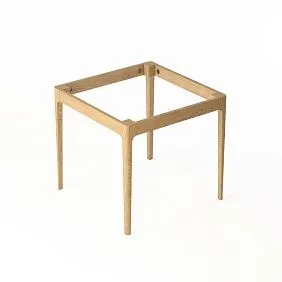


Straight wooden legs: clarity and versatility
A straight leg is cylindrical, square, or rectangular in cross-section, strictly vertical, without bends. The most neutral type. It does not loudly declare a style—it creates a base without drawing attention away from the tabletop.
Straight wooden table legs are good where the tabletop already carries a decorative load: a solid slab with a live edge, marble with expressive veining, an aged board with history. Here, the leg is a quiet, precise accent.
A square cross-section of 7×7 cm is suitable for a dining table. A cylinder with a diameter of 5–6 cm is for a writing desk or console. For a coffee table—more delicate options with a diameter of 3–4 cm and a height of 35–45 cm.
Get Consultation
Tapered legs: movement and lightness
A tapered leg is straight, narrowing from the body to the floor. The diameter at the base of the tabletop is larger, the diameter at the floor is smaller. This principle creates visual movement: the table seems to 'push off' from the surface.
Conical wooden table legs are one of the most popular types for neoclassical, modern classic, and Scandinavian styles. They are both stable and visually light. They look especially organic on tables with straight rectangular tops.
Turned legs: profile as ornament
Turned legs are produced on a lathe, creating a variable profile: beads, roundings, diameter transitions, decorative grooves. This is not carving—it's form. But form created with intention.
Turned wooden table legs are a classic type for a wide range: from moderate classic to more saturated neoclassical. They have ornamentation without overload. This is a leg that adorns the table without overpowering it.
STAVROS offers turned legs in several collections with different profile saturation. They can be organically combined with decorative inlaysandmoldings to create a unified furniture system in the interior.
Carved wooden legs: maximum decor
Carved legs are ornamental relief on the surface. Acanthus leaves, floral motifs, geometric weaves. CNC milling with manual finishing. This is a category for those who create a table as a work of art.
Carved decorative table legs — for executive office desks, for dining tables in classic interiors, for consoles in Empire or Baroque style. 'Prestige' level: manual sanding after CNC, sharp edges of the ornament, maximum detailing.
Massive supports for heavy countertops
Countertops made of natural stone, solid wood 60–80 mm thick, or porcelain stoneware weigh from 30 to 120 kg for the surface alone. Such countertops require supports with an appropriate cross-section.
Massive wooden table supports made of oak: diameter 8–12 cm, height according to table type. These are not just legs — they are load-bearing columns. Their style can be either laconic (straight cylinder or square) or decorative (turned column with a capital).
For the under-table structure for a heavy countertop, STAVROS also offersfurniture frames and under-table structures— ready-made solutions for mounting countertops of any weight.
Decorative legs for console and coffee tables
A console and a coffee table are items where the leg is fully visible. The body is small, the countertop is light, and the support is the center of attention. Here, the shape of the leg is perceived in all its detail.
Decorative wooden legs for a console table: height 80–90 cm for a standard console, diameter 4–6 cm. Tapered or turned. For a coffee table: height 35–45 cm, diameter 3–5 cm. The shape is coordinated with the interior style.
Next to the console legs, the following look organic:decorative rose outletsfor finishing attachment points andCrown Moldingfor finishing the perimeter.
Which tables are wooden legs suitable for
For a dining table: power and style
The dining table is the most heavily loaded item in a residential interior. It bears the weight of the tabletop, dishes, food, and up to several people leaning on it. Wooden legs for a dining table must combine structural reliability with expressive design.
Parameters: leg height 71–75 cm (standard dining table height from floor to tabletop). Cross-section: for a table for 4–6 people — diameter 6–8 cm with four supports. For a large table for 8–10 people — diameter 8–10 cm.
Shape — according to interior style. Classic dining room: turned or carved legs. Modern living room: tapered or straight. Scandinavian interior: tapered made of light oak or beech.
For a desk: ergonomics and character
A desk is an item that has not only load-bearing but also ergonomic requirements. The standard height of the work surface is 72–76 cm. The height of the legs affects the comfort of working in a seated position.
Wooden legs for a desk: straight or tapered supports with a height of 70–73 cm (plus the thickness of the tabletop — total 72–76 cm). For a study desk in a classic style — turned legs with a moderate profile.
Important point: a desk often has pedestals or drawers attached to the underframe. In this case, the legs must be coordinated with the entire piece's construction. STAVROS offersFrames and basesfor desks, which can be equipped with wooden legs from the same collections.
For a coffee table: delicacy and presence
A coffee table is a small piece with a low work surface (35–50 cm from the floor). The load is moderate. However, decorative requirements are high: the coffee table stands in the center of the living room and is visible from all sides.
Wooden legs for a coffee table: height 30–45 cm, cross-section 3–5 cm. Shape — tapered, turned, or straight depending on the style. For a classic living room — turned supports with a pronounced profile. For a modern one — laconic tapered legs made of dark oak.
For a console: height and elegance
A console is an accent piece. In the hallway, in the living room against a wall, in the bedroom by the headboard. The console's legs are the most visible part of the piece. Standard console height is 80–90 cm. Legs: height 77–85 cm (plus the thickness of the tabletop).
Wooden legs for a console table should be proportional: thin for a narrow, light console, more massive — for a wide one with a heavy stone tabletop. Shape — tapered or turned for most styles, carved — for a classic hallway.
For a dressing table: grace and style
A dressing table is a piece from the 'decorative furniture' category. The load is minimal, but the requirements for form are maximal. This is a piece for a boudoir, bedroom, a feminine interior statement.
Wooden legs for a dressing table: elegant, tapered, or shaped, with a height to match the required mirror height. Beech under white or pearl enamel is a classic for this type of item.
For a decorative interior table
A decorative interior table is not a place for eating or working. It is an art object, an accent, a detail. Here you can allow yourself the most expressive legs: shaped, carved, with patina, with non-standard height.
How to choose wooden table legs: 8 main criteria
By height: determines everything
The height of wooden table legs is the first parameter to start any selection. It determines comfort, seating, and the proportion of the item.
| Table type | Table height | Leg height (approximate) |
|---|---|---|
| Dining | 74–76 cm | 70–73 cm (+ tabletop thickness) |
| Writing | 72–76 cm | 68–72 cm (+ tabletop thickness) |
| Coffee | 40–50 cm | 35–45 cm (+ tabletop thickness) |
| Console | 80–90 cm | 76–86 cm (+ tabletop thickness) |
| Bar | 90–105 cm | 86–100 cm (+ tabletop thickness) |
| Toilet | 70–80 cm | 65–76 cm (+ tabletop thickness) |
Calculation: leg height + tabletop thickness = final table height. For a dining table, the standard is 74–76 cm. For a bar table — 90–105 cm.
Important note: tabletop thickness varies greatly. A thin plywood top — 18 mm. Solid wood — 40–60 mm. Natural stone — 20–40 mm. When calculating, consider the actual thickness of your specific tabletop.
By shape: silhouette from a distance
The leg shape defines the table's visual appearance. It's the first thing seen from 3–5 meters away when entering the room.
-
Straight square — strictness, modernity, conciseness
-
Straight cylindrical — neutrality, universality
-
Conical — lightness, movement, neoclassicism, Scandinavian style
-
Turned with profile — wide classical range, decorativeness through form
-
Carved — rich classicism, decorative maximum
The selection principle is simple: the leg shape matches the tabletop shape. Rectangular tabletop with sharp corners — straight or conical legs. Tabletop with rounded corners or live edge — turned or more organic shapes.
By table type
Dining, writing, coffee, console — each type has its own requirements for height and cross-section. More details — in the previous section. Rule: load and height determine structural requirements, style and form determine aesthetic ones.
By load: safety does not tolerate beauty without strength
The load on a table consists of several components:
-
Tabletop: solid wood 60 mm — 20–40 kg, stone — 40–100 kg, glass — 10–20 kg
-
Items on surface: dishes, books, appliances — 10–50 kg
-
Dynamic load: leaning, impacts, vibration — design factor 1.5–2
Total: a dining table carries 80–200 kg in total. With four legs — 20–50 kg per leg. With an oak leg diameter of 6 cm — this is a load with a margin. With a diameter of 3 cm under a heavy stone tabletop — this is already a risk.
Formula: leg cross-section ≥ 1/8–1/10 of tabletop size (by shortest side).
By tabletop size and weight
Leg must be proportional to tabletop not only structurally, but also visually. Thin legs under massive dark tabletop create feeling of instability. Massive thick legs under light glass top — visually overload lower part of item.
Practical rule: length of shortest tabletop side / 10 = recommended leg diameter. For table 80 cm wide — leg diameter 8 cm is optimal. Acceptable range: 7–10 cm.
By material: oak or beech, for tinting or for enamel
Oak — hardwood, density 650–700 kg/m³. Large expressive grain. For tinting and varnish finish preserving pattern. Dark, brown, saturated interiors.
Beech is a fine-textured, homogeneous wood with a density of 680 kg/m³. It accepts any enamel paint without the wood grain showing through. Suitable for white, light, and cream-colored tables. Styles: Provence, neoclassical, Scandinavian.
Both options are produced with kiln drying to a moisture content of 8 ± 2%. This is crucial: properly dried wood does not crack, warp, or deform when room conditions change.
Regarding the type of attachment: please clarify before ordering.
Wooden table legs are attached to the underframe or directly to the tabletop in several ways:
-
Bolt-on — a bolt passes through the lower crosspiece of the underframe or through the tabletop. Maximum reliability for heavy structures.
-
M8/M10 Stud — a metal stud is screwed into an insert nut in the end of the leg or into the lower beam of the underframe.
-
Corner Bracket — a metal bracket is attached to the top end of the leg and to the lower surface of the tabletop.
-
Mortise Joint — the leg fits into a groove in the lower part of the underframe; used in knockdown tables.
For a dining table with high load — bolt-on or bracket attachment. For a console or coffee table — a stud is sufficient.
When replacing old legs: determine the type of attachment already present in your table. Mismatched attachment type is the most common reason for leg returns in online orders.
By interior style: integrity of the image
A table exists within the context of a room. The table legs coordinate with the legs of chairs, the legs of a chest of drawers, and the wooden elements of the floor and walls. Disparate wooden details in one space are a sign of a poorly thought-out interior.
Unified system: table legs + chair legs + wooden elements of other furniture — from the same wood species, with the same tint, in the same ornamental style. STAVROS provides a complete system of furniture decor: legs,Capitals, Brackets, Outlets— from unified collections.
What leg height for a table is suitable for different tasks
Table height is one of the most important ergonomic characteristics. An error in it cannot be compensated for by anything.
Height for a dining table
Standard: 74–76 cm from the floor to the work surface. This is the height at which an average-height adult sits comfortably, freely resting their arms on the table without hunching. A height below 72 cm is uncomfortable for tall people. Above 78 cm is inconvenient for people of average and below-average height.
Legs for a dining table: height 70–73 cm plus the thickness of the tabletop.
Height for a writing desk
Standard for a desk: 72–76 cm. When working with a keyboard and mouse, it's important for the forearms to be horizontal and the shoulders not raised. For tall people — up to 80 cm (with a corresponding lift of the chair or stool).
Non-standard solution: adjustable height. For this, wooden legs with adjustable glides are used — a small adjustment range of 1–3 cm allows precise leveling on an uneven floor.
Height for a coffee table
Coffee table: 35–50 cm. This is a height convenient for reaching from a sofa or armchair: you grab a cup, place a magazine, set down a remote. A coffee table that's too low (below 35 cm) — is inconvenient. One that's too high (above 55 cm) — loses the 'coffee table' feel.
Height for a console table
A console is a functional and decorative piece. Standard height: 80–90 cm. This is the height at which an adult can place keys without bending over; a mirror above the console is positioned at a comfortable level.
For a children's hallway — lower, 65–70 cm. For a decorative console in a living room against a wall — standard 80–90 cm.
How height influences the look
Low legs (coffee table, 35–45 cm) create a 'grounded' feel, stability, horizontality. High legs (bar counter, 90–105 cm) create a vertical rhythm, dynamism, lightness. Tables of medium height (dining, writing) — a neutral ergonomic norm.
Which materials are best for wooden table legs
Why Wood is the Logical Choice
Wooden table legs have competitors: metal, plastic, composite. But wood has fundamental advantages.
Material unity. A wooden table on wooden legs is one object, one story. A wooden table on metal legs is a visual compromise that must be consciously accepted.
Restorability. A wooden leg can be sanded and repainted during table restoration. Metal or plastic legs can only be replaced.
Warmth. Wood is warm both tactilely and visually. This is important in a living space: a table is an object touched daily.
Strength with proper cross-section. Solid oak with an 8 cm diameter can withstand a load comparable to a metal pipe of the same diameter. For normal furniture table loads, wood is a fully sufficient material.
Oak: For Load-Bearing and Texture
Oak hardness on the Janka scale is about 5900 N (one of the highest values among domestic hardwood species). Density is 650–750 kg/m³. Large, expressive texture with a clearly readable pattern. Stable when properly dried.
Wooden table legs made of oak are for dark interiors, for rich classic styles, for tables in the 'medieval' style, for tables made of slabs or solid boards.
Beech: For Enamel Finishing
Beech is a homogeneous, dense wood species. Its hardness is lower than oak's but sufficient for furniture loads. It has a fine-textured structure without a large grain pattern. Under a dense enamel finish, beech provides a perfectly smooth surface without wood fiber show-through.
Wooden table legs made of beech are suitable for white, cream, gray, and pastel interiors. For Provencal kitchens, neoclassical living rooms, and Scandinavian spaces.
Processing Levels: Standard and Prestige
Standard — machine sanding to P120–P150 grit. A good surface for primer and enamel. For production and serial tasks.
Prestige — machine sanding plus hand finishing to P220–P280 grit. Perfect edges, clean profile transitions, and a smooth surface for clear varnish or thin tinting. For final decorative solutions.
How to choose wooden legs to match the table style
For a classic table
A classic table features a strict form, rich facade decoration, and expensive materials. Here, the leg is part of the system. Turned supports with profiling, columns with fluting, carved legs with acanthus decor. Made from solid oak, tinted to walnut or dark wenge.
For a large dining table in a classic dining room — four turned columns with a diameter of 8–10 cm and decorative rings. This is a monumental solution that matches the scale of the space.
When choosing decorative legs for a classic table, organically complement them withon the walls, creating a complete classical composition.at the attachment points to the under-table orcapitalsin the upper part of the support.
For neoclassical style
Neoclassicism – restrained classicism. Clean lines, moderate decor, high-quality materials. Cone-shaped turned legs with minimal profile, standard height, subtle transition from wide base to tapered bottom.
Material: beech with light tinting or oak with horizontal parquet. No ornament – only form.
For a modern table
Modern interior – straight lines, neutral materials, absence of ornament. Table legs: straight or slightly tapered, square or cylindrical cross-section, minimalist look.
Accent – on the material: oak with natural oil coating that preserves and emphasizes the grain, becoming living decor without ornament.
For Scandinavian interior
Scandinavian style – light wood, white or gray walls, natural textiles. Table legs: tapered, height 70–75 cm for dining, cross-section 5–7 cm. Beech with white or natural wax finish. Light oak with bleaching tint.
Tall tapered legs made of light wood under a laconic rectangular solid wood tabletop – a recognizable Scandinavian look that never goes out of style.
For decorative interior solutions
A decorative table is not for eating, not for working. For beauty, for accent, for atmosphere. Any shapes are possible here: figured, carved, with patina, with gilding. Legs are the main decorative element. The tabletop can be modest — the legs carry the look.
Common mistakes when choosing table legs
Mistake 1: calculating height without accounting for tabletop thickness
Ordered a leg 74 cm high, tabletop 40 mm. Final table height — 78 cm. Too high. Standard chair height 45 cm — and sitting is uncomfortable, shoulders raised. Always calculate: leg + tabletop = final table height.
Mistake 2: weak legs under a heavy tabletop
Beautiful turned legs 4 cm in diameter under a stone tabletop 80 kg. Result after six months: cracks, deformation, loss of verticality. Decorativeness does not compensate for insufficient cross-section. Always calculate the load.
Mistake 3: choosing only by photo
The leg in the photo looks proportional, but in reality turns out too thin or too tall for a specific tabletop. Look at technical parameters, not just the image. Better — come to the showroom and evaluate in person.
Mistake 4: mismatch of mounting
M8 threaded leg purchased for a table with bracket mounting. The structure cannot be assembled. Determine the mounting type before ordering.
Error 5: legs too decorative for a simple table
Carved figured legs under a simple laminated chipboard tabletop with 'oak' laminate — an absurd contrast. The level of leg decoration should match the level of tabletop decoration.
Error 6: disproportion between leg and tabletop
A thin leg with a diameter of 3 cm under a 120 cm wide tabletop — the item looks ready to tip over. A wide 12 cm leg under a small 60 × 60 coffee table — overloaded from below. Maintain proportion.
Error 7: different wood species or finishes when replacing one leg
Three original dark oak legs, one new light beech leg — the table looks 'broken'. When replacing one leg — buy all four simultaneously from the same batch.
Where to buy wooden table legs in Moscow
STAVROS: catalog and warehouse
Buy wooden table legs in MoscowAvailable in the STAVROS catalog. Over 130 models made from solid oak and beech. Filter by shape, height, collection, and availability at the Moscow warehouse. Order from one item.
Next to the legs in the catalog — a complete system of furniture decor:
-
Frames and basesfor mounting countertops
-
Decorative Insertsfor decorating items
-
Outletsfor decorating mounting points
-
Capitalsfor decorative columns
-
Crown MoldingandMoldingsfor furniture decoration
What to clarify before ordering
To ensure the order is accurate and the legs fit perfectly on the first try, prepare the following information:
-
Table type and its dimensions (countertop width × length)
-
Countertop thickness
-
Required final table height
-
Mounting type (bolt, stud, bracket)
-
Load (tabletop weight + planned table load)
-
Wood species (oak for tinting or beech for enamel)
-
Style (to select shape from the appropriate collection)
Pickup and delivery
STAVROS Moscow warehouse — pickup if items are in stock. Order conditions, payment methods, delivery options — on the page "Payment and Delivery". Delivery across Russia by transport companies.
Showroom on Volokolamskoe Highway
STAVROS showroom in Moscow (Volokolamskoye Highway, 3) — a place where you can see table legs at real scale. Compare 'Standard' and 'Prestige' in person. Match a leg to your tabletop sample. Get professional advice for selection based on your specific task.
Working hours and contacts — on the page "Contacts. Moscow".
Who wooden table legs are especially suitable for
For private buyers
Building a table from a slab? Want to make a coffee table yourself? Replacing the worn-out legs of an old desk? Natural wood table legs are both structural and decorative. STAVROS sells from a single item.
For interior designers
For a design project where tables, consoles, cabinets, and shelves should form a unified wooden system — the STAVROS catalog allows you to select legs, underframes, rosettes, and decor from one collection. These are not 'similar' elements — they are systemic.
For furniture workshops
Solid wood table legs are a professional production component. Stable warehouse in Moscow, wide assortment, possibility of wholesale supplies. A table on solid wood turned legs is a different price segment, different positioning.
For restorers
A lost leg of an antique table must be reproduced precisely: shape, wood species, behavior under finish. Only solid wood ensures compatibility with the original wood. The STAVROS catalog includes historical leg forms for restoration projects.
For Custom Furniture Manufacturers
Wooden turned or carved legs are an argument in favor of a high price segment. A customer choosing a table with solid oak legs pays consciously and appreciates quality.
FAQ: answers to frequently asked questions
What wooden table legs are the most popular in Moscow?
The most in demand are conical turned legs 70–73 cm high for dining tables, decorative turned supports 35–45 cm high for coffee tables, as well as carved legs for classic and office desks.
How to choose the height of table legs?
Required leg height = final table height minus tabletop thickness. For dining: final height 74–76 cm. For coffee table: 40–50 cm. For console: 80–90 cm. For bar: 90–105 cm.
Which legs are suitable for a heavy tabletop?
Massive wooden oak supports with a diameter of 8–12 cm with bolt or bracket fastening. For a tabletop weight over 60 kg — reinforced fastening and sufficient leg cross-section are mandatory.
Are wooden legs suitable for a writing desk?
Yes. Straight or tapered wooden legs with a height of 70–73 cm are suitable for a writing desk. For a classic-style office writing desk — turned legs with a moderate profile.
Which legs to choose for a coffee table?
Tapered or turned wooden legs with a height of 35–45 cm, diameter 3–5 cm. Shape — according to the living room style: minimalist for modern interiors, turned — for classic.
When should you choose turned legs for a table?
When the table belongs to a classic or neoclassical style, when decorative form without carved ornamentation is needed, when the tabletop is neutral and the leg should add character.
Can old table legs be replaced with new wooden ones?
Yes. Measure the type of fastening (stud, bolt, bracket), thread diameter, height of the current legs. When ordering from a STAVROS manager — provide these parameters for precise selection without modifying the table base.
How to understand if the mounting will fit?
Determine the type of fastening on your table. Look at the underside of the tabletop or the end of the existing legs. Bolt, stud, bracket — each of these types is visually identifiable. Measure the thread diameter with a caliper or compare it to M8 and M10 bolts.
Where to buy wooden table legs in Moscow?
At STAVROS — a manufacturer of wooden furniture decor. Catalog with in-stock items, showroom: Volokolamskoye Highway, 3. Phone: 8-800-555-46-75 (toll-free). Orders from a single item. Delivery in Moscow and across Russia.
How to avoid mistakes when choosing table supports?
Calculate the required height considering the tabletop thickness. Estimate the load. Determine the fastening type. Ensure the leg cross-section matches the tabletop weight. Check the leg proportion relative to the table size. Choose a shape that aligns with the tabletop style and interior.
About the company STAVROS
Wooden table legs in Moscow— is a precise choice that lasts for years. The right leg is not just a support. It's a solution that sets the style of the piece, determines its stability, and lays the foundation for the table's long life in your space.
STAVROS — a Russian manufacturer of wooden furniture decor made from solid oak and beech. Legs for tables, sofas, dressers, and other furniture,Decorative Inserts, Crown Molding, Moldings, Capitals, Bracketsandfurniture frames— a complete decor system for your furniture and interior.
Over 130 leg models, more than 4000 decorative items in the catalog. Chamber drying, two quality levels — Standard and Prestige. Blanks for enamel and tinting. Orders from a single item. Warehouse and showroom in Moscow: Volokolamskoye Highway, 3. Phone: 8-800-555-46-75 (toll-free across Russia).
STAVROS — when the table stands exactly as it should.