Article Contents:
- History of Wooden Mouldings in Russian Architecture
- From Protection to Art: The Evolution of Mouldings
- Regional Features and Styles
- Functional Role of Mouldings in Modern Homes
- Protective Function of Mouldings
- Aesthetic Role in Facade and Interior Decoration
- Types of Wooden Mouldings by Shape and Style
- Classic Straight Mouldings
- Decorative and Carved Mouldings
- Mouldings in Various Architectural Styles
- Materials for Manufacturing Mouldings
- Popular Wood Species for Mouldings
- Finishing and Protecting Wooden Mouldings
- How to Choose Wooden Mouldings for Your Home
- Compatibility with architectural style
- Technical parameters and dimensions
- Quality Criteria for Wooden Mouldings
- Where to Buy Wooden Mouldings: Market Overview
- Specialized Stores and Construction Markets
- Online stores and marketplaces
- Ordering from Manufacturers: Advantages and Features
- Prices for Wooden Mouldings: What Affects Cost
- Factors affecting the price
- Price Categories and What They Include
- Installing Wooden Mouldings: Technologies and Recommendations
- Preparatory work
- Step-by-step installation guide
- Common Installation Mistakes and How to Avoid Them
- Care for Wooden Mouldings and Their Restoration
- Regular maintenance and prevention
- Restoration of Damaged Mouldings
- Modern Trends in Wooden Moulding Design
- Combination of tradition and modernity
- Ecological and natural properties
- Innovative technologies in production
- Conclusion: Choosing the Perfect Mouldings for Your Home
Russian architectural heritage is unthinkable without wooden mouldings — these remarkable decorative elements that have adorned windows and doors of homes for centuries. Combining practicality and aesthetics, mouldings have become an indispensable part of Russian architecture, reflecting folk culture and the craftsmanship of woodcarvers. Today, interest in traditional decorative elements is reviving, and more homeowners are asking themselves, where to buy wooden mouldingsWooden casings are not just a decorative element. They are a symbol of connection with historical roots, an embodiment of the people's aesthetic concepts, and a functional detail protecting window and door openings from adverse environmental influences. In today's world, where individuality and eco-friendliness are so highly valued, wooden casings are experiencing a second life, becoming elements not only of traditional, but also of modern design.
The history of wooden casings in Russian architecture


The tradition of decorating windows and doors with wooden casings goes back to deep antiquity. Initially, casings served a purely practical function — sealing gaps between window frames and walls, protecting homes from cold, wind, and precipitation. However, over time, their utilitarian purpose enriched with aesthetic and even sacred meanings.
From protection to art: the evolution of casings




In ancient Russian architecture, windows were considered the 'eyes of the house' and simultaneously a vulnerable spot through which not only bad weather, but also evil forces could enter. Therefore, casings were adorned with symbolic patterns intended to protect the dwelling. Solar signs, plant motifs, depictions of birds and animals — each carving element had its own meaning and performed a protective function.
In ancient Russian architecture, windows were considered the 'eyes of the house' and simultaneously a vulnerable spot through which not only bad weather but also evil forces could enter. Therefore, window casings were adorned with symbolic patterns intended to protect the dwelling. Solar symbols, plant motifs, depictions of birds and animals—each element of carving had its own meaning and served a protective function.
By the 18th-19th centuries, wood carving art had reached its peak. Casings had transformed into true works of art, reflecting not only local traditions but also artistic styles of the era — Baroque, Classicism, Modernism. Each region of Russia developed its own decorative features: Tomsk casings differed from Vologda ones, Nizhny Novgorod ones — from Ural ones.
Our factory also produces:


Regional characteristics and styles
The diversity of wooden casing styles is breathtaking. In northern regions, solid carving with geometric patterns predominated, in central Russia — openwork carving with plant motifs, in the Volga region — complex compositions with Baroque elements.
Tomsk carving was renowned for its delicacy and ornamental richness. Vologda casings were distinguished by strictness and symmetry. Ural masters often used motifs of local flora and fauna. Such diversity of styles makes Wooden casings not just a decorative element, but also part of cultural heritage.
Get Consultation
Functional significance of casings in a modern home
Despite the fact that today construction technologies have advanced significantly, wooden casings have not lost their functional significance. They still perform several important tasks, making a home not only beautiful but also practical.
Protective function of casings
Modern Wooden casings continue to perform their original function — protecting window and door openings from external influences. They seal the joints between frames and walls, preventing moisture, dust, and insects from entering. This is especially relevant for wooden houses, where due to natural shrinkage, gaps may form.
In addition, casings protect window frames and door casings from premature wear, taking on the main impact of precipitation and ultraviolet radiation. This significantly extends the service life of windows and doors, saving money on their repair or replacement.
Aesthetic role in facade and interior design
In addition to their practical function, casings play an important aesthetic role. They give the house facade a finished look, emphasize the architectural style and individuality of the building. Properly selected casings can visually alter the proportions of a building, making it more harmonious and attractive.
In interiors, wooden casings also serve a decorative function, creating a unified design style and highlighting the beauty of natural wood. They can become an accent element, drawing attention and setting the tone for the entire room.
Types of wooden casings by shape and style
The modern market offers a vast variety of wooden casings, differing in shape, style, and decoration method. The choice of a specific variant depends on the architectural style of the house, the owner's personal preferences, and budget.
Classic straight casings
Straight casings are the simplest and most universal option. They are smooth rectangular strips that can be either completely plain or adorned with shallow carving or beveled edges. Such casings fit perfectly into modern minimalist interiors and exteriors, as well as classic styles.
The advantage of straight casings is their universality and relatively low cost. They easily combine with other decorative elements and do not overload the overall appearance of a room or facade.
Figured and carved casings
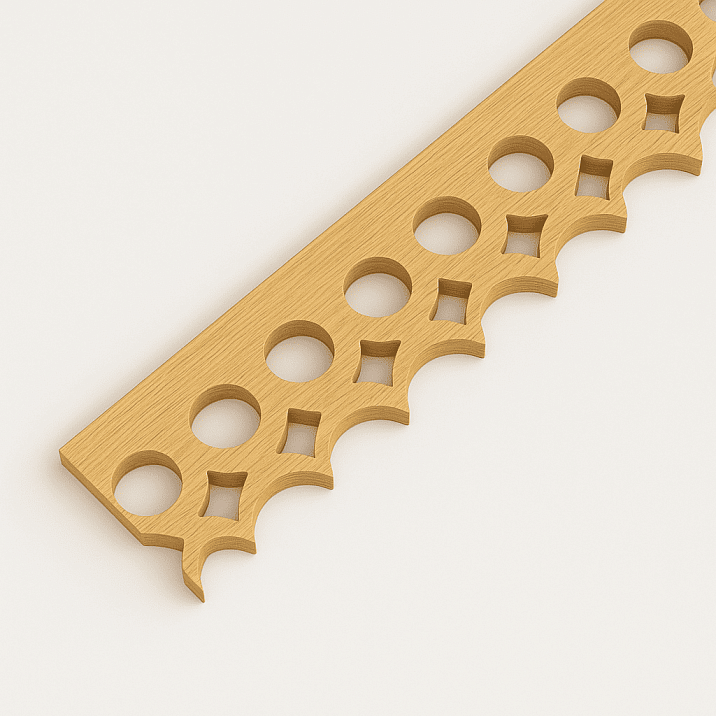
Figured casings have a more complex shape with curved lines, protrusions, and recesses. They can be adorned with relief or openwork carving, creating an effect of delicacy and lightness. Such casings become true ornaments of the house, attracting attention and evoking admiration.
Carved casings look especially good on wooden houses in Russian, Scandinavian, or Alpine styles. They emphasize the naturalness of materials and create an atmosphere of coziness and warmth.
Casings in various architectural styles
Depending on the architectural style of the house, you can choose casings that will harmoniously complement the overall concept:
- Russian style — richly carved casings with traditional motifs (sun, birds, plant ornaments)
- Scandinavian style - simple, minimalist forms with minimal decoration
- Classic style - symmetrical casings with elements of classical architecture (columns, pilasters, capitals)
- Modern style - smooth, flowing lines, floral motifs
- Country style - simple forms with minor decorative elements
- Contemporary style - geometric forms, minimalism, clean lines
Materials for making casings
The quality and durability of casings largely depend on the choice of material. Traditionally, casings are made from various types of wood, each with its own characteristics and advantages.
Popular wood species for casings
Spruce - the most common and affordable material for making casings. It is easy to process, has a pleasant light tone, and a distinct texture. Spruce casings are inexpensive but require careful protective treatment, as this wood is relatively soft and susceptible to moisture and insects.
Fir - also belongs to coniferous species and has similar characteristics to spruce. Fir casings have a more uniform structure and fewer knots, making them preferable for creating smooth, uncarved items.
Larch - one of the strongest and most durable coniferous species. It contains natural resins that protect the wood from rot and insects. Larch casings can last for decades without additional treatment, but they are more expensive than spruce.
Oak - a traditional material for making premium-class casings. Oak wood is characterized by high strength, moisture resistance, and beautiful texture. Oak casings will last for generations, but their cost is significantly higher than that of coniferous species.
Linden - ideal material for carved casings. This wood is soft, uniform, and lacks a distinct texture, making it perfect for creating intricate carved patterns. However, for outdoor use, linden casings require careful protective treatment.
Processing and protection of wooden casings
To Wooden casings To last long and retain an attractive appearance, proper processing and protection are necessary. This process includes several stages:
- Sanding - removal of irregularities and creation of a smooth surface
- Priming - treatment with special compounds that improve adhesion of subsequent coatings
- Antiseptic treatment - protection against mold, mildew, and insects
- Fire-retardant treatment - increasing the fire resistance of wood
- Finish coating - application of paint, varnish, or oil to protect against moisture and ultraviolet rays
For outdoor casings, protection against atmospheric effects is especially important. Modern technologies allow significantly extending the service life of wooden items thanks to special compounds that penetrate deeply into the wood structure and create a reliable protective barrier.
How to choose wooden casings for your home
Choosing casings is a responsible step that requires consideration of many factors. The correct choice affects not only the appearance of the house but also the durability of the entire structure.
Compatibility with architectural style
The first and most important rule - casings must match the architectural style of the house. Ornate carved casings will look out of place on a modern minimalist building, while simple straight planks will not highlight the beauty of a house in Russian style.
When choosing the style of casings, consider:
- The architecture of the house
- The material of the walls
- The style of the roof and other facade elements
- The overall landscape design concept
Technical parameters and dimensions
In addition to aesthetic characteristics, technical parameters of the casings must be considered:
- Dimensions - the width and thickness of the casings should be proportional to the size of windows and doors
- Wood moisture - for outdoor use, moisture should not exceed 12-15%
- Surface finish quality - the surface should be smooth, without burrs or chips
- Wood grade - for visible elements, it is better to choose higher grades without knots or defects
Quality criteria for wooden casings
Quality Wooden casings must meet the following criteria:
- Correct geometry - items must be straight, without warping or misalignment
- Uniform color and texture - especially important for visible elements
- Absence of defects - cracks, chips, loose knots
- Quality processing - smooth surface, clear molding lines
- Correct moisture level - overly dry wood may crack, overly wet wood may deform upon drying
Where to buy wooden casings: market overview
The modern market offers numerous options for purchasing wooden casings - from specialized stores to online platforms. Each option has its own advantages and disadvantages.
Specialized stores and construction markets
Traditional purchasing method wooden architraves Visiting specialized stores or construction markets. Advantages of this approach:
- Ability to personally assess the quality of items
- Consultation with specialists
- No risk of damage during delivery
- Ability to purchase accompanying items (fasteners, protective coatings)
However, this method has drawbacks - limited selection, need for self-transportation, often higher prices.
Online stores and marketplaces
In recent years, online purchases, including construction materials, have gained increasing popularity. Advantages of purchasing casings through the internet:
- Wide Range
- Ability to compare prices and features
- Delivery to your home
- Often lower prices
- Ability to order non-standard sizes
When choosing an online store, pay attention to the seller's reputation, customer reviews, delivery and return conditions.
Ordering from the manufacturer: advantages and features
The optimal option for those who value quality and personalized service - ordering casings directly from the manufacturer. This offers several advantages:
- Possibility of manufacturing to custom sizes and sketches
- Manufacturer's quality guarantee
- Absence of middleman markup
- Professional consultation regarding material and design selection
- Option to visit the production facility and control the manufacturing process
Many manufacturers offer a full-service cycle—from measurements and design to installation of finished products, significantly simplifying the home construction process.
Prices for wooden door casings: what affects the cost
Cost wooden architraves May vary significantly depending on multiple factors. Understanding these factors will help make an optimal choice considering budget and quality requirements.
Factors affecting price
Main factors determining the cost of wooden door casings:
- Wood species - casings made from coniferous species (pine, spruce) are significantly cheaper than those made from hardwoods (oak, beech) or valuable exotic species
- Complexity of shape and decoration - simple straight casings are cheaper than ornate or carved ones
- Dimensions - the wider and thicker the casing, the higher the price
- Processing quality - sanded casings with protective coating cost more than untreated ones
- Wood grade - higher grades without knots or defects have a higher cost
- Manufacturer - products from well-known brands are usually more expensive than those from lesser-known manufacturers
- Sales region - prices may vary significantly across regions depending on material availability and logistics
Price categories and what they include
On the market for wooden door casings, several price categories can be distinguished:
Economy class (from 65 to 500 rubles per linear meter):
- Material: primarily pine or spruce
- Shape: simple straight casings without decoration
- Processing: minimal, often requires additional sanding and protection
- Grade: small knots and defects are allowed
Mid-range class (from 500 to 1500 rubles per linear meter):
- Material: quality pine, spruce, larch
- Shape: simple shaped casings with simple decoration
- Processing: quality sanding, often with protective coating
- Grade: minimal number of defects
Premium class (from 1500 rubles per linear meter):
- Material: larch, oak, beech, exotic species
- Shape: complex shaped and carved casings
- Processing: high-quality sanding, professional protective coating
- Grade: top grade, no visible defects
- Additional: possibility of custom manufacturing according to individual project
Installing wooden trim: technologies and recommendations
Correct installation of trim ensures its longevity and aesthetic appearance. This process requires certain skills and tools, but when following the technology, it can be done independently.
Preparation Work
Before beginning installation, a series of preparatory works must be performed:
- Acclimatization - trim must adapt to the conditions of the room where it will be installed (minimum 48 hours)
- Protective treatment - if trim is not treated at the factory, it must be treated with antiseptic and primer
- Tool preparation - for installation, you will need: tape measure, level, pencil, handsaw or circular saw, drill, hammer, construction stapler, wood glue
- Marking - precise determination of trim installation locations
Step-by-step installation instructions
Installation Process wooden architraves includes the following stages:
- Measurements and preparation of parts:
- Measure the height and width of the window or door opening
- Cut the trim to the required length, taking into account the angle of connection (usually 45 degrees)
- Check the accuracy of dimensions by placing the trim against the opening
- Installing vertical elements:
- Apply glue to the back of the trim
- Place the trim against the opening and level it
- Secure with nails, screws, or construction stapler
- Repeat the procedure for the second vertical element
- Installing horizontal element:
- Apply glue to the connection points with vertical elements
- Install the horizontal element, ensuring tight contact with vertical elements
- Secure it in the same way as the vertical elements
- Final finishing:
- Fill in the heads of nails or screws with wood putty
- If necessary, perform final sanding
- Apply protective coating (varnish, paint, oil)
Typical mistakes during installation and how to avoid them
When installing wooden trim, the following errors are often made:
- Incorrect measurements - always check dimensions several times and consider the features of the opening
- Ignoring acclimatization - trim must adapt to room conditions before installation
- Incorrect cut angle - for perfect connection, angles must be exactly 45 degrees
- Insufficient fastening - saving on fasteners may lead to trim peeling off
- Lack of protective treatment - without proper protection, trim will quickly lose its attractive appearance and may deform
Significantly extends their service life and preserves their attractive appearance. Regular maintenance helps avoid serious damage and costly repairs.
Proper care of wooden casings Regular maintenance allows avoiding serious damage and costly repairs.
Regular maintenance and prevention
To maintain the jambs in good condition, it is recommended:
- Regular cleaning - removing dust and dirt with a soft brush or damp cloth
- Checking the condition of the protective coating - at least once a year
- Updating the protective coating - every 2-3 years for exterior jambs and every 5-7 years for interior jambs
- Checking fasteners - tightening loose screws, replacing damaged nails
- Repairing minor damage - filling cracks, chips, scratches with special compounds
Restoration of damaged jambs
If the jambs are seriously damaged but retain their structural integrity, they can be restored:
- Cleaning off old coating - removing paint and varnish using sanding or special strippers
- Repairing damage - filling cracks and chips with wood putty, replacing rotten sections
- Sanding - leveling the surface, preparing for new coating application
- Protective treatment - antiseptic treatment, priming
- Finish coating - applying paint, varnish, or oil
In case of serious damage or complete destruction of individual elements, replacement may be required. It is important to select new elements that closely match the original ones in material, shape, and size.
Modern trends in wooden jamb design
Despite their traditional nature, wooden jambs are constantly evolving, reflecting modern trends in architecture and design. Today, several main directions of their development can be identified.
Combination of tradition and modernity
One of the main trends is reinterpreting traditional forms and ornamentation in a modern context. Designers take historical samples as a basis, but simplify and stylize them, adapting them to contemporary aesthetics. This approach allows maintaining a connection with cultural heritage while creating a current, modern look.
Popular is the combination of traditional carved elements with minimalist forms, use of asymmetry and non-standard compositional solutions. This makes Wooden casings appropriate even in the most modern architectural projects.
Ecological and natural
In an era of growing interest in eco-friendly materials and sustainable development, wooden jambs are experiencing a new resurgence. They meet the demand for naturalness, eco-friendliness, and connection with nature, which is becoming increasingly relevant in modern society.
Special attention is paid to the origin of the wood - jambs made from wood obtained through responsible forestry practices, with appropriate certifications (FSC, PEFC), are becoming increasingly popular. Interest is also growing in using reclaimed wood and alternative materials based on wood waste.
Innovative production technologies
Modern technologies significantly expand the possibilities of producing wooden jambs:
- CNC milling allows creating complex, precise patterns that are inaccessible with hand carving
- Laser cutting and engraving open new possibilities for creating thin, detailed ornamentation
- 3D modeling helps visualize future products and optimize the production process
- New protective coatings significantly extend the service life of jambs and expand their application possibilities
These technologies make production more efficient and accessible, and also allow implementing the most daring design ideas.
Conclusion: choosing the perfect jambs for your home
Wooden trim is not just a functional element protecting window and door openings. It is an important part of the house's architectural appearance, reflecting its style and the individuality of its owners. Properly selected trim highlights the building's strengths, creates a harmonious look, and enhances its aesthetic value.
When choosing wooden architraves It is important to consider many factors — from the architectural style of the house to the climatic characteristics of the region. Equally important are the quality of the material, precision of manufacturing, and reliability of protective coatings, which determine the durability and practicality of the products.
The modern market offers a vast variety of options — from simple straight planks to complex carved compositions, from budget models made of pine to exclusive items crafted from premium wood. This allows everyone to find the optimal solution that matches their taste and budget.
Regardless of the chosen style and material, quality wooden trim will be a worthy decoration for any home, highlighting its individuality and creating an atmosphere of coziness and warmth. Proper installation and regular maintenance will ensure their longevity and preserve their attractive appearance for many years.
When choosing, where to buy wooden mouldingsRegardless of the chosen style and material, quality wooden trim will be a worthy decoration for any home, highlighting its individuality and creating an atmosphere of coziness and warmth. Proper installation and regular maintenance will ensure their longevity and preserve their attractive appearance for many years.