






































Article Contents:
- When to buy wall moldings
- When a wall is too long and monotonous
- When you need to visually adjust proportions
- When you need to create style from nothing
- When you need to zone areas without partitions
- When you need well-thought-out paint-ready finishing
- Wood, MDF or polyurethane: which material to choose for wall moldings
- Solid oak
- Solid beech
- High-density MDF
- Material Comparison Table
- Which profiles of wooden moldings are suitable for walls
- Flat and rectangular profiles
- Profiles with a bevel or chamfered edge
- Profiles with oval or rounded cross-section
- Profiles with one decorative side (one-sided relief)
- Profiles for wall panels (boiserie)
- How to choose wall moldings to match the interior style
- Classical and Empire
- Neoclassicism
- Modern interior and minimalism
- Scandinavian Style
- Eclecticism and art deco
- How to select the size of wall moldings: rules of proportion
- Molding width and ceiling height
- Molding width and task
- Frame height on the wall
- Profile thickness
- How to calculate the quantity of wooden moldings before purchase
- Step one: measure everything on the wall
- Step two: calculate the linear meters of each line
- Step three: account for corner trimming
- Step four: add technological margin
- Calculation example for an accent wall
- What to look for in the catalog when purchasing wooden wall moldings
- Profile and cross-section
- Material and quality level
- Length of the strip
- Wood moisture
- Availability of compatible elements
- Application scenarios: what exactly wooden moldings do on walls
- Decorative frames on an accent wall
- Wall panels (boiserie)
- Horizontal molding belt
- Framing Door and Window Openings
- Framing a fireplace or niche
- Installation of wooden moldings on the wall: key points
- Foundation Preparation
- Marking
- Fastening
- Corner joints
- Final finishing
- Wooden wall moldings in Moscow and St. Petersburg: how to buy with guaranteed availability
- Wooden Molding Selection Table by Task and Style
- FAQ: Answers to Popular Questions About Wooden Wall Moldings

A wall without molding is just a wall. Flat, mute, lacking scale and architectural logic. But add one horizontal profile at the right height or assemble a decorative frame from four strips — and the space begins to breathe completely differently. Depth appears. Rhythm appears. That very feeling of a 'finished' interior emerges, which is hard to describe in words but is immediately perceived by the eye.
The question 'whichMoldings for walls to buy" sounds businesslike and commercial, but behind it lies a whole array of decisions: which material to choose — solid oak, beech, or MDF? Which profile to select? What width? How to calculate the quantity? How not to make a mistake with the style? This guide answers precisely these questions — practically, concretely, without fluff.



When to Buy Wall Moldings
First and foremost — an honest answer to the question 'why at all?'. Wall moldings are not a mandatory element of every interior. But there are tasks they handle better than any other tool.




When the wall is too long and monotonous
A wall 5–7 meters wide without a single accent is an architectural problem. It doesn't read as a unified whole, lacks a center of gravity, and the eye slides over it, not knowing where to stop. A horizontal molding or vertical segmentation into sections immediately solves this problem: the wall gains structure.
Our factory also produces:





When you need to visually correct proportions
Low ceiling? Vertical molding strips or tall frames stretch the space upward. Too high a ceiling and a small room area? A horizontal molding belt at two-thirds of the wall height 'lowers' the space to a human scale. It's not magic—it's the geometry of perception.
Get Consultation
When you need to create style from nothing
An apartment in a new building with bare walls, no architectural details, no character. Decorative frames made of moldings are the fastest way to breathe individuality into such a space. Three or four frames on an accent wall turn a featureless plane into a meaningful architectural surface.
When you need to delineate zones without partitions
In an open floor plan, moldings work as invisible boundaries: the living area gets one decorative language, the dining area—another. No walls, no partitions, only through the rhythm of profiles on the walls.
When you need a well-thought-out finish for painting
Wooden wall moldingsmade of MDF or solid wood for subsequent painting—one of the most popular requests right now. A monochrome interior with white profiles on a white wall is about texture, about light and shadow, about tangible surface depth. No extra colors, only form.
Wood, MDF, or polyurethane: which material to choose for wall moldings
Three materials compete for a place in this segment on the market. Each has its own niche, and a mistake in material choice is costly—both in money and time.
Solid oak
Oak represents status and durability. The density of European oak reaches 650–750 kg/m³, with a Janka hardness of 5.5 kN. Such molding does not deform or warp when properly installed, maintaining its shape for decades.
The main feature of oak is its expressive natural texture with characteristic annual rings. Under tinting or clear varnish, oak molding fully reveals this texture. Under opaque painting, the texture disappears—in this case, oak is chosen primarily for its strength and premium material origin.
In the STAVROS catalog, solid oak wood moldings are presented in two quality levels—Standard and Prestige. Both undergo manual sanding and are made from properly dried wood with controlled moisture content of 8–12%.
Solid beech
Beech has a different character. Its density is slightly lower than oak (620–680 kg/m³), but the main value of beech lies elsewhere: a uniform fine-pored structure without a pronounced texture. This makes beech ideal for moldings under paint—the surface becomes smooth, without 'showing through' texture.
Additionally, beech bends well after steaming. Radius moldings, arched frames, curvilinear wall systems—this is beech's domain. The minimum bending radius without loss of strength reaches 8–10 times the thickness of the workpiece.
Beech moldings are the optimal choice for projects requiring complex geometric solutions or where all decor is planned under a single coating.
High-density MDF
MDF (Medium Density Fiberboard)—with a density of 750–850 kg/m³—occupies its clear niche: maximum geometric stability at an affordable price. MDF does not warp, has no internal stresses or defects of natural material, and perfectly accepts paint and varnish coatings.
For moldings under paint in budget and mid-range projects—this is a rational choice. For projects where the tactility of natural material, wood tinting, or environmental considerations are important—it is not.
STAVROS produces MDF moldings with the same level of geometric precision as solid wood: straightness tolerance ±1 mm per 2 meters, surface finish class Ra 1.6 µm.
Material comparison table
| Criterion | Solid oak | Beech array | MDF |
|---|---|---|---|
| Strength | Very High | High | Good |
| Dimensional stability | High with stable climate | High with stable climate | Maximum |
| For tinting/varnish | Excellent | Good | No |
| For painting | Good | Excellent | Excellent |
| Radius elements | No | Yes | No |
| Durability | More than 50 years | 30–40 years | 5–15 years |
| Ecological | Maximum | Maximum | Class E1 |
| Price | Higher | Medium | Below |
Which profiles of wooden moldings are suitable for walls
Profile shape is not an aesthetic whim. It is a technical parameter that determines how the molding will function in a specific task. Different profiles solve different problems.
Flat and rectangular profiles
The simplest type. No relief—only straight edges and sharp corners. Perfect for modern, minimalist, Scandinavian interiors. Flat molding provides a clear shadow from linear lighting, creating graphics without ornamental noise.
Width of flat profiles for walls: from 15 mm (thin graphic line) to 80–100 mm (expressive horizontal stripe).
Profiles with a chamfer or beveled edge
A bevel adds play of light. A molding with a 45-degree bevel on both sides under side lighting looks like a recessed line—an effect of geometric shadow without actual wall indentation. Works well in modern interiors with directional lighting.
Profiles with oval or rounded cross-section
Soft geometry, no sharp edges. Suitable for bedrooms, children's rooms, spaces where a sense of softness and coziness is important. Rounded profiles work well in neoclassical style—they are concise enough not to appear heavy, yet expressive enough to be noticeable.
Profiles with one decorative side (one-sided relief)
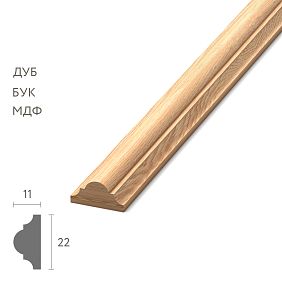
One side is flat (the mounting side to the wall), the other has relief: a cavetto, fluting, or foliate motifs. Used for framing wall panels, as a horizontal belt, or as a border.
The STAVROS catalog includes over 40 standard profiles for wall applications, ranging from 15 mm to 200 mm in width. Items MLD-001 (from 210 rub.) are simple geometric profiles for modern style, MLD-024 and MLD-060 are more complex, ornamental, for classical solutions.
Profiles for wall panels (boiserie)
Wide moldings 80–120 mm with deep profiles are used to create classic wooden panels—boiserie. This is no longer just a decorative line, but a full-fledged architectural system covering the wall from the baseboard to a horizontal belt at a height of 80–100 cm from the floor.
The width of such profiles, frame elements, internal crossbars, and corner blocks—all are available in the section decor for STAVROS moldings.
How to choose wall moldings to match the interior style
The profile of a molding is perceived by the brain before it becomes conscious. This means: an incorrect molding in a correct interior destroys its integrity — even if everything else is flawless. And vice versa.
Classic and Empire
A classic interior requires a rich profile: cavettos, a frieze with ornamentation, multiple levels of relief. Moldings for the classic style are wide (80–150 mm), with an expressive decorative cross-section. On walls, they form a system of panels with an upper frieze and a lower framing section.
Color scheme: ivory, antique gold, natural oak with a tint.
Neoclassicism
Neoclassicism is a dialogue with tradition without its literal reproduction. Here, moldings are moderately wide (40–80 mm), the profile is soft, with one or two levels of relief, without excessive ornamentation. Wall frames are delicate, not overwhelming, 'hinting' at classicism.
Optimal material: solid beech painted white or with a light tint.
Modern interior and minimalism
Here, a straightforward profile without ornaments is needed, with sharp edges and minimal width. The task of molding in a modern interior is to create a line, shadow, rhythm — without decorative noise. Width 20–40 mm, relief depth 5–10 mm.
Material: MDF or solid beech painted with white matte paint — for complete integration with the wall, playing only on the texture of shadows.
Scandinavian style
Scandinavian interiors are not afraid of molding but require conciseness. Simple rectangular profiles of 25–50 mm, natural light shades or white paint. The goal is to add structure without disrupting the sense of simplicity.
Material matters: natural wood (beech, ash) with oil or clear varnish creates a tactile warmth valued by Scandinavian aesthetics.
Eclectic and Art Deco
Art Deco works with geometry, contrast, and metallic accents. Moldings here can be wide (60–100 mm) with a stepped profile. A characteristic story is dark walnut or oak in wenge combined with light walls.
How to choose the size of wall moldings: rules of proportion
Size is not about 'like it or not.' The size of molding is determined by the architecture of the room, and violating this logic is visible to everyone—even those who cannot explain why something looks 'off.'
Molding width and ceiling height
Basic rule: molding width in mm ≈ ceiling height in meters × 10. With a ceiling of 2.7 m, the optimal molding width is 25–35 mm. With a ceiling of 3.5 m—35–50 mm. With a ceiling of 4 m and above—from 60 mm up to expressive 100–150 mm.
An 80 mm wide molding in a room with a 2.5 m ceiling will feel oppressive. A 20 mm molding with a 4 m ceiling will be completely lost.
Molding width and purpose
-
For fine graphics (lines and borders): 15–30 mm;
-
For decorative frames: 30–60 mm;
-
For wall panels (boiserie): 60–120 mm;
-
For architectural accents (framing openings, fireplaces): 80–200 mm.
Height of frames on the wall
Decorative frames made from moldings usually start from the height of the baseboard (10–15 cm from the floor) and end at a level of 2/3 or 3/4 of the wall height. The vertical dimension of the frame should be one and a half to two times smaller than the horizontal one — this gives a stable and calm proportion.
Profile Thickness
The depth of the molding's relief (projection from the wall) affects the expressiveness of shadows. For thin lines without volume — 5–10 mm. For expressive relief with side lighting — 15–25 mm. For rich classical stucco — from 30 mm and above.
How to calculate the quantity of wooden moldings before purchase
Calculation is the part where mistakes cost money. The method is simple but requires attentiveness.
Step one: measure everything on the wall
Sketch the wall with dimensions. Mark the layout of future moldings: horizontal lines at required heights, outlines of frames. Indicate door and window openings.
Step two: calculate the linear meters of each line
Each horizontal molding = wall width. Each vertical frame element = frame height × number of frames. Top and bottom frame horizontals = frame width × 2 × number of frames.
Step three: account for corner cutting
For each internal corner (90°), add 5–7 cm for cutting on each side. For each external corner — 8–10 cm. Decorative frames have four corner joints — each requires a 45° cut.
Step four: add a technological allowance
To the total footage, add:
-
Straight sections: +5%
-
Frames with corner joints: +10–12%
-
Complex profiles with ornamentation: +15%
-
Any radius elements: +20%
Example calculation for an accent wall
Wall 4.2 × 2.8 m (width × height). Three decorative frames are planned, each 1.1 m wide and 1.6 m high.
Perimeter of one frame: (1.1 + 1.6) × 2 = 5.4 m. Three frames: 5.4 × 3 = 16.2 m. Horizontal belt above the frames: 4.2 m. Total: 16.2 + 4.2 = 20.4 m. 12% waste allowance: 20.4 × 1.12 = 22.8 m. Round up to 24 m considering the standard length of the strips.
Standard length of STAVROS wooden moldings is 2.0–4.0 m. It is convenient to order in multiples of the plank length to minimize waste.
What to look for in the catalog when buying wooden wall moldings
Purchasing moldings online or in a showroom requires checking several parameters. Missing even one means risking a mismatch on site.
Profile and cross-section
Look at the cross-section image (in the catalog it is usually shown in a cutaway view). Check: how deep is the relief, are there sharp edges or only rounded ones, how the molding is mounted to the wall — with a flat side or via a groove.
Material and quality level
STAVROS offers two levels: Standard and Prestige. Both are certified, both are made from properly dried solid wood, but Prestige features higher detail in artistic execution, meticulous finish sanding, and selection of blanks by color and texture.
Length of the plank
Standard lengths in the catalog are 2.0 and 4.0 m. For long straight walls, 4-meter planks are more advantageous — fewer joints, less cutting, and a neater result.
Wood Moisture
A critically important parameter that is rarely checked. Moisture content of 8–12% is the standard for interior products. Wood with higher moisture will shrink on-site, creating gaps at joints and warping of the profile. STAVROS producesTrimming Itemswith controlled moisture in specialized drying chambers.
Availability of compatible components
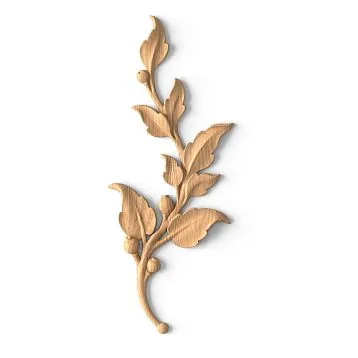
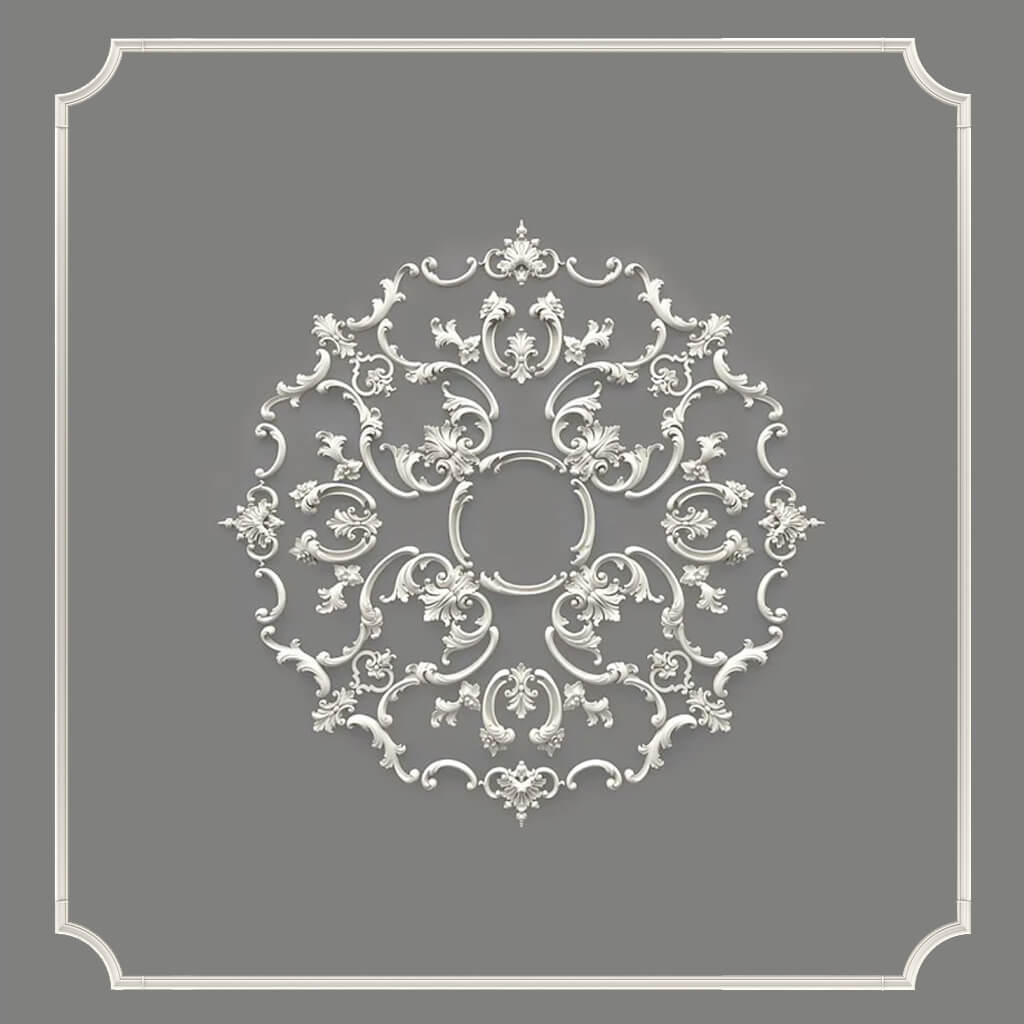
A good supplier offers not only planks but also corner elements, decorative blocks for joints, and corner rosettes. The STAVROS catalog includesDecor for Molding— corner inserts, ornamental overlays, central medallions. This allows assembling a complete system from a single source.
Application scenarios: what exactly is done with wooden moldings on walls
Theory is theory, but the most valuable thing is specific tasks. Here are five real scenarios where woodenwall molding to buy— is the correct and effective solution.
Decorative frames on an accent wall
The most popular technique right now. On the wall—usually behind a sofa, behind a bed, or across the entire wall opposite the entrance—a system of molding frames is installed. The frame width is 3–5 cm, with a simple profile or a soft relief. The frames are painted to match the wall color, creating an effect of tangible depth without actual volume. All this is achieved through the play of shadows.
The optimal material for this scenario: MDF or beech for painting.
Wall panels (boiserie)
Boiserie is a classic wooden cladding of the lower part of a wall with framed panels. The height of the panel system from the baseboard to the horizontal molding is typically 80–110 cm. Inside, there are wooden inserts or simply a painted wall within a frame.
Effect: the wall instantly gains classical architectural 'weightiness.' Boiserie is suitable for living rooms, dining rooms, hallways, and studies.
Optimal material: solid oak for tinting or varnishing—to maximize the effect of natural wood.
Horizontal molding belt
A single molding on the wall, running along the entire perimeter of the room at a height of 170–200 cm from the floor, serves as a visual divider between the upper and lower zones of the wall. The lower zone can be painted in a more saturated tone, while the upper zone can be left light. A simple and powerful technique.
Trimming door and window openings
A decorative wooden molding casing transforms an opening in a wall into an architectural element. Casing width: 60–90 mm for standard openings, 90–120 mm for more imposing ones.
Profiles compatible with architraves — in the sectionSTAVROS wooden molding products.
Fireplace or niche framing
A fireplace portal is a complex decorative system with side posts, a horizontal lintel, and sometimes a top section with a shelf. All this is assembled from several types of moldings: wide flat profiles as posts, profiled moldings as the top frame, decorative inserts in the corners.
Installation of wooden moldings on the wall: key points
Professional installation is half the result. Even a perfectly chosen molding will ruin the impression if installed carelessly.
Foundation Preparation
The wall must be dry, clean, without loose paint or dusty surfaces. Base moisture — no more than 6%. Irregularities over 5 mm are best leveled before installation: molding will not hide them but will only emphasize them.
Marking
Marking is 30% of the result. Draw horizontal lines with a laser level, mark the position of each frame considering symmetry. Check that all frame diagonals are equal — only this guarantees correct right angles.
Fastening
Wooden moldings are installed in two ways: with adhesive (polyurethane mounting adhesive) and with adhesive plus mechanical fasteners (countersunk screws with plugs).
For drywall walls — 6×50 mm toggle bolt with 250–300 mm spacing. For concrete and brick — 8×60 mm anchor with 400–500 mm spacing. For wooden bases — 5×70 mm screw with 400 mm spacing.
Corner Joints
Frame corners are joined at 45°. Cutting accuracy is ±0.1°. Every 0.5° of angle error creates a noticeable gap. Use a miter saw with a laser guide; do not cut moldings with a handsaw.
For internal corners (where walls meet), it is recommended to use a 'butt joint' method: the horizontal element runs to the corner, and the vertical element butts against it end-to-end. This is more precise than cutting at 45° on uneven construction corners.
Final finishing
After installation, all visible fastener holes are filled with putty. Joints between moldings on straight sections are treated with acrylic sealant—it remains elastic and does not crack during movement. The final coating is applied after the sealant has completely dried.
Wooden wall moldings in Moscow and St. Petersburg: how to buy with guaranteed availability
The question 'whereBuy Wall Moldingin Moscow' often leads to disappointment: the required profile is not in stock, the delivery time is three weeks, 'order the item, it will arrive when it arrives.' This doesn't work when the project is moving forward.
STAVROS solves this problem through a large stock program: main items from the catalog of wooden moldings are constantly in stock in the warehouse. Shipping from one piece. Pickup from Moscow and St. Petersburg. Delivery across all of Russia.
For clients from St. Petersburg who value speed—pickup from the St. Petersburg warehouse operates without waiting. The fullcatalog of wooden moldings and corniceswith prices, photos, and technical specifications is available on the STAVROS website.
Wooden Molding Selection Table by Task and Style
| Task | Recommended width | Material | Profile | Finish |
|---|---|---|---|---|
| Decorative Frames (Modern) | 20–35 mm | MDF / Beech | Straight, Sharp Edges | White Matte Paint |
| Frames (Neoclassical) | 35–60 mm | Beech / Oak | Soft Relief | White Paint / Light Toning |
| Wall panels (classic) | 80–120 mm | Oak | Complex ornamental | Toning / varnish |
| Horizontal belt (any style) | 25–50 mm | MDF / Beech | By style | Wall color |
| Door/window casings | 60–100 mm | Oak / beech | By style | Toning / paint |
| Fireplace portal | 100–200 mm | Oak | Complex profile | Tinting / varnish / gold |
| Scandinavian minimalism | 20–40 mm | Beech / MDF | Straight | White / natural oil |
| Accent verticals (loft) | 30–50 mm | Dark oak | Straight | Wenge tint |
FAQ: answers to popular questions about wooden wall moldings
Why is wooden molding better than polyurethane?
Solid wood molding is a natural material that can be tinted, repainted, sanded, and restored. The durability of oak molding with proper care is 50 years or more. Polyurethane is better suited for wet areas and ceiling decor. For walls in living spaces where the naturalness of the material is important, wood is unrivaled.
Which molding to choose for painting: solid wood or MDF?
For monochrome solutions under white paint, MDF provides a more uniform surface without wood grain texture. However, if the project involves several repaintings over the years — solid beech will withstand repeated sanding and coating renewal, while MDF will not.
Can wooden moldings be installed on drywall walls?
Yes. Light moldings up to 50 mm — with mounting adhesive. Heavier or wider profiles require additional fastening with a toggle bolt into the drywall or by reaching into the framing profile.
How long do wooden moldings last on walls?
Oak: 50 years and more. Beech: 30–40 years. MDF: 10–15 years under normal use. All these terms — with stable indoor climate (18–24°C, humidity 45–65%).
Do moldings need to be acclimatized before installation?
Yes, definitely. Wooden strips should be kept in a room with normal humidity for 48–72 hours before installation. This allows the wood to reach equilibrium moisture content with the environment and avoid warping after installation.
What adhesive to use for installing wooden moldings?
Polyurethane mounting adhesive — a universal option. Setting time 15–20 minutes, bonding strength is high. For heavy profiles, additionally use mechanical fasteners.
Where to buy wooden wall moldings in Moscow?
The STAVROS catalog features over 4,000 wooden products, including a full rangemoldings, cornices, and baseboardsmade of oak, beech, and MDF. Shipping from one piece, pickup from Moscow and St. Petersburg, delivery across Russia.
Can I order moldings with a custom profile?
Yes. STAVROS accepts orders for non-standard profiles. The minimum order quantity for custom manufacturing is from 50 linear meters. Production time is 10–14 working days for standard complexity.
How to calculate how much molding is needed for a wall?
Calculate the total perimeter of all planned elements (frames, horizontal belts, trims). Add 10–15% for trimming and technological waste. Round up to whole planks. STAVROS managers will assist with the calculation upon request.
Which STAVROS moldings are suitable for a classic interior with high ceilings?
For ceilings from 3.5 m — items MLD-024 (from 2,430 rub.) and MLD-060 (from 2,150 rub.) with a wide profile and expressive relief made of solid oak. To create a full panel system, use them in combination withdecorative overlays and molding decorfrom the same catalog.