Article Contents:
- What are wooden wall moldings and how do they differ from other profiles
- How molding differs from batten, baseboard, and trim
- Why wood is a special conversation
- Where wooden wall moldings are used: zones and scenarios
- Accent wall: one profile — one character
- Boiserie and classic wall panels
- Horizontal perimeter belt
- Decorating the area behind the sofa
- Wooden wall moldings for the bedroom
- Wooden wall moldings for the hallway
- Cornice molding at the ceiling
- Why choose wooden moldings: an honest breakdown
- Texture that cannot be copied
- Compatibility with Wooden Interiors
- Repairability for decades ahead
- Technical specifications of wooden moldings
- Which wooden moldings are suitable for walls: types of profiles
- Smooth rectangular molding (fascia)
- Molding with a bead (astragal)
- Molding with a heel
- Goose molding (kima-recta)
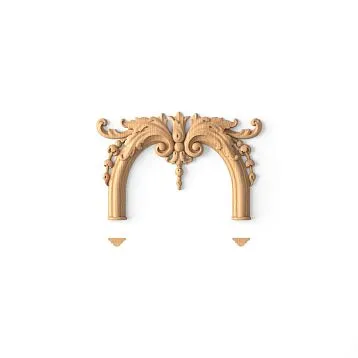
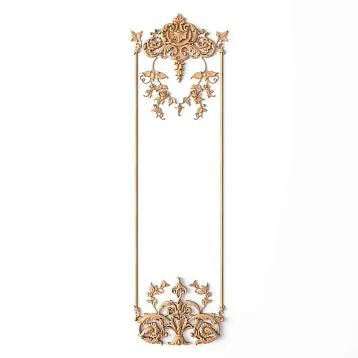
- Carved wooden wall molding
- Narrow wooden wall molding
- Wide wooden wall molding
- How to choose wooden moldings to match the interior style
- Wooden moldings for classic interiors
- Wooden wall molding for neoclassical interiors
- Wooden wall moldings for modern interiors
- Wooden wall moldings in Scandinavian style
- Wooden moldings for light and dark walls
- Wooden Moldings and Other Wall Solutions: How They Differ and When to Choose What
- Wooden moldings or slatted panels
- Wooden molding or stucco
- Wooden molding and wooden baguette
- Wooden molding and layout
- How not to overload a wall with wooden moldings: rules and mistakes
- Too fine a grid of frames
- Incorrect frame proportion
- Mismatch of profile width to room scale
- Mixing different profiles on one wall
- Conflict of molding with other trim
- Ignoring lighting
- Where to buy wooden wall moldings: catalog and supplier selection
- What to look for in a wooden molding catalog
- Buy wooden wall moldings with delivery
- What to pay attention to when choosing a supplier
- FAQ: wooden wall moldings — questions and honest answers
- STAVROS: wooden wall moldings — production, precision, selection

Imagine two identical rooms. Same proportions, same furniture, the same color palette. In the first — smooth painted walls. In the second — on the same paint, in the same tone, a system of rectangular wooden frames is installed. The frames don't stand out, don't shout for attention. They're simply present.
You enter both rooms. In the first, something is subtly unfinished. In the second — a feeling that someone has lived here, thought, settled in. The second seems more expensive — although it costs exactly the same plus a few meters of wooden profile.
This is the effectof wooden wall moldings. Not decoration. Not a whim. A tool that changes the perception of space — quietly, precisely, without unnecessary words.
Wooden moldingsfor walls is a profiled trim with a shaped cross-section made of solid wood or high-density MDF, mounted on a wall surface to create architectural relief, framing systems, or decorative bands. The scope of application ranges from a minimalist modern interior to complex neoclassical boiserie. The material is alive, warm, tactile. And this is fundamental.
If you are looking for whereBuy Wall Moldingmade of wood — you've come to the right place. But before moving on to choosing a specific profile, let's understand: why, where, and how. Because a molding placed in the wrong spot or chosen for the wrong scale is not a bad molding. It's a good molding in the wrong place.


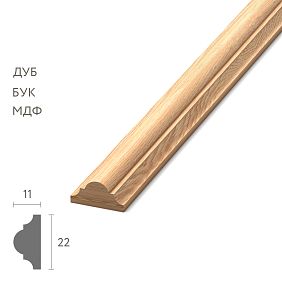

What are wooden wall moldings and how do they differ from other profiles
The word 'molding' comes from the English 'moulding,' which literally means 'shaping,' 'profiling.' It is any profiled trim product with a shaped cross-section intended for decorative finishing of surfaces or transitions between them.
The key here is 'shaped cross-section.' Unlike a simple batten or flat strip, molding has a profile: one or several curves, protrusions, recesses that create a play of shadows. It is precisely this relief that constitutes the visual value of the product.




How molding differs from batten, baseboard, and glazing bead
This is a confusion that almost everyone encounters when first introduced to trim. Let's clarify right away.
Batten — rectangular or square molding without a profile. Used for paneling, lathing, structural tasks. Performs a decorative function only through the rhythm of several adjacent frames, not through cross-sectional relief.
Baseboard — a molding profile for a special purpose: it covers the bottom joint between the wall and the floor. Has a shaped cross-section but is installed exclusively in the lower zone.Wooden Crown Moldings — a type of baseboard with a soft, rounded profile for concealing corner transitions.
Wooden molding — a functional profile for holding inserts in frame constructions: glass in doors, mirrors in furniture, decorative panels. The glazing bead works from inside the frame, the molding — from the outside, on the surface of the wall or facade.
Molding — a decorative profile whose purpose is precisely to create relief on a surface. It does not cover a joint or hold an insert — it builds the architecture of the plane.
Our factory also produces:


Why wood is a special conversation
Polyurethane, MDF, plaster — all these materials make moldings of quite decent quality. But a wooden molding is a different sensation. And literally so.
Wood is warm to the touch — this is not a metaphor, its thermal conductivity is many times lower than that of mineral materials. Wood has a texture that varies from board to board, from sheet to sheet. Wood absorbs finish in a living way, and the final appearance of a varnished or tinted profile carries the individuality of the specific blank.
In interiors where solid wood is present in the floor, furniture, or doors,Wooden molding on the wall creates material coherence — a unified language of space. This is something that cannot be imitated with white polyurethane, no matter how carefully it is installed.
Get Consultation
Where wooden wall moldings are used: zones and scenarios
Before choosing a profile, you need to understand what task it is for. Wooden wall molding has several completely different application scenarios.
Accent wall: one profile — one character
An accent wall is the main surface of a room that carries a decorative load. Behind the sofa in the living room. Behind the bed in the bedroom. Opposite the entrance in the hallway. It is the wall that is seen first.
Wooden molding for an accent wall can work in several ways:
-
A single large frame — one rectangular contour made of profile, occupying 60–80% of the wall area. Inside the frame — a different color, a different texture, or the same background. The effect is monumental and very rich visually.
-
A system of several frames — three to five frames in a horizontal row. Rhythmic division creates a sense of paneling without actual panels.
-
Vertical frames of different heights — an asymmetrical system that works in modern projects with a non-standard approach.
Boiserie and classic wall panels
Boiserie is a French term for wooden paneling on the lower part of a wall. The lower zone — from the floor to 90–120 cm — is covered with wooden panels or painted MDF, divided and framed by moldings. It is boiserie that is the main classic application of wall molding.
For boiserie you need:
-
Horizontal top molding belt (the finishing 'crown' of boiserie)
-
Vertical divider moldings between sections
-
Molding frames within each section
This system is not just decoration. It's an architectural detail that visually 'grounds' the wall and creates a sense of solidity in the interior.
Horizontal belt around the perimeter
One of the most concise yet powerful techniques: a horizontal molding runs along all walls of the room at the same height. Two classic heights:
-
90–110 cm — 'dado' level, the historical height of a chair. Traditional position in European architecture.
-
160–180 cm — with standard ceilings of 2.6–2.7 m, divides the wall into two nearly equal zones.
A horizontal belt made of wooden molding looks especially advantageous where the lower zone has a different color or finish — dark bottom, light top. In this case, the molding is not just a decorative element, but also a 'transitional layer' between the two zones.
Decorating the area behind the sofa
The area behind the sofa is not just a 'background wall'. It is a place that creates context for the entire relaxation zone. Wooden wall moldings in the living room in this area work as architectural framing.
Classic scenario: three vertical frames above the sofa, symmetrical. The middle one is exactly above the center of the sofa, the side ones are at an equal distance. Frame height: from the top line of the backrest to 15–20 cm below the ceiling. This creates a full vertical axis and unites the sofa and wall into a single composition.
Wooden wall moldings for the bedroom
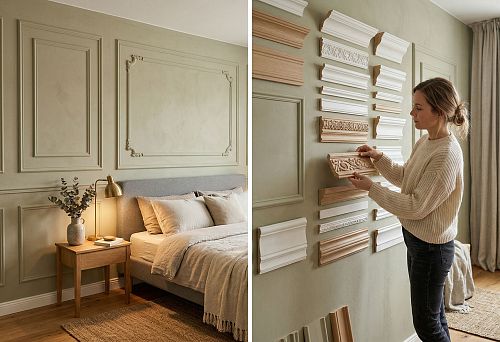
Moldings in the bedroom can be discussed separately. But the main thing here is the wall behind the headboard. It is perceived as the base surface of the entire bedroom, and it is the focus of all glances upon entering the room.
Wooden molding on the wall behind the bed works as a frame for the headboard. This can be one large frame with a width matching the width of the bed plus 40–60 cm on each side. Or a system of three frames — one above each nightstand and the main one above the headboard. Wood is especially appropriate here: the bedroom is a space of warmth and tranquility, and the material of the wall molding should correspond to this.
Wooden wall moldings for the hallway
The hallway is the first thing a guest sees. At the same time, it is usually an area with increased mechanical load: suitcases, bags, outerwear. Solid hardwood molding — oak or beech — is unrivaled here in terms of durability.
A horizontal belt at a height of 110–120 cm in the hallway solves two problems at once: it visually 'frames' the hanging area and sets a level below which the wall is protected from direct contact with clothing and objects. Below the belt — denser, more practical finishing. Above — decorative.
Cornice molding near the ceiling
Wooden cornice molding at the junction of wall and ceiling is one of the oldest architectural techniques. Its function is to create a smooth transition where there is a technical joint and to set the 'architectural crown' for the entire wall.
The width of cornice molding depends on ceiling height:
-
Ceilings 2.5–2.6 m: profile 40–60 mm
-
Ceilings 2.7–2.9 m: profile 60–80 mm
-
Ceilings from 3 m: composite cornice 80–150 mm and more
Why choose wood moldings specifically: an honest breakdown
The question isn't rhetorical. The market has polyurethane moldings, plaster moldings, MDF for painting. Why wood?
Texture that cannot be copied
Each piece of wood has a unique grain pattern. Two oak moldings cut from the same tree will be slightly different. This is perceived as valuable — in an era when everything around is reproduced in mass quantities.
Wood shimmers differently under side light than polyurethane under the same paint. Varnish on wood creates depth, not just shine. Staining on oak works completely differently than on MDF: it reveals the structure, not hides it.
Compatibility with wooden interiors
If the interior features oak parquet, oak furniture, and wooden doors, oak molding creates a system. One material, one language.Wooden trimMoldings, cornices, architraves, and baseboards made from the same wood species are what transform an interior from a collection of good items into a thoughtfully designed environment.
This doesn't mean everything has to be the same shade. Dark-toned wooden furniture paired with light-toned wooden moldings is also a system, built on contrast rather than monotony.
Repairability for decades to come
If a wooden molding suffers mechanical damage—a scratch, chip, or wear—it can be sanded and refinished with varnish or enamel. This doesn't require reinstalling it or special tools. A polyurethane molding with a chip needs either masking or replacement of the section.
For properties with long service lives—homes, offices, hotels—the long-term repairability of wood is a significant advantage.
Technical specifications of wooden moldings
| Parameter | Oak | Beech | MDF |
|---|---|---|---|
| Density, kg/m³ | 670–720 | 680–750 | 720–850 |
| Brinell hardness | 3,7 | 3,8 | 2,5–3,0 |
| Moisture content (kiln-dried) | 8–12% | 8–12% | N/A |
| Profile tolerance | ±0.1 mm/m | ±0.1 mm/m | ±0.05 mm/m |
| Texture | Unique | Unique | Absent |
| Under clear lacquer | Excellent | Excellent | No |
| For painting | Good | Good | Excellent |
Which wooden moldings are suitable for walls: types of profiles
Wooden wall moldings have no 'universal' profile. Each cross-section carries its own character—and it should be selected to match a specific interior style and specific task.
Smooth rectangular molding (fascia)
A flat strip with clear straight edges. No relief—only a clear rectangular contour. The most modern, most neutral, most universal profile.
Where it works: modern neoclassicism, Scandinavian style, minimalism with a wood accent, Japanese style. Where the line matters, not the relief.
Width: from 10 mm (almost invisible contour) to 60 mm (expressive frame). Optimum for frame systems—20–40 mm.
Molding with a bead (astragal)
Semicircular convex section, one central bead. Soft profile, creates a smooth, not harsh, shadow. One of the oldest architectural profiles.
Where it works: Neoclassical, Provence, soft classic, interiors with rounded forms. Where relief is needed, but without harshness.
Width: 15–50 mm. At a width from 35 mm, the bead becomes an expressive architectural detail.
Molding with a cavetto
S-shaped profile with a concave start and convex finish (or vice versa). A classic historical profile, present in European architecture since the Renaissance.
Where it works: Classic, neoclassical, Empire, historical styles. Where the molding should be read as an architectural element, not just as a frame.
Width: 25–80 mm. Below 25 mm, the profile 'gets lost' — the section becomes too small for the S-curve to be legible.
Cyma recta molding
Double curve with a concave lower and convex upper bend. Creates a complex play of shadow, most pronounced with side lighting. Historically — a profile of the higher orders of classical architecture.
Where it works: Strict classic, Empire, high neoclassical. Requires ceilings no lower than 2.8 m and sufficient scale of the entire interior.
Carved wooden wall molding
A carved profile is no longer just a cross-section, but an ornament. Acanthus leaves, plant-like interlacing, geometric repetition, floral motifs. A carving depth of 3–10 mm creates an expressive relief that cannot be achieved by milling a simple profile.
Carved wooden moldings are a choice for projects in high classicism, Baroque, and Art Deco. They require an appropriate stylistic context: in a minimalist apartment, a carved oak molding will look like a quote from another era.
Narrow wooden wall molding
Moldings with a width of 10–20 mm are a delicate tool. They create a fine contour line, barely noticeable in daylight, but revealing itself under side and evening lighting.
Narrow molding works:
-
In minimalist interiors, where decor should be unobtrusive
-
In small spaces, where a wide profile would create a sense of overload
-
As an 'invisible' framing system: the wall looks more complex, but the source of this complexity is not obvious
Wide wooden wall molding
Moldings 60–120 mm are already a large-scale architectural detail. They require appropriate space: high ceilings, a large wall area, and large-scale furniture.
A wide profile in a composite cornice (made of several adjacent moldings of different cross-sections) forms a developed classical cornice—just like on historical building facades, but indoors.
How to choose wooden moldings to match the interior style
Style is the first filter when choosing wall moldings. Let's break it down by stylistic directions.
Wooden moldings for a classical interior
Classical style features historical profiles in correct proportions: ovolo, cyma recta, composite cornice.Wooden wall moldingsIn a classical interior, it is not a decorative accent but an architectural element, without which the interior looks incomplete.
For classical style:
-
Profile with a historical cross-section (ovolo, cyma recta, scotia)
-
Width of cornice molding from 80 mm for ceilings from 3 m
-
Material: oak in dark stain or under white enamel
-
The system necessarily includes boiserie, a horizontal belt, and a cornice
Wooden wall molding for a neoclassical interior
Neoclassicism is a lighter classicism. The same principles, but without baroque heaviness. The profile is cleaner, the lines are stricter, the scale is smaller.
For neoclassicism:
-
Smooth or slightly profiled molding 25–50 mm
-
White enamel matching the walls or with minimal contrast
-
Frame system of 3–5 frames on an accent wall
-
Horizontal belt around the perimeter at a height of 100–110 cm
Wooden wall moldings for a contemporary interior
Contemporary molding is geometry without historical references. A rectangular fascia, a soft roll, a slightly beveled edge. Nothing extra.
in modern interiorsWooden wall moldingsThey don't function as 'classical decor,' but rather as a material accent. The wood here is valuable in itself—as a warm, natural material in an interior with a lot of glass, metal, or concrete.
Wooden wall moldings in Scandinavian style
Scandinavian style and wood are an organic pair. But Scandinavian molding is not classical at all. Narrow (10–20 mm), smooth, light or white. Frames of strict proportions. Minimal relief—maximum pure form.
For a Scandinavian interior, moldings made of birch or pine are well-suited: light texture, soft grain pattern.
Wooden moldings for light and dark walls
Light walls. Two approaches: molding matching the wall color—zero color contrast, only shadow from the relief. Or molding slightly darker—soft contrast, the frame is clearly readable.
Dark walls. Dark walls (deep blue, hunter green, anthracite) with wooden molding in a natural oak shade—this is a very expressive combination. The wood against a dark background comes to the foreground, creating a contrast of material and color simultaneously.
Wooden moldings and other wall solutions: how they differ and when to choose what
This is the most important practical block for those choosing between different decorative solutions for walls.
Wooden moldings or slatted panels
The comparison that arises most often. And for good reason: both solutions are made of wood, both are for walls, both provide a tactile wooden accent. But they work completely differently.
| Criterion | Wooden moldings | Slat panels |
|---|---|---|
| Effect | Framed, horizontal | Vertical rhythm |
| Style | Classic, neoclassic | Modern, Scandinavian |
| Coverage density | Contour frame | Solid surface |
| Installation difficulty | Medium | Below |
| Combination with each other | Possible | Possible |
slatted panels for walls— the best solution where vertical rhythm and a modern wooden screen are needed. Moldings — where a framing system and a classic language are needed.
Combination of both: the lower zone of the wall — slatted panels, the upper zone — molding frames with a dividing horizontal belt. Such a system looks very complex and yet logical.
Wooden molding or plasterwork
Wooden trimand plasterwork serve different roles within a single decorative system. Molding is a linear profile that creates horizontals and frames. Plasterwork is a three-dimensional decoration that acts as a point accent (rosette, medallion, overlay).
In a classic interior, they are used together: molding builds the frame, plasterwork decorates the corner joints and centers. In a modern interior, typically only one is used.
Wooden molding is preferable to plasterwork in interiors with natural wood. Polyurethane plasterwork and oak wooden molding are different materials, and in most cases, this is visible.
Wooden molding and wooden picture frame
Wooden Picture Frameis a molding profile with a groove for glass and cardboard. It frames paintings, mirrors, photographs. Wall molding does not have a groove—it creates relief on a flat surface.
Practical difference: if you need to frame a specific object (mirror, painting, panel)—you need a picture frame. If you need to create architectural relief on a bare wall—you need molding.
Stylistically, they can be made from the same wood, have the same profile, and the same tint—then picture frames and wall moldings create a unified system.
Wooden molding and glazing bead
Wooden moldingis a functional, not decorative, profile. It holds inserts in frame constructions. Molding is decorative. Often they work together: glazing bead is inside the frame, molding is on the outer surface.
Example: a door leaf with glazing. The muntin holds the glass from the inside of the groove. A wooden molding frames the transition from glass to leaf on the outside, giving the door a finished look.
How to avoid overloading a wall with wooden moldings: rules and mistakes
Molding is a tool. Like any tool, it can be misused. Let's look at typical mistakes.
Grid of frames is too fine
Small frames, spaced across the entire wall every 20–30 cm — that's not classic, it's ornament. Frames should be large and 'breathing'. Guideline: the distance between a frame and the edge of the wall (or an adjacent frame) should be no less than triple the width of the profile.
Incorrect frame proportion
A square frame is unstable. One that is too elongated vertically is unnatural. The golden ratio for wall frames: width to height from 1:1.2 to 1:2. Horizontally elongated frames are a more modern option; vertical ones are classic.
Profile width does not match the scale of the room
An 80 mm wide molding in a 12 m² room with 2.5 m ceilings — that's not classic, it's oppressive. The profile width should be proportional to the space: no more than 1/10 of the frame width and no more than 3–4% of the wall height for horizontal bands.
Mixing different profiles on one wall
One interior — one profile system. Two or three different moldings on one wall create a sense of incompleteness and randomness. Exception: a composite cornice made of several coordinated profiles — but this is already a deliberate architectural system, not a mix.
Conflict of molding with other trim
Wall molding must coordinate with baseboards, casings, and cornices. If the baseboard is made of light oak and the wall molding is made of dark beech — this is a conflict. All wooden trim elements should be made from the same species and the same tinting system — or consciously contrast, which is a separate design decision.
Ignoring lighting
Molding reveals itself only under proper lighting. With uniform overhead lighting, the relief is almost indistinguishable. With side lighting — the shadow from the profile creates depth. When planning a molding system, it is necessary to consider what lighting will be in the room. This is not an error in choosing the molding — it is an error in lighting design.
Where to buy wooden wall moldings: catalog and supplier selection
Decided on the profile, style, and application area. Now — to practice.
What to look for in a wooden moldings catalog
molding catalog— is not just a list of SKUs. A proper catalog provides the ability to see:
-
Cross-section of the profile — only through it can the relief be assessed. A photograph of the finished molding on the wall does not give an idea of the shadow's shape.
-
Exact dimensions — width, profile height, standard length. For calculating linear footage and selecting proportions.
-
Wood species and moisture content — kiln-dried to 8–12%, which is the standard for interior products.
-
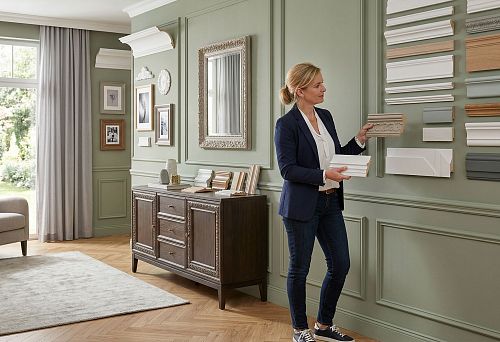
Sample availability — ordering a batch without a sample in hand is like choosing paint without a sample. You need to hold the profile in your hands.
Buy wooden wall moldings with delivery
Buy wooden wall moldingtaking into account the requirements of a specific project — this is a task that requires not only selecting an item number but also correctly calculating the linear footage.
The calculation is simple: frame perimeter × number of frames + 15% for trimming and waste. For a horizontal frieze around the room perimeter: room perimeter + 10–15% for joints and miter cuts.
Wooden wall moldings are supplied in standard lengths — typically 2.4 m or 3 m. When placing an order, consider the multiple: if your frame requires a strip 1.8 m long, a three-meter blank yields one frame with leftover material.
What to look for when choosing a supplier
Own production. Only the manufacturer controls the profile geometry and moisture content. A reseller may sell 'the same' molding with a tolerance of ±2 mm — and the joints in frame corners won't align.
Availability of samples. A serious manufacturer offers sample kits — an opportunity to compare several profiles in person. This is the standard for professional linear molding suppliers.
Batch consistency. All items from the same batch must have an identical profile. When purchasing for an entire project, it's important to source from a single batch.
Custom profile capability. For non-standard projects — when recreating a historical profile or creating an original one — the manufacturer must be able to produce according to drawings.
Decorative Wall Moldingsin full assortment — in the wooden molding catalog.
FAQ: Wooden Wall Moldings — Questions and Honest Answers
Which wooden moldings are best for walls?
Depends on the style. For classic and neoclassical — profiles with historical cross-sections (ovolo, cavetto, astragal) made of oak or for white enamel. For modern interiors — smooth fascia 20–40 mm. For Scandinavian — narrow white molding made of light wood. There is no universal 'best' profile: there is the right one for a specific task.
Where to buy wooden moldings for walls?
Wooden moldings— in the STAVROS catalog: wooden and MDF profiles with precise geometry, kiln drying, and readiness for finishing. A wide wall cluster — in the sectionMoldings for wall decoration.
How is a wooden molding different from a picture frame molding?
Picture frame molding — a profile with a groove for framing pictures and mirrors. Wall molding does not have a groove and creates architectural relief on a wall plane. Both belong towooden trim, but solve different tasks.
Can wooden moldings be used on an accent wall?
That's exactly what they're for. An accent wall with a frame system made of wooden moldings is one of the most expressive yet restrained techniques in wall decor. It works in the living room, bedroom, hallway, and study.
What's better for walls: wooden moldings or plasterwork?
Different purposes. Molding creates a linear frame system. Plasterwork creates volumetric point accents. In a classic interior, they work together. In a modern one, typically one or the other. Wooden molding is preferable to plasterwork in interiors with natural wood.
What's better: wooden moldings or slatted panels?
Moldings are a frame system, a horizontal classic rhythm.Slatted wooden wall panels— a vertical rhythm, a modern wooden screen. Both solutions are good — for different styles and tasks. A combination is also possible: slats in the lower zone, moldings in the upper.
Are wooden moldings suitable for a modern interior?
Yes, if the correct profile is chosen. A smooth rectangular oak molding is an absolutely modern element. A carved Baroque molding is historical. The modern interior welcomes wood with joy: a natural material exists organically in any context if the profile is chosen correctly.
Do I need to paint wooden molding?
Not necessarily. Wooden molding can be coated with clear varnish — then the texture is preserved. Or tinted — a color shift while preserving the wood grain pattern. Or painted with enamel — then the molding functions like a white MDF profile, but made of natural wood. The choice depends on the task.
How to calculate the quantity of wooden moldings?
Calculate the perimeter of each frame, multiply by the number of frames, add 15% for cutting and waste. For a horizontal belt: room perimeter + 10–15%. Moldings are supplied in lengths of 2.4–3 m, consider multiples when ordering.
STAVROS: wooden wall moldings — production, precision, selection
Choosing wooden wall molding is not buying a 'meter of wood'. It's a decision that will define the character of an entire wall for years to come. And this decision should be based on a precise profile, the correct wood species, and guaranteed surface quality.
STAVROS is a Russian manufacturer of wooden architectural elements and solid wood millwork. Full production cycle: own timber preparation, kiln drying to 8–12%, profile milling with a tolerance of ±0.1 mm/m, surface sanding for coating. Not a single intermediary between the wood and the finished product.
In the STAVROS catalog:
-
Wooden moldings— full range of wall profiles of different cross-sections and widths in oak, beech, MDF
-
Moldings for walls to buy— extensive wall section with cornices, baseboards, and related millwork
-
Wooden trim— baguettes, glazing bars, cornices, casings — all in one material system
-
slatted panels for walls— for those choosing between moldings and vertical wooden rhythm
Molding is not a detail. It's a solution. Make this decision with an understanding of material, profile, and space — and the result will last for decades.