












































































Article Contents:
- Anatomy of a Block: Cross-Sections, Lengths, Wood Species
- Standard Cross-Sections: From Miniature to Massive
- Lengths: Standards and Possibilities
- Wood Species: From Budget Pine to Premium Exotics
- Wooden Blocks in Interior Decor: From Walls to Ceilings
- Rack Walls: Rhythm and Texture
- Slatted Ceilings: Volume Overhead
- Partitions and Zoning: Dividing Without Separating
- Decorative Panels and Accent Walls
- Blocks in Furniture and DIY Projects: Hands-On Creativity
- Shelves and Racks: Simplicity of Construction
- Frames for Mirrors and Paintings: Framing What Matters
- Planters and Plant Boxes: Ecology and Functionality
- Hangers and Organizers: Order with Character
- Children's Projects: Development Through Creativity
- Trends 2026: Where Wooden Block Decor is Heading
- Sustainability as a Philosophy
- Minimalism and Functionality
- Mixing Textures and Materials
- Technology integration
- Customization and Uniqueness
- Material Selection: What to Look For
- Moisture: A Critical Parameter
- Grade: From Premium to Economy
- Surface Treatment: Readiness for Use
- Where to Buy Quality Wooden Blocks
- Construction Markets: Accessibility and Risks
- Large Construction Hypermarkets: Quality Standard
- Specialized Manufacturers: Quality and Service
- Conclusion: Blocks as the Foundation of Creativity
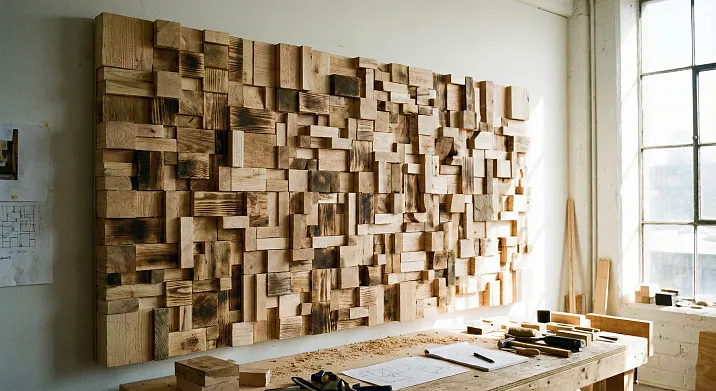
Wood is the most ancient material humans have worked with. Millennia ago, the first tools and dwellings were carved from tree trunks. Today, wood remains relevant, but its role has changed. From a material of survival, it has transformed into a material of aesthetics, creativity, and self-expression. And the most accessible, universal form of this material is the wooden block. Rectangular in cross-section, of various lengths, it carries no predetermined form, dictates no application. A block is a blank canvas, a geometric foundation from which a creator can make anything: from a slatted ceiling to a child's toy, from a mirror frame to a partition zoning a studio.
Modern production has turned wooden blocks from a crude, artisanal product into a precise industrial material. Cross-sections are maintained with millimeter accuracy, lengths are standardized, moisture is controlled, and surfaces are sanded smooth. Working with such material is a pleasure. It doesn't warp, twist, or crack if chosen correctly and treated properly.Where to buy wooden blocksIndustrial quality — a question that determines project success. The construction market offers cheap material of questionable moisture content, which turns into a crooked stick within a month. Specialized manufacturers offer calibrated, dried, ready-to-use material that is easy and pleasant to work with.




Anatomy of a block: cross-sections, lengths, wood species




Standard cross-sections: from miniature to massive
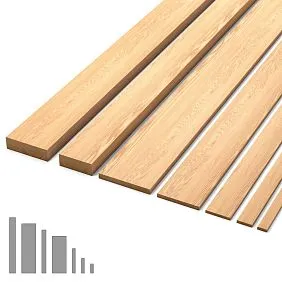
A wooden block is defined by its cross-section — the dimensions of the sides of a rectangle or square. Standard cross-sections range from modest 10×10 millimeters to massive 50×50 millimeters and larger.
Thin blocks 10×10, 15×15, 20×20 millimeters — material for small decorative works. They are used to make photo frames, grilles for planters, decorative overlays for furniture, children's crafts. Lightweight, elegant, they create graphics of thin lines.
Medium blocks 25×25, 30×30, 40×40 millimeters — a universal size for most decorative projects. Slatted panels for walls and ceilings, partitions for zoning, frames for mirrors, bases for shelves. Strong enough to bear loads, light enough not to overload the structure.
Large blocks 50×50 millimeters and larger — structural material that withstands serious loads. Furniture frames, load-bearing elements of partitions, shelving bases, frames for large mirrors and panels. Massiveness gives solidity, brutality, suitable for loft and industrial interiors.
Rectangular cross-sections (e.g., 20×40, 30×50 millimeters) create asymmetry, which is used to create rhythm. Alternating horizontal and vertical orientations of rectangular blocks creates visual dynamics.
Our factory also produces:


Lengths: standards and possibilities
The standard length of wooden blocks is usually 2, 2.5, or 3 meters. This is due to logistics — longer blanks are difficult to transport. For most projects, standard lengths are sufficient.
For high ceilings (3.5-4 meters), longer blanks are required. Specialized manufacturers produce blocks of non-standard length to order. This is more expensive but eliminates the need to join short segments.
The ability to order exact length is another advantage of buying from a manufacturer. You need blocks 2.3 meters long for a specific project — you order this length, receive them without waste.
Get Consultation
Wood species: from budget pine to premium exotics
Wood species determines the color, texture, strength, and cost of the block.
Pine — the most affordable species. Light-colored, with a pronounced texture (visible annual rings), soft to work with. The resinousness of pine is an advantage (natural protection against moisture) and a disadvantage (exuding resin requires treatment). Pine blocks are suitable for painting, tinting, varnishing. Price is low, availability is maximum.
Spruce — an analogue of pine, slightly lighter, with less resinousness. Texture is more uniform, fewer knots. Spruce is slightly more expensive than pine, but the choice between them is often a matter of personal preference.
Birch — a light-colored species without pronounced texture. Uniform light cream color, fine-grained structure. Birch is harder than coniferous species, holds shape better, less prone to deformation. Suitable for projects where smoothness and color uniformity are important. 30-50% more expensive than coniferous species.
Oak — a premium species. Dark, with expressive texture, hard, durable. Oak blocks are heavy, strong, last for decades without losing properties. Oak's texture is beautiful on its own, often only coated with clear varnish or oil. Price is 2-3 times higher than pine, but status and durability justify it.
Ash — a light-colored strong species with beautiful texture. Strength comparable to oak, but color is lighter, making ash popular for modern interiors where dark oak is too heavy. Price at the level of oak or slightly lower.
Exotic species (teak, merbau, wenge, mahogany) — for exclusive projects. Unusual colors (from dark chocolate wenge to reddish mahogany), high density, moisture resistance. Price is 5-10 times higher than pine, used for accent details.
Wooden blocks in interior decor: from walls to ceilings
Rack Walls: Rhythm and Texture
The most popular use of blocks in modern interiors is slatted panels on walls. Blocks are installed vertically or horizontally with uniform intervals, creating a rhythmic structure. This is not just decor, it's an architectural solution that changes the perception of space.
Vertical slats visually raise the ceiling. The eye follows along the verticals upward, the room seems taller. The spacing between slats is usually 5-10 centimeters. Too frequent spacing (less than 5 cm) creates a rippling effect, too sparse (more than 15 cm) loses rhythm.wooden plankwith a cross-section of 30×40 millimeters and a spacing of 7 centimeters — a classic solution for a standard room with a height of 2.7 meters.
Horizontal slats expand the space. The eye moves along the horizontals, the room seems wider. Horizontal orientation is also more calm, static, suitable for bedrooms, relaxation areas.
Diagonal compositions — a bold solution. Slats are installed at a 45-degree angle, creating dynamics, movement. Diagonals can be unidirectional (all at one angle) or form a chevron (zigzag of opposing diagonals). This requires installation precision, but the result is impressive.
The color of the slats determines the character. Natural wood, coated with oil or varnish, creates warmth, coziness, eco-friendliness. White-painted slats on a light wall create Scandinavian lightness. Dark slats on a light background — graphic contrast, modern expressiveness.
Slatted ceilings: volume overhead
A ceiling made of wooden blocks turns the fifth wall from a flat surface into a volumetric structure. Slats hide utilities (wiring, ventilation), improve acoustics (sound is absorbed by the gaps between slats), create visual interest.
Installation of a slatted ceiling is performed on a framework of guides installed perpendicular to the slats with a spacing of 60-80 centimeters. The slats are fastened to the guides using self-tapping screws, clips, or clamps. The gaps between the slats range from tight installation (5-10 mm) to wide intervals (10-15 cm), depending on the desired effect.
Lighting is integrated between the slats. LED strips installed in the gaps create diffused illumination that emphasizes the rhythm of the slats and produces atmospheric lighting. This is especially effective in bedrooms and living rooms where mood is important.
Partitions and zoning: dividing without separating
Slatted partitions made of battens zone open spaces without creating a sense of enclosure. In a studio apartment, they separate the sleeping area from the living room; in a kitchen, they separate the dining area from the work zone. Light passes through the gaps, the space remains visually unified but functionally divided.
The partition consists of a framework of horizontal guides (top and bottom, sometimes a middle one) to which vertical battens are attached. The height is typically 2-2.5 meters—there's no need to make it higher than the ceiling, and below 1.8 meters the partition loses its function as a visual barrier.
Mobile slatted screens are an option for flexible zoning. A framework on casters allows the partition to be moved, changing the configuration of the space according to needs.
Decorative panels and accent walls
Battens are used to create geometric panels on accent walls. Complex compositions made from battens of different lengths and orientations create three-dimensional pictures. This can be abstract geometry, stylized trees, mountain landscapes, city silhouettes—any form that can be laid out from rectangular elements.
Volume is created through multi-level installation. Some battens are attached directly to the wall, others on spacers, protruding by 1-2 centimeters. This creates relief, interplay of shadows, and visual depth. With side lighting, the panel comes to life, and shadows emphasize the volume.
Painting in different colors enhances the effect. A gradient from dark to light, contrasting combinations, a monochrome palette with variations in shades—any approach works if it is coordinated with the overall color scheme of the interior.
Battens in furniture and DIY projects: creativity with your own hands
Shelves and shelving units: simplicity of construction
Wooden battens are an ideal base for homemade shelves. Four vertical battens measuring 40×40 mm, several horizontal crosspieces, boards for the shelves—the simplest shelving unit can be assembled in an evening. Joining with self-tapping screws, metal brackets, or wooden dowels—the choice depends on the tools and skills available.
Open shelving units made from battens and boards create an industrial loft aesthetic. Minimal processing (sanding, oil or wax), deliberate simplicity of construction, visible fastenings—all this creates an honesty of material that is valued in contemporary design.
Cantilever shelves—battens fixed to the wall as brackets, onto which boards are laid. Visually light, they do not clutter the space and are suitable for small rooms where a bulky shelving unit would be excessive.
Frames for mirrors and paintings: framing what's important
A batten with a cross-section of 30×40 or 40×50 millimeters is a ready-made base for a frame. Four pieces, cut at a 45-degree angle, joined at the corners—a classic frame. The simplicity of the form is compensated by the quality of the material and finish.
Natural wood from valuable species (oak, ash, walnut), coated with oil, emphasizes the texture. Such a frame is itself a work of art, a framing worthy of the mirror or painting within.
Painted frames open up color possibilities. A white frame made from battens—Scandinavian classic. Matte black—contemporary graphic style. Gold or silver—neoclassical luxury. Stains mimicking rare woods turn a pine batten into an imitation of wenge or mahogany.
Multi-level frames—several frames of different sizes, nested within each other with a small offset, create a three-dimensional framing. This complicates the construction, but the result is expressive and sculptural.
Planters and boxes for plants: ecology and functionality
Wooden boxes for plants are assembled from battens (framework) and thin boards or slats (walls). The construction is simple—a rectangular framework made from battens at the corners and perimeter, to which boards are attached. Gaps between the boards provide ventilation and drainage of excess moisture.
A plastic liner or waterproofing is placed inside so that water does not come into direct contact with the wood. An alternative is treating the wood with moisture-resistant compounds (oil-wax, yacht varnish).
The dimensions of the planters are arbitrary—from compact 20×20 centimeters for succulents to large 60×60 for palms and ficus. Mobility is provided by casters attached to the bottom.
Vertical plant stands—a framework of battens to which shelves or brackets for pots are attached. This is a vertical garden that saves floor space and creates a green wall.
Hangers and organizers: order with character
A wall-mounted hanger made from battens—a horizontal bar with hooks or vertical battens with protruding wooden pegs (other short battens inserted at an angle). Simplicity of construction, functionality, the aesthetics of natural wood—an ideal combination for an entryway, bathroom, or bedroom.
Organizers for small items—boxes with partitions made from battens. The framework is assembled from battens, and the interior space is divided into cells by vertical and horizontal partitions. This is convenient for storing tools, sewing supplies, cosmetics, or stationery.
Storage racks—vertical structures made from battens for placing baskets, boxes, and shelves. Modularity allows the rack to be adapted to changing needs—adding a shelf, removing a basket, rearranging elements.
Children's projects: development through creativity
Wooden blocks are a safe, eco-friendly material for children's creativity. Construction sets made from blocks of different lengths, fastened with rubber bands, strings, or magnets, develop spatial thinking, motor skills, and creativity.
Toy furniture — tables, chairs, beds for dolls — is assembled from thin blocks (10×10, 15×15 mm). The child learns to plan, measure, and connect parts — it's both play and learning.
Frames for children's drawings made from blocks turn scribbles into works of art. The child sees that their creativity is valued enough to be framed and hung on the wall. This motivates them to keep creating.
Trends 2026: Where Wooden Block Decor is Heading
Eco-friendliness as a Philosophy
The global trend towards conscious consumption makes natural materials not a fashion, but a necessity. Wooden blocks from certified forests, treated with eco-friendly oils and waxes, meet this demand. Buyers ask about the origin of the wood, the processing method, and the environmental impact.
FSC certification (Forest Stewardship Council) guarantees that the wood comes from responsibly managed forests. PEFC (Programme for the Endorsement of Forest Certification) is another international sustainable forestry standard. Manufacturers providing these certificates gain a competitive advantage.
Minimalism and functionality
Excessive decor is giving way to functional solutions. Wooden blocks are valued for the honesty of the material, simplicity of form, and versatility of application. No need for complex carved elements — a simple block, properly installed, creates expressiveness.
Multifunctionality is becoming the standard. A slatted wall is not just decor, but also improves acoustics, hides base imperfections, and allows for the integration of lighting, outlets, and shelves. One element solves multiple problems — saving materials, time, and money.
Mixing Textures and Materials
Wood is combined with metal, concrete, and glass, creating a contrast of textures. Wooden blocks on a concrete loft wall. A slatted partition with glass inserts. A shelf made of blocks with metal brackets. These combinations enrich the space and create visual diversity.
Combining different wood species in one project is another trend. Light ash and dark walnut in a slatted panel, alternating in a certain rhythm, create an inlay effect without additional costs.
Integration of technologies
Smart home technology is penetrating wooden decor. Motion sensors integrated into slatted partitions turn on lighting when approached. Hidden outlets and USB ports in slatted panels allow device charging without visible wires. Acoustic systems built into slatted ceilings create high-quality surround sound.
These technologies require planning at the design stage. Channels for wiring, niches for sensors and speakers are incorporated into the structure, making the integration invisible.
Customization and Uniqueness
Mass production is giving way to individual solutions. Buyers want uniqueness, they want to participate in creation. Manufacturers offer customization — non-standard cross-sections, exact lengths, processing on request, personalized packaging.
DIY culture (Do It Yourself) is gaining momentum. People want to create with their own hands, see the process, and get satisfaction from the result. Wooden blocks are the perfect material for this. No complex tools or special skills are needed. A handsaw, sander, drill — a minimal set for creating a shelf, frame, or planter.
Choosing the Material: What to Look For
Moisture Content: A Critical Parameter
Wood moisture content determines material stability. Freshly cut wood has a moisture content of 60-80%. As it dries, it shrinks, warps, and cracks. For interior work, wood with a moisture content of 8-12% is required — this is the equilibrium moisture content for heated rooms.
Kiln drying guarantees the required moisture content. Wood is placed in drying kilns where moisture is controllably removed to a specified level. The process takes days or weeks depending on the species and thickness, but the result is stable.
Air drying is cheaper but less controllable. Wood is stacked outdoors with spacers between rows for air circulation, drying for months. Moisture content reaches 15-20%, which is acceptable for some projects but insufficient for furniture and precision work.
Moisture content is checked with a moisture meter. The device shows the percentage of moisture at the measurement point. Professional manufacturers indicate moisture content in documentation. If a seller cannot state the moisture content — that's a warning sign.
Grade: From Premium to Economy
Grade is determined by the number and size of knots, cracks, resin pockets, and color uniformity.
Extra Grade (or A) — perfect wood without knots, cracks, or resin pockets. Uniform color, smooth texture. This material is used for visible, critical elements — slatted walls, frames, furniture fronts. The price is maximum, but the appearance is flawless.
Grade B — allows small sound knots (up to 10 mm in diameter), minor color variations. Strength is not compromised, appearance is quite acceptable for most projects. Price is 20-30% lower than Extra Grade. The optimal choice for projects where a balance of price and quality is important.
Grade C — large knots, color non-uniformity, possible small cracks (non-through). Strength is maintained, but appearance requires additional processing (knot filling, tinting to even out color). Suitable for structural elements that will be hidden or painted with opaque paint. Price is 40-50% lower than Extra Grade.
Surface Treatment: Readiness for Use
Untreated blocks — sawn surface with roughness, requires sanding before finishing. This is cheaper but adds work.
Planed blocks — surface processed with a planer or jointer, smooth but not perfect. Requires light sanding with fine-grit sandpaper (grit 120-180) before applying a finish.
Sanded blocks — ready for finishing. The surface is smooth, without burrs or roughness. You can immediately apply oil, wax, or varnish. They are 15-20% more expensive but save time and effort.
Primed blocks — coated with primer for painting. Suitable for projects where dense painting is planned. The primer evens out absorbency, reduces paint consumption, and improves adhesion.
Where to buy quality wooden blocks
Construction markets: accessibility and risks
Construction markets offer a wide range of lumber at low prices. But the quality is often questionable. Moisture is not controlled — in a month, a block may warp, twist, or develop cracks. Grading is conditional — sellers call grade B what is actually grade C. Geometry is imprecise — cross-section varies by millimeters between different blocks.
If the budget is critical and the project does not require perfect quality (e.g., a rough frame that will be hidden), a construction market is acceptable. But for visible decorative elements, it's a lottery.
Large construction hypermarkets: quality standard
Chains like Leroy Merlin, Castorama, OBI offer calibrated material with controlled moisture and grading. The price is 20-30% higher than the market, but the quality is more stable. Packaging, labeling, the possibility of return if defects are found — a civilized approach.
The range of cross-sections and lengths is limited to standard items. Non-standard sizes are unavailable. Species are usually coniferous (pine, spruce), less often birch. Premium species (oak, ash) are rare and expensive due to trade markup.
Specialized manufacturers: quality and service
Where to buy wooden blocksGuaranteed quality — from manufacturers specializing in woodworking. STAVROS with 23 years of experience working with wood offers calibrated kiln-dried blocks with 8-10% moisture, grades from Extra to C, all popular cross-sections and lengths.
Manufacturer advantages:
Quality control at all stages — from raw material selection to final packaging. Each batch is checked for moisture, geometry, and grade.
Wide range of species — pine, spruce, birch, oak, ash. Cross-sections from 10×10 to 50×50 mm and more. Standard and custom non-standard lengths.
Processing — untreated, planed, sanded, primed. The choice depends on the project and budget.
Consultations — managers help choose species, cross-section, and grade for a specific project. They calculate the required quantity and provide recommendations on processing and installation.
Delivery — to Moscow, St. Petersburg, all of Russia. Packaging protects the material during transportation.
Stock program — popular items in stock, shipped in 1-3 days. Non-standard sizes are custom-made in 7-14 business days.
Conclusion: blocks as the foundation of creativity
Wooden blocks are not just construction material. They are the foundation for creativity, a tool for self-expression, a way to create a space that reflects your individuality. From slatted walls structuring the interior to homemade shelves storing favorite books, from frames for family photos to planters for houseplants —wooden plankturns into what you envisioned.
Accessibility, versatility, and eco-friendliness make blocks an ideal material for DIY projects. You don't need years of carpentry training to create a functional shelf or stylish frame. Basic tools, a bit of patience, quality material — and the result will exceed expectations.
2026 trends — eco-friendliness, minimalism, functionality, customization — fully align with the nature of wooden blocks. This is a material that will never become outdated because it appeals to fundamental human needs: connection with nature, the desire to create with one's own hands, the pursuit of uniqueness.
Choosing quality material is critical for project success.Where to buy wooden blocksthat won't warp, won't develop cracks, that will bring joy for years — this question determines whether your project becomes a source of pride or disappointment. STAVROS with 23 years of experience working with wood guarantees quality that turns ideas into reality.
Create spaces worthy of your life. Turn simple wooden blocks into architectural accents, functional furniture, unique decor. Let everywooden plankbecome a line in the story you write with your own hands, a tool for creating a home that reflects your individuality, values, and creative approach to life.


