Article Contents:
- Why wall battens and skirting cannot be chosen separately
- What does 'speak the same language' mean
- The bottom of the wall holds the entire composition
- What role does a wooden wall batten play in interior design
- Batten as rhythm and geometry
- Types of batten solutions for walls
- Wooden batten: main parameters
- How solid wood skirting gathers the bottom line of the wall
- What is the role of a baseboard in a batten system?
- Solid wood baseboard: why solid wood is better
- What should match between the batten and baseboard: tone, wood species, thickness, character
- Parameter 1. Wood tone temperature
- Parameter 2. Texture prominence
- Parameter 3. Visual thickness and weight
- Parameter 4. Baseboard profile activity
- Parameter 5. Finish coating and surface gloss
- When should the batten be an accent, and when should it be a calm background?
- Batten as an accent: first scenario
- Batten as background graphics: situation two
- Batten only on part of the wall: situation three
- How to choose a baseboard for battens: by profile, height, and visual weight
- Baseboard profile and its connection to battens
- Baseboard height: how to calculate correctly
- Visual weight: how to measure it without a ruler
- Which scenarios work especially well
- Scenario 1. Modern interior in neutral tones
- Scenario 2. Warm minimalism
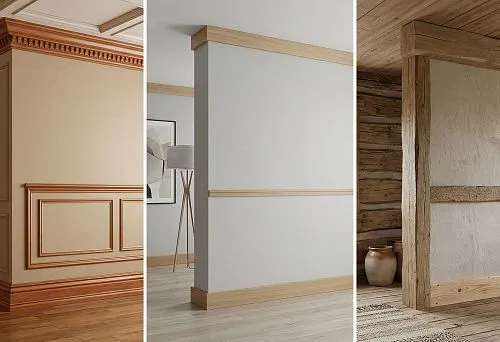
- Scenario 3. Neoclassicism with wooden accents
- Scenario 4. Scandinavian and Nordic style
- Mistakes that make battens and baseboards clash with each other
- Mistake 1. Warm battens and cold baseboard (or vice versa)
- Mistake 2. Prominent baseboard profile on a delicate wall
- Mistake 3. Different wood logic
- Mistake 4. Too small a baseboard under powerful battens
- Mistake 5. Too massive a baseboard under a delicate wall
- Mistake 6. Different finish coatings
- Mistake 7. Lack of connection with the floor
- Mistake 8. Choosing based on photos without considering real conditions
- Additional elements that enhance the system
- Moldings as an intermediate horizontal line
- Wooden cornice as the top frame
- Wooden trims and glazing beads
- Practical checklist before purchase
- FAQ: Answers to Key Questions
- Conclusion
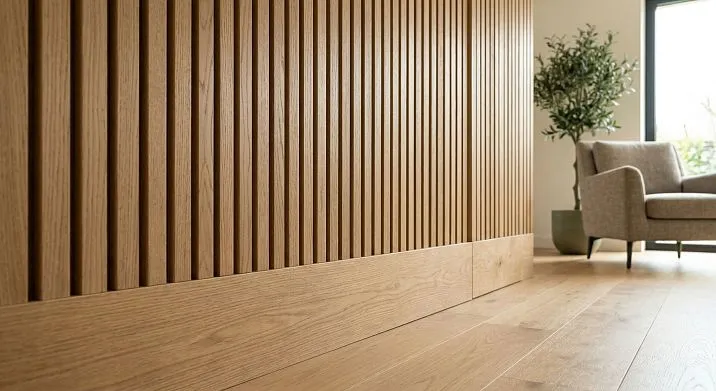
This is not a question of budget or material quality. It is a question of system logic.Wooden plank for walland solid wood baseboard are two elements of a single interior construction. When they are selected as a unified whole, the space gains that cohesiveness which cannot be explained in words, but which any person stepping over the room's threshold unmistakably feels.
Wooden plankon the wall sets the vertical rhythm,with a classic profile creates a sense of solidity, reliability.fixes the bottom horizontal—and it is precisely at the point of their visual meeting that the integrity of the interior is either born or destroyed. How to achieve this—we will examine in detail and practically.


Why wall battens and baseboards cannot be chosen separately
Many approach the selection of trim sequentially: first they think about the walls, then the floor, then 'we'll find something for the baseboard.' This is a convenient logic, but it almost always leads to one result—visual inconsistency that later cannot be fixed without redoing the work.
Why does this happen? Because a wooden wall batten and a solid wood baseboard are not independent decorative elements. They are in constant visual dialogue. The human eye, upon entering a room, instantly scans the perimeter: the ceiling line, the verticals of the walls, the lower base at the floor. If these three levels are coordinated—the space feels complete. If there is no connection between them—the brain registers discomfort, even if consciously a person cannot explain what exactly is bothering them.




What does 'speaking the same language' mean?
When they say that the batten and baseboard should 'speak the same language,' they mean a combination of parameters:
-
Temperature of the wood tone: both warm or both neutral
-
Visual thickness and weight: comparable, not contrasting
-
Surface activity: both with pronounced texture or both smooth
-
Type of finish: uniform or as close as possible
-
Overall 'mood': both modern, both classic, both Scandinavian
This is precisely what creates a system in which wooden battens in the interior and the lower line of the baseboard are perceived as parts of a single concept, not as randomly adjacent details.
Our factory also produces:


The bottom of the wall holds the entire composition
There is another important point that is often underestimated. The lower line of the interior—the baseboard at the floor—acts as a visual base, the foundation of everything that stands above. The quality of this base determines whether the vertical lines of the battens on the wall will appear 'floating' and light, or whether they will look heavy and random.
When the baseboard is correctly chosen in terms of height, profile, and tone—the battens above it gain support. When the baseboard is weak, disproportionate, or from a different style—the battens 'hang' without a foundation, creating a sense of incompleteness.
Get Consultation
What role does a wooden wall batten play in the interior
Before discussing the connection with the baseboard—it's necessary to understand what exactly a batten does and what types exist. Only by understanding the function of an element can you correctly pair it.
Batten as rhythm and geometry
The main thing thatWooden plank for wallprovides is rhythm. Repeating vertical stripes create linear geometry that visually organizes the space. This is not just decoration—it's an architectural technique that works on several levels of perception at once:
Room height. Vertical battens 'stretch' the ceiling—even in a room with a 2.7 m ceiling, a wooden batten wall creates a sense of greater vertical space. Horizontal battens, on the contrary, visually widen the space.
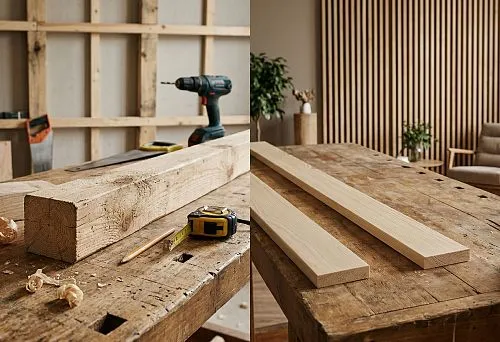
Scale and density of rhythm. Narrow battens (20–40 mm) with frequent spacing create a fine, almost fabric-like texture—delicate and refined. Wide battens (60–100 mm) with sparse spacing—a more graphic, calm rhythm. This choice affects not only the aesthetics of the wall but also which baseboard will suit it.
Texture and naturalness. Wood is a living material. Its grain, pores, and uneven fibers create a sense of warmth and organic quality that no synthetic counterpart can provide. This is precisely what makes wooden slats in interior design one of the most sought-after solutions for living spaces.
Types of slat wall solutions
Solid slat wall — slats cover the entire wall surface without gaps between them or with a minimal gap. Effect: a rich, saturated, warm surface. Works well in bedrooms, studies, and living rooms as an accent element.
Slat wall with gaps — slats are installed with equal intervals, through which either the wall or a specially prepared background (different color, different material) is visible. Effect: lightness, airiness, play of light and shadow. One of the most popular modern techniques.
Fragmentary slat zone — slats cover only part of the wall: the lower third, an accent area behind a sofa or bed, or the area above a table. Effect: a targeted accent without overloading.
Horizontal slats — an atypical but very expressive option. The horizontal rhythm visually expands the space and works well in narrow rooms.
Wooden slat: key parameters
When choosing a wooden slat for a wall, you need to determine three main parameters:
| Parameter | Range | Visual effect |
|---|---|---|
| Slat width | 20–100 mm | Narrow — delicate, wide — calm |
| Slat thickness | 6–20 mm | Thin — lightness, thick — volume |
| Spacing between slats | 0–80 mm | Frequent — fabric, sparse — graphics |
The price of a wooden batten depends on the wood species, cross-section, and quality of processing: a pine batten will be noticeably more affordable than an oak or ash batten. However, it is the wood species that largely determines the tone, which will then need to be coordinated with the baseboard.
How a solid wood baseboard gathers the bottom line of the wall
If the batten is the vertical rhythm, then the baseboard is the horizontal foundation on which this rhythm rests. Remove the baseboard — and the battens will 'fall through' the floor, losing their completeness. Install the wrong baseboard — and all the effort to create a beautiful batten wall will be ruined by a mismatch in the bottom line.
What the baseboard does in a system with battens
Visual closure of the bottom joint. The joint between the wall and floor is a technically inevitable meeting point of two planes that almost never meet perfectly. A wooden floor baseboard covers this joint and creates a clean horizontal line.
Completion of the vertical lines of the battens. Each batten on the wall starts at the top and ends at the floor. How exactly it 'arrives' at the bottom edge of the wall — whether it butts against the baseboard, hides behind it, or meets it end-to-end — determines the neatness of the entire solution. A solid wood baseboard with the correctly chosen height creates a clear horizontal 'landing strip' that provides the battens with a visual foundation.
Connection between floor and wall. In interiors with wooden parquet or solid wood flooring, a wooden baseboard becomes a transitional element between the tone of the floor and the tone of the batten wall. If chosen correctly, it 'guides' the eye from the floor to the wall without a visual jump.
Solid Wood Skirting Board: Why Solid Wood is Better
The question often arises in the context of choosing between MDF skirting boards and solid wood skirting boards. When it comes to a system with wooden slats, the answer is unequivocal: only solid wood.
The reasons are fundamental:
Unified material language. Solid wood slats + MDF skirting board are different materials with different textures, different reactions to light, and different 'liveliness' of the surface. Even with the same color finish, the difference is noticeable. Solid wood + solid wood is a unified material world.
Durability. The skirting board near the floor receives mechanical impacts from shoes, vacuum cleaners, and furniture. A solid wood skirting board withstands them without surface damage—it can be restored, re-sanded, and repainted.
Shape stability. A solid wood floor skirting board is significantly more resistant to deformation due to humidity fluctuations than MDF. This is especially important in rooms with wooden parquet, where seasonal material movement is inevitable.
Buying a wooden baseboardIt's worth choosing consciously: not just by height and color, but considering the entire system you are creating.
What should match between the slat and the skirting board: tone, wood species, thickness, character
This is the central expert question of the entire article. Five parameters that determine whether the 'slat + skirting board' pair will work as a unified system or fall apart into unrelated fragments.
Parameter 1. Wood tone temperature
Wood can be warm or cold—this is not a metaphor, but an actual visual characteristic.
Warm species and tones: oak (honey, cognac), ash in warm toning, larch (reddish), walnut (chocolate). Warm wood creates a cozy, intimate atmosphere.
Neutral and cold species: birch (almost white), maple (light, slightly milky), ash in light toning, bleached oak. Cold wood is more modern, airy, Scandinavian.
Rule: the batten and baseboard should be in the same temperature group. Warm oak battens and a cold bleached baseboard create a visual conflict that disrupts unity.
Parameter 2. Texture prominence
Wood texture is the pattern of fibers, pores, and annual rings. It can be:
-
Pronounced, graphic (oak with a large open pattern, ash with wavy lines)
-
Delicate, uniform (beech, birch, maple)
-
Rich, 'lively' (walnut with tangled fibers, Karelian birch)
When battens have a pronounced, large texture, a baseboard with the same active texture creates visual competition. In this case, it's better if the baseboard is made from the same species but with a less 'graphic' cut (tangential vs radial)—or painted in an opaque color.
Parameter 3. Visual thickness and weight
An 80×7 mm batten is a flat, lightweight element. An 80×15 mm baseboard is significantly more 'voluminous' at the same width. A 100×20 mm baseboard next to a 40×6 mm batten will look disproportionately heavy.
Principle: the visual thickness of the baseboard should not be multiple times greater than the thickness of the batten. If the battens are thin and delicate, the baseboard should also be relatively flat and lightweight.
Parameter 4. Baseboard profile activity
A flat rectangular baseboard — minimal decor, maximum cleanliness. A baseboard with an ogee — a bit more classic. A baseboard with several setbacks and profile elements — rich classic.
Wooden battens in a modern interior are typically paired with a baseboard of minimal or moderate profile. An active classic baseboard profile next to minimalist battens creates a stylistic contradiction.
Parameter 5. Finish and surface sheen
Battens with natural oil + a baseboard with glossy varnish — these are two different surface light behaviors. Under directional lighting, the difference will be very noticeable. The finish should be uniform for the entire system:
-
Natural oil — a living, matte, warm surface
-
Matte varnish — even, clean, modern
-
Concealing paint — an opportunity to hide differences in wood species and tones, creating a monochromatic system
-
Semi-matte varnish — a compromise option that works well in most interiors
When a slat should be an accent, and when it should be a calm background
This is not just a stylistic question. The role the slats play on the wall — primary or supporting — determines what the baseboard should be.
Slat as an accent: first situation
An accent slat wall is a case where wooden slats are the main visual element of the room. They can be painted in a contrasting color, have lighting, cover the full height of the space, or stand out with a special wood species.
In this situation, the baseboard should be calm and neutral. Its task is to provide a foundation for the accent wall without drawing attention to itself. The best choice: a wooden floor baseboard of moderate height (60–80 mm), without an active profile, in a tone close to the slats or slightly darker.
If the baseboard is too active next to an accent slat wall — two strong elements will start competing, and the space will lose its focus.
Slat as background graphics: second situation
Delicate slats as a background solution — slats cover most or all of the wall, but are themselves 'quiet': light, thin, frequent, without contrast. Their task is to create texture, not an accent.
In this case, the baseboard can be slightly more expressive than in the first option. Since the battens are not 'shouting'—a baseboard with a moderate profile or slightly greater height will be well-defined and add a neat finishing touch to the bottom line.
Battens on only part of the wall: situation three
Battens occupy only a fragment of the wall—the lower third, the area behind the sofa or bed, a separate niche. In this case, the baseboard should be chosen so that it complements the battened area and also works correctly along the remaining walls where there are no battens.
This complicates the task a bit: the baseboard must be universal—calm enough not to compete with the battened area, and expressive enough not to get lost on the empty walls.
How to choose a baseboard for battens: by profile, height, and visual weight
Moving on to specific selection parameters. Three criteria that allow you to make the right decision without unnecessary doubts.
Baseboard profile and its relationship with battens
For thin, frequent battens (20–40 mm, spacing 20–40 mm). The baseboard should be light and flat. Optimal profile: rectangular or with a small bevel. Height: 60–70 mm. Thickness: 12–15 mm. Such a baseboard will not visually overload a system where the wall is already saturated with a fine rhythm.
For wide, calm battens (60–100 mm, spacing 40–80 mm). The baseboard can be slightly more expressive—with one bead or a small stepped profile. Height: 70–90 mm. Thickness: 15–18 mm.
For massive battens (width 80–100 mm, thickness 15–20 mm). The baseboard must have sufficient visual weight so as not to get lost against the background of powerful verticals. Height: 80–100 mm. Thickness: 18–22 mm.
Skirting board height: how to calculate correctly
The height of a wooden floor skirting board depends on several factors:
| Ceiling Height | Slats | Recommended skirting board height |
|---|---|---|
| up to 2.6 m | Thin, delicate | 50–65 mm |
| 2.6–2.8 m | Standard | 65–80 mm |
| 2.8–3.0 m | Any | 70–90 mm |
| Above 3.0 m | Large or standard | 80–110 mm |
Fundamental rule: the skirting board should not occupy more than 4–5% of the wall height. Otherwise, the lower 'base' begins to visually reduce the height of the room.
Visual weight: how to measure it without a ruler
Visual weight is not a physical parameter, but a perception. It can be assessed with a simple test: look at the batten and the skirting board from a short distance (2–3 meters). Which element attracts more attention? If it's the skirting board — it's too active. If it's the batten — everything is fine. If both are equal — there might be a slight overload.
with a classic profile creates a sense of solidity, reliability.should be slightly 'quieter' than the battens — this is a universal rule for most interiors.
Which scenarios work especially well
Theory is good. But practice is more convincing. Here are several scenarios where the combination of 'wooden slats on the wall + solid wood skirting' yields excellent results.
Scenario 1. Modern interior in neutral tones
White or light gray walls, light-colored floor (whitewashed oak, light ash). A slatted wall made of thin, light-colored 40×7 mm slats with a 30 mm spacing creates a delicate vertical texture. Skirting made of ash in a natural light tone, 65 mm height, rectangular profile.
Result: a light, airy interior with natural wood that doesn't feel heavy or overwhelming. Wooden slats in this type of interior work as an expensive detail without ostentatious display.
Scenario 2. Warm minimalism
Warm walls (cream, linen, sand), floor made of warm oak. An accent slatted wall made of warm oak slats 60×10 mm with a 50 mm spacing — behind the sofa or along the bed. Skirting made of oak matching the floor tone, 80 mm height, with a slight bevel.
Result: all wooden elements of the interior — the floor, slatted wall, skirting — are perceived as a unified warm wooden world. This is what designers call 'monochrome wood': when all shades and textures belong to the same tonal family.
Scenario 3. Neoclassicism with wooden accents
Wall moldings, classic skirting boards, wooden cornices — and a slatted zone as a modern accent within a classical context. Slats 80×12 mm, vertical, in a dark tone (stained walnut or 'cognac' oak). High skirting, 90–100 mm, with a moderate classic profile, in the same dark tone.
Result: an interior with historical architectural references, where the slats add modernity without destroying the classical spirit. The wall slats and solid wood skirting here work as two layers of the same statement: the slats are modern, the skirting is classical.
Scenario 4. Scandinavian and Nordic style
White walls, light surfaces, plenty of air. Thin white or very light battens, 20–30 mm, with a wide spacing create a graphic grid with almost no visible texture. Minimalist skirting board: 50–60 mm, rectangular, white or light gray.
Result: the purest Scandinavian aesthetic, where wood is present but does not dominate. The wooden batten and skirting board here almost blend with the wall—and this is a deliberate technique.
Mistakes that cause battens and skirting boards to clash with each other
Knowing the mistakes is half the battle. Here are the eight most common ones that ruin the 'batten + skirting board' system.
Mistake 1. Warm battens and a cold skirting board (or vice versa)
The most frequent and most destructive mistake. Warm oak on the wall and a cold, bleached skirting board at the floor create a temperature conflict that is intuitively felt as 'something is off.' Solution: always check the temperature tone of both elements before purchase.
Mistake 2. A bold skirting board profile against a delicate wall
If the battens are thin and closely spaced—they create a delicate background graphic. A heavy skirting board with a rich, classic profile next to such a wall will look like a loud voice in a quiet room. The result—the skirting board draws attention that should belong to the wall.
Mistake 3. Different wood logic
Pine battens with pronounced resin streaks and birch skirting with uniform texture are different characters, different wood 'emotions.' Even with the same finish color, they won't be perceived as a system.
Mistake 4. Too small skirting under powerful battens
Battens 80–100 mm wide and 12–15 mm thick are a visually massive element. Skirting 40–50 mm next to them will look like a thin thread at the base of a powerful structure. The proportion is broken.
Mistake 5. Too massive skirting under a delicate wall
The opposite mistake: delicate thin battens 20–30 mm + tall massive skirting 100–120 mm. The skirting visually 'eats up' the lower third of the wall and creates a sense of imbalance.
Mistake 6. Different finish coatings
Battens in oil, skirting in glossy varnish. With side lighting — a striking contrast of surfaces. The finish coating must be uniform.
Mistake 7. Lack of connection with the floor
Skirting should 'transition' from floor to wall. If the skirting tone relates neither to the floor nor to the battens — it ends up in a visual vacuum, belonging to no surface.
Mistake 8. Choosing from photos without considering real conditions
A beautiful photo online always involves specific lighting, specific photo editing, and a specific scale. A slat that looks perfect in a photo with studio lighting may appear completely different in your room with a north-facing window. Check samples in the actual conditions of your space.
Additional elements that enhance the system
The combination 'slat + baseboard' is the foundation. But there are several additional elements that make the system even more cohesive.
Moldings as an intermediate horizontal element
Moldings— these are horizontal profile strips on walls that can be added as a dividing trim between the lower panel zone and the upper wall zone. In a slat system, molding can serve as the 'ceiling' for the slat zone: slats run from the bottom up to the molding, above which is a clean wall.
This solution works well in interiors where the slat wall occupies only the lower third or half of the height. Molding made from the same wood species as the slats and baseboard completes the zoning and makes the transition neat.
Wooden cornice as a top frame
If the system already includes a slat wall and a solid wood baseboard, a wooden cornice at the junction of the wall and ceiling becomes a logical finishing touch. Three levels of wooden trim: cornice at the top, slats on the plane, baseboard at the floor — this is a full-fledged wooden architectural system that makes the space cohesive from floor to ceiling.
Wooden trims and glazing beads
At the junctions of the slat plane with window reveals, door frames, or room corners, it is convenient to use wooden trims — thin, flat strips that cover technical joints and maintain a unified wooden language throughout the entire perimeter.
Practical checklist before purchase
Before placing an order — go through this list. It will help ensure that the battens and baseboard form a system, not a random set.
1. Where exactly will the battens be?
On the entire wall, only on an accent section, or along the perimeter? This affects how 'quiet' the baseboard should be.
2. What is the floor in the room?
The floor tone is the starting point for choosing the baseboard tone. The baseboard should 'echo' the floor, not contrast sharply with it.
3. What width and thickness are you choosing for the battens?
Write down the parameters. From these, the permissible range of baseboard height and thickness will be derived.
4. Are you planning painting or a natural finish?
If painting — you can take different wood species. If natural — only one species or one tonal group.
5. What interior style?
Modern minimalism → straight skirting board. Warm classic → skirting board with a moderate profile. Neoclassical → skirting board with a pronounced profile.
6. Do the tonal temperatures of the batten and skirting board match?
Check samples under the real lighting conditions of your room.
7. Is a full set needed — battens, skirting board, moldings, cornice?
If yes — plan from the start so that all elements are from a unified stylistic system.
Buy wooden wall batten andWood skirting board as a set — means guaranteeing yourself visual integrity without costly mistakes and rework.
FAQ: Answers to Key Questions
How to match wooden wall batten to skirting board?
The main rule — the same tonal range of wood (both warm or both neutral), similar visual weights (the batten and skirting board should not be in different 'weight categories'), unified finish. Active battens → skirting board calmer. Delicate battens → skirting board can be slightly more expressive.
Which skirting board is best for wooden slats?
For thin and frequent slats — a flat rectangular skirting board 60–70 mm. For wide slats — a skirting board 70–90 mm with a moderate profile. For an accent slat wall — a calm skirting board without active relief. Wood species — the same as the slats, or from the same tonal group.
Do the slats and skirting board need to be made from the same wood species?
With a natural finish (oil, varnish) — preferably. Different species create different tones and textures, which will be noticeable. When painted a uniform color — the species is less important, the main thing is a uniform finish.
Which wood tone works best for slats and skirting board?
Warm tones (oak, ash, larch) — are universal, create coziness. Light neutral tones (birch, maple, whitewashed oak) — for modern and Scandinavian interiors. Dark tones (walnut, wenge, dark oak) — for rich, opulent interiors with good lighting.
Can I buy slats and skirting board in the same style?
Yes. It is important to choose both elements within a unified stylistic system — in terms of level of decorativeness, tone, and profile character. In the STAVROS catalog, both slats and solid wood skirting boards are produced in coordinated series.
Where to buy wooden wall slats and solid wood skirting board?
STAVROS offers a full range of wooden wall slats and solid wood floor skirting boards with the possibility of selection within a unified stylistic system. Slats, skirting boards, and all wooden moldings — in one catalog, with coordinated profiles and uniform quality.
How to calculate the number of battens and baseboard?
The area of the batten wall is divided by the width of one batten, taking into account the gap. The baseboard length is the perimeter of the room plus 10–15% extra for cutting and joints.
Conclusion
Wooden wall battens and solid wood baseboard are not just two different products that happen to be in the same room. They are two levels of one architectural system: the vertical rhythm of the wall and the horizontal base at the floor. When they are coordinated in tone, character, profile, and finish — the interior looks cohesive, expensive, and well thought out. When there is no connection between them — the space breaks down into unrelated fragments, and no other decorative solutions can fix this.
That is why you need to choose wooden wall battens and wooden baseboard as a system — from the very beginning, at the planning stage, and not as two independent decisions.
STAVROS company produces wooden wall battens, solid wood floor baseboards, cornices, moldings, and a full range of wooden millwork made of oak, ash, and beech. All STAVROS products are manufactured with a unified surface treatment standard and in coordinated style series — which allows forming full-fledged interior sets without visual inconsistency. If you want your batten wall and the lower line of the room to work as a single system — start with the right choice of materials. In the STAVROS catalog, you will find everything you need: from delicate thin battens for a modern minimalist interior to a massive baseboard for a classic living room with high ceilings. Each element is made of natural wood, with a thoughtful profile and stable dimensions that ensure precise and neat installation without fitting and rework.