Article Contents:
- Which wooden panel can be bought for interior
- Which wooden panels are most often bought
- Wall Panels
- Slatted panels
- Solid Wood Panels
- MDF panels
- Veneered panels
- Panels for decorative finishing
- How to choose a wooden panel before purchase
- By material
- By format
- By size
- By color and texture
- By interior style
- By application area
- Which panel to buy for different tasks
- For an accent wall
- For TV zone
- for the bedroom
- For the hallway
- For partition and zoning
- For niche, column and complex areas
- For furniture and decorative inserts
- What is better to buy: solid wood, MDF or veneer
- What to buy: ready-made panel or individual slats
- How to choose the panel size
- What to consider before buying
- How wooden panels look in interior
- Common mistakes when buying wooden panels
- How to decide which wooden panel to buy for you
- If you need natural texture
- If you need painting in project color
- If you need an accent wall
- If you need easy adaptation to project
- If you need classic or neoclassical decor
- If you need a ready-made commercial interior
- Purchase algorithm: from task to product
- Frequently Asked Questions

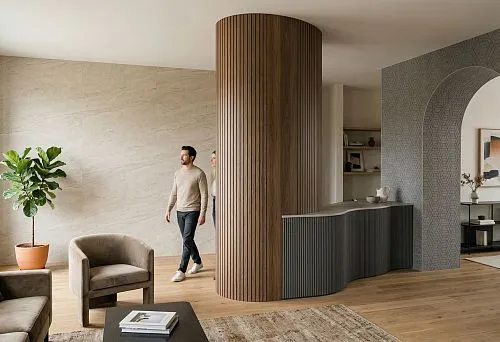
When a person searches for 'buy wooden panel', they have typically already passed the stage of general inspiration and are ready for a specific solution. Not theory, not abstract discussions about the beauty of wood—but a practical answer: which panel to choose, how one option differs from another, and what exactly will suit their wall, niche, bedroom, or living room. This is exactly what we will cover in this material: a complete practical guide to choosing wooden panels with a focus on purchase. No general words—only what really helps make a decision.



Which wooden panel can be bought for interior
The very concept of 'wooden panel' combines several fundamentally different product categories. Before going to the catalog, it's important to understand what exactly you are looking for.
Ready-made wall panels are modular products of standard sizes, ready for installation without preliminary assembly. Suitable for wall finishing, niches, accent zones, TV panels, and bed headboards.
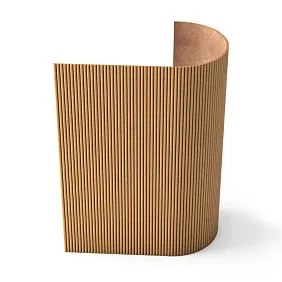
Slat panels are a structure of parallel slats with uniform spacing, fixed on an MDF backing or fabric base. They create an expressive rhythm of lines and work well with side and directional lighting.Rafter panelsOn a fabric base, they wrap around columns, arches, and radius walls without distorting the pattern—this is their fundamental technical advantage.
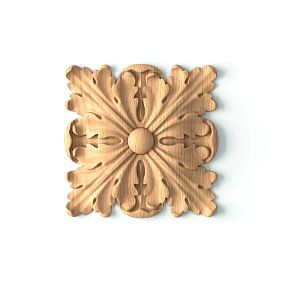
Decorative panels are products with relief, milled profiles, carvings, or volumetric inserts. They are used in classic, neoclassical, and custom interiors as architectural accents.
Panels for painting are MDF with a perfectly sanded surface, ready for applying any enamels and paint coatings. The most flexible option in terms of color.
Panels with natural wood texture — solid wood or veneer of valuable species with an open grain pattern, coated with transparent oils, wax, or varnish. Maximum naturalness.
Understanding these categories immediately narrows the search from 'wooden panels in general' to a specific type of product for your task.




Which wooden panels are most often purchased
Our factory also produces:



Wall panels
Wooden wall panels are the broadest category. These are ready-made modular products used for finishing any vertical surfaces: from full wall cladding to an accent fragment behind a sofa or bed. A wall panel can be smooth, textured, slatted, or carved — it all depends on the task and interior style.STAVROS wall panelsin the boiserie style — this is one of the most prestigious options for classic decor, which turns a wall into an architectural object.
Get Consultation
Rack panels
This is the most dynamically growing market segment of the last six years. The slatted structure creates architectural rhythm and a lively play of light and shadow, which cannot be reproduced by flat surfaces. Vertical slats visually elongate the room in height — a critically important technique in standard apartments. The assortmentslatted panels made of MDF and solid oakcovers rigid modules on an MDF backing for flat walls and flexible panels on a fabric base for non-standard surfaces: columns, arches, rounded corners.
Solid wood panels
Products made from solid wood — oak, beech, ash, walnut — represent the most natural and prestigious class.Solid wood panel— this is the living grain pattern, the tactile value of natural material, and the feeling of authenticity that is not imitated by any synthetic analogues. Oak with a density of 700–750 kg/m³ is especially popular: high strength, wear resistance, and a wide range of finishes from light natural to deep dark gray.
MDF Panels
Medium-density fiberboard is the working material for most modern interior projects. MDF with a density of 750–850 kg/m³ does not warp, does not react to humidity fluctuations, and has a perfectly smooth surface for painting.primed MDF slatted panel PAN-002— a ready-to-paint option for those designing interiors through color. Any enamel from the RAL or NCS system adheres flawlessly to MDF, creating a monolithic chromogenic coating.
Veneered panels
Veneer — a thin slice of natural wood from valuable species, glued onto an MDF base. This is a compromise that many consider optimal: the appearance and tactile qualities of natural wood at a significantly lower cost and with the geometric stability of MDF.wood-look slatted wall panel— in oak or ash veneer — a choice for those who value natural aesthetics without the risk of deformation in urban apartment conditions.
Panels for decorative finishing
Carved wooden panels— this is a separate class of decorative products with three-dimensional patterns, historical ornaments, geometric patterns, or custom reliefs. Used in classic, baroque, neoclassical, and custom interiors as architectural accents: above fireplaces, in niches, in framing systems, on door portals.
How to choose a wooden panel before purchase
By material
The first question is not 'which is more beautiful,' but 'what should the panel be made of for my task':
-
Solid wood — for interiors where absolute naturalness, tactile value, and material status are important. Requires acclimatization and a stable climate.
-
MDF is for projects under painting, where color is the main tool. Stable, geometrically precise, not afraid of humidity fluctuations in urban apartments.
-
Veneer on MDF is for those who want natural wood grain with guaranteed stability. The best balance of aesthetics and practicality.
By format
-
Ready-made panel — quick installation, precise rhythm, predictable result.
-
Flexible panel on fabric base — for columns, arches, and any non-standard surfaces.
-
Rigid panel on MDF backing — for flat walls and furniture fronts.
-
Carved and relief — for decorative accents in classic and authorial interiors.
By size
Panel size is chosen based on the scale of the room and the task. Standard panelsPAN-001have a size of 1010×8×950 mm — this is a convenient modular format suitable for both small accent zones and assembling large surfaces. More details on size selection — in a separate section below.
By color and texture
Choosing texture is one of the most responsible decisions. Ask yourself: do you want to see a live fiber pattern or a uniform painted surface? Warm cognac tone or cold gray-graphite? The soft play of semicircular slats in the light or the clear geometric rhythm of straight profiles? Answers to these questions immediately narrow the choice to specific items in the catalog. If unsure, orderProduct samples— small fragments of the panel that can be tried on the real lighting of your room.
By interior style
| Style | Recommended panel type | Material |
|---|---|---|
| Modern | Batten, smooth | MDF for painting, oak |
| Minimalism | Smooth for painting | MDF in neutral tones |
| Scandinavian | Vertical batten | Light oak, whitewashed MDF |
| Japandi | Batten, moderate spacing | Oak oil, warm tones |
| Neoclassical | Relief, profile | MDF for painting, veneer |
| Classic | Carved, boiserie | Solid oak, beech |
By area of application
Each area of the room has its own specifics of load and visual requirements:
-
Living room: accent wall behind the TV or sofa — slatted or relief panel.
-
Bedroom: headboard area — smooth or slatted with soft texture.
-
Hallway: protective cladding for the lower part of the wall — dense oak or MDF for durable enamel.
-
Study: full cladding or fragments — solid wood or veneer to create an atmosphere.
-
Commercial spaces: durability and expressiveness — MDF for painting or veneered panels with lacquer coating.
Which panel to buy for different tasks
For an accent wall
An accent wall is the most common reason for searching for wooden panels. Slatted solutions with a vertical rhythm of planks work best here: with side or directional lighting, the surface comes to life, creating a strong visual effect without overloading details.buy slatted panelsmade of paintable MDF or solid oak means getting a ready-made solution for an accent wall that can be installed in one day.
For the TV zone
TV zone — this is an architectural headboard for the main screen in the living room. A slatted wall behind the TV creates a frame that simultaneously highlights the technology and makes it less dominant in the interior. The optimal choice is rigid slatted panels on an MDF backing with precise geometric rhythm: installation with adhesive or on a frame, panel width depending on the scale of the niche.
For the bedroom
Area behind the bed headboard — a classic place for a wooden decorative panel. Here, a calm, unobtrusive texture is valued, which creates a feeling of coziness and rest. Light oak with an oil finish, a slatted panel with moderate spacing in warm tones, or MDF under a neutral matte enamel — all these options work in the bedroom to create a relaxing atmosphere. It is important to avoid too dark and heavy tones, which create a feeling of pressure.
For the hallway
Hallway — a zone of high mechanical load. A wooden panel here performs both a decorative and protective function. The lower strip of the wall up to a height of 1.0–1.2 m, clad in dense oak or MDF under a hard enamel, protects against impacts, scratches, and dirt for years to come. Vertical slats along the entire height in a narrow corridor visually expand the space — an important technique for standard hallways.
For partition and zoning
Open-plan layouts need zoning without building solid walls. A slatted structure in the role of a partition lets light through, creates a visual boundary between zones, and adds architectural expressiveness.Panels for zoningmounted on floor and ceiling rails without attachment to walls — an ideal solution for rental interiors or leased premises.
For niches, columns, and complex areas
These are the most technically challenging surfaces where standard rigid panels cannot be used. Flexible slatted panels on a fabric base are the engineering solution specifically for such situations. They wrap around columns, arches, or radius niches without cuts or deformations, maintaining an even rhythm of slats across the entire surface curvature. Purchasing such a panel is the right step for a non-standard architectural situation where conventional material would create unsightly joints and breaks in the pattern.
For furniture and decorative inserts
Slatted panels are actively used not only on walls but also in furniture projects: cabinet fronts, headboards, shelf ends, decorative inserts in cabinets and tabletop structures. Here, the format of a flexible panel on a fabric base is especially convenient—it can be cut with a knife to the required size and glued onto the furniture front without milling or special fasteners.
What is better to buy: solid wood, MDF, or veneer
Almost every customer asks this question. The correct answer is not 'solid wood is better' or 'MDF is more convenient,' but 'what is better for your specific task.'
When solid wood is better:
-
You value absolute naturalness and the tactile quality of the material.
-
The room has a stable climate (country house, air-conditioned office).
-
The project is aimed at the high-end segment, where the material is perceived as status-enhancing.
-
You want an open wood grain texture, finished with oil or wax.
When MDF is better:
-
Color is the main tool of your project, and the panel must be painted.
-
A room with central heating, where the air is especially dry in winter (a typical city apartment).
-
Perfect geometric stability is needed without the risk of deformation.
-
The project budget is limited, but the quality of the finish is fundamentally important.
When veneer is better:
-
You want the natural texture of wood, but in the conditions of a city apartment.
-
A balance between the aesthetics of natural wood and the practicality of an MDF base is needed.
-
The project involves an open grain pattern, but without the risk of warping.
Quick selection table:
| Parameter | Solid wood | MDF | Veneer |
|---|---|---|---|
| Natural texture | ✓✓✓ | — | ✓✓ |
| Painting in any color | — | ✓✓✓ | — |
| Geometric Stability | ✓ | ✓✓✓ | ✓✓✓ |
| Moisture resistance | ✓ | ✓✓✓ | ✓✓✓ |
| Tactile value | ✓✓✓ | ✓ | ✓✓ |
| Price | High | Moderate | Medium |
What's better to buy: a ready-made panel or individual slats
Another question that often confuses buyers. Let's break it down honestly.
A ready-made panel is more advantageous when:
-
You need a predictable, uniform gap between slats without manual marking.
-
Installation is done on your own without involving professional carpenters.
-
You need a flexible panel for a non-standard surface (column, arches, radius).
-
Installation speed and seamless module joining are important.
-
The task is an accent wall or TV zone with a clear rhythm.
Individual slats are more convenient when:
-
A non-standard layout is needed: diagonal, herringbone, fan, radial pattern.
-
Custom spacing that does not match ready-made formats.
-
A complex author's project with unique geometric solutions.
-
The surface requires fitting to non-standard dimensions.
For most tasks — accent wall, TV zone, headboard, hallway — a ready-made slatted panel is optimal: it installs faster, provides a predictable result, and does not require special carpentry skills.
How to choose the panel size
Panel size is one of the parameters most often ignored when purchasing and later regretted.
Panel width (the width of an individual slat) determines the scale of the rhythm. Narrow slats of 20–40 mm create a fine, detailed pattern suitable for small spaces. Wide planks of 80–120 mm produce a large, generalized rhythm that reads well in spacious living rooms and meeting areas.
Panel length — in most cases, panels are installed from floor to ceiling, creating a continuous vertical rhythm. The standard module height for most manufacturers is 2400–2700 mm, which covers the typical ceiling height with minimal waste.
Thickness determines shadow depth. Thin planks of 8–12 mm give a delicate pattern. Thicker ones — 15–20 mm and above — create a pronounced sculptural effect, which is especially interesting with accent lighting.
Spacing between slats — the distance from the center of one slat to the center of the next. Close spacing creates a dense surface, close to solid cladding. Wide spacing makes the structure airy, almost lacy.
For small rooms: narrow slats, vertical orientation, light tones, one accent wall. This visually stretches the space upward and doesn't overwhelm a small room.
For large rooms: wider planks, pronounced relief, dark tones are acceptable — the scale of the space can handle it.
Number of panels is calculated simply: divide the surface area by the area of one module, then add 10–15% for cutting and fitting.
What to pay attention to before purchase
Before placing an order, answer a few questions for yourself:
-
Where will the installation be? Wall, column, niche, ceiling, furniture front — each surface requires its own type of panel.
-
What is the base surface? A smooth plastered wall is suitable for adhesive installation. An uneven concrete wall or a surface with utilities requires frame installation.
-
Is a transition to the ceiling or adjacent surfaces needed? If the panel continues from one wall to another or transitions into a ceiling niche, corner and transition profiles are required.
-
Will it be painted? If yes — paintable MDF. If no — solid wood or veneer.
-
How important is natural texture? If the living texture of wood is fundamentally important — solid wood or veneer. If the interior is built on color — MDF.
-
Are there outlets and switches on the wall? Locations for electrical points need to be marked and prepared before installation, not after.
-
How does the panel relate to the floor and doors? Tonal harmony between the panel, flooring, and door leaves is a mandatory condition for a cohesive interior.
How do wooden panels look in an interior
Relying only on catalog photos is a common mistake. The actual perception of a panel depends on lighting, room scale, and its adjacency to other materials. Nevertheless, there are stable combinations:
Modern interior: slatted MDF panel in matte gray or warm beige tones behind a sofa, white walls around the perimeter, black metal hardware and lighting. Laconic, architectural, expensive-looking.
Minimalism: smooth paintable panel matching the wall color with a barely noticeable relief. A unified surface, no visible seams, color as the main accent. The panel adds volume without disrupting the purity of the plane.
Japanandi: oak in a warm natural-toned oil finish, open wood grain texture, slatted rhythm with moderate spacing. Adjacent — linen textiles, matte ceramics, brass details. Naturalness as a philosophy.
Neoclassical: reliefWall Panels with geometric profiles, painted in neutral cream-gray tones. Moldings, cornice profiles, plasterwork — wood integrates into a classical context through correctly chosen relief and color.
Warm natural interior: dark oak in a deep tobacco tone, natural stone, copper and bronze, wool textures. WoodenSolid wood panels here — the foundation of the atmosphere.
Common mistakes when buying wooden panels
This is a real list of the most frequently made mistakes:
-
Buying based solely on a photograph: studio lighting and professional angles always look better than reality. Order samples before making a final decision.
-
Confusion between solid wood, MDF, and veneer: three different materials with different properties, prices, and applications. Not knowing them guarantees a mismatch between expectations and results.
-
Ignoring wall dimensions: buying a beautiful panel that, due to its module, doesn't fit a specific wall without unsightly offcuts — a classic story.
-
Confusing panels with battens: extra installation costs and wasted time.
-
Installing without a plan: preparing for outlets, switches, corner transitions—all this needs to be thought through before installation, not during.
-
Mismatch with flooring and doors: cold gray MDF next to warm light parquet and honey-colored wooden doors creates a sense of disjointedness and error.
-
Too dark texture in a small room: dark panels on all walls of a small space create a tunnel effect.
-
All walls at once: wooden panels are an accent tool, not a finish for the entire perimeter. One or two surfaces work; all four—overload.
-
Lack of understanding of the final layout: without knowing exactly how battens will lay on a wall with a window, door, and outlet—you risk getting unsightly cuts in the most visible places.
-
Choosing panels without considering interior style: relief classic profiles in a Scandinavian living room—a visual mistake that's expensive to fix.
How to understand which wooden panel to buy for you
This is the most practical section. Go through the scenarios—find yours:
If you need a natural texture
Choose panels from solid oak or veneered solutions on an MDF base. The finish is oil or clear varnish, highlighting the natural wood grain. The tone ranges from light natural to warm tobacco.Solid wood panel— your choice if the naturalness of the material is essential.
If you need painting to match the project color
Choose MDF with a density of 750–850 kg/m³, perfectly primed or sanded for painting.MDF slatted panel PAN-002— a ready-made solution for any enamel. The color is selected according to RAL or NCS in exact accordance with the project palette.
If you need an accent wall
Slatted panels with vertical rhythm and side lighting. Solid oak for naturalness, MDF for pure color. Rigid modules on an MDF backing for a flat wall; flexible panel on a fabric base for non-standard geometry.
If you need easy adaptation to the project
Flexible slatted panelPAN-001— a universal solution. It is cut with a knife to any size, glued without special tools, and works on flat walls, columns, arches, and furniture fronts.
If you need classic or neoclassical decor
wall panels boiserie— relief products with profiles, moldings, and volumetric inserts for classic and neoclassical interiors. MDF for painting in neutral tones or solid wood for tinting.
If you need a ready-made commercial interior
Veneered panels with lacquer coating or MDF for hard enamel — for restaurants, offices, hotels. Modular system for quick installation of large areas.Wood and MDF products from the manufacturerwith delivery from one piece across all of Russia.
Purchase algorithm: from task to product
Before going to the catalog, go through five steps:
-
Define the task: accent wall, zoning, full cladding, decorative element, furniture facade.
-
Choose the material: solid wood — naturalness; MDF — painting and stability; veneer — balance.
-
Determine the format: slatted, smooth, textured, carved; rigid or flexible.
-
Select the size and texture: width, pitch, tone, surface structure. If in doubt — order samples.
-
Proceed to purchase: choose specific items in the catalog, check the availability of required sizes, calculate the quantity with a 10–15% allowance for cutting.
Frequently asked questions
Which wooden panel is best to buy for a wall?
Depends on the task. For an accent wall — slatted panel made of MDF or solid oak. For full cladding — smooth veneered panel. For a wall to be painted — primed MDF.
What is better to buy: solid wood panel or MDF?
Solid wood — for naturalness and status. MDF — for painting in any color and geometric stability in urban apartment conditions. Veneer on MDF — the best compromise.
Which wooden panels are suitable for an accent wall?
Slatted panels with vertical rhythm, especially effective with side or accent lighting. Both MDF for painting and oak in natural tinting are possible.
Can I buy a panel for painting?
Yes. MDF panels with a primed surface are ready for application of any water-based enamels. Color is selected from the RAL or NCS catalog.
What is better to buy for interior: a ready-made panel or slats?
For most tasks — a ready-made panel: faster, more precise, without the risk of uneven spacing. Individual slats are suitable for non-standard custom layouts.
Which panels are suitable for a bedroom?
Slatted or smooth panels in calm warm tones for the headboard area. Light oak with an oil finish or MDF for a neutral matte enamel.
Which panels are better for an entrance hall and corridor?
Dense oak or MDF for a hard enamel. Lower wall cladding up to 1.0–1.2 m in height protects against mechanical damage.
How to choose a wooden panel by size?
Consider the width of the slat (scale of rhythm), spacing (surface density), length (to match ceiling height), thickness (depth of shadow). For small rooms — narrow slats, light tones, vertical orientation.
Can wooden panels be used for zoning?
Yes. The slatted partition design allows light to pass through and visually divides the space without building solid walls.
Are wooden panels suitable for a modern interior?
Absolutely. Slatted panels with a clean geometric rhythm and MDF for neutral painting are among the most in-demand solutions specifically in modern projects.
How do I figure out how many panels to buy?
Measure the surface area (height × width), divide by the area of one module, add 10–15% for cutting and fitting. Don't forget to subtract the area of door and window openings.
What should I look at before buying, besides appearance?
The base material for installation, presence of sockets and switches, corner joints, color matching with the floor and doors, mounting method, and compatibility with adhesive or fastening systems.
Wooden panels are not just a finishing material. It's a solution that shapes the character of a space: its warmth, atmosphere, architectural expressiveness, and emotional tone. The right choice of format, material, and size makes the interior cohesive; the wrong one turns expensive material into a noticeable mistake.
If you're ready to buy a wooden panel for your interior and want to be confident in the material quality and manufacturing precision — pay attention to the products of STAVROS. STAVROS is a Russian manufacturer with twenty-four years of experience, its own production from solid oak and beech, an assortment of over 4000 models, and delivery of a single piece across all of Russia. In the catalogslatted panels made of MDF and solid oak, wall panels and boiserie, Carved decorative panelsandProduct samplesfor selection before ordering. Quality that remains.