Article Contents:
- Philosophy of the Wooden Staircase: More Than Just Ascension
- Symbolism and Meaning in Architecture
- Aesthetics and Tactility of Wood
- Ecological and health benefits
- Anatomy of a Wooden Staircase: From Elements to Whole
- Main Components and Their Functions
- Types of Construction: From Simple to Complex
- Materials: Character and Soul of Wood
- Wooden Staircase in Interior Design: Styles and Solutions
- Classic: Beyond Time and Trends
- Modern Minimalism: Purity of Lines
- Rustic and Country: Warmth and Coziness
- Eco-Style: Nature in the Home
- Where to Buy a Wooden Staircase: Choosing a Reliable Manufacturer
- Selection Criteria: Quality, Experience, Reputation
- Custom Order or Ready-Made Solution
- Service and Warranties: What to Pay Attention To
- Practical Aspects of Choosing a Wooden Staircase
- Ergonomics and Safety
- Integration into the Home Space
- Maintenance and care
- Innovations and Trends in the World of Wooden Staircases
- Modern Wood Processing Technologies
- Ecological aspects and sustainable development
- Integration with modern technologies
- Conclusion: a choice that will stay with you for years

A wooden staircase is not just a functional element connecting floors of a house. It is an architectural axis around which space revolves, a sculpture that animates the interior, a path along which the life of the home moves. Wooden constructions hold a special place in the world of staircases — warm, living, breathing, carrying the energy of nature and the craftsmanship of human hands. In this article, we will dive into the wonderful world of wooden staircases, uncover their secrets, and tell you, where to buy a wooden staircasewhich will become a true work of art in your home.


Philosophy of the Wooden Staircase: More Than Just Ascension




Symbolism and Meaning in Architecture
Since ancient times, the staircase has been not just a functional element, but also a powerful symbol. Ascending the steps was associated with spiritual growth, with movement from the earthly to the heavenly. In architecture of different epochs and cultures, the staircase often became a central element around which all space was arranged.
In a modern home, a wooden staircase retains this symbolic meaning, becoming a metaphor for the connection between different levels of family life. It unites public and private spaces, creates a smooth transition between them, sets the rhythm of movement and perception of the home.
Our factory also produces:



Aesthetics and Tactility of Wood
Wood is a material with a unique aesthetic and tactile qualities. Each species has its own character, pattern, color, and texture. Touching a wooden surface provides a special feeling of warmth and life, which cannot be obtained from synthetic materials.
A wooden staircase brings natural beauty and harmony into the home. It can serve as a striking accent in a minimalist interior or as an organic part of a classic or rustic style. The texture of wood creates visual interest, plays with light and shadow, and makes the space deeper and more multidimensional.
Get Consultation
Ecological and Health Benefits
In an era of growing ecological awareness, choosing natural materials becomes not just an aesthetic but an ethical decision. A wooden staircase is an eco-friendly interior element that does not emit harmful substances, does not accumulate static electricity, and does not cause allergic reactions.
Moreover, wood has the ability to regulate air humidity, absorbing excess moisture and releasing it when dry. This creates a more comfortable and healthy microclimate in the home. Some wood species, such as oak or larch, emit phytoncides — natural disinfectants that purify the air and positively affect the respiratory system.
Anatomy of a wooden staircase: from elements to the whole
Main components and their functions
A wooden staircase is a complex engineering structure consisting of multiple elements, each performing its own function:
Steps — horizontal elements we use to ascend and descend. They must be wide and deep enough for comfortable and safe movement.
Stringers — vertical elements between steps. They may be absent in open staircases, but in closed ones they play an important role in ensuring structural rigidity.
Stringers and treads — load-bearing elements on which steps rest. The stringer has a toothed shape and is located under the steps, while the tread is a beam with notches on its inner side.
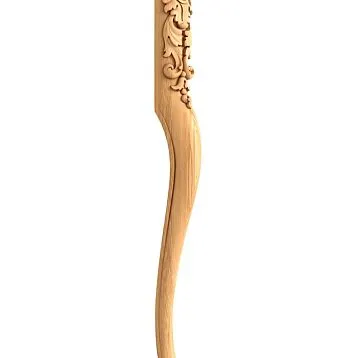
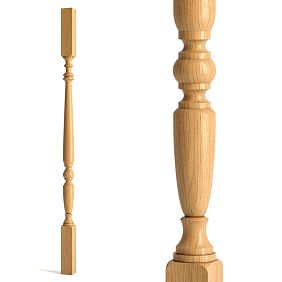
Balusters — vertical supports that hold the handrail. They can have various shapes — from simple posts to intricately carved elements.
Handrails and railings — horizontal elements ensuring safety during ascent and descent. The handrail must be easy to grasp, have a smooth surface, and an ergonomic shape.
Posts — supporting elements installed at the beginning, end, and turns of the staircase. They ensure the stability of the entire structure and often become decorative accents.
Types of construction: from simple to complex
There are many types of wooden staircases, differing in construction and shape:
Straight staircases — the simplest and most common type. They have one straight flight and are usually installed along a wall. Such staircases are convenient to use but require a considerable amount of space.
L-shaped staircases — have a 90-degree turn and consist of two flights. They are more compact than straight staircases and are often used in corner spaces.
U-shaped staircases — have two 90-degree turns or one 180-degree turn. They consist of three flights and two landings or two flights and one landing. Such staircases are well-suited for homes with limited space.
Helical staircases — have a spiral shape and rotate around a central axis. They occupy minimal space but are less convenient to use due to narrowing steps.
Modular staircases — consist of ready-made elements that can be combined in various ways. This allows creating structures ideally suited to a specific space.
Materials: character and soul of wood
Choosing the wood species for a staircase is not only a technical but also an aesthetic decision. Each species has its own character, features, and advantages:
Oak — a classic choice for staircases. It is distinguished by exceptional strength, resistance to moisture and mechanical damage. Oak staircases have a noble golden hue and pronounced texture that becomes even more beautiful over time.
Beech — a species with uniform structure and pleasant pinkish tone. Beech staircases look elegant and modern, and harmonize well with various interior styles.
Ash — distinguished by high strength and elasticity. Ash wood has a beautiful texture with pronounced annual rings and a light tone that can be easily stained to various colors.
Larch — one of the strongest and moisture-resistant species. Larch staircases are especially suitable for homes with high humidity or for outdoor structures.
Spruce — an affordable species with a warm golden tone. Spruce staircases are less strong than oak or beech, but with proper treatment and maintenance, they can last for many years.
Wooden staircase in interior: styles and solutions
Classic: timeless and fashionable
Classic style in staircase design — embodies elegance and luxury. Such staircases usually have rich finishes, carved elements, graceful balusters, and massive posts. They become a central element of the interior, attracting attention and creating an atmosphere of aristocracy.
For classic staircases, dark wood species — oak, walnut, mahogany — are most often chosen. They can be complemented with elements made of metal, stone, or glass, but wood always remains the primary material setting the tone of the entire structure.
Modern Minimalism: Clean Lines
In modern interiors, wooden staircases take on more streamlined forms. Here, clean lines, functionality, and the absence of excessive decoration are valued. Such staircases often feature open treads without risers, minimalist railings made of glass or metal, and simple geometric shapes.
Light-colored wood species — beech, ash, maple — or, conversely, very dark, almost black shades are chosen for modern staircases. The wood texture can be emphasized with transparent varnishes or, conversely, concealed under a single-tone paint.
Rustic and Country: Warmth and Coziness
The rustic and country styles bring us back to the roots, to natural beauty and simplicity. Staircases in these styles are typically made from rough-hewn wood, preserving the natural texture, knots, and irregularities. They may have scratches, cracks, and signs of age — all of which give them character and individuality.
Wood species with pronounced texture — pine, spruce, larch — are chosen for such staircases. They can be stained in warm, earthy tones or left in their natural color. Balusters and posts often have simple yet expressive shapes, reminiscent of traditional rural craftsmanship.
Eco-style: Nature in the Home
Eco-style is a modern design direction aiming for maximum naturalness and eco-friendliness. Staircases in this style are made from minimally processed wood, often retaining bark, natural edges, and organic shapes.
Wood species with interesting texture and pattern — Karelian birch, various tree knots, exotic species with unusual color and pattern — are chosen for eco-staircases. Such staircases become not just functional elements, but works of art, showcasing the beauty and uniqueness of natural materials.
Where to Buy a Wooden Staircase: Choosing a Reliable Manufacturer
Selection Criteria: Quality, Experience, Reputation
Choosing a manufacturer of wooden staircases is a responsible step that affects not only the aesthetics but also the safety of your home. What to pay attention to when selecting a company:
Experience — the longer a company has been on the market, the more experience it has in solving various tasks and problems. Experienced manufacturers usually have a portfolio of completed projects that can be reviewed before placing an order.
Quality of materials — a reliable manufacturer uses only high-quality wood, properly dried and processed. It should be ready to provide information about the origin of the wood, its grade, moisture content, and other characteristics.
Production technologies — modern equipment and technologies allow creating more precise, high-quality, and durable structures. Find out what equipment the company uses and how quality control is carried out at different production stages.
Reputation and reviews — study customer reviews, look at photos of completed projects, visit an exhibition hall if possible. A reliable manufacturer values its reputation and strives for long-term relationships with clients.
Custom Order or Ready Solution
When choosing a wooden staircase, you have two main options: order a custom project or select a ready-made solution from a catalog.
A custom order allows you to create a staircase perfectly suited to your needs, tastes, and room characteristics. You can choose any wood species, any shape, any decorative elements. However, such an approach is usually more expensive and requires more time for design and manufacturing.
Ready-made solutions — these are standard staircase models offered by the manufacturer in its catalog. They are usually more affordable and can be manufactured and installed in a shorter timeframe. Many manufacturers offer the option to slightly customize ready-made models — changing dimensions, selecting wood species, or finish color.
Choosing between a custom order and a ready-made solution depends on your priorities, budget, and room characteristics. In some cases, a ready-made model with minor modifications may be ideal for your home, while in others, only a custom project will solve all the tasks.
Service and Warranties: What to Pay Attention To
In addition to the quality of the staircase itself, it is important to pay attention to the service offered by the manufacturer:
Consultation and Design — a good manufacturer should offer professional consultation, help you choose the optimal solution, and develop a project taking into account all room characteristics and your preferences.
Measurements and Installation — accurate measurements and professional installation are critically important for the safety and longevity of the staircase. Find out if the company provides these services and who will carry them out.
Warranty and Maintenance — a reliable manufacturer should provide a warranty on its products and be ready to offer post-warranty service. Clarify warranty terms, what is included in it, and what to do in case of problems.
Additional Services — some manufacturers offer additional services such as restoration of old staircases, furniture manufacturing in a unified style with the staircase, and consultation on care and maintenance.
If you are wondering, where to buy a wooden staircase about high quality, pay attention to companies that specialize specifically in wooden structures and have positive customer reviews.
Practical Aspects of Choosing a Wooden Staircase
Ergonomics and safety
The staircase is not only a design element but also a functional structure you will use daily. Therefore, ergonomics and safety should be a priority when choosing:
Step dimensions - the optimal step depth is 25-30 cm, height - 15-18 cm. These parameters ensure comfortable and safe movement.
Staircase width - the minimum width for comfortable use is 80 cm, but the optimal width is 90-100 cm. This allows two people to pass each other on the staircase and ensures convenience when carrying large items.
Slope angle - the optimal staircase slope angle is 30-45 degrees. Staircases with steeper inclines take up less space but are less convenient and safer.
Handrails and guardrails - they must be strong enough, easy to grip, and positioned at the optimal height (90-100 cm from the step level).
Anti-slip elements - to increase safety on steps, you can install anti-slip pads or strips, especially if there are children or elderly people in the house.
Integration into the home space
The staircase should naturally fit into the overall space of the home, matching its style, scale, and color palette:
Placement - the staircase can be a central interior element located in the hallway or living room, or a more modest structure hidden in a separate room. The choice depends on the house layout and your preferences.
Lighting - proper lighting for the staircase not only increases safety but also highlights its beauty. You can use overhead lighting, wall-mounted fixtures, built-in step lighting, or a combination of various light sources.
Coordination with other elements - the staircase should harmonize with floors, doors, furniture, and other wooden interior elements. This does not mean everything must be made of the same type of wood, but colors and textures should complement each other.
Acoustics - wooden staircases may creak when used, especially over time. This factor should be considered when choosing the construction and materials, especially if the staircase is located near bedrooms or other quiet rooms.
Care and Maintenance
A wooden staircase requires certain care to maintain its beauty and functionality:
Regular cleaning - remove dust with a soft dry cloth or vacuum cleaner with a soft attachment. For deeper cleaning, use a slightly damp cloth and special wood surface care products.
Protection from moisture - avoid water getting on wooden surfaces. If this happens, immediately wipe the moisture with a dry cloth.
Protection from sunlight - direct sunlight can cause wood to fade and crack. Use curtains or blinds to protect the staircase from prolonged sun exposure.
Reapplication of finish - over time, protective coatings (varnish, oil, wax) wear out and require reapplication. The frequency depends on the intensity of staircase use and the type of coating.
Professional maintenance - every few years, it is recommended to perform professional maintenance of the staircase, including checking all connections, tightening fasteners, and reapplying the finish.
Innovations and trends in the world of wooden staircases
Modern wood processing technologies
Modern technologies allow creating wooden staircases with improved characteristics:
Thermo-treatment - a process in which wood is heated to high temperatures in an oxygen-free environment. This increases its resistance to moisture, fungi, insects, and reduces its tendency to deform.
Compression treatment - a technology in which wood is compressed under high pressure, increasing its density and strength. Such wood can be used to create thinner, lighter, yet still strong structures.
3D milling - a technology that allows creating complex three-dimensional shapes and patterns on wooden surfaces with high precision. This opens new possibilities for staircase design and decoration.
Laser engraving - a technology that allows applying delicate patterns, inscriptions, and images with high detail on wooden surfaces.
Ecological aspects and sustainable development
In the modern world, more attention is being paid to ecological aspects of material production and use:
Sustainable forestry - many manufacturers use wood from forests where sustainable forestry is practiced, meaning new trees are planted in place of those that have been cut down.
FSC and PEFC certification - these certifications guarantee that the wood is obtained in accordance with ecological, social, and economic standards.
Ecologically clean finishes - modern wood finishes such as varnishes, oils, and waxes are increasingly made from natural bases, without toxic components.
Reusing - some manufacturers use wood from old buildings, bridges, ships, giving it new life as unique staircases with history.
Integration with modern technologies
Modern wooden staircases are increasingly integrated with various technologies to enhance comfort and safety:
Smart lighting - LED step lighting activated by motion sensors or controllable via smartphone.
Heating systems - built-in step heating systems that make the staircase more comfortable in cold weather and prevent slipping.
Acoustic solutions - special materials and constructions that minimize creaking and noise when using the staircase.
Modular systems - constructions that can be easily modified or expanded when the home layout or family needs change.
Conclusion: a choice that will remain with you for many years
A wooden staircase is not just a functional interior element, but an investment in beauty, comfort, and value of your home. A properly chosen and well-crafted staircase will delight you with its beauty, serve faithfully for many years, and may even become a family heirloom passed down to future generations.
When choosing a staircase, consider not only its appearance, but also practical aspects - ergonomics, safety, ease of use, compatibility with the home layout and style. Do not compromise on material quality and craftsmanship - this may lead to problems in the future.
If you are wondering, where to buy a wooden staircaseIf you want it to become a true decoration of your home, consult professionals with experience and reputation in this field. They will help you choose the optimal solution, taking into account all your preferences and room characteristics.
Remember, a wooden staircase is not just a path from one floor to another, it is a journey you make every day, a part of your home that will be with you for many years. May this journey be beautiful, comfortable, and safe!