












































































Article Contents:
- Why beams are needed: functions and effects
- Creating visual rhythm and structure
- Space Zoning Without Walls
- Visual correction of room proportions
- Creating style and atmosphere
- Functionality: not only decoration
- Types of beams: from structural to decorative
- Structural beams
- Decorative beams made of solid wood
- Hollow decorative beams (false beams)
- Beam sizes: how to choose proportions
- Beam cross-section
- Spacing between beams
- Number of beams
- Beams in different interior styles
- Loft: industrial brutality
- Rustic, country, chalet: rural authenticity
- Provence: French romance
- Scandinavian: northern minimalism
- Classic and neoclassic: noble restraint
- Minimalism: accent without excess
- Installing decorative beams
- Preparing the ceiling
- Marking
- Installing solid beams
- Installing hollow beams
- Running communications
- Joint finishing
- Care for Wooden Beams
- Where to buy wooden beams
- Manufacturers of trim items
- Construction bases, sawmills
- Construction Hypermarkets
- Online stores
- Carpentry Workshops
- Conclusion: Beams Create Architecture
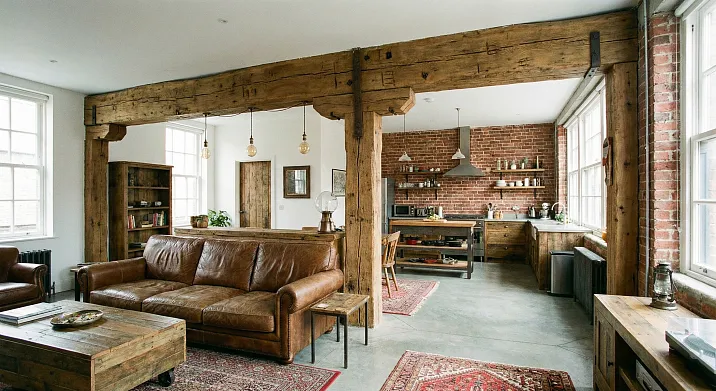
Enter the spacious living room of a country house. A ceiling four meters high, white and smooth. And along it — massive oak beams with a 200×200 millimeter cross-section, dark, with pronounced texture, knots, cracks, traces of time. They cross the ceiling at 1.5-meter intervals, creating rhythm, structure, architectural depth. Without beams, this would have been just a high white ceiling. With beams — it’s a space with character, soul, and history.
Now enter an urban studio apartment. Brick walls, concrete ceiling, industrial furniture. And under the ceiling —Wooden beammassive, brutal, dark. It runs over the kitchen zone, visually separating it from the living room, zoning the space without physical partitions, preserving openness and light. The beam does not carry load (it is a decorative element), but it creates a loft style, adds industrial character, and structures the space.
Wooden beams in interior design — more than decoration. They are architectural elements that create visual rhythm, zone space, alter room proportions, and add style ranging from rustic village atmosphere to industrial loft. They are capable of transforming a bland, standard interior into a unique space with character.
This article is a professional guide on using wooden beams in interior design by an expert with fifty years of experience in architecture, wooden structures, and interior design. We will examine the functions of beams from decorative to functional, discuss beam types from solid to hollow, show how beams work in different styles from loft to classic, and explain installation and material selection.
Ready to learn how one element changes space? Dive into the world of wooden beams.




Why beams are needed: functions and effects




Creating visual rhythm and structure
An empty ceiling — a flat surface without expressiveness. Wooden beams create rhythm — repeating horizontal elements that set the pace of the space. Rhythm makes the interior readable, organized, and architecturally meaningful.
The interval between beams determines the character of the rhythm. A frequent rhythm (beams every 60-80 cm) creates density, richness, and intimacy. A medium rhythm (beams every 120-150 cm) — classic, balanced. A rare rhythm (beams every 200-300 cm) — monumental, spacious.
The direction of beams affects the perception of space. Beams along the long side of the room visually elongate the space, emphasizing its length. Beams along the short side visually widen the room, making it more square. Intersecting beams (grid) create a complex structure, adding volume.
Our factory also produces:



Zoning space without partitions
In studio apartments, combined kitchen-living rooms, open-plan offices, wooden beams are an effective zoning tool. Changing the direction, height, or rhythm of beams visually marks the boundaries of functional zones.
Example: in a kitchen-living room, beams over the kitchen zone run parallel to the short wall with a frequent rhythm (every 80 cm), while over the living room they run parallel to the long wall with a rare rhythm (every 200 cm). Changing direction and rhythm clearly marks the zone boundaries, preserving the physical openness of the space.
Another example: one massive beam runs over the boundary between the kitchen and living room, visually separating them as an architectural boundary. Lights can be mounted on the beam, illuminating each zone separately.
Get Consultation
Visual correction of room proportions
Reducing the visual height of the ceiling. In rooms with very high ceilings (4-5 meters), the space may feel cold, inhuman, and unwelcoming. Massive dark beams visually "lower" the ceiling, making the space more intimate, human-scale, and cozy.
Increasing visual height. Paradox: beams physically lowering the ceiling by 15-30 cm can visually increase height. Light-colored beams on a light ceiling, placed along the short wall, create horizontal lines that "stretch" the space, making it appear higher. The effect is enhanced if beams reach the walls (without setback) — the ceiling appears infinite.
Correcting narrow rooms. In narrow, long rooms (hallways, narrow rooms), beams placed across (along the short side) visually widen the space, making it more square and proportionate.
Creating style and atmosphere
Wooden beams — a powerful stylistic marker. They unambiguously define the direction of the interior.
Rustic, country style: rough beams from solid wood with knots, cracks, uneven coloring create a village atmosphere, closeness to nature, authenticity. Associations with rural houses, barns, farms.
Loft: massive dark beams (or beams with metal elements) combined with brick walls, concrete ceilings, industrial furniture create an urban atmosphere, brutality, industrial character. Associations with converted industrial buildings, factories, warehouses.
Chalet: large beams from dark wood with pronounced texture combined with stone walls, natural textiles create an alpine cabin atmosphere, coziness, warmth, protection. Associations with mountain chalets, hunting cabins.
Scandinavian: light beams (white or natural light oak, ash) on a white ceiling create lightness, airiness, northern restraint. Associations with Scandinavian houses, closeness to nature, minimalism.
Provence: white or pastel beams (blue, lavender, cream) with an aged effect create a romantic village atmosphere, French charm. Associations with French countryside, lavender fields, cozy farms.
Functionality: not only decoration
Hiding utilities. Hollow decorative beams — ideal for running electrical wiring, ventilation ducts, pipes. Utilities are hidden inside the beam, while only the beautiful wooden surface is visible externally. Relevant during renovation of old buildings, where wall grooving is difficult.
Light Fixture Mounting. Beams serve as the base for hanging lights, spotlights, and track systems. Lights mounted on beams create interesting lighting effects, illuminate beams from below or above, and accentuate them.
Mounting Other Elements. You can mount hanging chairs, hammocks, potted plants, shelves, and decorative elements to beams. The beam becomes a multifunctional element, bearing not only aesthetic but also practical loads.
Structural Reinforcement. In wooden houses and buildings with wooden floors, beams often serve a structural function — supporting the floor and distributing loads. In this case, they are both functional and decorative simultaneously.
Beam Types: From Structural to Decorative
Structural Beams
True load-bearing beams, part of the building's structure, supporting the floor and roof.
Where Found: Wooden houses (log cabins, frame houses), old buildings with wooden floors, attics, lofts, converted into living spaces (where floor beams are visible).
Characteristics: Solid or glued-laminated beams of large cross-section (150×150 mm, 200×200 mm, 200×300 mm and larger), length from 3 to 12 meters, heavy (a 200×200 mm oak beam weighs 50-70 kg per linear meter).
Processing: Structural beams are typically planed (sanded), sanded, impregnated with protective compounds (antiseptic, fire-retardant), and coated with varnish, oil, or stain. Natural wood defects (knots, cracks, uneven color) are often preserved — they add authenticity and character.
Advantages: Naturalness, authenticity, real wood texture and mass, longevity (last centuries), high aesthetic value.
Disadvantages: High cost (solid wood is expensive), weight (require strong floors), complex installation (crane or special equipment needed for lifting), reduced room height (beams protrude downward 15-30 cm).
Solid Wood Decorative Beams
Beams made of solid or glued-laminated wood, installed exclusively as a decorative element, not bearing structural loads.
Characteristics: Cross-section is usually smaller than structural beams (100×100 mm, 120×120 mm, 150×150 mm), length 2-6 meters, lighter weight (but still significant — a 120×120 mm oak beam weighs 12-18 kg per linear meter).
Wood Species: Oak (most popular — strong, durable, expressive texture), Ash (lighter than oak, strong), Spruce (budget option, soft, resinous, requires protection), Larch (strong, moisture-resistant, reddish tint).
Processing: Brushing (removal of soft fibers, highlighting texture, creating relief), toning (stains in various shades from light to black), painting (white, pastel, black), artificial aging (patina, cracks, scratches, wormholes), burning (burning surface creates black relief, highlighting texture).
Mounting: To the ceiling using metal brackets, anchors, bolts. The beam is positioned under the ceiling, with fasteners hidden inside or masked by decorative elements.
Advantages: Naturalness, real wood texture, tactile comfort, prestige, possibility of creating unique elements with individual processing.
Disadvantages: Higher cost (a 120×120 mm oak decorative beam — 2500-5000 rubles/meter), significant weight (require strong fasteners), reaction to humidity (wood may deform with humidity changes — requires stable climate).
Hollow Decorative Beams (False Beams)
Beams that mimic solid wood but are hollow inside. Composed of three sides (P-shaped construction), which are slipped over a previously secured ceiling beam or directly attached to the ceiling.
Materials:
Solid Wood: Three boards (bottom and two sides) are joined, forming a P-shaped profile. Appears as a solid beam externally but is hollow inside. Wall thickness 20-40 mm. Visually indistinguishable from solid beams, but 3-5 times lighter and cheaper.
MDF with veneer: MDF base covered with veneer of premium species (oak, ash, walnut). Lighter than wood, more geometrically stable (MDF does not warp with humidity), 40-60% cheaper.
Polyurethane: Wood imitation from polyurethane with textured surface and wood-colored finish. Lightest (10-15 times lighter than solid wood), cheapest (300-1500 rubles/meter vs 2500-5000 for solid wood), moisture-resistant, do not deform. Minus — artificial material, texture imitation is visible up close.
Advantages of hollow beams: Lightness (a 120×120 mm hollow wooden beam weighs 3-5 kg/m vs 12-18 kg/m for solid), easy installation (do not require heavy fasteners, can be installed by oneself), internal cavity (for running utilities, installing lights), 50-70% cheaper than solid beams.
Disadvantages: Less prestigious than solid beams (though visually indistinguishable), hollow ends are visible up close (must be covered with caps), polyurethane — artificial, imitation.
Beam Sizes: How to Choose Proportions
Beam Cross-Section
Cross-section — beam size in cross-section (height and width). Determines visual mass and monumentality.
For standard apartments (ceilings 2.7-3 m): beams with cross-section 80×80 mm, 100×100 mm, 120×120 mm. Noticeable, create effect, but do not overload or press down.
For high ceilings (3.5–5 m): beams with cross-sections of 150×150 mm, 200×200 mm, 200×300 mm. Proportionate to the scale of the space, creating monumentality.
For low ceilings (2.5–2.6 m): beams with cross-sections of 60×60 mm, 80×80 mm, or omitting beams in favor of other decorative elements. Heavy beams will lower the ceiling further, creating a sense of pressure.
Rule: the higher the ceiling, the larger the beams. Beams should be proportionate to the space. Thin beams in a high room will disappear, while heavy beams in a low room will create pressure.
Beam spacing
Spacing determines the density, rhythm, and richness of the ceiling.
Frequent rhythm (60–80 cm): creates a dense structure, intimacy, and richness. Suitable for small rooms (15–25 m²), where coziness is needed. Or for styles with dense decoration (rustic, chalet).
Medium rhythm (120–150 cm): classic, balanced. Universal, suitable for most rooms and styles.
Rare rhythm (200–300 cm): monumental, spacious. Suitable for large rooms (40+ m²), high ceilings. Or for minimalist interiors, where an accent is needed but not overloading.
Rule: the smaller the room, the less frequent the beams should be (frequent beams in a small room create overcrowding and pressure). The larger the room, the more frequent beams can be (rare beams in a large room will disappear).
Number of beams
One beam: minimalist accent. One strong beam centered on the ceiling or above the zone boundary. Suitable for modern minimalist interiors, where a single expressive element is needed.
3–5 beams: classic option for standard rooms (20–35 m²). Create rhythm without overloading.
More than 5 beams: for large rooms (40+ m²), rustic styles (where density and richness are valued), or to create a grid (intersecting beams).
Grid (coffered ceiling): beams intersect at right angles, forming rectangular cells. Creates a complex volumetric structure, classic monumentality. Suitable for high, spacious rooms (living rooms, halls), classic interiors.
Beams in different interior styles
Loft: Industrial Brutality
Loft — a style born in industrial buildings converted into housing. Beams here are a natural element, reminding of the industrial past.
Beam characteristics: heavy, cross-section 150–200 mm; dark (dark oak, wenge, black); rough (with knots, cracks, unevenness); sometimes with metallic elements (steel plates, rivets, bolts, imitating structural joints); brushed, tinted to dark tones, sometimes charred.
Combination: brick or concrete walls, concrete ceiling or painted gray, industrial furniture (metal, rough wood), exposed utilities (pipes, ducts), large windows, minimal decor.
Quantity: medium or large (5–10 beams), medium or frequent rhythm, sometimes intersecting beams.
Functionality: beams in lofts are often used to mount lighting fixtures (track systems, pendant lamps on wires), hanging chairs, plants.
Rustic, country, chalet: village authenticity
Styles inspired by village, farm, alpine architecture. Beams here are a mandatory element, creating a connection with nature, authenticity, and coziness.
Beam characteristics: heavy or medium cross-section (120–200 mm); natural tones (light or medium oak, ash) or dark (dark oak, walnut); with emphasized natural defects (knots, cracks, uneven color, axe marks); brushed, tinted, artificial aging (patina, wormholes).
Combination: wooden walls (planks, beams, logs) or plastered walls in natural tones (white, cream, beige), stone elements (stone fireplace, stone wall), rough or aged wooden furniture, natural textiles (linen, wool, cotton), lots of wood.
Quantity: large (7–15 beams), medium or frequent rhythm, sometimes grid.
Chalet: a special variant of rustic, characteristic of alpine houses. Beams are very heavy (200–300 mm), dark, combined with stone walls, large windows, fur, rugs.
Provence: French romance
French village style, romantic, light, with a touch of antiquity.
Beam characteristics: medium or small cross-section (80–120 mm); white or pastel (blue, lavender, cream, mint); with aging effect (scratches, patina, cracks, places where wood shows through paint); smooth or slightly brushed.
Combination: white or pastel walls, floral prints (wallpaper, textiles), vintage furniture (often painted white or pastel with aging effect), lots of textiles (curtains, cushions, tablecloths), decorative elements (ceramics, woven baskets, dried flowers).
Quantity: average (4-7 beams), medium rhythm.
Effect: beams in Provence create lightness, airiness, romance. They do not press down but float, adding charm and French character.
Scandinavian: northern minimalism
Scandinavian style values naturalness, functionality, minimalism, and light.
Beam characteristics: small or medium section (80-120 mm); light (white, light oak, beech, birch); with preserved or slightly emphasized texture; matte finish (oil, matte lacquer); clean lines, no excess.
Combination: white walls, light floor (light oak, bleached oak, beech), minimalist furniture of simple forms, natural materials (wood, linen, wool, leather), minimal decor, maximum light (large windows, light tones).
Quantity: small or medium (3-5 beams), medium or rare rhythm.
Effect: beams in Scandinavian style create structure but do not overload. They are light, airy, emphasize naturalness and connection to nature.
Classicism and Neoclassicism: noble restraint
Classic styles rarely use beams (in classicism, smooth ceilings with cornices, moldings, coffers prevail). However, in some variations of classicism (especially English and American) beams are present.
Beam characteristics: medium section (100-140 mm); natural tones (medium or dark oak, walnut) with transparent lacquer emphasizing texture; smooth, without roughness, with decorative profiles (rounded edges, bevels); often combined with coffers (beams form cell frames, recesses inside cells, rosettes at the center of each recess).
Combination: cornices, moldings, classical furniture, parquet, symmetry, proportionality.
Quantity: medium, rare rhythm or grid (coffers).
Neoclassicism: simplified classicism, more modern. Beams are lighter (white oak, bleached), often painted white, simple forms.
Minimalism: accent without excess
Minimalism usually avoids decoration, but one or two beams can become the sole expressive accent in a neutral space.
Beam characteristics: medium or large section (120-200 mm); contrasting with ceiling (dark beam on white ceiling or light beam on dark ceiling); smooth, rectangular cross-section, without ornamentation; matte finish.
Quantity: one or two beams, rare rhythm or one strong beam in the center.
Effect: the beam becomes a focal point, attracting attention, structuring space, but not overloading it.
Installation of decorative beams
Ceiling preparation
The ceiling must be flat, strong, ready for beam mounting. Installing beams on stretch ceilings is problematic (anchors are needed before installing the stretch ceiling). For suspended ceilings (gypsum board) — possible, but mounting must go through the gypsum board into the concrete slab or wooden beams of the main ceiling.
Standard ceilings (concrete slabs, plastered or painted) are optimal.
Marking
Determine beam placement (direction, spacing, quantity). Mark lines on the ceiling along which beams will run. Use a laser level and plumb line to create perfectly straight lines.
Check for levelness. Beams must be strictly horizontal (use a level). Sloped beams create visual discomfort and a sense of spatial curvature.
Installation of heavy beams
Mounting on brackets: metal brackets (angles, L-shaped or U-shaped profiles) are mounted to the ceiling with anchors or screws spaced 80-120 cm apart. The beam is laid on the brackets and secured with self-tapping screws. Brackets are visible — they can be left exposed (part of loft aesthetics) or concealed with decorative covers.
Mounting on bolts: metal bolts (threaded rods 15-25 cm long) are screwed into the ceiling, holes are drilled in the beam, the beam is slipped over the bolts and secured with nuts and washers. Bolts are hidden inside the beam and not visible from the outside. More aesthetic but more complex method.
Weight: a solid oak beam 120×120 mm weighs 12-18 kg/m, a 150×150 mm beam — 20-30 kg/m. For a 4-meter-long beam, weight is 48-72 kg (120×120) or 80-120 kg (150×150). Requires assistance of 2-3 people for lifting, strong fasteners (anchors in concrete or strong screws in wood).
Installation of hollow beams
Mounting on a beam: a wooden beam (40×40 mm or 50×50 mm cross-section) is anchored or screwed to the ceiling along the beam line with a spacing of 60-80 cm. A hollow beam (P-shaped structure) is slipped over the beam and secured to the beam from the inside using self-tapping screws (screws are driven through the side walls of the beam into the beam). Fasteners are not visible from the outside.
Direct mounting: if the beam is lightweight (polyurethane or thin-walled wooden), it can be glued to the ceiling using construction adhesive ("liquid nails", polyurethane glue). Glue is applied to the top edges of the side walls and the inner side of the bottom, the beam is pressed against the ceiling and secured with supports for 12-24 hours until the glue dries.
End caps: the ends of the hollow beam are covered with decorative plugs (wooden, made from the same material as the beam, or from another material — metal, MDF). The plugs mimic the end of a solid beam and conceal the cavity.
Weight: a hollow wooden beam 120×120 mm weighs 3-5 kg/m, a beam 150×150 mm — 5-8 kg/m. A polyurethane beam 120×120 mm — 0.5-1 kg/m. Lightness significantly simplifies installation — can be installed by one person without helpers.
Communication routing
If the beams are hollow and electrical wiring or lighting fixtures are planned to be installed inside — lay the cables before installing the beam. Cables are laid in a conduit (protection against damage), the conduit is laid on the ceiling along the beam line or inside the mounting beam (if the beam is hollow).
After installing the beam in the required locations, holes are drilled (for pulling out wires of lighting fixtures), wires are pulled through the holes, and lighting fixtures are connected.
Joint finishing
Joints of beams at room corners and areas where they meet walls are covered with decorative elements (corner caps, moldings) or filled with sealant, spackled, and painted to match the beam color.
Care for wooden beams
Regular cleaning: every 1-2 months wipe with a dry cloth or vacuum cleaner with a soft brush, removing dust. Beams under the ceiling collect dust (warm air rises, carrying dust).
Wet cleaning: every 6-12 months wipe with a slightly damp (well-wrung) cloth using a mild cleaning agent (wood cleaner, liquid soap). Do not soak excessively.
Finish renewal: after 10-15 years (varnish) or 5-8 years (oil) the finish wears out — it dulls, and in places it wears off. For varnished beams — lightly sand with fine-grit sandpaper (320-400 grit), removing the top layer, apply a fresh coat of varnish with a brush. For oiled beams — clean, degrease, apply oil, let it absorb, wipe off excess.
Insect protection: if beams are made of softwood (pine, spruce) or are old, there may be appearance of wood-boring beetles. Signs — small holes, wood dust. Upon detection — treat with wood insecticide (impregnation or aerosol), fill holes with spackling, repaint.
Where to buy wooden beams
Manufacturers of trim items
Wooden beamBuy directly from manufacturers of decorative elements and carpentry items — lower price (no intermediaries), choice of sizes, species, finishes, possibility to order custom beams.
Construction bases, sawmills
For structural beams, solid timber — contact construction bases or sawmills. There you can buy beams of various cross-sections (100×100, 150×150, 200×200 mm and more), various species (pine, spruce, larch, oak — rarely). Price is lower than for manufacturers of ready-made decorative beams, but requires independent processing (sanding, impregnation, painting).
Construction hypermarkets
Leroy Merlin, Obi, MaxiDom have sections for decorative elements where hollow beams (usually polyurethane, rarely wooden) are sold. Medium selection, medium prices, can see in person.
Online stores
Wide selection of decorative beams (wooden, polyurethane) with delivery. Study photos, descriptions of dimensions, read reviews with photos of real installations.
Carpentry workshops
For exclusive beams made of rare species, with unique finishes (carving, artistic painting, complex toning) — contact carpentry workshops. Custom manufacturing, lead time 2-6 weeks, high price.
Conclusion: beams create architecture
A wooden beam is more than a decorative element. It is an architectural tool that creates structure, rhythm, character of space. It can transform a plain ceiling into an expressive composition, zone space without partitions, change room proportions, set the style from rustic to loft.
From structural solid beams to lightweight hollow imitations, from dark brutal oak to white Provencal beams, from rare monumental accents to dense rustic latticework — the choice is determined by interior style, ceiling height, room size, your taste and budget.
Company STAVROS — leading manufacturerof wooden beamsEach STAVROS beam is crafted from premium-grade selective solid wood with 8-12% moisture content after prolonged kiln drying (guaranteeing dimensional stability, absence of deformation, cracking, or warping). Production is carried out on four-sided planer equipment by Weinig (Germany), ensuring perfectly flat surfaces, precise dimensions (tolerance no more than 0.5 mm), and smooth finish. Brushing and texturing are performed on specialized brushing machines with adjustable depth settings, creating a natural relief that accentuates the wood’s grain. All beams undergo multi-stage protective treatment with antiseptics and fire-retardant agents, providing protection against rot, mold, fungi, insects, and fire.
Beam finishing is done using professional-grade products: staining with Sayerlack (Italy) dyes in hundreds of shades provides even, deep coloration that highlights the wood’s texture; Osmo Biofa oil finishes create a matte, silky surface that protects against moisture and dirt while emphasizing the natural beauty of the wood; Hesse Lignal Sirca lacquers produce a durable, long-lasting coating (lasting 15–20 years) with adjustable gloss; painting with enamels in any RAL color (white, pastel, black); artificial aging, patina, brushing, and burning create effects of long-term use, vintage, and authenticity.
STAVROS offers a full range of services: professional consultation from designers and architects to help select beam sizes, quantities, and placement tailored to your room’s style and purpose (zoning, visual correction, atmosphere creation); 3D visualization of your interior with beams (see the result before installation); precise calculation of beam, fastener, and accessory quantities; complete kit assembly (beams, end caps, brackets, anchors, screws); detailed installation instructions with photos, videos, and drawings; professional on-site installation by experienced craftsmen (cost 1500–3000 rubles per beam, depending on size and room complexity; 2-year warranty on installation quality). Official 3-year warranty on all solid wood beams, guaranteeing absence of manufacturing defects, deformation, cracking, or coating delamination under proper use.
Visit stavros.ru, explore the catalog with detailed photos of beams in real interiors, technical descriptions, cross-section drawings, and finish options; order samples to evaluate texture, color, and quality; arrange delivery across Russia with professional packaging, or visit our showroom in Moscow, where dozens of beam samples from various species, cross-sections, and finishes are displayed — you can see, touch, and receive consultations from professional designers, view interior application examples — and transform your space with elements that create architectural expressiveness, character, uniqueness, cozy or bold atmosphere, classic or modern style, for decades to come.
Visit stavros.ru, browse the catalog with detailed photographs of beams in real interiors, technical descriptions, cross-section drawings, surface treatment options, order samples for texture, color, and quality assessment, arrange delivery across Russia with professional packaging, or come to our showroom in Moscow, where dozens of beam samples from various species, cross-sections, and treatments are displayed — you can see, touch, and receive consultations from professional designers, view interior application examples — and transform your space with elements that create architectural expressiveness, character, uniqueness, atmosphere of coziness or brutality, classic or modern style, lasting for decades.


