Article Contents:
- Decorative ornaments with plant motifs
- Types of plant ornaments
- Application of decorative patterned inlays
- Wooden corner elements
- Functions of Corner Elements
- Types of corner elements by shape
- Application of corner elements in interior design
- Creating compositions: from detail to whole
- Principles of Composition
- Examples of compositional solutions
- Materials and Technologies
- Wood Species for Carved Decor
- Manufacturing technology
- Installation of decorative elements
- Surface Preparation
- Selection of adhesive and application technique
- Final processing after installation
- Conclusion

In the art of creating a harmonious interior, there is a philosophy where beauty arises from details - small, seemingly insignificant elements that, collectively, create a complete composition, demonstrating taste and understanding of architectural traditions.Decorative ornaments patternsfrom natural wood andWooden Corner Elementsare precisely such details - seemingly minor, yet capable of radically transforming space, adding volume, creating visual accents, turning simple furniture into works of decorative art.
The history of using decorative wooden elements spans millennia. From the richly adorned furniture of Egyptian pharaohs to carved iconostases of Orthodox churches, from inlaid boxes of the Renaissance to luxurious French Baroque furniture - carved decoration has always been a sign of craftsmanship, taste, and wealth. Each era created its own characteristic ornaments, but plant motifs - acanthus leaves, grapevines, rosettes, scrolls - remained unchanged symbols of life, growth, natural beauty.
Modern woodworking technologies have made this beauty accessible to a wide range of consumers. High-precision CNC machines reproduce intricate carvings that were previously created by hand over months of master carpenter's labor. At the same time, the quality of the products does not fall short of handcrafted work - modern equipment ensures perfect repeatability of details, crisp lines, and depth of relief. Furniture made from quality oak, beech, and ash, after installation and finishing, creates the feeling of expensive antique furniture at significantly lower cost.
The demand for decorative wooden elements in modern design is linked to the return of interest in classical aesthetics, quality, and individuality. In the era of mass production of identical furniture, decorated items stand out, creating uniqueness in interiors, demonstrating an understanding of the value of true craftsmanship.


Decorative ornaments with plant motifs
Plant ornament - the oldest and most universal type of decoration, based on stylized depiction of floral elements. Leaves, flowers, fruits, branches, intertwined in endless compositions, symbolize life, growth, natural harmony. This symbolism makes plant motifs suitable for any spaces - from residential interiors to public areas.




Types of plant ornaments
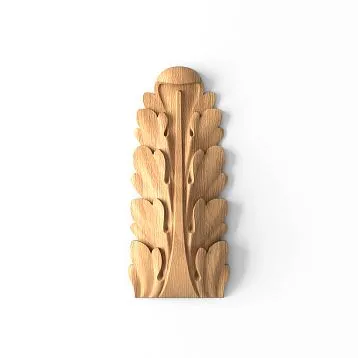
Classic acanthus leaf ornament - the most common motif, originating from ancient architecture. Acanthus is a plant with carved serrated leaves, which ancient Greek masters stylized into a decorative element adorning the capitals of Corinthian columns. Since then, the acanthus leaf has become a symbol of classical architecture, used in countless variations - from monumental architectural details to small furniture inlays.
Modern carved inlays with acanthus leaves reproduce this classic form with varying degrees of detail. Simple inlays have a generalized leaf silhouette with minimal detailing - suitable for modern classicism, where restraint is important. Detailed inlays reproduce every vein and serration of the leaf, creating a three-dimensional sculptural form - characteristic of traditional classicism, Baroque, and Empire styles.
Grapevine motifs - clusters of grapes surrounded by leaves and twisting tendrils - symbolize abundance, fertility, joy of life. This motif is especially popular in dining room, kitchen, and wine cellar interiors, where its symbolism is most appropriate. Grapevine inlays can be symmetrical, forming a balanced composition, or asymmetrical, imitating the natural growth of vines.
Rosettes - circular or oval elements with radially spreading petals, resembling a blooming flower. Rosette sizes vary from miniature 30-40 millimeters for small furniture decoration to large 150-200 millimeters for accent elements. Rosettes can be simple with a few large petals or complex multi-tiered with dozens of small details, creating a lace-like effect.
Floral compositions reproduce specific flower types - roses, lilies, peonies, daisies - with naturalistic accuracy or stylized decorativeness. Realistic flowers are characteristic of romantic styles - Provence, shabby chic, Victorian style. Stylized flowers are suitable for modern, Art Nouveau, where natural forms are reinterpreted into decorative graphic compositions.
Geometric plant patterns combine natural motifs with mathematical precision. Leaves and flowers are arranged in symmetrical compositions, form repeating patterns, create ornamental bands. Such patterns are characteristic of Eastern styles, Art Deco, Neoclassicism, where decorativeness and rhythmicity are important.
Our factory also produces:


Application of decorative patterned inlays
Furniture facades - the main area of application for decorative inlays. A simple smooth cabinet or chest door transforms into a work of decorative art with the addition of carved inlays. The inlay can be placed in the center of the facade as a central element attracting attention. It can frame the perimeter, creating a decorative border. Several inlays placed symmetrically create a complex composition.
For cabinets in classic style, large central inlays are characteristic - rosettes, floral compositions, acanthus leaves, placed precisely in the center of the door. The inlay size is usually 1/4-1/3 of the door width, creating visual balance. Too small an inlay will be lost, too large will overload the facade.
Cabinets and sideboards are decorated with appliqués on each drawer, creating a vertical rhythmic composition. Appliqués can be identical on all drawers to create uniformity or vary in size—increasing from top to bottom, creating visual stability. Appliqués are placed at the center of the drawer front or offset toward the edge for an asymmetrical composition.
Tables and consoles are decorated with appliqués on the aprons—horizontal elements connecting the legs. A carved appliqué on the front apron becomes the central decorative element of the table, visible when viewed from the front. Appliqués can also adorn the tabletop perimeter, creating a three-dimensional edge instead of a simple edge.
Doors—interior and furniture—become enriched with appliqués, transforming a simple door panel into a classic paneled door. Appliqués create relief panels that mimic traditional framed-pane construction. For tall doors, vertical compositions of three to five appliqués, arranged along the central axis, are characteristic.
Fireplaces are decorated with appliqués on the mantel, transforming simple cladding into an architectural piece. Botanical motifs are especially appropriate in the fireplace area—fire and nature create symbolic connections. Appliqués are placed on the vertical posts of the mantel, on the pediment, and frame the firebox opening.
Wall panels gain completeness with the addition of decorative appliqués at the corners or centers of sections.MoldingsAppliqués create panel structure; they add refinement. The combination of strict geometric moldings and organic botanical appliqués creates a classic aesthetic.
Get Consultation
Wooden corner elements
Corner elements are specialized decorative details designed for decorating corners of furniture, rooms, and architectural structures. Their uniqueness lies in solving both technical and aesthetic tasks—they conceal joints and create additional decorative accents.
Functions of corner elements
Joint concealment—the first and most important function. When two planks are joined—crown moldings, molding, ——at a 45 or 90-degree angle, a visible seam always remains. Even with perfect trimming, changes in humidity cause micro-movements that widen the joint. A corner element completely covers this problematic zone, creating a neat appearance regardless of the joint quality.
Creating decorative accents—corner elements can be significantly more ornate than the main plank. At a corner where two or three planes meet, such an element becomes a focal point. Four identical corner elements at the corners of a room create symmetry, rhythm, and visual organization of space.
Simplified installation—a practical advantage. Instead of complex trimming of two planks at a precise angle, the craftsman simply joins straight ends with a corner element. This is faster, simpler, and does not require high skill. This is especially relevant for complex profiles, where precise angular trimming is technically very difficult.
Protection of corners from mechanical damage—corners of furniture and rooms are most vulnerable to impacts. A corner element, usually heavier than the main plank, absorbs impacts, protecting the main structure. In case of damage, a corner element is easier to replace than to repair the entire structure.
Types of corner elements by shape
Internal corner elements are designed for decorating concave corners—wall junctions in rooms, corners of built-in furniture. Their shape is adapted for placement in a 90-degree angle between two planes. The size of such elements is usually 50–150 millimeters per side, depending on the scale of the main structure.
Simple internal elements replicate the profile of the main plank, creating a smooth transition. Decorative elements have more complex shapes—rose, flower, leaf—placed in the corner zone. After installation, they create the impression that the carved element naturally grows from the corner, framed by planks on both sides.
External corner elements for convex corners—projections, columns, pilasters. Their shape is opposite to internal ones—the element wraps around the protruding corner, creating a three-dimensional frame. External corners are more noticeable in interiors, so their decoration is especially important for achieving a finished look.
External corner elements are often larger and more ornate—large leaves, three-dimensional roses, complex geometric shapes. They may protrude from the surface by 20–40 millimeters, creating a pronounced relief. This is characteristic of classical interiors, where volume and detail richness are valued.
Universal corner elements are designed for use in both internal and external corners. Their symmetrical shape allows installation in any configuration. Usually, these are rose-shaped elements with round or square forms, geometric elements without a specific orientation.
Application of corner elements in interiors
Ceilingcorner elements—decorate intersections—crown moldings—at wall junctions. In a rectangular room, four corner elements create a complete ceiling trim composition. The size of ceiling corner elements is usually larger than furniture corner elements—80–200 millimeters, corresponding to the room’s scale.
Coordinating ceiling corner elements with cornices is critical. If the cornice has a simple geometric profile, the corner element should be equally restrained. An ornate classical cornice requires a matching corner element with carving and ornamentation. After painting in a single color, the cornice and corner elements create a unified decorative system.
Furniture corner elements decorate the corners of facades, tabletops, and bases. On cabinet doors, corner elements are placed at the four corners of the frame frommolding—creating a complete composition. The size of furniture corner elements is smaller—30–80 millimeters, corresponding to the scale of the furniture.
Especially effective are corner elements on tabletops—carved elements at the four corners of a table create a rich frame. For round tables, corner elements are placed around the perimeter at equal intervals, forming a decorative band. This transforms a simple tabletop fromMDF—into a prestigious item.
Wall panels gain completeness with corner elements at all corners of sections.Moldings—create rectangular frames; corner elements emphasize the corners. If the panel has an additional central appliqué, a five-element composition is formed—four corners and a center, creating classic symmetry.
door frames with corner elements transform simple {count} into architectural portals. Corner elements are placed in the upper corners of the opening, visually supporting the upper part of the frame. This solution is especially effective for arched openings, where the corner element is placed at the start point of the arch.CasingsCreating compositions: from details to the whole
True beauty arises not from individual elements, but from their harmonious combination. Decorative appliqués and corner elements must be coordinated with each other, with the main furniture, with the architecture of the room, creating a unified, thought-out composition.
Scale consistency — all elements must correspond to each other in size. Large furniture requires large appliqués and corner elements, small furniture — miniature ones. Rule: the size of a decorative element is 1/5–1/3 the size of the decorated detail. For a cabinet door 50 centimeters wide, a central appliqué of 10–15 centimeters is suitable.
Principles of composition
Stylistic unity — all elements must belong to the same style. Classical appliqués with acanthus leaves combine with classical corner elements — rosettes. Geometric modern appliqués — with minimalist corner elements. Mixing styles creates eclecticism, which requires professional sense of proportion.
Color harmony unites different elements. Usually, all decoration is painted in a single color — white, gold, or to match the main furniture. This creates visual unity despite variety of forms. Alternatively, appliqués and corner elements can be painted in contrasting colors to create accents.
Rhythmic organization is created by repeating elements. Identical appliqués on all cabinet doors form a horizontal rhythm. Corner elements in the four corners of a room — a symmetrical structure. Alternating large and small elements — a dynamic rhythm. Regularity is important — chaotic placement creates disorder.
Examples of compositional solutions
Examples of compositional solutions
A classic cabinet with full decoration includes central appliqués on each door, corner elements at the four corners of each door, perimeter framingmoldings. The base is decorated with a horizontal appliqué or frieze. The cornice crowns the composition. This solution creates richness of detail, characteristic of traditional classicism.
A minimalist chest with restrained decoration has only small corner elements on each drawer — one in the right or left corner, creating an asymmetrical accent. Or a small central appliqué only on the top drawer, leaving the rest smooth. This creates modern elegance while preserving classical elements.
A dining set with coordinated decoration — table, chairs, buffet — features repeating motifs. The same plant ornament on chair backs, buffet doors, and table aprons creates stylistic unity. Corner elements of the same shape on the table and buffet link the items. This creates an ensemble, not a collection of random items.
An interior with a systematic approach uses decoration not only on furniture, but also on architectural elements.Ceiling molding, Baseboards, Casings, furniture appliqués repeat one ornament or are coordinated in style. This creates total refinement, characteristic of palace interiors.
Materials and technologies
The quality of decorative elements is determined by material and manufacturing technology. Natural wood remains the standard of nobility and durability, modern processing technologies make it accessible.
Wood species for carved decor
Oak — the king of furniture species, possessing a unique combination of hardness, beauty of texture, durability. Oak appliqués and corner elements create a sense of monumentality and prestige. Oak density of 700–800 kg/m³ ensures strength, allowing creation of delicate carving details without risk of chipping. Oak texture is expressive even under paint, and under transparent lacquer creates a noble appearance.
Beech combines the hardness of oak with a lighter color and contrasting texture. Beech elements are effective under transparent finish, highlighting the beautiful pattern of annual rings. Beech density of 650–750 kg/m³ ensures strength with less tendency to crack compared to oak.
Linden — a soft species, ideal for delicate carving. Linden density of only 450–550 kg/m³ allows creating the finest details, impossible in hardwoods. Linden elements require careful handling, but create unparalleled detail. Usually used for exclusive handcrafted elements.
Modern production of carved elements uses CNC machines — computer numerical control. A 3D model is created in computer software, then the machine with high precision reproduces it in wood. End mills of various sizes and shapes sequentially process the blank, creating relief of any complexity.
Manufacturing technology
CNC processing accuracy reaches 0.1 millimeter, ensuring identical elements in a batch. This is critical for symmetrical compositions — all four corner elements are absolutely identical. For mass production, this is the only way to ensure repeatability while maintaining quality.
Final finishing is done manually. After milling, the element is sequentially sanded with abrasives of different grits — from coarse 80–120 to remove milling marks to fine 220–320 for creating a smooth surface. Relief indentations are processed with special attachments replicating the shape of the indentations.
Priming and painting are done in several stages. Primer fills wood pores, creating an even base. After drying, the primer is sanded. Paint is applied in two to three thin layers with intermediate drying. Final lacquer coating provides protection and depth of color. Overall finishing time for one element may reach several days, including drying time.
Installation of decorative elements
Quality installation of decorative appliqués and corner elements requires precision, correct materials, and adherence to technology. Even the most beautiful elements will look poorly with careless installation.
The surface of furniture or walls must be clean, dry, and degreased. Dust, dirt, grease stains reduce adhesive bond, leading to element detachment. The surface is wiped with solvent or alcohol to remove contaminants. Loose areas are reinforced with primer.
Surface preparation
For installation on painted surfaces, paint must be durable and non-peeling. Glossy surfaces are lightly sanded with fine abrasive to improve adhesion. Matte paints provide better adhesion without additional treatment. Check paint durability — try peeling paint in an inconspicuous area.
Marking is critical for symmetrical compositions. The center of the facade is determined by measurement and halving. Distances from the center to the centers of appliqués are marked. For corner elements, angles with equal offsets from edges are marked. Use a pencil for marking — lines after installation will not be visible.
Choice of adhesive and application technique
Choice of adhesive and application technique
PVA wood glue is suitable for most applications. It provides a strong bond between wood and wood,MDFpainted surfaces. PVA is safe, has no strong odor, and is easily removable before drying. The setting time of 15-30 minutes allows adjustment of the element's position.
Polyurethane glue creates a stronger bond, water-resistant and resistant to vibrations. Suitable for elements subjected to loads - countertops, doors of frequently used furniture. The downside is that it foams during setting, requiring careful pressing of the element. Excess glue is harder to remove.
Epoxy glue creates the strongest bond for particularly critical applications. Used for large, heavy elements subjected to shear forces. The two-component composition requires mixing before use, and working time is limited. After full curing, the bond is practically permanent.
Gluing technique: glue is applied in a thin, even layer to the back of the element. The element is placed onto the marked area, lightly pressed, and position adjusted if necessary. Then, the element is firmly pressed for 2-3 minutes until the glue initially sets. Any excess glue is immediately wiped off with a damp cloth.
For additional security, finish nails can be used - thin, headless nails 20-30 mm long. They are driven through the overlay into the base at an angle and pressed in 1-2 mm. The nail entry points are spackled and become invisible after painting. The combination of glue and nails ensures maximum reliability.
Final finishing after installation
If elements are installed on unprimed furniture, the entire surface is primed and painted together with the overlays. This creates a visually unified surface where the boundary between base and overlay is indistinguishable. Primer and paint fill microscopic gaps around the element, making the joint completely invisible.
When installing on painted furniture, local touch-ups of installation areas are possible. Visible boundaries between the element and base are touched up with a fine brush. If the element and base are already painted in the same color, touch-up is minimal. It is important to use the same paint as on the base surface for perfect color match.
Protective coating extends service life. Matt or semi-gloss varnish provides protection against moisture, dirt, and mechanical damage. Varnish is applied in one to two thin coats using a brush or spray. Gloss varnish highlights the relief, creating a play of light, but requires a flawless surface.
Wax finish creates a velvety surface with a subtle sheen. Furniture wax is applied with a cloth and worked into the surface using circular motions. After drying, the surface is polished with a soft cloth until a silk-like sheen appears. Wax enhances wood texture, creates a warm tone, and provides water-repellent properties.
Conclusion
Decorative ornaments with patterns and wooden corner elements are a powerful tool for transforming interiors and furniture. These seemingly minor details, when combined, create complete compositions that demonstrate taste, understanding of classical traditions, and attention to detail.
Plant ornaments - acanthus leaves, grapevines, rosettes, floral compositions - carry centuries-old symbolism of life, growth, and natural harmony. Their versatility makes them suitable for any space, from residential to public. The variety of sizes, from miniature to large, and levels of detail, from simple to complex, allows selecting elements for any style and scale.
Wooden corner elements simultaneously solve both technical and aesthetic tasks - they conceal joints, simplify installation, create decorative accents, and protect vulnerable areas. Internal, external, and universal variants cover all possible applications, from ceiling decoration to furniture facades.
Creating harmonious compositions requires adherence to principles of proportional harmony, stylistic unity, color harmony, and rhythmic organization. From fully decorated classical furniture to minimalist solutions with individual accents - proper use of decorative elements transforms the space.
High-quality materials - oak, beech, ash - processed on modern CNC equipment and hand-sanded create professional-grade products. Proper installation with careful preparation, quality glue, and finishing treatment ensures longevity and flawless appearance.
STAVROS Company offers a wide range of decorative ornaments with plant patterns and wooden corner elements made from high-quality solid oak and beech. Each item undergoes rigorous quality control, ensuring clear carving, smooth surface, and precise dimensions.
Variety of ornaments from classic to modern, sizes from small to large, forms from simple to complex allows realization of any design concepts. Ready-to-finish elements or pre-painted ones provide flexibility in project implementation.
Expert consultation support helps correctly select elements, calculate quantities, obtain installation and finishing recommendations. This saves time and money, guarantees a professional result, and prevents typical mistakes.
Choosing decorative elements from STAVROS means investing in beauty born from details, quality proven by time, and individuality that distinguishes your interior from mass solutions. Every detail contributes to creating a whole - a harmonious space with character and soul.