Article Contents:
- What makes a slatted panel decorative: the physics of beauty
- Materials: two worlds — two philosophies
- Solid oak: nature as the main argument
- MDF for painting: precision and color freedom
- Slat profiles: the language of forms
- Rectangular: architectural precision
- Semi-circular: softness and natural organicity
- Trapezoidal: decorative richness
- Combined Profile: Non-Standard Solutions
- Types of Decorative Slat Panel Construction
- Rigid Panel on MDF Backing
- Flexible Panel on Fabric Base
- Acoustic Panel with Filling
- Decorative Slat Panels in Different Interior Styles
- Scandinavian Style: Nature in Every Detail
- Japandi: Minimalism with Meaning
- Minimalism: Relief as the Only Decoration
- Modern Classic: History in a New Interpretation
- Loft: Warmth Against Industrial Cold
- Organic Modern: Nature as a Concept
- Decorative Slat Panels for Walls: Room by Room
- Living room: accent wall as architectural centerpiece
- Bedroom: headboard as natural shelter
- Entrance Hall: First Impressions Are Never Second
- Children's Room: Natural Materials as a Developmental Environment
- Kitchen: zoning and accent
- Restaurant and Cafe: Atmosphere That Sells
- Office and Meeting Room: Architecture of the Corporate Image
- Coordinated Finishing System: From Slat Panel to Final Touch
- Moldings: The Upper Architectural Boundary
- Baseboards: The Natural Foundation of the System
- Decorative Overlays: Classic Frame System
- Extension Slats for Non-Standard Junctions
- Staircase: Wooden Theme from Top to Bottom
- Lighting: Light as a Constructive Element of the Decorative System
- Installation of decorative slatted panels: a technically competent approach
- Adhesive mounting
- Frame Installation
- Acclimatization
- Module joining
- About the Company STAVROS
- FAQ: decorative slatted wall panels

A wall is not just a structural element of a building. It's the first thing a person sees when entering a room. The first thing that shapes the feeling — of coziness or cold, spaciousness or crampedness, boredom or admiration. And here's the paradox: most people spend months choosing a sofa, weeks selecting flooring, but devote three minutes to the wall — white paint, wallpaper, or 'something neutral.'
Those who understand interior design more deeply know: a wall is an architectural tool. Anddecorative slatted wall panels— is perhaps the most expressive of the available tools. They create relief where there was a flat surface. They introduce rhythm where monotony reigned. They give the surface volume, depth, the ability to converse with light — quietly, constantly, convincingly.
This is not a trend that will pass in a season. Slatted wooden surfaces in interiors are an architectural language with a centuries-old history, reinterpreted in modern materials and technologies. Today it speaks the language of paintable MDF and climate-dried solid oak, but the essence remains unchanged: rhythm, material, light.
Let's break this down completely. From material selection — to the last anchor link of the coordinated linear footage.
What makes a slatted panel decorative: the physics of beauty
Before talking about styles and rooms, we need to understand the mechanics. Why do decorative slatted wall panels work where other finishing solutions fail?
The answer in three words: relief, light, shadow.
Any flat surface—painted, wallpapered, or tiled—interacts with light in the same way: it reflects it uniformly. A textured surface—such as slats protruding above the substrate plane—interacts with light differently. The side edges of the slats cast shadows into the gaps. The shadow creates depth. Depth is visual volume.
And this volume is alive: it is one thing in morning light, another in directed evening light, and a third in side artificial lighting. A slatted wall is not static. It changes throughout the day along with the light—just as any natural surface changes.
Add to this solid oak with its unique grain—and the decorativeness rises to a fundamentally different level. The pattern on each slat is unique. This is not a printed ornament, not laminate imitating wood—this is a living natural texture where no two centimeters are alike.
It is precisely the combination of texture, material, and interaction with light that makes decorative slatted wall panels indispensable in a serious interior.




Materials: two worlds—two philosophies
Our factory also produces:


Solid oak: nature as the main argument
Oak is one of the densest hardwood species in the European climate (700–750 kg/m³). Hardness, durability, and a rich grain pattern with characteristic medullary rays—that's what makes it the first choice for decorative wall systems.
But there is a technological nuance that determines everything: the moisture content of the wood during installation. Properly dried oak—8–10% with climatic drying in special chambers. Only at such moisture content do the slats retain their geometry after installation. Undried oak deforms: slats bend, crack, and twist. On a decorative wall, this is a catastrophe.
Oak stains preserve the natural grain pattern in any shade:
-
Natural honey—a classic of Scandinavian interior
-
Bleached (fumed) — ashy Nordic look
-
Light gray — Japandi, restrained natural coolness
-
Dark brown — historical depth, modern classic
-
Graphite — loft, modern urban character
Oil or lacquer protects the surface differently. Oil — open pore, maximum tactility of natural wood, renewal every 3–5 years. Lacquer — closed surface, practicality, durability without maintenance.
Get Consultation
MDF for painting: precision and color freedom
MDF — pressed wood fiberboard with homogeneous structure. No knots, no natural defects, no variations in absorbency. It is precisely this homogeneity that makes MDF an ideal base for decorative slatted panels for precise painting.
Working density: 750–850 kg/m³. This is not a marketing phrase — it is a production parameter that determines the geometric stability of the slats throughout their entire service life.
MDF for painting provides what no natural material can: precise color according to the RAL or NCS catalog. This means — absolutely any shade. Pure white RAL 9010 for Scandinavian minimalism. Deep anthracite RAL 7016 for modern classic. Bottle green RAL 6005 for a natural organic interior. Dusty pink RAL 3014 for a delicate feminine bedroom.
And one more fundamental advantage: MDF panels can be repainted without dismantling. After 7–10 years — a new RAL, a new look for the space, the same base.
Batten Profiles: The Language of Forms
The batten profile—its cross-section—governs the character of light and shadow and, consequently, the visual appearance of a decorative wall. Choosing a profile means choosing the emotion the surface evokes.
Rectangular: Architectural Precision
Vertical side faces. Sharp edges. Clear, contrasting shadow with a hard boundary under any directional light. The surface reads as disciplined, structural, architecturally precise.
In white monochrome—a graphic rhythm of parallel shadows. In dark anthracite—a monumental relief surface with deep shadows. The rectangular profile works with any RAL color and any material.
Semi-circular: Softness and Natural Organicity
Rounded edges produce a soft, diffused shadow. No harshness, no architectural rigidity. The surface is perceived as warm and natural—even if it's painted MDF.
It is with the semi-circular profile that oak reveals itself most fully: soft beading + live grain = natural sculpture on the wall. Under warm 2700K light—a surface you want to touch.
Trapezoidal: Decorative Saturation
The batten widens towards the bottom. Multi-level shadow—the side faces and the lower platform create different shadow zones. The most decoratively saturated of the three profiles. For commercial spaces with high decorative requirements—the optimal choice.
Combined profile: non-standard solutions
Alternating slats of different widths and profiles in a single panel is a non-standard authorial technique. The rhythm becomes complex, multi-layered. This is a solution for spaces where architectural expressiveness is the top priority.
Types of decorative slat panel construction
Knowledge of construction types is knowing which tasks a panel can solve, and which it cannot.
Rigid panel on MDF backing
Standard construction for straight walls. MDF backing 12–16 mm, slats fixed with factory spacing. Module 0.6 × 2.4 m = 1.44 sq.m. Joins into a single continuous surface.
Application: accent walls, full room cladding, partitions, niches — any rectilinear surfaces.
Flexible panel on fabric base
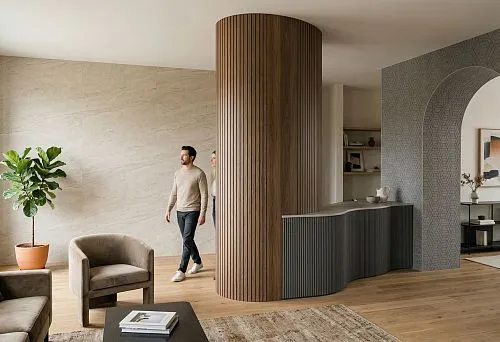
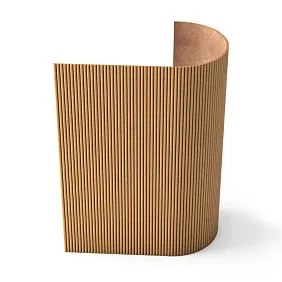
Fabric backing allows the panel to be bent along a radius. For columns, arches, curved partitions, niches with rounded corners — indispensable.
When mounting on a column: the panel is wrapped around the base, fixed with adhesive over the entire surface. The slats follow the curvature — uniform rhythm without breaks.
Acoustic panel with filling
Rigid panel + acoustic filling in the frame (mineral wool 50–100 mm, acoustic felt). For meeting rooms, restaurants, home theaters, children's rooms. Reduction of reverberation — from 15 to 35% depending on the coverage area and room volume.
Decorative slatted panels in different interior styles
This is the section that is usually read first — and rightly so. Style is the context in which a material is revealed or lost.
Scandinavian style: nature in every detail
Light oak with oil finish. Semi-circular profile. Spacing 35–40 mm. Vertical slats. Warm light 2700 K. Nearby — white walls, linen textiles, light flooring, live plants.
decorative slatted wall panelsIn Scandinavian style, it is first and foremost a natural narrative. Wood on the wall converses with wood on the floor, with natural materials in textiles, with natural forms in plants. All together creates a feeling that outside is a northern forest, and inside is its warm continuation.
wooden moldingMade of oak with the same tint along the upper edge.Solid oak skirting boardFrom below. A unified natural system — Scandinavian monolithic quality in material.
Japandi: minimalism with meaning
Oak with gray tint or MDF in RAL 9001 cream. Horizontal slats. Wide spacing 45–55 mm. Rectangular profile. Nothing extra — no decorative molding, no overlays. Only a clean surface, quiet rhythm, emptiness as an intentional choice.
In Japandi, decorative slatted panels are not decor in the usual sense. This is a meditative structure: a surface that is present but does not shout. The Japanese philosophy of 'ma' — empty space as an active element — is literally embodied in the gaps between the slats.
Minimalism: relief as the only decoration
MDF for painting in monochrome. Everything — walls, panels, molding, baseboard — in one RAL. Rectangular profile. Relief exists only through shadow. No additional decorative elements.
For minimalism, this is absolutely the right solution: the decorative panel here works not as an ornament, but as an architectural tool for managing the surface. Minimalism is not emptiness, it is discipline. And a slatted panel in monochrome is a manifestation of this discipline.
Modern classic: history in a new reading
Dark oak with classic brown tinting.Decorative Insertsframed by a slatted field — vertical posts and horizontal crossbars create a classic frame system.wooden corniceon the ceiling. This is modern boiserie — a classic panel system of the 18th century in the living material of the 21st.
In modern classic, decorative slatted panels carry historical meaning: the wall as an architectural object, not a background. Each element — slat, frame, cornice — is part of a thoughtful system where there are no random details.
Loft: warmth against industrial cold
MDF in RAL 7016 anthracite or oak with dark tinting. Rectangular profile. Wide slat. Nearby — concrete, metal, brick.
In the loft, a decorative slatted wall serves as a warm, natural 'island' within the industrial space. The contrast of materials enhances expressiveness: where everything is cold and rigid, a surface with warmth and rhythm emerges. The gaze is inevitably drawn to it.
Organic Modern: nature as a concept
Oak with a natural finish. Semi-circular profile. Massive natural surfaces—stone, terracotta, natural textiles. Living plants.
In organic modern style, decorative wooden slatted panels are the key material statement. Not just one of many natural elements, but the primary natural 'voice' of the space, setting the tone for the entire concept.
Decorative slatted wall panels: room by room
Living room: an accent wall as an architectural center
The living room is the central space of the house. Here, every decision works to create an atmosphere experienced daily by guests and residents.
Accent wall behind the sofa — 10–16 sq.m, 7–11 modules. Material — oak or MDF for painting — depends on the style. Profile — according to the character of the space. Lighting — directional spotlights 35–40° + LED strip behinda wooden molding along the upper edge.
Additional technique: a slatted partition between the living room and kitchen, dining room, or hallway. The open design lets light through, maintains a visual connection between zones, but clearly marks the boundary. This is functional decorativeness—beauty that simultaneously solves a layout problem.
Bedroom: headboard as a natural shelter
Bed headboard — the most intimate application of decorative slatted panels. 3–4 modules. Oak with a semi-circular profile in a honey finish or MDF in a soft accent RAL color. Spacing 35–45 mm.
LED strip along the lower perimeter of the panel. With warm light at 2700 K — an upward glow along the wooden surface. Natural material + warm light + rhythm of slats = a feeling of a natural shelter that psychologically prepares for rest.
Important detail: molding along the top edge of the panel and baseboard at the bottom complete the system. Without them, the wall behind the headboard looks unfinished — like a painting without a frame.
Entryway: first impressions don't come twice
The entryway forms the first impression of a home — and of its owners.decorative slatted wall panelsin the entryway — it's an architectural statement from the first step.
For a narrow hallway: horizontal slats, 30–35 mm spacing, warm neutral RAL or light oak. Visually 'expand' the space. For an entryway with high ceilings: vertical slats, 'lift' the space even higher, create a formal feel.
Practical point: moisture-resistant coating is essential. MDF with 2K lacquer or oak with waterproof lacquer. The entryway is a zone of high everyday aggression: wet shoes, damp jackets, accidental stains.
Children's room: natural material as a developmental environment
A child raised in a space with natural materials develops a different — more subtle and rich — perception of the world. This isn't philosophy, it's physiology: tactile contact with living materials develops the nervous system differently than contact with plastic.
Oak or MDF in a soft natural RAL. Semi-circular profile — no sharp edges. Vertical slats to 'raise' the ceiling. Neutral warm tone: white 9001, mint, pastel.
A children's room with slatted walls grows with the child: what at three years old is a cozy natural backdrop for play, at thirteen becomes a stylish minimalist interior, and at twenty — a modern youth space. No need to remodel every five years.
Kitchen: zoning and accent
In the kitchen, slatted decorative panels are used for zoning and creating accents. The wall in the dining table area, the backsplash in the island area—but only with the right coating: moisture-resistant 2K lacquer for MDF, water-resistant lacquer for oak.
The perfect scenario: kitchen fronts in an exact RAL + a slatted wall in the dining area in the same RAL = a unified color monolith of the kitchen space.Furniture HandlesMade from an agreed-upon material—the final tactile point of the system.
Restaurant and café: the atmosphere that sells.
A slatted wall in a restaurant is one of the most effective tools for creating atmosphere. Warm oak, trapezoidal profile, directed lighting at 2700 K, acoustic filling in the frame.
Result: a warm, natural space with reduced reverberation, where guests can hear each other, relax, stay longer, and return again. This is no longer just aesthetics—it's economics.
Office and meeting room: the architecture of the corporate image.
MDF in corporate RAL. Rectangular profile. Reception area—one accent slatted wall. Meeting room—acoustic slatted panels around the perimeter.
With skillful design of corporate space, a slatted wall in the exact RAL of the brand is the most convincing way to declare the professionalism and character of the company without words.
System of coordinated finishing: from slatted panel to the final touch.
Decorative slatted panel is the foundation of the system. Its potential is fully revealed only when all adjacent elements are coordinated within a unified production program.
Moldings: the upper architectural boundary
wooden moldingAlong the upper boundary of the slatted field — a horizontal line, 'sealing' the system. In the same oak finish or the same RAL — monolithic completeness.
Technical technique: molding with a 20–30 mm gap from the ceiling + LED strip inside it. Downward warm light across the slatted surface — one of the most effective lighting techniques for living spaces.
For classic interiors —wooden corniceWith a profiled front surface. The architectural 'roof' of the slatted field with historical dignity — a horizontal line that carries weight.
Baseboards: the natural foundation of the system
Solid oak skirting boardnext to oak slatted panels — the lower natural boundary. One wood species, one tint, one production.— is a horizontal element that frames the room at the bottom of the walls where the wall meets the floor. Skirting boards perform several functions: they hide the technological gap between the wall and floor covering (necessary for thermal expansion), protect the lower part of the wall from mechanical damage, create visual completion, and may conceal wiring.In the same RAL for MDF systems. Monolithic from floor to ceiling — this is the difference between 'done' and 'designed'.
Decorative overlays: classic frame system
Decorative InsertsCreate architectural frames around the slatted field. Vertical posts + horizontal crossbars = classic boiserie in a modern interpretation. In the same oak finish or RAL — a monolithic system. In contrasting material — an architectural dialogue.
Extension slats for non-standard junctions
wooden plankMade from solid oak or MDF for corner transitions, reveals, niches — an organic addition that maintains the continuity of the wooden theme in any non-standard junction.
Staircase: wooden theme from bottom to top
In a country house, decorative slatted walls in the stairwell +balusters for staircasesMade from the same solid oak = an architectural wooden theme that accompanies a person through all floors. This is not a coincidence of elements — it is an architectural concept.
Lighting: light as a constructive element of the decorative system
Ask yourself an honest question: does your project have directional or side lighting for the decorative slatted wall? If not — the panel won't reveal even a tenth of its potential.
Directional spotlights 30–45°: basic tool. Shadow in the gaps — depth. Warm light 2700 K for living spaces.
LED strip behind molding: downward light across the slatted surface. A 'cinematic' technique — the entire panel plane softly glows from above.
LED in the gaps: strip on a backing, light from the gaps. Most effective with dark panels or two-tone systems.
A parameter that is often forgotten: angle. At 30° — sharp, contrasting shadow. At 60° — soft, diffused. The same profile at different angles — fundamentally different surface character.
Dimmer: essential for living spaces. A decorative slatted wall with dimmable light — a surface with a mood that changes throughout the day and evening.
Installation of decorative slatted panels: a technically competent approach
Adhesive mounting
Requirements: wall must be even, deviation no more than 5 mm per 2 m. Surface clean, dry, primed. Adhesive: MS-polymer or acrylic-urethane without solvents. Application: zigzag along perimeter + dots in center. Finish nails Ø1.2 × 30 mm along perimeter.
First module — strictly according to laser level. Each subsequent module — tightly against previous one with alignment of slat pattern.
Frame installation
Metal profile CD 60×27 mm. Load-bearing profile spacing 400–600 mm. Horizontal alignment — laser level. All cables and utilities must be laid before installation of first module.
Double fixation: adhesive on substrate + finish nails into profile. Reliable for any area and any type of load.
Acclimatization
48 hours horizontally in installation room. Mandatory for both MDF and solid wood. Without acclimatization — risk of slat deformation after installation during humidity stabilization.
Module Joining
Slat pattern must be continuous across module joints. Factory step accuracy ≤ 0.5 mm — essential requirement. With unstable step, joints are visible — and this is an irreparable defect.
About the company STAVROS
Decorative slatted wall panels are not just purchasing square meters of material. This is an architectural solution that defines the character of space for decades. And the manufacturer matters here — fundamentally, not symbolically.
STAVROS — Russian manufacturer of MDF and solid wood products for interior finishing and furniture production. Decorative slatted wall panels — made from MDF with density 750–850 kg/m³ and climate-dried solid oak (8–10% humidity). All three profiles: rectangular, semicircular, trapezoidal. Rigid and flexible constructions. Factory painting in any RAL or NCS. Step accuracy control ≤ 0.5 mm in each batch. Two-level quality control system. Manual processing of decorative elements.
Fully coordinated system:Moldings and cornices, MDF skirting boardsandBaseboards made of solid oak, additional slats, Decorative Inserts, balusters for staircases, Furniture HandlesOver 4000 models. 20,000 modifications. 39 product groups. Shipping from one piece. Delivery throughout Russia.
FAQ: Decorative Slatted Wall Panels
How do decorative slatted panels differ from regular wall panels?
Decorative slatted panels create a physical relief on the wall—the protruding slats interact with light, forming shadow and depth. This is a fundamentally different visual quality compared to flat wall panels, which only provide color or a textured pattern without real volume.
Wood or MDF—what to choose for a decorative slatted wall?
It depends on the task. Oak offers natural expressiveness, a unique grain pattern, and tactility. MDF provides precise RAL color, perfect geometry, and the possibility of repainting without dismantling. For natural styles (Scandinavian, Japandi, organic)—choose oak. For minimalism, corporate settings, or precise design projects—choose MDF.
Can decorative slatted panels be installed on curved surfaces?
Yes—when using a flexible panel on a fabric base. The minimum bending radius—check with the manufacturer for the specific profile and spacing. Rigid panels on an MDF backing are only for linear surfaces.
How to calculate the number of decorative slatted panel modules?
Surface area (minus openings) ÷ 1.44 sq.m (standard module) = number of modules. Round up. Add 15% reserve for trimming. Always order with a reserve—reordering from another batch carries a risk of color mismatch.
Is special wall preparation needed before installation?
For adhesive installation: clean, dry wall, deviation no more than 5 mm over 2 m, primed surface. For frame installation — minimal requirements for the substrate: the frame levels out any unevenness.
How to care for decorative slatted oak panels?
Oiled oak: oil renewal every 3–5 years — wiping with special care oil without dismantling. Lacquered oak: practically maintenance-free. Daily care: dry or slightly damp cloth. No abrasives or alcohol-containing compounds.
Do slatted panels reduce sound levels in a room?
The slatted relief itself scatters sound waves, reducing direct reflections. With acoustic filling of the frame (mineral wool 50–100 mm) — measurable reduction of reverberation by 15–35%. For meeting rooms, restaurants, and home theaters, acoustic slatted panels are a justified functional solution.