Article Contents:
- What are decorative slat wall panels and how do they differ from regular slats
- Rigid panel on MDF base
- Flexible Panel on Fabric Base
- MDF panel for painting
- Material for the task: MDF, oak or beech - what to choose for your interior
- MDF: precise geometry and monochrome interior
- Solid oak: living surface with biography
- Solid beech: Scandinavian neutrality
- When modular panels are better than individual slats
- Decorative slat panels in the living room: three scenarios, three solutions
- TV zone: a background that makes the interior
- Accent wall: one expressive gesture
- Niche in the living room: depth that wasn't there
- Decorative slat panels in the bedroom: atmosphere matters more than function
- Headboard zone: architectural framing of the bed
- Decorative wall in the bedroom: not an accent, but an environment
- Bedroom with lighting: a detail that changes everything
- Decorative slat panels on the wall in the hallway: a first impression that doesn't come twice
- Why the hallway especially benefits from slat cladding
- How to choose material for the hallway
- Hallway Geometry: What to Do with Corners and Niches
- Decorative Slat Panels in the Hallway and Study: Two Special Cases
- Long Hallway: The Psychology of Space
- Study and Home Office: Concentration and Status
- Interior Styles and Slat Panels: Perfect Matches
- Minimalism: Architecture Instead of Decoration
- Scandinavian Style: Wood as an Environment
- Neoclassicism: Slats Instead of Moldings
- Loft and Industrial Style: Dark Wood and Rough Texture
- Installing Decorative Slat Panels: What to Know Before Starting
- Wall preparation
- Installation on contact adhesive
- Medium-thickness pieces are attached using a combined method - with adhesive and additional mechanical fixation.
- Final painting for PAN-002
- Recessed panel lighting: how to enhance architecture without overloading
- How not to make a mistake with the choice: a checklist before buying
- FAQ: answers to the most frequently asked questions
- Conclusion
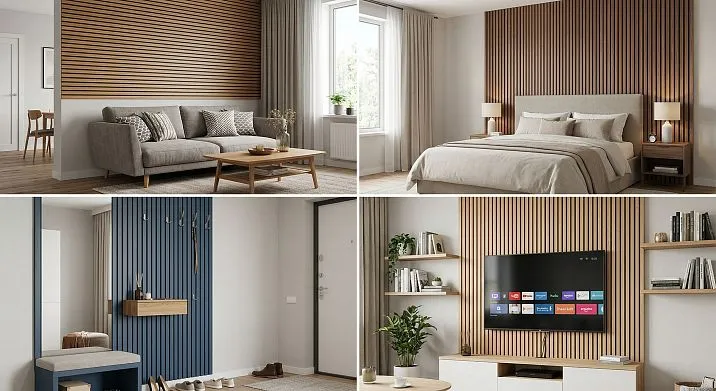
There are things that at first glance seem simple, but upon closer inspection turn out to be truly complex. This is exactly the story withdecorative slatted panelsfor walls. At first glance - a set of wooden or MDF battens fixed on a base. In reality - a full-fledged architectural tool capable of radically changing the character of a space: lengthening a room, raising the ceiling, creating a sense of coziness or solemn severity, highlighting a functional area without a single partition.
But this is precisely where the problem with most renovations begins. A person sees a beautiful picture, buys the first battens they come across, hangs them on the wall - and gets a result far from what was intended. Because choosing decorative slat panels is not like choosing curtain colors. It is a decision that affects the perception of the entire room and is made once, preferably correctly.
This article is precisely about how to make this decision correctly. For every room, for every zone, for every style.


What are decorative slat panels for walls and how do they differ from ordinary slats
Before moving on to application scenarios, it's worth understanding the terminology. Because fundamentally different things are sold on the market under similar names, and confusion here is costly.
An individual slat is a single profile made of wood or MDF that is mounted independently, with custom calculations for spacing, angle, and fastening. This format offers maximum freedom for creating custom designs but requires significantly more time for installation and precise preliminary planning.
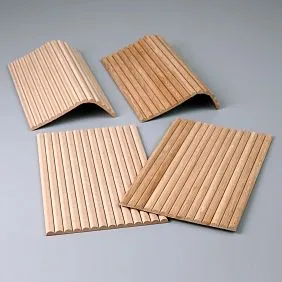
A decorative slat panel is a ready-made module where the slats are already fixed to a backing with a specific spacing. The backing can be rigid (MDF board) or flexible (fabric base). It is installed as a single unit, ensuring a quick and predictable result. This type of product has become dominant in residential and commercial interiors in recent years.
The key advantage of a ready-made module over a set of individual slats is the consistency of spacing and geometry. When slats are laid manually, even an experienced craftsman can accumulate errors: by the middle of the wall, the spacing can shift by 2–3 mm, which is enough to make the pattern 'drift.' In a ready-made panel, the spacing is set by the manufacturer and does not change—no matter what happens during installation.
slatted panels for wallsare now produced in several fundamentally different configurations, and knowing these configurations is the first step to making the right choice.




Rigid panel on MDF base
The slats are fixed to an MDF board. The structure is absolutely rigid, does not bend, and provides a perfect flat surface. Used for straight walls, furniture fronts, and straight sections of ceilings. Mounted with adhesive or mechanical fasteners to a pre-prepared base.
Our factory also produces:



Flexible panel on fabric base
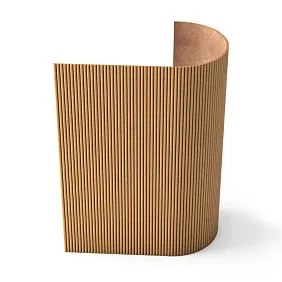
The slats are secured to an elastic fabric backing with precise spacing. The ready-made module is rolled up and unrolled on-site, wrapping around curved surfaces without distorting the pattern. This is the only solution for columns, arches, radius walls, and rounded corners.Slat panel on fabric baseis mounted with contact adhesive and additional fastening using micro-pins.
Get Consultation
MDF panel for painting
A distinct type deserving special attention. Deep-milled MDF battens are laid on a flexible fabric base, with the surface coated with two layers of primer-isolator. The product is ready for painting with any finish color without additional preparation. This is a solution for those building an interior with a precise color palette who don't want to search for a match between the finished panel color and the wall shade.Batten panels for painting— this is color control without compromise.
Material for the task: MDF, oak, or beech — what to choose for your interior
The question of material in slatted panels is not a question of 'more expensive or cheaper.' It's a question of scenario. Each material addresses its own set of tasks, and attempting to replace one with another yields predictably weak results.
MDF: precise geometry and monochrome interior
MDF is high-density pressed wood fiber. The material has no pronounced texture, is easy to mill, is geometrically stable, and does not deform under normal operating conditions. This is precisely why MDF is the choice of those building an interior with clean lines, precise color, and minimalist spatial graphics.
MDF slatted panels for painting provide what solid wood cannot: an absolutely uniform surface without texture transitions. As a result, the wall reads as a pure architectural relief — only the rhythm of the ribs and the shadow between them. No 'random' effects of natural wood, only what was designed.
Primed slatted panelPAN-002 is available in two height formats: 950 mm and 2700 mm. Width — 1010 mm. Battens — deep-milled MDF, base — flexible fabric. Primer is applied in two layers on a polyurethane base, which completely eliminates the need for self-priming and ensures uniform absorption of the finish paint.
This material is the first choice for minimalism, neoclassicism, modern classic, and all styles where precise color coordination of the wall with other interior elements is important.
Solid oak: a living surface with a biography
Oak is not just a type of wood. It is a visual language that is immediately read as 'genuine,' 'expensive,' 'long-lasting.' The pronounced grain pattern, the tactile warmth of the surface, the depth of tone that changes with the angle of light—all this creates an effect unattainable by any other material.
Solid oak in slatted panels is appropriate where the interior is built on natural materials and appeals to the natural environment. Scandinavian style, Japanese minimalism, eco-interior, the 'warm' version of modern classicism—solid oak will work better than MDF everywhere.
It's important to remember: natural wood reacts to humidity. In rooms with an unstable microclimate—entryways, hallways with access to the outdoors, kitchens near the sink—solid wood behaves less predictably than MDF. This is not a contraindication, but a factor to consider when choosing.
Solid beech: Scandinavian neutrality
Beech is lighter than oak, more uniform in texture, without sharp transitions in the grain. It is precisely this 'quietness' that makes it an ideal material for Scandinavian interiors, children's rooms, bedrooms with a soft, neutral atmosphere.Slat panel on fabric basePAN-001 is also produced from solid beech—for those who need naturalness without dark and saturated tones.
When a modular panel is better than individual slats
This is a question often asked: why pay for a ready-made module if you can buy slats and lay them yourself?
The answer is simple. A ready-madeslatted modular wall panelProvides:
-
Consistent spacing—no cumulative error.
-
Uniformity of the set—all slats are of the same tone and cross-section.
-
Fast installation—a 1010 mm wide module installs in 3–5 minutes instead of hours spent marking and laying individual profiles.
-
Flexibility where needed—the fabric base allows working with non-standard surfaces.
-
Ready for finishing—primed MDF requires no additional preparation.
Individual slats are advantageous in only one scenario: when a fully custom construction with non-standard spacing, diagonal laying, or three-dimensional relief is needed. In most residential interiors, this case is rare.
Decorative slat panels in the living room: three scenarios, three solutions
The living room is the flagship of the entire apartment. It is here that guests are received, evenings are spent, and relaxation happens after a workday. Decorative slat wall panels in the living room must work in several registers simultaneously: be beautiful, create an atmosphere, and yet not interfere with the functional use of the space.
TV zone: a backdrop that makes the interior
The TV zone is where most renovations make the same mistake: a TV on a bare wall without context. A black screen on a white wall is a visual disaster, even when the TV is off.
Decorative slat panels on the wall behind the TV solve this problem radically. The slat texture creates a background where the screen stops being a 'hole' and becomes part of the overall architectural composition. Vertical orientation of the slats is important: it works with the height of the wall, creating a sense of monumentality in the zone.
Several principles that consistently work in the TV zone:
-
Width of the cladding — not less than the width of the TV stand, ideally from wall to wall or up to a clearly defined architectural joint.
-
Height — from floor to ceiling. Partial cladding as an 'island' behind the screen looks unfinished.
-
Color — contrasting with the other walls in the room or darker. Light slats on a light wall get lost.
-
Material — paintable MDF in a dark tone or solid oak with rich staining. Both options provide the necessary visual weight.
For a flat wall in the TV zone, it is optimal to usebuy an MDF slat panelin the 2700 mm format — this is a full rise from floor to ceiling of standard height without joints. If the wall has a curve, column, or other non-standard element — the flexible PAN-001 panel wraps around it without losing rhythm.
Accent wall: one expressive gesture
An accent wall in the living room is not just a decorative technique. It's a way to zone space without physical partitions, to create a focal point around which the rest of the interior is built.Decorative slat wall panelshandle this task better than accent painting or patterned wallpaper: they provide not just color, but volume and rhythm.
In living rooms with a sofa against the wall, accent slat cladding allows you to forgo the traditional 'sofa headboard'—decorative paintings, shelf consoles, mirrors. The slats themselves create a complete decorative plane into which you can integrate sconces or lighting without a sense of clutter.
An interesting technique found in modern living rooms: horizontal slats on the accent wall behind the sofa. They establish a 'horizon'—the line relative to which the entire space is perceived. The sofa seems to grow into the wall, the seating area becomes complete and self-sufficient.
For Scandinavian style, an accent wall works better in light tones: whitewashed oak, natural beech, MDF panel in a creamy white shade. For minimalism and loft—dark tones, saturated graphite or dark brown.
Niche in the living room: depth that wasn't there
A niche is one of the most advantageous architectural elements in modern apartments. But without proper finishing, it remains just a recess in the wall.Decorative Slat Panels for Wallsin a niche—a technique that transforms a technical planning element into a full-fledged design accent.
The back wall of the niche, lined with slatted panels with lighting between the battens, creates an effect of glowing depth: the light source is nowhere visible; it simply 'seeps' from behind the slats, producing a soft, diffused glow. This works as a standalone installation and simultaneously as functional lighting for the shelf space.
For niches, Slatted panels for walls and ceiling — including in configurations where the slatted cladding transitions from the back wall of the niche to its ceiling, creating a three-dimensional slatted 'frame'.
Decorative slatted panels in the bedroom: atmosphere matters more than function
The bedroom is the most personal space in the home. Here, there's no need to impress guests; here, one needs to recover. This shifts priorities: in the living room, visual impact is important; in the bedroom, it's tactility, warmth, a sense of being cocooned.
That's precisely why decorative slatted panels in the bedroom function differently than in the living room. Here, there's less contrast, more nuance.
Headboard zone: architectural framing for the bed
The wall behind the headboard is the focal point of the bedroom. It's what a person sees upon waking. It determines the first impression of the space. A blank white wall above the bed is a missed opportunity. Slatted cladding transforms it into an architectural gesture.
How to properly work with the headboard zone using slatted panels:
In width — the panel should be wider than the bed. If the bed width is 160 cm, the minimum panel width is 200 cm, the optimal width is the full wall width from one architectural element to another. A narrow panel strictly above the bed looks accidental.
Regarding height — two scenarios. First: from floor to ceiling — maximum architectural effect, the bedroom acquires a monumental character. Second: from the headboard to the ceiling — a more intimate, cozy option. In bedrooms with ceilings above 2.8 m, the first option works better.
Regarding material — for the headboard area, solid oak or beech wins over MDF due to tactile warmth. But if the bedroom palette is strictly monochrome,Primed slatted panelPAN-002 at 950 mm will give a perfectly accurate color without compromises.
Regarding orientation — both directions work for the headboard area. Vertical slats create solemnity, horizontal ones — a calm 'horizon of peace'. The horizontal option in a bedroom often looks more interesting precisely because of its atypical nature.
Decorative wall in the bedroom: not an accent, but an environment
Unlike the living room, where an accent wall works as an independent object, in the bedroom, slat cladding can and should be part of a broader environment. A Scandinavian-style bedroom with three out of four walls in light slats — this is no longer an accent, it's an environment. A completely different level of immersion.
With this approach, it's important to avoid monotony. It's easily avoided in two ways: different orientation of slats on different walls (vertical behind, horizontal on the side) or different materials (solid oak behind the bed, MDF in white paint on the side walls).
Bedroom with lighting: a detail that changes everything
slatted wall panelswith LED lighting in the bedroom — a solution that has long ceased to be niche. LED strips in the grooves between the slats create soft diffused light that works as a nightlight, a decorative accent, and functional reading lighting all at once. Especially effective — behind the headboard, when light 'flows' from behind the slats from bottom to top, creating a floating structure effect.
Decorative slat panels on the wall in the hallway: a first impression that doesn't get a second chance
The hallway is the calling card of an apartment. The first few seconds a guest spends at the entrance shape their impression of the entire home. Yet, the hallway traditionally remains the 'poor relative' of the renovation: the money is gone, there's no time left, and so—we'll just paint it.
This is a mistake that's easy to fix. Decorative slat wall panels for the hallway are one of the most cost-effective investments in renovation in terms of cost versus visual impact.
Why the hallway particularly benefits from slat cladding
The hallway is almost always small, often windowless, with complex geometry (doors, niches, turns). It is here that decorative slat panels reveal their full functionality:
-
Vertical slats visually raise the ceiling—this is especially critical in low hallways.
-
Slat cladding hides base imperfections—walls in hallways are traditionally far from ideal.
-
Dark slats in high-contact areas (near the coat rack, by the entrance door) are practical: they don't show marks from clothing and bags brushing against them.
-
The slat texture itself creates a sense of depth in a narrow space: the gaze 'travels' into the pattern, making the corridor seem wider.
How to choose material for the hallway
Paintable MDF is the first choice for a hallway. I'll explain why. There are always temperature and humidity fluctuations in the hallway: in winter, cold, wet clothing and shoes, and damp umbrellas are brought in from outside. Solid wood behaves worse than MDF under such conditions: even with normal heating, the temperature difference between the door and the living area creates slight but constant stress in the wood's structure.
MDF is free from this problem.buy an MDF slat panelPainted with moisture-resistant enamel — and you get a cladding that will last as long as the renovation itself.
Geometry of the hallway: what to do with turns and niches
Most hallways have non-standard geometry: turns, shoe niches, doorless openings. A rigid panel in these conditions requires careful cutting and joining.Flexible slat panelFabric-based panels here offer an obvious advantage: they wrap around interior corners without complex joints, install continuously through rounded transitions, and resonate with any geometry.
Slat panel on a radius wall— a solution that is especially relevant in homes with complex architecture: bay windows, rounded corners in the wardrobe area, arched openings in the hallway.
Decorative slat panels in the corridor and study: two special cases
Long corridor: psychology of space
A long corridor is a psychological challenge. A person feels as if in a tunnel: the walls press in, the perspective stretches to infinity. Decorative slat panels on the wall in the corridor can either enhance this effect or completely neutralize it — depending on the correctness of the solution.
What works:
-
Vertical slats on the end wall at the end of the corridor create a visual 'focal point' — the gaze fixes on the texture, and the feeling of an endless tunnel disappears.
-
Vertical slats on one long wall (not both) create a rhythm that makes moving through the corridor more interesting.
-
Dark slats on one wall + a light opposite wall create an illusion of width.
What doesn't work:
-
Horizontal slats on the long walls of a corridor — they emphasize the length and enhance the tunnel-like feeling.
-
Slats on both long walls simultaneously — create clutter in a narrow space.
Study and home office: concentration and status
The study is a separate story. Here, decorative slatted panels serve a dual function. On one hand — acoustic: the slatted structure scatters sound, reduces reverberation, and makes the space more comfortable for long, concentrated work. On the other hand — status-related: a study with slatted cladding is perceived as a serious, professional space.
For a study, dark tones of solid oak or MDF in a rich gray-brown or dark gray work well. Vertical slats behind the desk — a classic technique that works both in a home study and a commercial office.slatted wall panels photosprovide a clear idea of how this technique works in real interiors.
Interior styles and slatted panels: precise matches
Slatted paneling is not a stylistic solution in itself. It is a tool that works differently in different styles. Knowing exactly how allows for a much more precise choice.
Minimalism: architecture instead of decor
In a minimalist interior, there is no place for decor for decor's sake. Every element must serve a function or define structure. Decorative slatted panels in minimalism are precisely structure: a vertical rhythm that organizes the wall plane, turning it into an architectural element, not just a surface.
Color in a minimalist interior is monochromatic.Batten panels for paintingHere, they are unrivaled: they allow for any shade—from pure white to deep anthracite—without the textural 'accidents' of natural wood. The slat spacing is medium, the orientation is strictly vertical.
Scandinavian style: wood as environment
Scandinavia in interior design is not just white walls and wooden accents. It is about creating an environment where natural materials are perceived not as decor, but as a natural part of the space. Decorative slatted panels in a Scandinavian interior should be natural: light oak, beech, ash in natural tones or with a light whitewashed tint.
Slat panel on fabric basePAN-001 made of solid beech is a perfect match for the Scandinavian look: a lively texture without an aggressively pronounced grain, a warm neutral tone, a natural surface that is pleasant to touch.
Neoclassicism: slats instead of moldings
In a neoclassical interior, slatted panels occupy the niche that was once held by moldings and pilasters. They create the same vertical rhythm, the same wall structure, but without the historical references that make an interior too thematic. This is modern classicism: pure geometry with an elegant rhythm.
For neoclassical style, warm-toned slats are optimal — natural oak with clear varnish or MDF in milky white or cream. Fine or medium spacing, strictly vertical orientation.
Loft and industrial style: dark wood and rough texture
In loft style, slatted panels are about character, not coziness. Dark oak with rich tinting or MDF in almost black enamel against a concrete or brick wall — this contrast creates precisely the tension that makes a loft a loft.
Large slat spacing, somewhat rough texture, minimal finishing and coating. Panels with visible fabric backing at the edges — here this is not a defect but a detail that emphasizes the 'uncontrived' nature of the interior.
Installation of decorative slatted panels: what you need to know before starting
Installation is a topic often overlooked in materials about slatted panels. Meanwhile, most mistakes are made at this stage.
Wall preparation
This is a critical stage for rigid panels: an MDF module of any size will replicate the irregularities of the base. If the wall varies by 5 mm, the panel will also 'vary,' and the joint between modules will become visible. The wall must be leveled before installation — with putty or drywall cladding.
For flexible panels, the requirements are softer: the fabric backing allows for slight compensation of irregularities. But here too, the base must be cleaned of dust, peeling paint, and grease stains.
Installation with contact adhesive
Standard scheme for PAN-001 and PAN-002: contact adhesive is applied to the back of the panel and the wall, allowed to set according to the adhesive instructions, then the panel is pressed firmly across the entire surface. Additional fixation — with micro-pins around the perimeter using a pneumatic gun.
Important point: when installing a flexible panel on a curved surface—a column or arch—adhesive is applied evenly across the entire back side without gaps. Any unglued area on a bend may "come loose" over time.
Trimming and jointing
A panel 1010 mm wide is cut with a hacksaw or jigsaw for MDF. Flexible panels on a fabric base are cut with a utility knife—this takes seconds. When joining several modules, it is important to align the slat spacing: the slats should continue uninterrupted across the joint, creating the impression of a single surface. This is why it is recommended to order the entire volume of panels from a single production batch.
Final painting for PAN-002
After installation, the PAN-002 surface is ready for final painting. Water-based acrylic or latex paints are recommended, applied in two coats with intermediate sanding using fine sandpaper (grit 240–320). The seam between panels, if necessary, is filled with finishing putty and sanded flush—after painting, it becomes invisible.
Slat panel lighting: how to enhance architecture without overloading
The topic of lighting deserves separate discussion. Slat panels and LED lighting are a duo that works flawlessly under one condition: the lighting must be concealed.
Visible LED strip on the surface of a slat panel is crude. A strip hidden in a groove between battens or behind the lower edge of the structure is a completely different story. The light doesn't "shine" anywhere in the literal sense; it simply exists as a soft, diffused glow between the slats.
Three effective techniques:
Bottom-up lighting—the strip is attached behind the lower edge of the panel or in the lower part of the mounting gap. Light travels upward along the slats, creating a "floating" wall effect. Especially impressive behind a bed headboard.
Back-of-slat lighting—the mounting insert simultaneously serves as a channel for the LED strip, which illuminates the back surface of the slats. A gap of at least 20 mm between the wall and the rear plane of the panel is required.
Contour lighting — the strip runs along the perimeter of the panel (top and bottom), creating a light frame. Works in combination with dark slats on a light wall.
How to avoid mistakes when choosing: a checklist before purchase
Before placing an order, it's worth going through a few questions:
-
What is the geometry of the wall? Straight — rigid panel or flexible, no difference. Curvilinear — only flexible.
-
What interior style? Monochrome, minimalism, neoclassicism — MDF for painting. Scandinavian, eco-style, modern classic with natural materials — solid oak or beech.
-
What color is needed? If there is an exact shade from a palette — only MDF for painting. If a natural wood tone is acceptable — solid wood.
-
What is the ceiling height? Up to 2.7 m — PAN-002 format in 950 mm for an accent panel or 2700 mm for full cladding. Above 2.7 m — vertical joining will be required.
-
How much material is needed? Panel width — 1010 mm. Divide the total cladding area by 1.01 and add 15% for trimming.
-
Will the order be from a single batch? Be sure to clarify when placing the order — slats from different batches may vary in tone.
Buy decorative slat panels for wallswith delivery throughout Russia is available on the manufacturer's website. If necessary, before placing the main order, it is worth requesting a sample of the OPAN-001 model — it allows you to evaluate the real color and texture of the material in person.
FAQ: answers to the most frequently asked questions
How do decorative slat panels differ from ordinary slats?
A decorative panel is a ready-made module with a fixed slat spacing on a substrate (rigid or flexible). Ordinary slats are separate profiles for self-installation. A ready-made panel ensures consistent spacing, batch uniformity, and significantly faster installation.
Which decorative slat panels are suitable for a small room?
For small rooms — vertical slats with wide spacing in light tones. The vertical rhythm visually raises the ceiling, and wide spacing does not overload the wall. Dark slats in a small space require caution: they visually reduce the space.
How to choose slat panels according to ceiling height?
For a 2.7 m ceiling — a panel format of 2700 mm provides seamless cladding without a joint. For a 3 m ceiling and above — two options: joining two panels with aligned spacing or using individual RK-002 slats of the required length.
How to choose the direction of the slats — vertical or horizontal?
Vertical — if you need to raise the ceiling and add solemnity. Horizontal — if you need to widen a narrow space or create a calm, meditative rhythm. In bedrooms and living rooms, horizontal slats often look more interesting precisely because of their atypical nature.
Can slat panels be painted after installation?
Yes, if the primed PAN-002 model was used. The surface is already prepared for painting. Acrylic or latex paints in two coats with intermediate sanding using 240-grit sandpaper are recommended.
How to join panels on a long wall?
Join the panels so that the slats continue across the joint without offsetting the pattern. To do this, lay out the panels on the floor before installation and check the rhythm alignment. The seam between modules becomes invisible after final painting or puttying with proper installation.
Are slatted panels suitable for commercial interiors?
Yes. Decorative slatted panels are widely used in offices, meeting rooms, showrooms, restaurants, and hotels. In commercial interiors, the acoustic effect of the slatted structure and its durability are particularly valued.
Where can I see live examples of slatted panel applications in interiors?
A visual guide to the application of slatted panels in real interiors — in the article slatted wall panels photos.
Is there a difference in installing PAN-001 and PAN-002 panels?
There is no fundamental difference: both models are installed using contact adhesive with additional fixation using micro-pins. PAN-002 is painted in the final color after installation. PAN-001 in oak or beech finish can be coated with tinting or clear varnish. PAN-001 in MDF finish is primed and painted similarly to PAN-002.
Can slatted panels be used for furniture and facades?
Yes.Slat panel for furniture— one of the direct applications of PAN-001. The flexible fabric base allows working with curved fronts of cabinets, chests, and built-in sliding wardrobes. Slat furniture decor is an excellent way to visually connect it with wall cladding in a single space.
Conclusion
Decorative slat panels for walls are that rare case when beauty and functionality do not contradict but enhance each other. They change the proportions of a room, set the atmosphere, create architecture where there was none, and at the same time are installed without unnecessary complexity and last as long as needed.
The main thing is to correctly understand the task. The living room requires one solution, the bedroom another, the hallway a third. MDF for painting, natural oak, or a flexible panel on a fabric base — each material is created for its own scenario, and knowing these scenarios makes it possible to choose precisely, not by trial and error.
STAVROS Company is a Russian manufacturer with a history that began in 2002 with a small workshop of carved wooden products. Over more than twenty years, STAVROS has evolved from restoring historical interiors to developing a modern line of slat panels for residential, commercial, and public spaces. The STAVROS catalog includes flexible PAN-001 panels on a fabric base in three material options (MDF, oak, beech), primed PAN-002 panels for final painting, as well as interior slats RK-002 for custom slat structures. All products are made to order, delivered throughout Russia via SDEK. STAVROS is about material precision, honest geometry, and interiors that last a long time.