Article Contents:
- What are decorative wooden panels
- What types of decorative wooden panels are there
- Slatted panels
- Smooth panels
- Relief and 3D panels
- Panels for partitions and zoning
- Panels for accent walls
- What materials are decorative panels made from
- Solid wood
- MDF with decorative finish
- Veneered panels
- Combined Solutions
- Where to use decorative wooden panels
- In the living room
- In the bedroom
- In the entryway
- In the study
- In the dining room
- In the TV area
- In niches and decorative partitions
- Decorative wooden panels for space zoning
- How to choose panels according to interior style
- Modern style
- Minimalism
- Scandinavian Style
- Jatoba
- Neoclassicism
- Warm modern interior
- How to choose color, texture and format
- What to choose: solid wood, MDF or veneer
- Advantages of decorative wooden panels
- Common mistakes when choosing decorative wooden panels
- How to care for decorative wooden panels
- Combining wooden panels with other materials
- Slat panels: a separate conversation about the market leader
- FAQ: Answers to Popular Questions About Decorative Wood Panels
- Conclusion
There are solutions that change an interior once and for all. Not cosmetically — truly. Decorative wood panels belong precisely to this category: a material that simultaneously speaks of taste, creates atmosphere, and works to enhance the visual volume of a space. They don't just cover a wall — they transform it, filling it with the warmth of natural texture, the depth of light and shadow, and that very 'substantial' beauty impossible to achieve with paint or wallpaper.
Why wood? Why now, in the era of concrete, glass, and digital minimalism, is the demand for wood panels for decorative finishing only growing? The answer lies in the physiology of perception. Humans are intuitively drawn to natural materials: they reduce anxiety, create a sense of grounding and reliability. Wood in an interior is not retro-nostalgia, but a conscious choice of a modern person who understands the difference between a space where one lives and a space where one merely exists.
This article provides a complete breakdown: what types of decorative wood panels exist, how they differ in formats and materials, how to choose a solution for a specific style and room, and what mistakes are most commonly made when purchasing.
What Are Decorative Wood Panels
It's important to immediately clarify the concepts, because the market is overloaded with confusion. A decorative wood panel is not a rough finish or a technical wall board. It is an element of final interior design, whose main task is to create an expressive visual and tactile effect on a wall surface.
Ordinary wall finishing solves utilitarian tasks: it hides unevenness, protects the substrate, serves as a background. A decorative panel is a completely different story. It is itself a design object. Its texture, relief, rhythm of lines, play of light and shadow — all this constitutes independent aesthetic value. This is precisely why decorative wood wall panels are installed in an already finished, final interior: they are not an underlay — they are the finale.
Wood in the role of a decorative material provides what no synthetic analogue can: a living grain pattern, tactile warmth, the scent of nature, and a sense of handcraft. Each solid wood panel is unique. Two identical products made from natural wood do not exist in principle.




What Types of Decorative Wood Panels Are There
The market offers a wide spectrum of formats, and choosing between them is not a matter of taste. It's a matter of the task you set for the finish.
Our factory also produces:


Rack panels
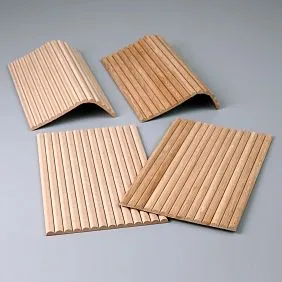
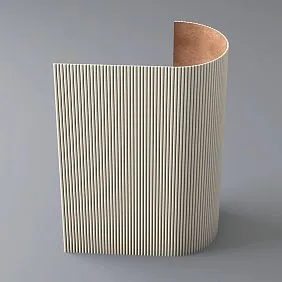
Slatted decorative panels are the most in-demand and versatile format of the last five years. The construction consists of parallel slats (battens) of identical cross-section, fixed at equal intervals on an MDF backing or fabric base.
The main advantage of slats is their active interaction with light. With side or directional lighting, vertical slats cast thin shadows, transforming a flat wall into a sculptural relief. This effect is absolutely impossible to reproduce with paint—only with a three-dimensional surface.
The vertical orientation of slatted panels visually elongates a room in height, which is critically important for apartments with ceilings of 2.5–2.7 m. Horizontal slats, on the contrary, visually expand the space—they are used in narrow hallways and corridors.
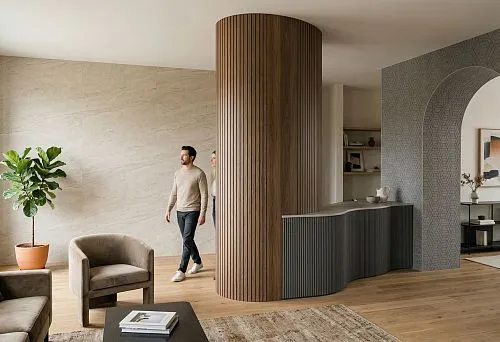
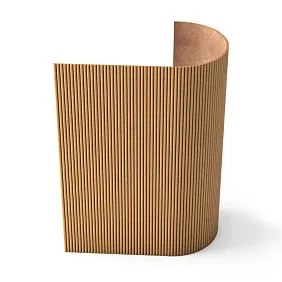
There are rigid slatted panels on an MDF backing—for flat walls, furniture fronts, and ceilings—and flexible panels on a fabric base, which wrap around columns, arches, and radius walls without deformation. Preciselyslatted panels made of MDF and solid oak—this is a professional design tool, not just a finishing material.
Get Consultation
Smooth Panels
Smooth wooden panels are a classic that never goes out of style. A flat surface without pronounced relief focuses attention on the texture of the wood itself: the grain pattern, play of shades, and natural uniqueness of each board.
Smooth panels are appropriate where restraint is needed: in a bedroom, study, or library. They create a warm, enveloping background without overloading the space with decorative accents. They look especially advantageous when combined with matte enamel on adjacent walls and natural textiles.
Relief and volumetric panels
Relief wooden panels are an artistic statement. Milled relief, geometric patterns, three-dimensional patterns, carved motifs—all of this works to create an accent. Such panels do not become a background: they themselves are the main element of the wall.
Relief panels are organic in neoclassical interiors, in contemporary decor with geometric accents, in Art Deco, and in mixed 'warm' styles. They require competent lighting: without directional light, the relief loses half of its expressiveness.
Panels for partitions and zoning
A separate segment consists of panels used not as wall finishing, but as a constructive decorative element. Slatted partitions, semi-transparent wooden screens, vertical slats serving as zoning structures—all of this belongs to the category of decorative solutions that divide space without solid walls.
Panels for accent walls
An accent wall is one of the key techniques in modern interior design. One surface of the room is highlighted by texture, color, or relief, creating a visual focal point. Wooden panels for an accent wall work especially expressively: they add depth, warmth, and a sense of luxury to the interior without overloading it.
What materials are decorative panels made from?
Solid wood
Solid wood is the top tier among all materials for decorative panels. Natural oak, beech, ash, and walnut wood have a unique grain pattern that cannot be reproduced artificially. Oak's density of 700–750 kg/m³ ensures exceptional mechanical strength and durability. Solid wood panels are an investment for decades.
The key condition for solid wood quality is proper wood drying. At moisture levels above 10–12%, panels will warp over time. Manufacturers who work with a controlled microclimate in production (temperature 20–24°C, humidity at least 40%) guarantee the stability of the product geometry during long-term use.
Solid wood under tinting and clear varnish reveals the natural wood grain to its fullest. Stains and tinting oils allow for a wide palette: from Scandinavian light gray to deep wenge, from warm cognac to cold graphite.
MDF with decorative finish
MDF (medium-density fiberboard, 750–850 kg/m³) is a rational and technologically advanced solution. A uniform structure without knots, resin pockets, or natural defects ensures a perfectly smooth surface for painting. Matte, satin, and semi-gloss enamels all adhere equally well to sanded MDF.
The main advantage of MDF is unlimited color possibilities. A panel can be painted to match the wall color—and it will 'dissolve' into the interior, leaving only a clean, relief rhythm. Or you can choose a contrasting accent color and make the slatted surface the main visual object in the room. PreciselyMDF Moldings—cornices, moldings, slats—serve as the perfect complement to wooden panels in a unified wall finishing system.
MDF for painting is the choice for those who use color as the main design tool. It is both practical and budget-friendly.
Veneered panels
Veneer is a thin slice of natural wood glued onto an MDF base. It is the golden mean between pure MDF and solid wood: the surface retains the lively pattern of natural wood, while the cost remains significantly lower than that of solid wood.
Veneered panels are especially popular for large-format cladding: when you need to decorate a large wall surface while maintaining visual unity of the pattern. The technology allows for 'book-matching' veneer — a mirror combination of sheets creating a symmetrical natural pattern.
Combined Solutions
Modern interior design often involves combining several materials in a single wall finishing system. Solid oak slatted panels + paintable MDF moldings + carved overlays — such a solution provides richness of layers with a reasonable budget and high decorative density.
Where to use decorative wooden panels
In the living room
The living room is the main space of the house, the place of first impression. Decorative wooden panels in the living room are most often used to create an accent wall: behind the sofa, behind the TV console, or around the fireplace. Vertical slatted cladding behind the sofa creates architectural depth and sets the axis of symmetry for the entire room.
For a living room in a contemporary style, choose slatted panels with neutral toning — gray, tobacco, natural oak. For neoclassical — relief panels with molding framing and geometric panels.
In the bedroom
The bedroom is a space of tranquility, where decor should work softly, without aggressive accents. Wooden decorative panels for the bedroom are installed primarily behind the bed headboard: this is a classic technique that creates a sense of coziness, visually 'frames' the bed, and gives the rest area a finished look.
For the bedroom, smooth panels or slats with a fine pitch in light tones are preferable. They are not oppressive, do not overload, and create a warm neutral background. Dark shades — wenge, graphite — work in the bedroom only with sufficient natural light.
In the hallway
The hallway is the first and last impression of the house. Decorative wooden panels for the hallway solve several tasks at once: they hide mechanical damage to the lower part of the walls (scratches, impacts), create a visual accent, and form a 'welcoming' image of the interior.
For the hallway, a combination of 'panel + molding' is especially appropriate: the lower part of the wall is finished with a panel up to a height of 90–120 cm, the upper part is a smooth painted surface. This solution looks great in classic, Scandinavian, and 'warm contemporary' interiors.
In the study
The study is a space of concentration and status. Here, wooden panels for the interior work to create an image of seriousness, solidity, and professionalism. Dark oak slats, massive milled panels in the style of an English library, strict geometric moldings on the walls — all this turns a study into a study, not just a room with a computer.
In the dining room
The dining room is a gathering place for family and guests. Decorative wood wall cladding here creates an atmosphere of warmth and a set table. Slatted panels along the long wall visually elongate the space and create a soft acoustic effect — there is less unwanted echo in a dining room with wooden slats.
In the TV area
The TV wall is one of the most popular scenarios for using wooden panels. Decorative panels for the TV zone serve a dual function: they hide cables and equipment in a unified system of niches and shelves, while also creating an expressive visual backdrop. The slatted texture behind the television is both practical and beautiful.
In niches and decorative partitions
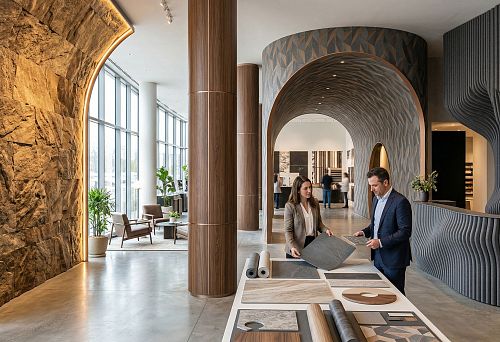
Niches, arches, reveals, decorative partitions — all these architectural elements of an apartment benefit from being clad with wooden panels. Flexible slatted panels on a fabric base wrap around curved surfaces and columns without adjustment, creating a continuous texture on complex architectural forms.
Decorative wooden panels for space zoning
Zoning is one of the key tasks in modern interior design, especially in apartments with open floor plans. How to separate the kitchen and living room without losing light? How to designate a work area in a bedroom without creating a sense of confinement? How to separate a children's play area from the common zone without solid partitions?
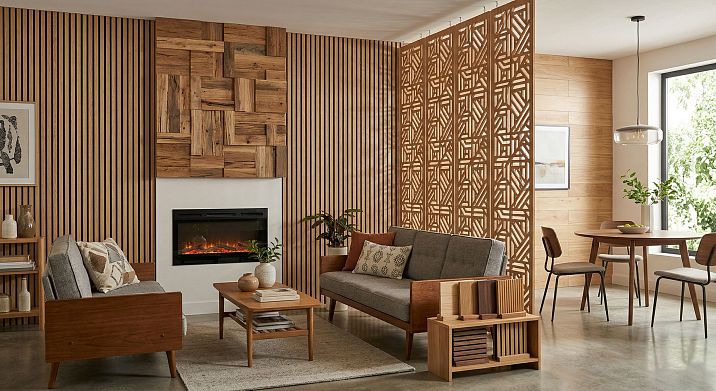
Decorative wooden panels for space zoning provide an elegant answer to all these questions. A vertical slatted structure, placed as a divider, allows light to pass through, creates a visual boundary, and yet preserves the feeling of a unified space. This fundamentally distinguishes it from a solid wall: you divide zones without creating claustrophobia.
Slatted partitions work especially effectively in studio apartments, where the sleeping area and living room need to be demarcated, or in kitchens where the dining area should be separated from the work triangle.
For zoning, slats with a wider spacing are chosen — from 5 to 10 cm between the planks. This preserves the visual 'breathability' of the structure. A dense slatted rhythm with a spacing of 1–2 cm creates an almost solid surface — suitable for zoning where greater privacy is needed.
The key rule: a zoning slatted panel should be made from the same material as the main wall finish, or consciously contrast with it — in color, texture, or tinting.
How to choose panels based on interior style
Modern style
Modern interiors favor clean forms, absence of unnecessary details, and a balance of natural materials with neutral surfaces. Solid oak slat panels in natural or light gray tones, smooth wooden panels with minimal texture, and slats with clear, uniform spacing without decorative excess are suitable for it.
Minimalism
Minimalism demands even greater strictness. Here, panels with maximally smooth surfaces, monochrome finishes, or extremely neutral wood toning work. No carving, no patterns—only the pure rhythm of vertical lines or horizontal slats. MDF panels with a matte enamel finish are ideal for a minimalist interior.
Scandinavian style
Scandinavian interiors are built on the contrast of white and wood. Wooden panels here serve as a 'warm' accent against light-colored walls. The perfect choice is slats made of light oak or birch without toning, or with an oil finish that emphasizes the wood's natural pale golden hue. Horizontal slats in a Scandinavian interior are a classic of the genre.
Japandi
Japandi is a hybrid style combining Japanese simplicity and Scandinavian coziness. It is characterized by warm neutral tones, natural materials, and fundamental restraint. Wooden panels in the Japandi style are light gray, beige, or milk-colored oak slats with a soft oil finish. The form factor is vertical slats with uniform spacing, no reliefs.
Neoclassicism
Neoclassicism is a style where decorative wooden panels are revealed in all their fullness. Here, relief panels with molding frames, geometric raised panels, carved overlays, and classic cornice profiles are appropriate.Wall panels in the classic style—is a full-fledged architectural system where every element works in an ensemble: moldings, cornices, baseboards, overlays. It is precisely this approach that turns an ordinary apartment into an interior with history.
Warm contemporary interior
Warm modern interior is one of the most popular requests in recent years. It combines modern geometry with natural materials, soft lighting, and an earthy palette: terracotta, ochre, taupe, warm gray-beige. For it, slat panels made of oak in 'cognac,' 'tobacco,' or 'warm walnut' tones are suitable, as well as smooth panels with textured oil that emphasizes the wood's natural grain.
How to choose color, texture, and format
Choosing a decorative wooden panel by color and texture is not a matter of 'like or dislike.' It is systematic work with the interior as a whole.
Light shades of wood—birch, whitewashed oak, light ash—visually enlarge the space, add airiness, and work well in small rooms. They are universal for Scandinavian, minimalist, and modern styles.
Dark shades — wenge, mocha, graphite oak — create intimacy, a sense of luxury and depth. They work in spacious rooms with good lighting. In small spaces, dark panels can create an undesirable 'tunnel' effect.
A smooth surface accentuates the wood grain and works as a calm background. A textured and brushed surface enhances tactility, creates a play of light and shadow, and adds textural expressiveness.
The vertical rhythm of slats stretches the space upward. The horizontal rhythm expands it horizontally. The choice of direction is always dictated by the geometry of the room.
When choosing the color of panels, it is important to consider three reference points: the floor, doors, and key furniture. The panels should either match their tone (creating a unified wooden 'theme' for the interior) or consciously contrast with them — but not compete. If the floor is light, it is acceptable to use dark panels on an accent wall. If the floor is dark — light or neutral slats will create the necessary balance.
What is better to choose: solid wood, MDF, or veneer
This question is asked by almost everyone choosing decorative wall panels for the first time. There is no universal answer — each material solves its own tasks.
| Parameter | Solid wood | MDF for painting | Veneered panel |
|---|---|---|---|
| Appearance | Living natural pattern, unique | Uniform, perfectly smooth | Natural pattern, repeatable |
| Decorativeness | Maximum, natural texture | Depends on color and finish | High, imitates solid wood |
| Durability | Decades with proper care | Depends on the coating, 10–15 years | 10–20 years |
| Cost | High | Affordable | Medium |
| Painting | No (only oil, varnish, tinting) | Yes, any color | No (only varnish, tinting) |
| Best scenario | Premium interior, study, living room | Any style, budget project | Large format at a reasonable price |
If the budget allows — go for solid oak. It's an investment that only increases in value over the years. If you need complete color freedom and strict cost control — MDF for painting will solve the task with no less aesthetic appeal.
Advantages of decorative wooden panels
Why do wooden panels for decorative finishing continue to hold leading positions despite competition with stone, concrete, metal, and wallpaper? Because no other material simultaneously provides everything that wood does.
-
Expressive appearance. The grain pattern, the play of light and shadow on the relief, warm shades — wood creates a 'living' interior that changes depending on lighting and viewing angle.
-
Warm natural texture. The tactile sensation of wood cannot be reproduced synthetically — cool plastic and film will never evoke the same response.
-
Accentuation without overload. Wooden panels create a visual focal point without overloading the space — unlike bright paints or colorful wallpapers.
-
Universal compatibility. Wood pairs organically with metal, stone, textiles, concrete, and glass—it works in practically any material environment.
-
Acoustic properties. The slatted structure scatters sound waves and reduces reverberation—rooms with wooden panels are more comfortable and quieter.
-
Zoning without losing light. Slatted partitions divide space while maintaining its visual openness.
-
Eco-friendliness. Natural wood is a biologically neutral material that does not emit harmful substances when properly treated.
Common mistakes when choosing decorative wooden panels
The market for wooden interior panels is vast, and the cost of a mistake in selection can be high—both literally and figuratively. Here's what most often goes wrong.
-
Choosing panels separately from the floor and doors. Wood in an interior should work as a system. If the panel tone clashes with the flooring, the space 'falls apart' visually.
-
Buying dark panels for a small room. Dark wood absorbs light and shrinks space. Light and neutral tones work best in small rooms.
-
Saving on material drying. Unseasoned wood will warp, twist, and crack after installation. Properly kiln-dried lumber with controlled moisture content is a mandatory quality requirement.
-
Installing slatted panels without thoughtful lighting. The main advantage of slats—the play of light and shadow—only reveals itself with directed side lighting. Without it, the slats look flat.
-
Use panels throughout the room. Wooden panels work as an accent, not as a continuous cladding of all four walls. The exception is a classic-style study or library.
-
Ignore flexible panels for curved surfaces. Rigid panels cannot be bent without deformation—special flexible solutions are needed for columns, arches, and radius walls.
-
Do not consider room humidity. For the kitchen and bathroom, panels with a protective coating resistant to moisture are needed. Unvarnished solid wood quickly loses its shape in high humidity conditions.
-
Choose panels based on photos without seeing the material in person. A photograph does not convey either the tactility or the real tone of the wood. Whenever possible, always look at samples.
How to care for decorative wooden panels
Caring for decorative wooden panels is simple—provided the material is properly protected during installation.
Dry cleaning is the main method. A soft dry cloth or brush with soft bristles removes dust between the slats without risk of damaging the surface. Use it once a week as part of regular cleaning.
Wet cleaning—only when necessary, with a slightly damp cloth. Excess moisture is the enemy of wood. After wiping, the surface must be dried immediately.
Surface protection—varnished and oiled finishes do not require special care. MDF panels for painting are protected by a paint layer: if scratches appear, local repainting is possible without removing the panels.
Control room humidity—optimal conditions for wooden panels: temperature 18–22°C, air humidity 40–60%. Too dry air (in winter with heating) causes micro-cracks; too humid—swelling and deformation.
Refreshing the oil finish for solid oak panels is required every 3–5 years depending on intensity of use. The oil can be restored locally, without dismantling the panels.
Combining wood panels with other materials
Decorative wood panels are one of the most 'friendly' interior materials: they harmoniously coexist with diverse surroundings.
Wood + metal. Matte brass, brushed steel, black wrought metal in furniture legs, lighting fixtures, handles — all create an expressive contrast with the warm texture of oak, working in both modern and neoclassical interiors.
Wood + stone. Marble countertops, limestone tiles, natural stone flooring — a natural 'pair' for wooden wall panels. The organic warmth of wood and the mineral coolness of stone mutually enhance each other.
Wood + concrete. Industrial loft aesthetic: a concrete wall as a background and a slatted wood panel as a warm accent. This is one of the most sought-after contrasts in recent years.
Wood + textiles. Upholstered furniture, rugs, and curtains in natural tones form a unified natural palette with wood panels — a tactilely rich, cozy space.
Wood + moldings and carved decorative elements.Carved overlays and decorative molding— the perfect complement to wooden wall panels in classic or transitional style. Molding framing transforms a simple wood panel into a full-fledged architectural system with frames, panels, and profiles.
Slatted panels: a separate discussion about the market leader
Among all formats of decorative wooden panels, slatted panels have been the undisputed leader for the past five years. There are several reasons for this.
Firstly, versatility: they work in living rooms, bedrooms, hallways, on furniture, in commercial spaces — everywhere. Secondly, visual effectiveness: vertical slats instantly transform a space, adding a sense of height and architectural completeness.
Thirdly, a wide choice of materials: paintable MDF allows you to get the desired color for any concept, while solid oak provides a lively natural texture. Fourthly, installation without special tools: rigid panels are attached with glue or finishing nails, flexible ones — only with glue to the shape of a curved surface.
Decorative slatted panels made of MDF and solid oak— is one of the most in-demand options for those who want a professional result without a professional installation budget. The panels join seamlessly, provide precise slat rhythm without adjustment, and work equally well on both flat walls and curved surfaces.
FAQ: Answers to popular questions about decorative wooden panels
What are decorative wooden panels?
These are elements of interior finishing made from natural wood or wood with a coating (MDF, veneer), which are installed on walls to create a decorative effect: texture, relief, an accent zone, visual volume.
How do decorative panels differ from ordinary wall panels?
An ordinary wall panel solves utilitarian tasks — protection, leveling. A decorative one addresses aesthetic ones: it is itself the main visual element of the wall, creating light and shadow, texture, an accent.
Which decorative wooden panels are best to choose for walls?
Depends on the task. Slatted panels are for accent walls and zoning. Smooth panels are for warm background decor. Relief panels are for decorative accents in classic or contemporary style.
Are wooden decorative panels suitable for an apartment?
Yes. This is one of the most practical and aesthetic choices for residential interiors of any scale—from a studio to a spacious apartment with multiple rooms.
What is better: solid wood, MDF, or veneer?
Solid wood—for a premium result with a live natural texture. MDF—for complete color freedom and an optimal budget. Veneer—the golden mean when you need the look of wood at a lower cost.
Can wooden panels be used for space zoning?
Yes, it is one of the best zoning tools. Slatted partitions divide the space while maintaining visual openness and light.
Which panels are suitable for the living room and bedroom?
For the living room—slatted or relief panels on an accent wall. For the bedroom—smooth or fine-slat panels behind the bed headboard in light or neutral tones.
Which styles do wooden decorative panels go with?
With most contemporary styles: minimalism, Scandinavian, Japandi, modern, neoclassical, loft, warm modern interior. Wood is one of the most versatile materials in design.
Is it difficult to care for decorative wooden panels?
No. Dry cleaning once a week is sufficient. Varnished surfaces do not require special care. Oil finish on solid wood is refreshed locally every 3–5 years.
What is better: slatted or smooth panels?
Reeded panels are the choice for those who want maximum expressiveness and play of light and shadow. Smooth panels are for a warm, restrained solution that accentuates the natural texture. Both options work brilliantly — in different scenarios.
Conclusion
Decorative wooden panels are not a trend that will pass in a season. This is a material that works on the level of archetypes: wood has been and remains a synonym for warmth, quality, and thoughtful interior design. No matter what style you choose — minimalism or neoclassicism, Japandi or warm contemporary — wooden panels for decorative finishing will find their place in any conceptual space.
They create an accent wall that transforms an ordinary living room into an interior object. They form a wooden decor behind the headboard, making the bedroom a place of peace. They build reeded partitions that divide space without losing light. They dress the TV area in the natural texture of wood, which no film can provide.
The main thing is to choose quality material from trusted manufacturers who control wood drying, panel geometry, and finishing. Because in working with wood, the detail decides everything.
If you are looking for professionaldecorative reeded wooden panelsfor your project — pay attention to the company STAVROS. Since 2002, STAVROS has been manufacturing products from solid oak, beech, and MDF for residential and commercial interiors across Russia. More than 4000 models, 20,000 modifications, own production with controlled microclimate — this guarantees that every panel, every slat, every molding will serve for decades without deformation or loss of appearance.
STAVROS is not just a decor supplier. It is a partner who thinks about the interior as seriously as you do.