Article Contents:
- When weight decides everything: features of wall-mounted furniture
- Material of the future: what is polyurethane foam
- Large decorative elements: where they are used
- Facades of cabinet furniture
- Kitchen cabinets
- Furniture for living rooms and bedrooms
- Combination of lightweight decor with wooden frame
- Surface Preparation
- Staining and Toning
- Technical advantages of polyurethane over wood
- Moisture Resistance
- Shape Stability
- Repairability
- Economic Advantage
- Range of polyurethane overlays
- Recessed Outlets
- Cartouches
- Coats of arms and emblems
- Corner Elements
- Panels and inserts
- Installation of polyurethane overlays: step-by-step instructions
- Step one: marking
- Step two: surface preparation
- Step three: applying adhesive
- Step four: installation
- Step five: fixation
- Step six: finishing
- Interior styles and polyurethane decor
- Classic and neoclassic
- Baroque and Rococo
- Art Deco
- Provence and Country Style
- Modern styles
- How polyurethane differs from foam and plaster
- Foam (polystyrene foam)
- Gypsum
- Polyurethane
- Modern trends: polyurethane in author's design
- Painting in Bright Colors
- Combining with other materials
- Custom shapes
- How to choose quality polyurethane decor
- Material density
- Clarity of relief
- Absence of defects
- Geometry
- Manufacturer
- Polyurethane and ecology: debunking myths
- Material composition
- Certification
- Comparison with Other Materials
- Waste disposal
- Restoration of old furniture using polyurethane
- Assessing furniture condition
- Choice of decor
- Installation and painting
- Result
- Polyurethane in commercial projects
- Restaurants and Cafes
- Hotels
- Stores and showrooms
- Offices
- Frequently asked questions about polyurethane decor
- Can polyurethane overlays be used outdoors?
- How to Care for Polyurethane Decor?
- Can polyurethane elements be repainted?
- How long does polyurethane decor last?
- Can polyurethane overlays be made to custom sketches?
- Does polyurethane feel different from wood to the touch?
- Can polyurethane be glued to metal or glass?
- Is polyurethane flammable?
- The future of polyurethane decor
- Biodegradable polyurethanes
- 3D printing
- Smart coatings
- Integration with electronics
- Conclusion
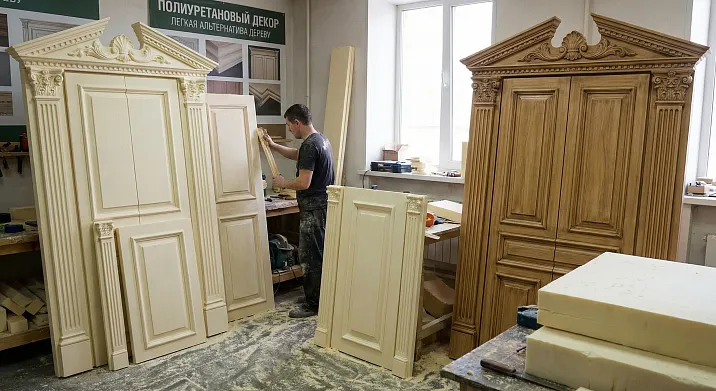
The furniture industry is developing rapidly, and today manufacturers face the challenge not only of creating beautiful furniture but also making it functional, durable, and safe to use. Wall-mounted cabinets, kitchen unit fronts, tall wardrobe systems—all require careful calculation of the load on fasteners. And this is where a material that many underestimate comes into play: polyurethane foam. It becomes a real lifesaver for designers and furniture makers when it comes to large decorative elements—rosettes, cartouches, coats of arms, bas-reliefs.
Why exactlypolyurethane foam decor? It's simple: weight. When a large rosette 30 centimeters in diameter or a massive cartouche with heraldic symbolism needs to be placed on the front of a wall-mounted cabinet, wooden carving may be too heavy. Hinges won't hold, fasteners will loosen, and in the worst case, the front may simply detach from the body. Polyurethane overlays solve this problem radically: they are several times lighter than wood, yet visually indistinguishable from classic solid wood carving.


When weight decides everything: features of wall-mounted furniture
Wall-mounted fronts are always a compromise between aesthetics and engineering calculations. Modern hinges can withstand significant loads, but everything has its limits. If a front is too heavy, it begins to sag, doors stop closing tightly, and misalignments occur. This is especially true for wide kitchen unit doors, which must be both decorative and sturdy.
Imagine: you're designing a classic Baroque-style kitchen. The client wants to see luxurious rosettes, intertwined acanthus leaves, perhaps even small sculptural inserts on the fronts. If all this were made from solid oak or beech, each element would add from 500 grams to a kilogram or more to the front's weight. Multiply that by a dozen doors—and the load on the body and walls becomes critical. And what if we're talking about drywall partitions? There, every gram counts.
This is wherepolyurethane decorationcomes to the rescue. A large polyurethane rosette weighs only 100-200 grams while retaining all the visual advantages of its wooden counterpart. Moreover, modern casting technologies allow creating elements with such detail that they can only be distinguished from wood carving by touch or weight.




Material of the future: what is polyurethane foam
Polyurethane foam is a polymer material obtained by foaming liquid components to form a cellular structure. Inside each element are millions of tiny air bubbles that provide lightness. Meanwhile, the outer film hardens, forming a strong surface resistant to mechanical impacts.
For the furniture industry, dense decorative polyurethane foam is used, which is molded in special silicone or metal molds. This allows obtaining overlays of any complexity: from simple geometric patterns to the most intricate compositions with multi-layered detailing. After extraction from the mold, the element is sanded, primed, and painted—typically in white, which can easily be tinted to match any wood species or other material.
Important advantagepolyurethane products—their chemical neutrality. The material does not emit harmful substances, is not afraid of moisture, and is not susceptible to rot or mold. This makes it ideal for use in kitchens, bathrooms, and high-humidity areas. Wooden elements in such conditions can swell, crack, and lose shape. Polyurethane remains stable for decades.
Our factory also produces:
Large decorative elements: where they are used
When it comes to large overlays, the immediate question arises: where exactly should they be used? The answer is simple—anywhere expressiveness is needed without extra load. Let's examine the main areas of application.
Get Consultation
Fronts of case furniture
Cabinets, dressers, sideboards, display cabinets—all require decorative finishing, especially when it comes to classic or palace styles. A central rosette on a cabinet door, symmetrical cartouches on corners, heraldic overlays—all these are traditional elementsof furniture decor. But if the furniture is wall-mounted, every gram matters.
Polyurethane rosettes with diameters from 15 to 40 centimeters are easily glued to the front using special mounting adhesive. After painting, they blend with the overall tone of the furniture, creating the illusion of a solid carved surface. Meanwhile, the front's weight remains within acceptable limits, and the mounting hinges last for years without loosening.
Kitchen cabinets
The kitchen is a place where high demands for functionality and aesthetics come together. Modern kitchens in classic style are often decorated with volumetric overlays, panels, and cornices. And here, polyurethane is the optimal choice. It is not afraid of temperature fluctuations, steam, or condensation. It is easy to clean and does not absorb grease or odors.
Large cartouches or coats of arms on the central facades of islands, corner overlays on upper cabinets, decorative inserts in glass doors — all of this can be made from polyurethane without overloading the structure. This is especially important for wall-mounted cabinets that are attached to the wall: here, every extra kilogram increases the risk of collapse.
Furniture for living rooms and bedrooms
Wall units, sliding wardrobes, bed headboards, dressers — whereverfurniture facadesare present, decor is appropriate. Polyurethane overlays allow for creating luxurious compositions without the risk of overloading the structure. Large rosettes, asymmetrical scrolls, volumetric medallions — all of this is accessible and safe.
For bedrooms, large decorative inserts on bed headboards are especially relevant. If made from solid wood, the overall weight of the structure increases significantly, complicating installation and transportation. Polyurethane solves this problem: lightweight yet impressive elements are attached directly to the headboard panel, creating the impression of expensive carved work.
Combining lightweight decor with a wooden frame
One of the most common questions designers and furniture makers have is: how to combine polyurethane overlays with wooden facades? Will it look artificial? The answer is categorical: with proper preparation and painting, the difference is completely unnoticeable.
Surface preparation
Before installing a polyurethane overlay, the wooden facade must be cleaned of dust and degreased. If the surface is coated with varnish or paint, it is important to ensure good adhesive adhesion — sometimes light sanding is required. The polyurethane element itself is also degreased on the reverse side.
The adhesive for installation must be specialized — ordinary PVA will not work here. Polyurethane or acrylic mounting compounds are used, providing a strong, flexible bond. The element is pressed against the surface, fixed for a few minutes — and the connection is ready. Full adhesive polymerization occurs within a day, after which the overlay can be painted.
Painting and Staining
The most important stage is painting. This is where it is decided whether the overlay will look organic on the wooden facade. Polyurethane is easily painted with acrylic paints, stains, and patina. Effects of aging can be created, relief can be emphasized, and wood texture can be imitated.
Multi-layer painting technique is often used: first, a base tone is applied, then patina or wax in the recesses, after which the element is lightly sanded so that the protruding parts become lighter. This creates depth, interplay of light and shadow, making the overlay visually indistinguishable from wooden carving.
If the facade has a wood texture, acrylic stains or paints with a wood effect can be used. Modern compositions allow recreating the texture of oak, walnut, wenge with astonishing accuracy. After applying varnish, the overlay becomes part of the facade — and only its weight reveals its polymer nature.
Technical advantages of polyurethane over wood
Why are furniture manufacturers increasingly turning to polyurethane if wood is a traditional, centuries-tested material? The answer lies not only in weight but also in a range of technical characteristics.
Moisture Resistance
Wood, even treated with varnish, remains a hygroscopic material. It absorbs moisture from the air, swells, then dries and may crack. For furniture placed in the kitchen or bathroom, this is a serious problem. Polyurethane is completely moisture-resistant — it does not absorb water, does not change geometry, and does not lose strength. This allows the use of decorative overlays even in conditions of direct contact with steam and condensation.
Shape stability
Wood is a living material. It reacts to changes in temperature and humidity and can deform. This is especially true for fine carving: small details may chip, scrolls may break off. Polyurethane retains its shape under any conditions. It withstands temperature fluctuations from minus forty to plus eighty degrees, does not become brittle in frost, and does not soften in heat.
Repairability
If a wooden overlay is damaged — a fragment is chipped, a crack appears — it is difficult to restore. Either complete replacement or labor-intensive restoration is required. With polyurethane, it's simpler: minor chips are easily filled with putty and touched up. Major damages are also repaired — or the element is simply replaced with a new one, as they are inexpensive and always available.
Economic Advantage
Wood carving is manual labor requiring high skill. Each overlay is carved by a master, making it expensive. Polyurethane elements are produced by casting in molds — this is mass production, significantly reducing cost. At the same time, the quality of detailing can be even higher than that of hand carving: modern molds reproduce the smallest details with precision down to fractions of a millimeter.
Assortment of polyurethane overlays
The modern market offers a huge variety of decorative elements made of polyurethane. From simple geometric rosettes to the most complex Baroque compositions — the choice is limited only by the designer's imagination.
Rosettes
Round or oval overlays with symmetrical ornamentation. Diameter can vary from 10 to 50 centimeters and more. Used as central elements on cabinet facades, doors, panels. Can be flat or volumetric, with classic floral ornamentation or modern geometric patterns.
Cartouches
Asymmetrical decorative overlays, often imitating scrolls, ribbons, shields. Used to create dynamic compositions, especially popular in Baroque, Rococo, Art Deco styles. Cartouches can be paired (left and right) or single, size — from compact 15x10 cm to large 50x30 cm.
Coats of arms and emblems
Overlays with heraldic symbols, monograms, ciphers. Used to create individual, status interiors. Can be standard (lion, eagle, crown) or custom-made according to client sketches. Sizes — from 20 to 60 centimeters in height.
Corner elements
Overlays designed for decorating corners of facades, frames, panels. Usually these are plant scrolls, acanthus leaves, geometric patterns. Can be symmetrical (for inner corners) and asymmetrical (for outer corners). Size — from 10x10 to 25x25 cm.
Panels and inserts
Large rectangular or shaped elements for filling the central part of the facade. They can depict scenes, ornaments, abstractions. Sizes range from 30x20 cm to 100x60 cm and larger. Used on wide cabinet doors, wall panels, bed headboards.
Installation of polyurethane overlays: step-by-step instructions
Installing decorative elements made of polyurethane does not require special skills, but it is important to follow the technology. Let's consider the process step by step.
Step one: marking
Before starting work, determine the exact location of the overlay on the facade. Use a tape measure, level, pencil. If there are several elements, it is important to maintain symmetry. Mark the contours of the future overlay on the facade — this will help control the gluing process.
Step two: surface preparation
Degrease the facade surface with alcohol or a special cleaner. Remove dust, dirt. If the surface is glossy, lightly sand it with fine-grit sandpaper to improve adhesion. Also wipe the back side of the polyurethane overlay with alcohol.
Step three: applying adhesive
Use special mounting adhesive for polyurethane. Apply it to the back side of the overlay in an even layer, avoiding excess. If the element is large and heavy, you can also apply adhesive to the facade surface — this will enhance adhesion.
Step four: installation
Carefully place the overlay onto the facade, following the markings. Press the element firmly, ensuring it sits in place without misalignment. Maintain pressure for 2-3 minutes for the adhesive to set. Immediately remove any excess adhesive that has squeezed out along the edges with a damp cloth.
Step five: fixation
If the overlay is large, additionally secure it with painter's tape during the adhesive polymerization time (usually 24 hours). After complete drying, the tape can be removed — the element will hold firmly.
Step six: finishing
After the adhesive has dried, you can proceed with painting. First apply primer (if the overlay was not factory-primed), then — a base coat of paint. After drying, you can add patina, wax, varnish — depending on the desired effect.
Interior styles and polyurethane decor
Can polyurethane overlays be used in different interior styles? Absolutely. The variety of forms and the possibility of painting make this material universal.
Classicism and neoclassicism
The most fertile ground for polyurethane decor. Rosettes, cartouches, floral ornaments, columns, pilasters — all these are integral elements of classic interiors. Polyurethane allows recreating the luxury of palace halls without astronomical costs and structural overload.
Baroque and Rococo
Lush, dynamic, detail-overloaded styles require many decorative elements. Here polyurethane is indispensable: asymmetrical cartouches, scrolls, cherubs, garlands — all can be placed on furniture facades without worrying about the strength of the fastenings.
Art Deco
Geometric ornaments, symmetry, clear lines — polyurethane easily adapts to these requirements. You can find overlays with motifs characteristic of Art Deco: zigzags, circles, stylized plant forms.
Provence and country
Light, subtle carving, floral motifs, and patination—all of this is easily achieved with polyurethane elements. Painted in pastel tones and artificially aged, they fit perfectly into the romantic aesthetic of Provence.
Modern Styles
Even in minimalism, loft, Scandinavian style, polyurethane decor can be used — but in restrained, laconic forms. Geometric overlays, strict rosettes, monochrome painting — and now a modern interior gains individuality without losing stylistic purity.
How polyurethane differs from polystyrene foam and plaster
Confusion often arises between polyurethane, polystyrene foam, and plaster. All three materials are used for decor, but each has its own characteristics.
Polystyrene foam (expanded polystyrene)
The lightest of the three materials, but also the most fragile. Polystyrene foam crumbles easily, breaks, and poorly withstands mechanical loads. It is cheap but not durable. For furniture facades that are constantly opened and closed, subjected to accidental impacts, polystyrene foam is not suitable. Moreover, it is flammable and releases toxic substances when heated.
Plaster
A traditional material for stucco, known since ancient times. Plaster is eco-friendly, strong, durable, but very heavy. A plaster rosette with a diameter of 30 cm can weigh 2-3 kilograms — this is unacceptable for hanging furniture. Moreover, plaster is afraid of moisture and requires careful handling during transportation.
Polyurethane
The golden mean: lightweight, strong, moisture-resistant, durable. Not flammable, does not release harmful substances, easy to process and paint. The only drawback — price higher than polystyrene foam, but significantly lower than high-quality plaster stucco or wood carving.
Modern trends: polyurethane in authorial design
More and more designers are using polyurethane overlays not as an imitation of wood, but as an independent artistic material. Authorial collections, exclusive forms, non-standard solutions are emerging.
Painting in bright colors
Who said decorative overlays must be white or wood-like? Modern interiors allow bold color solutions. Rosettes painted in emerald, blue, burgundy, gold — these are bright accents that transform furniture, making it unique.
Combining with other materials
Polyurethane pairs excellently not only with wood but also with metal, glass, and mirrors. An overlay on a glass cabinet door, painted to match the frame's color, creates a stained-glass effect. Polyurethane decor on a metal surface (e.g., on a safe or bar counter front) adds unexpected softness to an industrial style.
Custom Molds
Many manufacturers offer custom mold production based on individual sketches. This allows for creating a unique overlay—with a company logo, family crest, or original ornament. Such decor transforms furniture into an art object, emphasizing the owner's status.
How to Choose Quality Polyurethane Decor
The market offers a wide selection of polyurethane overlays, but quality can vary significantly. What should you pay attention to when purchasing?
Material Density
Quality polyurethane should be sufficiently dense, without large pores on the surface. Check the cross-section or backside of the element: the cells should be fine and uniform. If large voids or inconsistencies are visible, it's a sign of low quality.
Clarity of Relief
Detailing is an important indicator. A quality overlay has clear, well-defined relief without blurred contours or filled-in recesses. All small elements should be distinguishable, and the carving should be expressive.
No defects
Check the overlay for chips, cracks, cavities, or drips. A quality element should be perfectly smooth (or uniformly textured, if designed that way) without visible casting defects.
Geometry
The overlay should be flat, without warping or deformations. Place it on a flat surface—the element should fit snugly and not wobble. If the overlay is wavy or bent, it will be difficult to glue properly.
Manufacturer
Choose reputable manufacturers with a good track record. The company STAVROS offers a wide range of high-quality polyurethane decorative elements suitable for the furniture industry and individual creative projects.
Polyurethane and Ecology: Debunking Myths
One common question: how safe is polyurethane for health? Does it emit harmful substances? Let's break it down.
Material Composition
Polyurethane is produced through a chemical reaction of polyols and isocyanates. During synthesis, all components polymerize, forming a stable substance. Finished polyurethane is an inert polymer that contains no free monomers and does not emit volatile compounds.
Certification
Quality polyurethane products have all necessary safety certifications. In Europe and Russia, strict standards regulate the content of harmful substances in materials that come into contact with humans. Legally marketed polyurethane decor complies with these standards.
Comparison with Other Materials
Polyurethane is safer than many traditional materials. For example, some wood varnishes and impregnations contain formaldehyde, solvents, and heavy metals. MDF can release formaldehyde when heated. Polyurethane, however, is chemically stable and does not react to temperature changes within the household range.
Disposal
Polyurethane does not decompose in the environment like wood, but it also does not release toxins. Used elements can be disposed of as household waste or sent for recycling (some enterprises accept polyurethane for secondary use).
Restoring Old Furniture with Polyurethane
One of the most interesting applications of polyurethane decor is restoring old furniture. If you have a Soviet-era wardrobe, chest of drawers, or sideboard that looks outdated but is structurally sound, polyurethane overlays can give them a new lease on life.
Assessing furniture condition
First, assess the item's condition. If the frame is sturdy, hinges are functional, and fronts are not warped—you can proceed with the update. Remove old paint or varnish, fill cracks and chips with putty, and sand the surface.
Choosing Decor
Select overlays that match the future furniture's style. For a classic look, rosettes and cartouches work well; for Provence—floral motifs; for Art Nouveau—geometric elements. Consider the front dimensions: the decor should not be too small or, conversely, overwhelm the surface.
Installation and Painting
Glue the overlays according to the instructions described above. After the adhesive dries, paint the entire furniture in a uniform color—this will make the decor an organic part of it. You can add patination, artificial aging, or gilding—these techniques will give the furniture a noble, vintage appearance.
Result
After the update, an old wardrobe transforms into a stylish interior piece that you wouldn't hesitate to place in a living room or bedroom. Meanwhile, the costs are minimal: polyurethane overlays are inexpensive, paint and varnish are also affordable, and the work can be done yourself over a weekend.
Polyurethane in Commercial Projects
Decorative polyurethane elements are actively used not only in private interiors but also in commercial projects: restaurants, hotels, shops, and offices.
Restaurants and cafes
Food service establishments are often designed in a specific style: classic, loft, Provence, ethnic. Polyurethane decor allows for quickly and affordably creating the desired atmosphere. Overlays on bar counters, buffet fronts, wall panels—all contribute to crafting a memorable establishment image.
Hotels
In the hotel business, not only aesthetics are important, but also practicality. Furniture undergoes intensive use, requires easy maintenance, and resistance to moisture and damage. Polyurethane decor meets all these requirements: it is durable, easy to clean, and not afraid of accidental impacts.
Stores and showrooms
Retail spaces should be stylish and presentable. Polyurethane overlays are used for decorating showcases, shelving, and checkout areas. They create the impression of expensive finishing at moderate costs.
Offices
Even in a business environment, there is room for decor. Executive offices, meeting rooms, and reception areas are often decorated using classical elements. Polyurethane overlays on furniture and walls give the office solidity and emphasize the company's status.
Frequently asked questions about polyurethane decor
Can polyurethane overlays be used outdoors?
Yes, polyurethane is resistant to atmospheric influences. However, for outdoor use, it is better to choose special forms designed for facades. They have increased density and additional protection against ultraviolet radiation.
How to care for polyurethane decor?
Care is simple: just wipe the overlays with a damp cloth. You can use mild detergents. Avoid abrasives and aggressive chemicals—they can damage the painted surface.
Can polyurethane elements be repainted?
Yes, polyurethane is easily repainted. If you decide to change the color of the furniture, simply remove the old paint (if it is glossy—lightly sand it with sandpaper) and apply a new one. The material holds any type of paint excellently: acrylic, alkyd, latex.
How long does polyurethane decor last?
With proper installation and care—decades. Polyurethane is not prone to rotting, does not crack, and does not deform. The only thing that may be required is updating the paint coating every few years.
Can a polyurethane overlay be made according to my own sketch?
Yes, many manufacturers offer the service of creating molds according to individual sketches. This requires certain costs for creating the mold, but you get unique decor that cannot be found anywhere else.
Does polyurethane feel different from wood?
Yes, polyurethane feels smoother and cooler to the touch than wood. However, visually, especially after painting and patination, the difference is almost unnoticeable. From a distance of more than a meter, it is almost impossible to distinguish polyurethane from wood carving.
Can polyurethane be glued to metal or glass?
Yes, polyurethane can be glued to any surfaces provided proper preparation and the use of suitable adhesive. For metal and glass, it is better to use polyurethane-based adhesive or epoxy compounds.
Does polyurethane burn?
Polyurethane is classified as a difficult-to-burn material. It does not support combustion but can melt at high temperatures. For residential premises, this is safe, as the ignition temperature is much higher than that of wood or fabrics.
The future of polyurethane decor
Technology does not stand still, and polyurethane decor continues to improve. What trends do we see in the near future?
Biodegradable polyurethanes
Scientists are working on creating polyurethanes based on plant raw materials that can decompose in the environment. This will preserve all the advantages of the material but make it environmentally friendly.
3D printing
Technologies for 3D printing from polyurethane mixtures are already emerging. In the future, this will allow creating decorative elements of any complexity directly on-site, without the need to order molds and wait for production.
Intelligent coatings
Coatings for polyurethane are being developed that change color depending on lighting, temperature, and humidity. Imagine a decorative overlay that is light in the morning and darkens in the evening, adapting to the room's lighting.
Integration with electronics
In the future, polyurethane elements with built-in LED lighting, touch sensors, and even displays may appear. Decor will cease to be just an ornament and become a functional part of a smart home.
Conclusion
Decor made of polyurethane foam is not just a cheap imitation of wood or plaster. It is a modern, high-tech material that solves real problems in furniture production and interior design. Lightness, strength, moisture resistance, ease of installation, and affordable price—all this makes polyurethane overlays the optimal choice for cabinet furniture facades, especially wall-mounted ones.
If you need to create a luxurious interior in a classic style, update old furniture, implement a commercial project, or simply add individuality to your home — polyurethane decor can handle these tasks. It allows you to combine the beauty of wood carving with the practicality of modern materials, without sacrificing either aesthetics or functionality.
The STAVROS company offers a wide range of decorative elements made of polyurethane for any task: from small corner overlays to large rosettes and panels. High product quality, detailed relief work, affordable prices, and fast delivery throughout Russia make STAVROS a reliable partner for furniture makers, designers, and private customers. ChoosePolyurethane Items from STAVROS — and create interiors that amaze!