Article Contents:
- What is Custom Furniture Decor and When is it Needed
- How Custom Decor Differs from Standard Solutions
- When an Individual Approach is Truly Justified
- For Which Furniture and Interior Projects Custom Decor is Chosen
- Why Wooden Furniture Decor Remains in Demand
- How Wood Differs Visually and Tactilely
- Why Wooden Decor is Particularly Suitable for Classic Furniture
- When Wooden Elements are Better than Other Solutions
- How material affects the perception of the facade and furniture as a whole
- What wooden furniture decor can be ordered in Moscow
- Carved overlays for facades
- Wooden rosettes and accent elements
- Moldings and decorative profiles
- Corners, inserts and symmetrical compositions
- Furniture facade decor sets
- Elements for custom interior projects
- What furniture is wooden decor suitable for
- For cabinets
- For dressers and cabinets
- For display cases and buffets
- For kitchen fronts
- For doors and furniture panels
- For furniture restoration and updating
- How to choose custom furniture decor for a specific task
- By furniture style
- By facade size
- By relief depth
- By composition symmetry
- By the combination of several elements with each other
- On the overall role of decor in interior design
- What to choose for different tasks
- If you need to update old furniture
- If you need decor for a classic wardrobe
- If you need to decorate dresser fronts
- If you need accent carved decor
- If a restrained solution is required
- If a cohesive classic furniture look is important
- Advantages of wooden decor for furniture
- Natural appearance and texture
- Suitability for classic and status solutions
- Ability to assemble an individual composition
- Good visual combination with wooden furniture
- Suitable for new products and restoration
- How to order furniture decor in Moscow without making mistakes
- First, determine which furniture needs decor
- Then choose the style and level of decorativeness
- Check the dimensions and proportions of the facade
- Immediately plan the composition of all elements
- Select decor not as individual elements, but as a system
- What mistakes are most commonly made when choosing
- Choose decor that is too large for small facades
- Mix incompatible carved elements
- Do not consider the furniture style
- Overload facades with details
- Order elements without an overall composition
- How to use wooden furniture decor without overloading
- When one overlay is enough
- When symmetry works best
- How to combine overlays, rosettes and moldings
- Why it's important to consider furniture scale
- How to maintain balance between decor and furniture form
- Checklist before ordering furniture decor
- Comparison table: types of wooden furniture decor
- FAQ: Answers to Popular Questions
- When is it better to order custom furniture decor rather than buy ready-made?
- Which wooden furniture decor to choose?
- What is suitable for cabinet and dresser facades
- Is wooden decor suitable for furniture restoration?
- Which elements are best for classic furniture?
- Where to order furniture decor in Moscow?
- How to choose decor based on the size of the facade?
- How to combine wooden decor with interior design?
- Conclusion

There is a difference between furniture that is simply bought and furniture that is created. The first is chosen from available stock—you look at the color, check the size, count the drawers. The second is designed: proportions are thought out, finishes are selected, an image is built. And it is here that a question arises, which sooner or later confronts everyone seriously engaged in interior design: what kind ofcustom furniture decorto choose so that it not only adorns the facade but works—precisely, meaningfully, as part of a system?
Wooden furniture decor is a category where the material is inseparable from meaning. Wood itself carries a message: naturalness, warmth, durability, craftsmanship. A carved oak overlay on a cabinet facade is not just an ornament. It is a statement that labor, taste, and intention have been invested into this interior.
How to choose? When is a custom order needed, not a ready-made element? Why wood—and not polyurethane, not MDF, not plastic? Let's break it all down step by step, practically and without abstractions.



What is custom furniture decor and when is it needed




How custom decor differs from standard solutions
Standard decorative elements are fixed sizes, set shapes, a limited choice of patterns. They are good when the furniture is standard, the facade is typical, the style is neutral. But the moment a specific project arises—a non-standard facade, a unique cabinet shape, a special ornamental motif, or large-scale production with repeating parts—standard decor stops working.
custom furniture decor— it's about crafting elements for a specific task: the right size, the right relief, the right ornament, the right combination with other furniture details. It's not more expensive — it's more precise. The difference is like between a ready-made suit and one tailored to order: both look like suits, but the second one fits differently.
Our factory also produces:



When an individual approach is truly justified
The answer is straightforward: custom decor is justified in any situation where a standard solution doesn't meet the task.
Specific cases:
-
An element of non-standard size is needed — larger or smaller than what's available
-
A furniture series is being produced with repeating parts — each piece needs to be identical
-
The ornament must match other interior details — cornices, door trims, moldings
-
Antique furniture is being restored — decor is needed that exactly replicates the lost element
-
An interior project requires an authorial solution — decor as part of the designer's concept
Get Consultation
For which furniture and interior projects custom decor is chosen
Most often, custom manufacturing is used by:
Furniture manufacturers — when overlays or rosettes are needed for a specific line of cabinets, beds, or kitchen sets within a unified collection.
Interior designers — when a project requires consistency among all decorative elements: furniture, doors, wall panels, ceiling rosettes.
Owners of country houses — when the interior is created 'from scratch' according to an author's project and every detail must work within the system.
Restorers of antique furniture — when it is necessary to recreate a lost carved element exactly according to the sample.
Owners of commercial properties — restaurants, hotels, banks, representative offices — where the image component of the interior is fundamental.
Why wooden furniture decor remains in demand
How wood differs visually and tactilely
Wood is the only natural material with a living pattern. Two items made from the same species are never identical: the texture of oak is unique to each, the direction of the grain is unpredictable, and the shade varies from trunk to trunk. It is this uniqueness that makesto buy, which will allow you to transform your furniture using carved wooden elements. You can use the C-003-3 decor set to decorate furniture, walls, doors, or any other surface. The C-003-3 decor set is made of oak or beech, known for their strength, durability, and beauty. You can buy the C-003-3 decor set at the Stavros decor store, which specializes in producing and selling decorative elements and hardware for furniture and interiors. At the Stavros decor store, you will find a wide selection of decor sets of various shapes, sizes, and styles. You can choose it one-of-a-kind.
But wood is not just a visual story. It is a material that is felt tactilely: cool to the touch at first and warming from contact, with clear edges of carving that are pleasant to touch with a finger. No polyurethane, no matter how accurately it copies the form, can reproduce this sensation.
Why wooden decor is especially appropriate for classic furniture
Classic as a style was born from wood. Before the advent of synthetic materials, all furniture was made from solid wood—oak, beech, walnut, mahogany. Carved overlays, rosettes, moldings, and corners were an integral part of furniture production. This is not a decorative technique; it is a historical norm.
When today furniture in a classic style is equipped withcarved wooden elements, it continues this tradition. Wood in this context is not a 'material' but a 'language.' Polyurethane or plastic here will always be perceived as an imitation, as a quote in quotation marks. Solid wood is the original.
When wooden elements are better suited than other solutions
Wooden decor is the best choice in the following situations:
-
Furniture made of solid wood or veneer—the material matches, integration is flawless
-
Classic or neoclassical style—a historically correct solution
-
Subsequent finishing — the wood accepts varnish, paint, wax, patina without losing relief
-
Restoration project — only wood can reproduce the original material
-
Premium segment — where the status of the material is fundamental
How material influences the perception of the facade and furniture as a whole
The overlay material changes the perception of the entire piece of furniture. An oak wooden rosette on an oak cabinet facade is a unity of material that is instantly readable. A polyurethane overlay on a wooden facade is two different languages on one object. Sometimes this is justified — but only when it is a conscious decision, not a compromise.
The color, species, and texture of the wood work together with the color of the finish, hardware, and textiles. It is a complex system, andWooden Furniture Decoroccupies an important place in it.
What wooden furniture decor can be ordered in Moscow
Carved overlays for facades
Decorative carved overlays are the broadest category of wooden furniture decor. These are three-dimensional elements with a relief ornament that are attached to the facade surface and create a decorative accent.
The STAVROS catalog features over 400 modelsof wooden carved overlaysmade of oak and beech — from small corner elements to large ornamental panels. Types of overlays by placement:
-
Central — placed in the center of the facade as the main accent
-
Corner — in the corners of a frame or door as a finishing element
-
Symmetrical — used in pairs or groups to create rhythm
-
Asymmetrical — for dynamic authorial compositions
-
Modular (constructor) — connect with moldings and profiles into a unified system
Among the ornamental motifs: acanthus leaves, grapevines, floral garlands, rocaille, cartouches, shells, heraldic themes. The author's collection "Summer Garden" — exquisite Baroque carving with plant motifs in a modern interpretation.
Wooden rosettes and accent elements
Furniture Rosettes— round, oval, square, or rectangular decorative elements with symmetrical ornamentation. The name comes from the French 'rosette' — little rose. Historically, rosettes adorned furniture, ceilings, and architectural coffers as far back as the Classical era.
A wooden carved rosette in the center of a furniture facade is not just a round overlay. It is a focal point around which the entire decorative composition of the door is organized. The sizes of wooden rosettes for furniture range from 5–6 cm (small drawers and doors) to 20–25 cm (central facades of cabinets, buffets, display cases).
Rosette shapes from the STAVROS catalog: round with leaf ornamentation, square with geometric patterns, oval with floral motifs, shaped with multi-level relief.
Moldings and decorative profiles
Wooden moldings for furniture— are linear decorative profiles that create a frame, rhythm, or structure on the plane of the facade. Without molding, a facade is just a flat surface. With molding — it's a system with a center, perimeter, and proportions.
STAVROS produces over 50 types of wooden moldings from solid oak, beech, ash, and linden — from simple rounded profiles to complex carved ones. All products are made from wood dried to 8–10% moisture content, which prevents deformation after installation.
Application of moldings in furniture:
-
Frame molding around the perimeter of a door — mimics a panel, giving the facade a classic look
-
Horizontal molding — delineates zones of a tall cabinet or display case
-
Vertical molding — visually narrows a wide facade, creates a sense of a column
-
Corner molding — finishes the joint of panels
STAVROS overlay-constructors feature a special recess on the back side that precisely matches the molding cross-section — the decor is mounted on top of the profile, creating a seamless system.
Corner pieces, inserts, and symmetrical compositions
Decorative corner pieces — small carved elements for corner areas of the frame. They complete the molding system: where two profiles meet at a right angle, the corner piece conceals the joint and creates an ornamental point.
Decorative inserts — elements for central or intermediate positions in a molding frame. Used in horizontal molding rows as rhythmic accents.
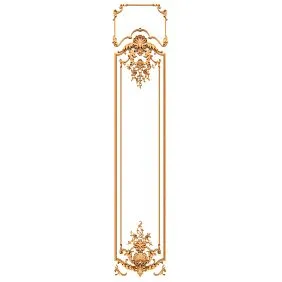
Symmetrical compositions of several wooden elements — this is already a system that organizes the facade as a finished work. Molding + center rosette + four corner pieces — a basic but very effective scheme.
Furniture facade decor kits
Furniture decor kits are sets of compatible elements from one collection. All parts are designed in a unified style, coordinated in scale and ornamental motif.
The STAVROS catalog features decor kits from series C-015, C-016, C-017, C-018, C-020, C-021 — these are ready-made sets for decorating one or several facades, including a central element, corner overlays, and coordinating moldings.
The advantage of the kit approach is guaranteed matching of relief, scale, and artistic design of all parts. This eliminates the most common mistake: when a person selects decor piece by piece and ends up with a random set of mismatched elements.
Elements for custom interior projects
For large interior projects requiring coordinated decoration of furniture, doors, wall panels, and ceiling elements, STAVROS offers a comprehensive solution: developing a layout scheme for decorative elements, manufacturing all necessary parts — moldings, overlays,rosettescornices, corner inserts — from a single range with guaranteed style matching.
Which furniture is suitable for wooden decor
For wardrobes
The wardrobe is the largest piece of furniture in most rooms. Its facade occupies a significant portion of the wall and determines the overall impression of the room. That is why the wardrobe facade requires a thoughtful decorative solution — not random, but designed.
Wooden decor is applied to wardrobes as follows:
-
Frame molding on each door — creates the feeling of a classic panel, breaks the plane into zones
-
Central rosette on wide doors — focuses the gaze, organizes symmetry
-
Corner overlays at molding intersections — complete the frame system
-
Decorative cornice at the top — architectural completion of the wardrobe body
-
Vertical pilasters on tall wardrobes reaching the ceiling — visually break up the monolithic plane
A library cabinet with wooden carved overlays, molding frames, and a decorative cornice is no longer just a place to store books. It is an architectural element of the interior.
For dressers and cabinets
A chest of drawers is arranged differently than a cabinet: several horizontal drawers, each a separate plane. The decor here works on the principle of rhythm: identical elements on each drawer create vertical and horizontal order, turning a set of drawers into a unified decorative system.
For a chest of drawers:
-
IdenticalWooden Inlaysin the center of each drawer — rhythm of repetition
-
Molding frames around the perimeter of each drawer — structuring the plane
-
Small rosettes above the handles — an accent over each opening point
Rule: all overlays on the chest of drawers are of the same size and one ornamental motif. Different elements on different drawers are not eclecticism, but disorder.
For showcases and buffets
A display cabinet and a buffet are furniture that works for display. Glass doors with a molding frame, a decorative cornice along the top edge, carved overlays in the upper part of the body — this is a classic design scheme, tested for centuries.
Wooden furniture decorFor display cabinets and buffets, the scale must be especially carefully chosen: too small gets lost on a tall cabinet, too large overwhelms the glazed sections.
For kitchen fronts
The kitchen is a zone of high humidity and temperature fluctuations. For wooden kitchen fronts, wooden decor is organic, but it is important to consider the coating technology: all elements must be coated with varnish or oil that is resistant to moisture and temperature changes.
Decor for the kitchen:
-
Molding frames on the fronts of upper and lower cabinets
-
Decorative cornice along the upper perimeter of the unit
-
Small overlays on upper cabinets
-
Corner elements on door frames
A kitchen with oak moldings is a classic kitchen in the full sense of the word. Not 'classic-style', but classic.
For doors and furniture panels
The furniture door is the most noticeable part of the front. It is what a person sees when opening and closing the cabinet. Wooden decor on the door — molding around the perimeter and a central overlay — turns a standard rectangular door into an element with character and history.
Furniture panels — side and back walls of open sections, wall modules — can also be decorated with molding frames or decorative overlays to create a unified look with the fronts.
For furniture restoration and updating
Restoration is a special scenario. Here the task is not to decorate, but to restore. A lost rosette, a broken overlay, a worn molding ornament — all this requires the new element to exactly match the old original.
Wooden decorative elements for furnituremade of natural oak or beech is the only correct material for restoration. Only wood will match the original in density, texture, and behavior during sanding and painting.
The second scenario is updating. An old Soviet sideboard, a 1960s chest of drawers, a 'wall' cabinet with neutral fronts — all of these can be transformed by adding wooden moldings and overlays, then painting the entire surface in a single tone. The result is furniture with a fundamentally new look, without replacing the body.
How to choose custom furniture decor for a specific task
By furniture style
Furniture style is the first and main criterion for choosing decor.
-
Classic (Baroque, Rococo, Empire) — deep relief, floral and acanthus motifs, complex ornaments, gilding and patina
-
Neoclassical — clear silhouette, moderate relief, geometric and plant motifs without overload
-
Provence, country — simple motifs, soft shapes, white or natural wood
-
Modern classic — minimal decor, one accent element, restrained ornament
Decor that contradicts the furniture style does not enhance its image—it creates a visual conflict.
Based on facade size
The size of the decorative element should be proportionate to the facade plane:
-
Facade width 25–35 cm — overlay or rosette 4–7 cm
-
Facade width 40–60 cm — overlay 8–12 cm, molding frame
-
Facade width 70–90 cm — rosette 12–16 cm, frame molding, corner elements
-
Facade width 90–120 cm and more — large overlays 15–20 cm, multi-level system
Always evaluate the element on the scale of the facade—not as a separate item, but as a detail of a specific plane.
By relief depth
The depth of the decorative relief determines the character of the furniture:
-
Up to 5 mm — delicate accent, laconic furniture, modern context
-
5–12 mm — moderate relief, classic of medium saturation
-
12–20 mm and more — rich relief, saturated classic, representative interior
Important: during subsequent painting, deep relief is enhanced (paint accumulates in depressions); during patination — creates an aged decor effect.
On composition symmetry
Classical furniture is built on symmetry. A decorative element that breaks the axial symmetry of the facade destroys the sense of harmony. The central axis of the door — vertical — should be the axis of symmetry for the entire decorative system.
If two elements are used — they are symmetrical relative to the center. Four corners — they are equidistant from the edges. One rosette — it is strictly centered.
By combination of several elements with each other
When there are several decorative elements on one facade, they should belong to the same ornamental 'family':
-
One floral style: leaves everywhere — leaves
-
One relief scale: all elements approximately the same depth
-
One surface type: all under varnish, all under patina — without mixing
Different ornamental motifs on one facade — this is not richness of decor, it is its absence.
On the overall role of decor in interior design
Sometimes furniture is the main accent of a space, sometimes it's a neutral background. The degree of decorativeness depends on this:
-
Furniture as an accent – richer decor, larger elements
-
Furniture as a background – minimal decor, one restrained element
-
Furniture in a system with a rich interior (moldings, wall moldings, decorative niches) – furniture decor is moderate so as not to compete
What to choose for different tasks
If you need to update old furniture
Minimal and maximally effective scenario. Wooden moldings around the perimeter of each door plus small overlays in the center. Then – painting the entire surface (furniture and decor) in a single color: white, ivory, dark walnut. Result: furniture with a completely new look, without replacing the cabinet.
If you need decor for a classic wardrobe
Molding frame on each door. Central rosette – strictly centered. Corner overlays at molding intersections. All elements – from the same collection. Finish – matching the furniture color. This is a basic classic scheme that always works.
If you need to decorate the facades of a chest of drawers
On each drawer – an identical wooden overlay in the center. Molding frame around the drawer perimeter – optional. Principle: rhythm of repetition. All overlays are the same size, same pattern, strictly centered. Nothing random, nothing different.
If an accent carved decor is needed
Deep-carved oak overlay – the central element of a display cabinet or sideboard. Pattern: acanthus leaves, cartouche, ornamental panel. Size – proportionate to the width of the facade. Accompanied by more restrained neighboring details – molding without ornament, corners without relief. One accent. The rest is background.
If a restrained solution is required
One wooden molding around the perimeter of the door. No overlays, no rosettes, no corners. The simplest profile — rounded or flat. Sometimes that's all furniture needs to go from neutral to having character.
If a solid, classic furniture image is important
Everything should form a system.Wooden decor setfrom one collection — overlays, rosettes, moldings, corners. A unified ornamental motif. A unified relief depth. A unified finish. No random elements, no compromises — only intent.
Advantages of wooden decor for furniture
Natural appearance and texture
Wood is the only decorative material that remains alive. The texture of oak, the pattern of beech, the depth of dark walnut — this is not an imitation of nature, it is nature itself. No technological material can fully reproduce this.
Appropriateness for classic and status solutions
In a classic interior, in an executive office, in an expensive country house, the material speaks before it is examined up close. Wooden decor speaks correctly: it is natural, it is handmade, it is durable.
The ability to assemble an individual composition
Wooden decorative elements for furniturefrom the STAVROS assortment are designed with combination in mind: modular overlays join with moldings, overlays with a recess fit over the profile, corners complete frame systems. This is not a set of random items—it is a thoughtful constructor for creating decorative systems.
Good visual combination with wooden furniture
Wood on wood is a unity of material. The surface pattern echoes, the tactile sensation matches, the reaction to the finish is identical. This is important with painted or varnished furniture: the paint lays on the decor and the body the same way—there is no boundary, no 'seam' between the overlay and the facade.
Suitable for new products and restoration
One of the most important properties of wooden decor is its versatility of application. It works both in the production of new furniture and in updating existing furniture, and in the restoration of antique items. This makes it indispensable across a wide range of tasks.
How to order furniture decor in Moscow and not make a mistake
First, determine which furniture needs decor
Wardrobe, chest of drawers, kitchen set, display cabinet, sideboard, doors—each has its own logic for placing decor. Start with a specific item: what exactly is being decorated, how many facades, what dimensions.
Then choose the style and degree of decorativeness
Strict classic with rich relief? Or restrained neoclassicism with one delicate element? This decision is made earlier than choosing a specific overlay model.
Check the dimensions and proportions of the facade
Measure each facade — width and height. Mark the center. Determine how the decor will be positioned: in the center, along the perimeter, in the corners. Evaluate the proportions to scale, ideally on paper or in visualization.
Immediately consider the composition of all elements
One element or a system? If several — how are they positioned relative to each other? Symmetrically? Along the vertical axis? Along the facade frame? Answers to these questions should be before ordering, not after.
Select decor not as individual elements, but as a system
The best result is when all decorative furniture elements are ordered from one assortment, from one collection. This guarantees matching style, scale, and relief — and eliminates the main mistake when selecting independently.
What mistakes are most often made when choosing
They choose too large decor for small facades
An overlay the size of half a door is not an accent, but a dominant. Decor should occupy no more than 20–30% of the facade area. Otherwise, it consumes the plane rather than decorating it.
They mix incompatible carved elements
A Baroque overlay with acanthus leaves and a corner element with geometric ornamentation are two different styles on the same plane. They do not create richness of decor; they create a contradiction.
They do not consider the style of the furniture.
Carved decor with a floral ornament on a minimalist, unfinished facade is a style conflict. Decor enhances the style of the furniture—and only then does it work. If the styles do not match, the decor destroys the image.
They overload facades with details.
Molding, a rosette, corner pieces, an additional overlay, another frame inside the first one—this is overload. The plane becomes 'noisy,' the eye finds no rest. Three decorative elements on one facade is the maximum for most solutions.
They order elements without an overall composition.
The most common mistake: they buy an overlay, then separately a molding, then corner pieces—all from different collections, in different scales, with different relief. The result is a random assortment instead of a system. Start with a concept, not with individual details.
How to use wooden decor for furniture without overloading it.
When one overlay is enough
One carved wooden overlay in the center of the facade is a minimal yet very effective technique. It creates a focal point, gives the door character, with nothing superfluous. This technique works especially well in neoclassical and restrained classic styles.
When symmetry works better.
Two elements symmetrically are stronger than one in the center. Four corner overlays—that's a system. This is the principle of classical furniture: symmetry organizes space, creates order, and a sense of intentionality.
How to combine overlays, rosettes, and moldings
Molding is the frame (structure). Rosette is the center (accent). Corner pieces are the finishing (detailing). This is a three-level system that works on most facades. Attempting to add another level—additional overlays, a second frame—often leads to overload.
Why it's important to consider furniture scale
Scale is about matching sizes. The decor for a small cabinet is fine. The decor for a tall wardrobe can be larger. The decor for an upper kitchen cabinet is minimal. The scale of decor is always secondary to the scale of the furniture.
How to maintain balance between decor and furniture form
Furniture form is primary. Decor supports it, emphasizes it, accents it. If the form is good, little decor is needed. If the furniture is neutral, decor takes on more. But in both cases, the rule is the same: decor serves the furniture, not the other way around.
Checklist before ordering furniture decor
-
For which furniture is decor needed—wardrobe, chest of drawers, kitchen, display cabinet, sideboard, doors?
-
For a new piece or for updating—this affects the mounting method and type of finish
-
What is the furniture style—classic, neoclassical, Provence, modern classic?
-
Restrained or pronounced decorativeness — one element or a system?
-
Is symmetrical composition important — one central or several elements along axes?
-
What are the dimensions of the facades — width and height of each door?
-
Need one element or a set — overlay, molding, rosette, corner pieces together?
-
Is wood decor specifically needed — considering furniture material and operating conditions?
Comparison table: types of wooden furniture decor
| Type of decor | Suitable for which furniture | What effect it gives | When is it better to choose |
|---|---|---|---|
| Carved overlay | Wardrobe, chest of drawers, display cabinet, sideboard | Accent point, ornamental center | One expressive element on the facade |
| Wooden rosette | Cabinet, display case, high sideboard | Central ornamental accent | Large facades, classic style |
| Molding | Any furniture, kitchen | Frame, rhythm, plane structure | For organizing and finishing the facade |
| Corner element | Any furniture | Completion of frame system | In combination with molding |
| Accent insert | Chest of drawers, kitchen, horizontal panels | Rhythmic accent in a molding row | For horizontal rhythm on the facade |
| Decorative set | Any furniture, interior projects | Integrated decorative system | When the unity of all details is important |
FAQ: Answers to popular questions
When is it better to order furniture decor rather than buy ready-made?
Custom decor is needed when standard sizes don't fit, when a series of identical items is required, when the pattern must exactly match other interior details, or when a lost element needs to be recreated for restoration.
Which wooden furniture decor to choose?
Depends on the task. For accent on a cabinet door – a carved overlay or rosette. For structuring a facade – a molding with a frame. For completing a molding system – corner elements. For a cohesive classic look – a set from one collection.
What is suitable for cabinet and dresser fronts?
For cabinets – frame molding + central rosette + corner overlays. For dressers – identical overlays in the center of each drawer + molding around the perimeter. All elements – from one collection.
Is wooden decor suitable for furniture restoration?
Yes, and it is the best material for restoration. A wooden element behaves identically to the original furniture parts during sanding, painting, and patination. Other materials create a visible seam between the new decor and the old surface.
Which elements are better to choose for classic furniture?
Carved overlays with floral ornamentation — acanthus leaves, grape motifs, rocaille. Large wooden rosettes with multi-level relief. Profiled moldings with decorative corner elements. All made from solid oak or beech — for maximum relief and the possibility of any finish.
Where to order furniture decor in Moscow?
At STAVROS — a manufacturer with its own workshops and CNC machines, offering over 4000 models and 20,000 modifications of products made from oak and beech.Custom wooden furniture decor— overlays, rosettes, moldings, corners, sets. Two quality levels: Standard and Prestige. Shipping from a single item. Warehouses in Moscow and St. Petersburg.
How to choose decor based on the size of the facade?
The central element should not exceed 25–30% of the facade width. The molding frame is set back 2–5 cm from the edge. When selecting several elements, first draw their arrangement to scale on paper — this will immediately show whether the composition works.
How to combine wooden decor with the interior?
The style of the furniture decor should match the style of the interior. The color of the decor should match the color of the furniture. The relief of the decor should be proportionate to the scale of the space. In small rooms — use restrained decor. In spacious rooms with high ceilings — richer decor is possible.
Conclusion
custom furniture decor— this is not a final touch added at the last moment. It is a decision made at the stage of designing the furniture or interior: what exactly, where exactly, at what scale, in what style, in what system.
Wooden decorative elements for furniture are a choice in favor of naturalness, durability, and authenticity. Wood does not age aesthetically. It acquires a patina of time, which only enhances its value.
The best result is not a random collection of beautiful details, but a well-thought-out system: molding, rosettes, overlays, and corners from the same collection, coordinated in style, scale, and relief. It is this approach that transforms furniture from a functional item into an interior element with character, history, and intent.
STAVROS is a manufacturer of wooden decor for furniture and interiors with over twenty years of experience. Own workshops, modern CNC machines, hand sanding, two quality levels. Over 4000 models made of oak and beech —Decorative Inserts, Wooden sockets, Moldings for furniture, Solid wood furniture legs, decor sets for facades. Shipping from a single item. Pickup from warehouses in Moscow and St. Petersburg. Delivery across all of Russia.
STAVROS is when decor is not added to furniture, but created together with it.Open the catalog and start with the right choice.