Article Contents:
- Why black accents work so well
- Visual 'frame' and spatial composition
- Psychology of black: status, precision, drama
- Black furniture handle: a small element, big effect
- Where and when a black handle is appropriate
- Materials and finishes for black handles
- Shapes of black handles: from minimalism to graphic design
- Furniture legs: black at the floor
- Why make legs contrasting at all?
- Which legs to paint black and which to leave as wood
- Leg shapes: from classic to modern
- Decorative elements: black graphics on volume
- Which elements make sense to make black
- Black on white and black on wood: two different personalities
- How to link black handles, legs, and decor into a unified system
- Three-point rule
- Unified finish: matte, satin, or gloss
- Balance with wood and light surfaces
- Examples of combinations for different rooms
- Kitchen-living room
- Bedroom
- Entry Hall
- Common mistakes when working with black accents
- Questions and Answers
- STAVROS: black accents that work for style

Black is back in play — but no longer as an aggressive dominant, but as a precise, calibrated accent that unifies the interior into a single composition. In 2026, black details no longer only associate with brutalist loft:black furniture handlesdarkfurniture legsmade from solid wood, thoughtfully designeddecorative elementsand monochromaticFurniture Handlesbecome tools for working with contrast, graphics, volume. The same technique — black strokes against light or natural backgrounds — in the hands of a professional transforms an ordinary space into an interior with character.
Black today is not about gloom. It’s about cohesion, structure, drama in the right dosage. It’s about confident 'everything here is thoughtfully designed,' even if the accent is just one — on a handle, on a table leg, or on a carved inlay.


Why black accents work so well




Visual 'frame' and spatial composition
The contrast between black and light is the strongest visual contrast possible. Against light walls, facades, or floors, black details function like graphics: they emphasize lines, establish rhythm, and unify scattered elements.
-
BlackFurniture Handleson a white or beige kitchen instantly transforms a calm cabinet into a designer object.
-
Darkfurniture legson a light floor visually lifts furniture, making it more graphic and slender.
-
BlackSolid wood decorative elementson a light door or panel turns the surface into an architectural accent.
Black in small doses acts as a delicate frame in graphics: it does not grab all attention, but guides the eye along the designer’s intended route.
Our factory also produces:



Psychology of black: status, precision, drama
Black is the color of power, control, status. It is associated with luxury cars, high-quality suits, premium technology. When black elements of hardware and decor appear in an interior, the space is perceived as more cohesive, luxurious, and 'characterful'.
At the same time, black in details does not overload the psyche: it does not press if it occupies 5–10% of the visual field. On the contrary, against a backdrop of ample light, wood, and soft textures, black accents work like perfectly tuned notes in a musical composition.
Get Consultation
Black furniture handle: a small element, big effect
Where and when a black handle is appropriate
black furniture handles— one of the simplest ways to add contrast to an interior without redoing everything. Simply replacing hardware on the kitchen, wardrobe, or dresser makes furniture visually 'cohesive' and more modern.
Ideal scenarios:
-
White or cream kitchen + black wooden or painted handles.
-
Light gray facades + black elongated knob handles.
-
Wood-style wardrobe + black minimalist bar handles.
-
Beige or gray dresser and bedside tables + black buttons or trapezoidal handles.
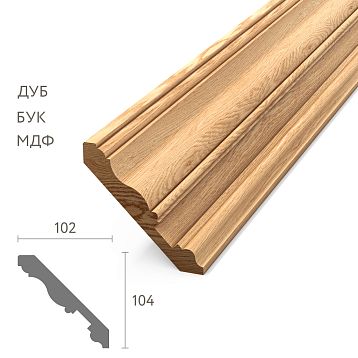
Black handles look especially striking where other dark elements already exist: window profiles, thin black lamps, picture frames, thin linesMDF molding for painting. In this case, handles become part of the overall graphic system.
Materials and finishes of black handles
Even within one color group, 'black' can sound differently — everything depends on the material and texture.
-
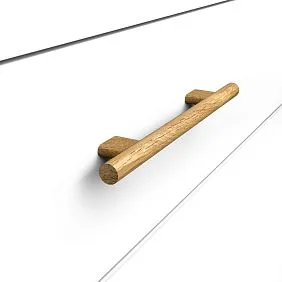
Black woodenFurniture Handlesunder matte paint — velvety, tactile, warm. Unlike metal, they do not 'ring' with coldness.
-
Handles made of solid oak or beech, painted in deep black, retain a slight readability of texture under paint — this adds character to the handle, distinguishing it from plastic.
-
Combining black wood with natural — for example, a handle with ends left in the color of oak and body painted black — gives a more complex, luxurious look.
In the STAVROS assortment there areWooden furniture handles with finish— a solution for those who want to achieve the perfect color and texture without painting themselves.
Black handle shapes: from minimalism to graphic design
Black color enhances the shape. What appears soft in white becomes much more graphic in black. Therefore, choosing the silhouette requires especially careful consideration.
-
Simple cylinders and blocks work perfectly in modern minimalism and Scandinavian interiors.
-
Long L-shaped handles on tall facades emphasize verticality and 'slim' the furniture.
-
Polished black buttons fit perfectly into neoclassicism and modern classicism: the color is modern, the shape — respectful of tradition.
-
Sculptural asymmetrical handles, painted black, become small art objects on facades.
If the interior already has black elements of complex shape (e.g., wrought iron details, decorative lamps), it makes sense to choose a simpler, geometric black handle — to avoid overloading the picture with ornamentation.
Furniture legs: black at floor level
Why make legs contrasting at all?
furniture legsin black color solve several tasks:
-
visually lift furniture above the floor;
-
create lightness where the body volume seems heavy;
-
set a horizontal rhythm at the bottom of the interior;
-
link furniture with other black accents — handles, lamps, profiles.
Especially striking are:
-
black turned legs under light-colored sofas and chairs;
-
dark supports under a dining table with a natural top;
-
black legs under a console or bench against a light wall and floor.
Which legs to paint black, and which to leave in wood?
Not every furniture benefits from black legs. There are several stable working schemes:
-
If the furniture body is light (white, beige, light veneer), blackfurniture legsalmost always enhances the image.
-
If the body is dark (oak, wenge), black legs should be used cautiously — better to make them slightly darker than the body or leave them in wood tone, and apply black to handles and decorative details.
-
In monochromatic light interiors, black legs of tables and chairs form a visual 'grid' at floor level — this helps space from 'spreading out' and maintains composition.
in the STAVROS catalog easily selectbuy furniture legsfor painting — made of solid wood, proper shape, which can be painted in the required black shade for a specific project.
Leg shapes: from classic to modern
Black enhances any shape, so balance is important.
-
Straight plank or conical legs — for minimalism, Scandinavian, Japanese style: black emphasizes their simplicity and geometry.
-
Turned baluster legs — for neoclassicism: in black, they read less "sweet" than in white or light tones, and add character to the interior.
-
Decorative supports under coffee tables — if you are building an interior around one or two expressive pieces, such legs in black will become a sculptural focal point.
Stavros offers a wide selection ofof furniture legs and supportsVarious diameters, heights, and profiles — from strict geometry to soft classicism. Black color on such forms is perceived especially nobly.
Decorative elements: black graphics on volume
What elements make sense to make black
Underdecorative elementsIn the context of 2026, it is worth understanding not only "beauty for beauty's sake", but also functional decor:
-
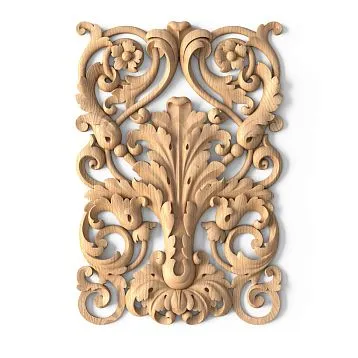
Carved appliqués on cabinet and chest facades;
-
Door stiles;
-
Corner elements for moldings;
-
Small wooden rosettes and cartouches;
-
Consoles and brackets under shelves.
All of this, painted black and set against a light wall or door, begins to function as graphic elements. Especially striking are:
-
Black stile on a light paneled door;
-
Black corner elements as part of a white wall molding frame;
-
Dark carved element in the center of a light-toned chest facade.
The best way to avoid mistakes — choose simple-shaped elements made of solid wood (e.g., oak or beech), similar to those offered by STAVROS in the sectionappliqués and decor for moldings, and already at the design stage, decide what will remain in wood and what will become a black accent.
Black on white and black on wood: two different characters
-
Black decorative elements on a white background — this is about graphic design, almost like a drawing. The interior becomes more architectural, clear, and strict.
-
Black decor on wood (e.g., on a veneered oak facade) — already closer to art deco, to premium quality, to deep, saturated combinations.
Black appliqués work well on kitchen, buffet, and display cabinet facades: if you don't want "gold", but desire status, a black carved element is an excellent alternative.
How to connect black handles, legs, and decor into a unified system
The Three-Point Rule
To avoid black appearing random, it must appear in at least three zones:
-
On furniture (handles, legs, possibly — part of the facade);
-
In architecture (thin moldings, door profiles, thinMDF ceiling moldings for paintingin dark tone);
-
In details (light fixtures, frames, graphics, textiles with black patterns).
If there are only black handles and nothing else in the room, they will look out of place. Add at least two more zones where black is expressed: thenFurniture Handles, Legsand decorative elements will harmonize with the rest of the picture.
One finish: matte, satin, or glossy
Black is not one thing. A combination of matte and glossy black can also be a technique, but beginners often find it misleading: details start to clash.
For a neat, luxurious effect:
-
Choose one finish type: either matte (the most trending in 2026) or soft satin;
-
Repeat it on all black elements: handles, legs, decorative appliqués, possibly — lamp profiles.
For example, matte blackfurniture handle+ matte blackfurniture legs+ matte black picture frame — and the graphics come together into a unified system.
Balance with wood and light surfaces
Black sounds especially good against:
-
light walls (white, milk, light gray);
-
natural wood (oak, beech, walnut in natural tones);
-
textured monochrome background (concrete, plaster).
Working scenario:
-
walls — light, with delicateMDF molding for painting;
-
furniture — wood + solid-colored fronts;
-
handles and legs — black;
-
accent decor — black appliqués or small details.
Thus, we get an interior where black does not 'absorb' light, but merely emphasizes it.
Examples of combinations for different rooms
Kitchen-living room
-
Upper and lower kitchen fronts — white or light gray.
-
Furniture handles — black— long wooden knobs on all fronts.
-
Dining table — oak top,table legs made of solid wood— painted black.
-
Chairs — light upholstery, black legs.
-
On the wall — thin black lamps, minimalist graphic posters in black frames.
Black unifies the kitchen and living area: handles, legs, frames, lamps work in unison.
Bedroom
-
Walls — warm light monochrome.
-
Bed — soft headboard, base on black wooden legs.
-
Nightstands — beige/gray, withblack handle-buttons.
-
Above the headboard on the wall — accent panel with thin black decorative strips or appliqués.
Black here works in moderation, emphasizing lines and not overpowering the feeling of coziness.
Entryway
-
Built-in wardrobe — light, almost blending into the wall.
-
On the fronts — verticalblack handle-bars— elongating space upward.
-
Banquette — light upholstery, black woodenLegs.
-
Mirror — in a thin black frame, black hooks for clothes.
As a result, the entryway looks cohesive and graphic, even if it is very compact by itself.
Common mistakes when working with black accents
-
Too much black with low ceiling
If you heavily use black on furniture, walls, and decor in a small room with a low ceiling, the space will visually appear lower and more cramped. In small rooms, keep black in details: handles, legs, small elements. -
Different character of black
When matte black, glossy black, black with strong brown undertone, and black with cool gray coexist in a room, the result is a sense of 'different blacks,' as if details from different stories. It's better to decide on one type in advance and repeat it. -
Random accents
One black handle against the absence of other dark elements will look like an error, not a technique. Always choose a set: handles + legs + at least one decorative element.
Questions and answers
Are black handles suitable only for modern interiors?
No. In classic and neoclassic interiors, black handles and legs work well if the shape supports the style. For example, black turned handle-buttons and turned legs-balusters will look noble and current.
Will black handles 'weigh down' a small kitchen?
At the right dosage — no. On the contrary, thin black handles on light fronts visually structure the set and make it 'lighter' due to clear graphics. The key — avoid introducing large black blocks on other surfaces.
Can black handles be combined with brass lamps?
Yes, this is a popular 2026 solution: cold black graphics + warm brass nobility. The key — maintain balance and repeat both metals at least 2–3 times in different zones.
Which is better for black accents: wood or metal?
For handles and legs, black wood looks more tactile, cozy, and 'homey'. Metal gives a colder, more technological effect. In residential interiors, black wood often wins — STAVROS offers ready-made solutions and paintable details.
How to care for matte black handles and legs?
Soft damp cloth, without abrasives and aggressive chemicals. For wooden parts with oil — periodic renewal of protective layer. For painted parts — careful wiping, light touch-up in scratched areas if needed.
STAVROS: black accents that work for style
To make black accents in interior sound luxurious and confident, you must treat the quality of the items no less strictly than their color. That's why professional designers and attentive homeowners choose STAVROS.
In the STAVROS catalog you will find:
-
solid wood furniture handles— with the option to paint them in a striking black color;
-
legs for furniture and supportsin various forms — from strict geometry to classic;
-
Solid wood decorative elements, which can be used as accent details and emphasized in black;
-
moldings and MDF elements for painting, with which black details read especially expressively.
Thoughtful design, quality wood, flawless finishing, and professional painting make black accents from STAVROS not only beautiful but also long-lasting. This is the case when one black handle or a pair of dark legs can change the feeling of the entire room — provided it is made without compromises.
STAVROS — this is the basis for interiors where black does not scare, but inspires.