Article Contents:
- History of balusters: from antiquity to the Petersburg style
- From pomegranate flower to architectural masterpiece
- Petersburg style: unique charm of the northern capital
- Functional significance of balusters: more than just support
- Safety and reliability: top priorities
- Aesthetic function: creating an architectural image
- Types of balusters: variety of forms and styles
- Classification by shape: from simple to complex
- Classification by manufacturing method: technologies of creating beauty
- Materials for balusters: choice defining character
- Wood: eternal classic and warmth
- Modern alternatives: innovations serving design
- Technical parameters and standards: safety above all
- Optimal sizes and proportions
- Calculating the number of balusters and their placement
- Requirements for strength and reliability
- Design Solutions: From Classic to Avant-Garde
- Classic solutions: timeless and beyond trends
- Modern trends: minimalism and functionality
- Ethnic motifs: returning to roots
- Installation and Mounting: From Theory to Practice
- Preparatory work: measurements and planning
- Ways to mount balusters: choosing the optimal solution
- Final Finishing and Protection
- Maintenance and Care: Preserving Beauty for Years
- Regular maintenance of wooden balusters
- Repairing damage and restoration
- Economic aspects: investment in beauty and safety
- Factors Affecting Cost
- Long-term advantages of quality balusters
- How to choose ideal balusters: practical recommendations
- Style Compatibility with Interior
- Considering room-specific features
- Material quality and manufacturing
- Conclusion: create your dream staircase
Have you ever wondered why some staircases look like ordinary functional elements, while others transform into true works of art, attracting admiring glances? The secret lies in the details, and the main one is the balusters. These elegant vertical supports not only hold the handrails but also create a unique look for the entire staircase structure, becoming a central element of the interior.
Saint Petersburg — a city with the richest architectural heritage, where the culture of wooden architecture has special traditions. Balusters SPb reflect this culture, combining centuries-old craftsmanship traditions with modern manufacturing technologies. They become not just a functional element, but a true decoration of the house, capable of transforming the space and creating an atmosphere of elegance and nobility.
In this article, we will reveal all the secrets of choosing ideal balusters for your staircase: from historical roots to modern trends, from technical characteristics to aesthetic nuances. You will learn how to properly select balusters so that they harmoniously fit into your interior and serve for many years, preserving their beauty and functionality.


History of balusters: from antiquity to the Petersburg style
Before diving into the world of modern balusters SPbLet’s take a brief journey through time and learn how these architectural elements evolved over centuries.




From pomegranate flower to architectural masterpiece
Interestingly, the name "baluster" comes from the ancient Greek word "balaustion," meaning "pomegranate flower." Indeed, if you look closely at the classic shape of a baluster, you can notice a resemblance to a partially opened bud of this plant. According to another version, balusters are reduced copies of architectural columns used in ancient architecture.
Interesting fact: neither in Ancient Rome nor in Ancient Greece did balusters exist as such, despite the widespread use of columns and pilasters. In architecture, they appeared only during the Renaissance and were initially used exclusively for balcony railings.
Balusters for staircases were first used in the 15th century, and by the end of this century, they became an indispensable part of architectural design. Depending on the styles that were in fashion, the decoration of balusters changed, but they had already firmly entered the architectural lexicon.
Our factory also produces:


Petersburg style: special charm of the northern capital
Saint Petersburg, founded by Peter I as the "window to Europe," absorbed the best European architectural traditions, including staircase design. The Petersburg style of balusters is characterized by particular elegance, harmonious proportions, and attention to detail.
In historic buildings of Saint Petersburg, you can see magnificent examples of balusters from various epochs and styles:
- Baroque balusters with lavish forms and rich decoration in the Winter Palace
- Classical balusters with strict proportions in aristocratic mansions
- Modern balusters with smooth lines and floral motifs in early 20th-century merchant houses
Modern masters of Saint Petersburg carefully preserve these traditions, creating balusters that fit organically into both historic interiors and contemporary spaces.
Get Consultation
Functional significance of balusters: more than just support
Balusters are not just decorative elements. They perform a number of important functions that make them indispensable in staircase construction.
Safety and reliability: top priorities
The primary function of balusters is to ensure safety when using the staircase. They create a reliable barrier, preventing falls from height, which is especially important in homes with children or elderly people.
According to building codes, the distance between balusters should not exceed 15 cm for residential wooden staircases. This is a safety requirement that prevents the possibility of falling through the railing.
Properly installed balusters make the entire staircase structure stiffer and more stable, evenly distributing the load between the handrails and the base. This is especially important for wooden staircases, which may deform under load and changes in humidity.
Aesthetic function: creating an architectural image
In addition to their practical function, balusters play a key role in forming the aesthetic appearance of the staircase. They can:
- Set the style of the entire interior, from classic to avant-garde
- Create visual accents that attract attention
- Form a rhythmic composition, adding dynamism to the space
- Highlight the status and taste of the house owner
Balusters are often the element that transforms an ordinary staircase into a work of art, the central interior feature that impresses guests.
Types of balusters: variety of forms and styles
Offers an impressive variety of design solutions. From minimalist, sleek forms to richly decorated baroque ornaments — every style finds its embodiment in polyurethane corner elements. This versatility opens boundless creative opportunities for designers and architects. balusters SPb offers an amazing variety of forms, styles, and materials, allowing you to choose the perfect solution for any interior.
Classification by shape: from simple to complex
Round balusters - a classic variant with a cylindrical shape. Their diameter is usually 40-50 mm. Such balusters are characterized by simplicity and versatility, fitting well into various interior styles. They can be plain or decorated with elements such as rings, grips, and knobs.
Square balusters - have the shape of a rectangular parallelepiped with a cross-section usually 40x40 or 50x50 mm. They give the staircase a more strict, geometric appearance and are often used in modern interiors. Square balusters can be plain or have beveled edges, carving, or milling.
Flat balusters - are made from boards 20-30 mm thick and have a flat shape with a decorative contour. They allow creating lace-like, intricate compositions and are often used in traditional Russian style. Flat balusters can have various cutouts, slots, and carved elements.
Figurative balusters - have a complex three-dimensional shape with numerous decorative elements. They become true works of art and the central design element of the staircase. Figurative balusters can be made in various styles, from Baroque to Modern.
Classification by manufacturing method: technologies of creating beauty
Turned balusters - are made on a lathe by rotating the blank and removing excess material with a cutting tool. This method allows creating symmetrical elements with smooth lines and transitions. Turned balusters are characterized by perfect geometry and smooth surface.
Milled balusters - are created using a milling machine, which cuts a specified pattern or design into the surface of the blank. This method allows creating both simple geometric shapes and complex decorative elements. Milled balusters can have either flat or three-dimensional relief.
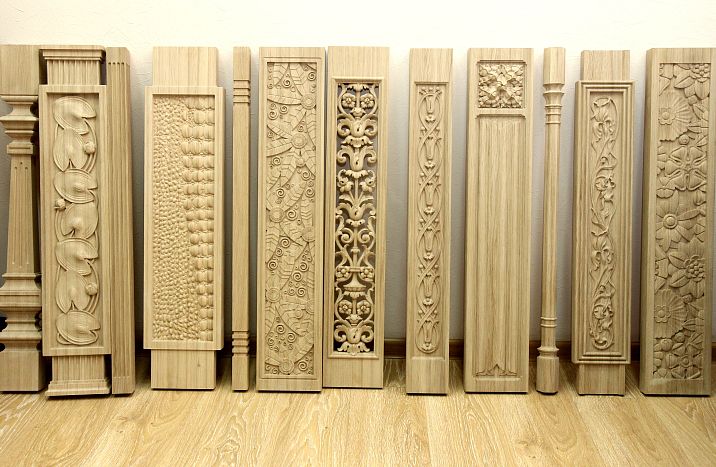
Carved balusters - are made using manual or machine carving of wood. This method allows creating unique, one-of-a-kind elements with high artistic value. Carved balusters can have floral, geometric, or figurative motifs.
CNC balusters - a modern manufacturing method using computer numerical control machines. This method combines high precision of machine processing with the ability to create complex, individual designs. CNC balusters are characterized by perfect repeatability of elements and the ability to realize any design ideas.
Materials for balusters: choice defining character
Choosing the material for balusters is crucial not only for their appearance but also for durability, strength, and performance characteristics.
Wood: eternal classic and warmth
Wood remains the most popular material for making balusters, and there are good reasons for this:
Aesthetic appeal - natural wood texture and warm tone create a cozy, home-like atmosphere. Each item is unique due to the distinctive grain pattern.
Ecological safety - wood does not emit harmful substances, and the essential oils and organic resins it contains positively affect the microclimate in the house.
Ease of processing - wood is easy to carve, turn, and mill, allowing the creation of items of any complexity and style.
Tactile comfort - wooden balusters are pleasant to touch, do not chill hands in winter and do not overheat in summer.
Various types of wood are used to make balusters, each with its own characteristics:
Oak - the king among wood species. Oak balusters are distinguished by exceptional strength and durability, withstanding significant loads without deformation. The noble texture with pronounced annual rings and warm honey-brown tone make oak balusters especially attractive. The service life of such balusters can reach 100 years with proper care.
Beech - a universal material for creating elegant balusters. Its homogeneous structure with fine pores provides a smooth surface and allows creating complex decorative elements. Beech has a pleasant light-pink tone, which may acquire a more saturated reddish hue over time. It is slightly less strong than oak, but it is more affordable.
Ash - a resilient beauty among wood species. It withstands significant loads, is resistant to rot, and has high elasticity. Ash's particular attractiveness lies in its variety of color tones - from light straw to rich brown with a pinkish hue. Ash is well-suited for mechanical processing, allowing the creation of balusters with complex shapes.
Spruce - the most popular and affordable material for balusters in Russia. It is easy to process, resistant to fungal damage, and has a pleasant pine aroma. The resins contained in spruce create natural protection against moisture and insects. Spruce balusters have a beautiful golden tone and a distinctive texture with visible annual rings.
Larch - a unique species that only hardens over time. It is characterized by high density, moisture resistance, and a beautiful amber tone. Larch balusters are practically immune to deformation and are ideal for rooms with high humidity.
Modern alternatives: innovations serving design
In addition to traditional wood, modern manufacturers offer balusters made from innovative materials:
Wood-plastic composite (WPC) combines the appearance of natural wood with enhanced resistance to moisture and temperature fluctuations. WPC balusters do not rot, crack, fade in sunlight, and require no regular maintenance.
Polyurethane - a lightweight and durable material that allows creating balusters with complex shapes and fine details. Polyurethane balusters are resistant to moisture, ultraviolet radiation, and mechanical damage, making them an ideal choice for humid environments.
Metal with wooden elements - a modern solution combining the strength of metal with the aesthetics of wood. Such balusters may feature a metal frame with wooden inlays or overlays, creating an interesting visual effect and enhancing the structure's durability.
Technical specifications and standards: safety comes first
When selecting and installing balusters, it is necessary to consider not only aesthetic preferences but also technical requirements ensuring the safety and comfort of staircase use.
Optimal sizes and proportions
The height of balusters in residential spaces should ensure a total railing height of 900-1000 mm from the stair tread level. For public buildings and outdoor staircases, this value increases to 1200 mm.
The cross-section of balusters may vary depending on design and material:
- For round balusters, the optimal diameter is 40-50 mm
- For square - 40x40 or 50x50 mm
- For flat - thickness 20-30 mm with width 80-120 mm
The distance between balusters should not exceed 150 mm for residential wooden staircases. This is a safety requirement, especially important in homes with children, to prevent falling through the railing.
Calculating the number and placement of balusters
The number of balusters is calculated by the formula:
N = (L - D) / (S + D) + 1,
where L – length of the handrail section, S – distance between balusters, D – diameter or width of the baluster.
To ensure maximum reliability, it is recommended to install one baluster per step. If this is not possible due to the staircase’s structural features, balusters must be evenly distributed and the required spacing between them must be maintained.
Requirements for strength and reliability
Balusters must withstand significant loads:
- Horizontal load on the handrail should be at least 0.3 kN/m (approximately 30 kg per meter)
- Vertical load on the handrail - at least 1.0 kN (approximately 100 kg)
Special attention should be paid to the fastening of balusters to treads and handrails. They must be secure and durable, capable of withstanding not only static but also dynamic loads.
Design solutions: from classic to avant-garde
Balusters SPb They offer a wide range of design solutions, allowing you to create a staircase perfectly matching the style of your interior.
Classic solutions: timeless and unfashionable
Classic balusters are characterized by harmonious proportions, symmetry, and refined details:
Turned balusters with a distinctive "barrel-shaped" profile, adorned with rings, beads, and other decorative elements. Such balusters are typically made from premium wood species (oak, beech, mahogany) and have a natural finish that highlights the beauty of the grain.
Carved balusters with plant or geometric ornaments, creating an effect of delicacy and lightness. The carving may be deep, relief, or surface/graphic.
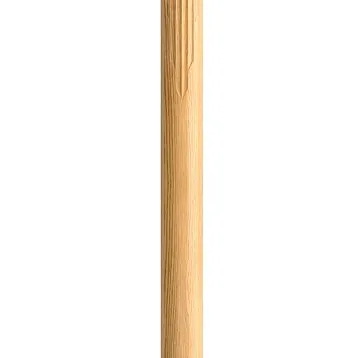
Balusters with fluting (vertical grooves), resembling ancient columns. Such balusters give the staircase a special grandeur and monumentality.
Classic balusters are ideal for traditional interiors, country houses, and mansions, where the atmosphere of nobility and solidity is valued.
Modern trends: minimalism and functionality
Modern balusters are characterized by minimalist forms, clean lines, and innovative materials:
Simple geometric shapes - straight or slightly curved balusters without excessive decoration, creating a sense of lightness and airiness.
Combined solutions - combination of wood with metal, glass, or other materials, allowing to create interesting visual effects and highlight the individuality of the interior.
Non-standard placements - instead of traditional vertical baluster placement, they can be installed at an angle or form complex geometric compositions.
Such solutions fit perfectly into modern minimalist interiors, lofts, and high-tech spaces.
Ethnic motifs: returning to roots
Ethnic motifs occupy a special place in baluster design, reflecting the cultural traditions of various peoples:
Russian style - flat balusters with carved relief, creating a lace-like effect. Traditional ornaments include solar symbols, floral motifs, and geometric patterns.
Scandinavian style - simple, minimalist forms with minimal decoration, made from light-colored wood. Often square balusters with small bevels or rounded edges are used.
Eastern style - richly decorated balusters with arabesques, floral ornaments, and geometric patterns. Often used inlays, gilding, and tinting.
Ethnic motifs allow creating a unique, memorable interior that reflects the cultural preferences of the home's owner.
Installation and mounting: from theory to practice
Correct installation of balusters is essential not only for aesthetic appeal but also for the safety of the entire staircase structure.
Preparatory work: measurements and planning
Before beginning installation, conduct thorough measurements and create a detailed plan:
- Determine railing height - measure from the stair level to the top of the handrail (usually 900-1000 mm).
- Calculate the number of balusters - using the formula provided above, determine the required number of balusters based on the required spacing between them.
- Marking installation points - mark the attachment points on the stairs and handrail, ensuring even distribution and compliance with required spacing.
- Prepare materials and tools - ensure all structural elements are ready for installation (treated with protective coatings, have necessary holes and grooves).
Ways to mount balusters: choosing the optimal solution
There are several ways to mount balusters, each with its own advantages:
Dowel joint - classic and most reliable method. Special holes are drilled in the stairs and handrail, into which the baluster dowels are inserted. This method ensures maximum structural rigidity and an aesthetically pleasing appearance without visible fasteners.
Mounting with self-tapping screws - a simpler method that allows quick installation of balusters. Screws are inserted at an angle through the baluster into the stair and handrail. After installation, fastening points are covered with wooden plugs or spackled and painted.
Use of special fasteners - modern method combining ease of installation with structural reliability. Special metal fasteners allow quick and precise installation of balusters, while also permitting replacement if necessary.
Final finishing and protection
After installing all railing elements, perform final finishing:
- Sanding - carefully sand all wooden surfaces, paying special attention to joints and fastening areas.
- Priming - apply a special primer that ensures better adhesion to the final finish and additional protection for the wood.
- Final finish - depending on desired result, apply varnish, oil, or wax. Varnish creates a durable protective film and adds gloss, oil penetrates deeply into the wood structure and highlights its natural beauty, wax creates a pleasant silky surface and additional protection.
- Structural integrity check - after completing all work, check the structural integrity by applying a load comparable to real operating conditions.
Maintenance and care: preserving beauty for years
Proper care of balusters will help maintain their attractive appearance and functionality for many years.
Regular care for wooden balusters
Wooden balusters require regular but simple care:
Daily dust cleaning - use a soft dry cloth or special care cloths for wooden surfaces.
Periodic wet cleaning - wipe balusters once a week with a slightly damp cloth soaked in a mild detergent solution. Afterward, always dry the surface with a dry cloth.
Updating protective coating - depending on usage intensity and coating type, it is recommended to renew the protective layer (varnish, oil, or wax) every 3-5 years.
Damage repair and restoration
Even with the most careful handling, damage may appear over time:
Minor scratches and scuffs on wooden surfaces can be removed using furniture wax or matching colored wax pencils.
Deep scratches and chips require a more serious approach - sanding the damaged area, filling with wood putty, and then staining or varnishing.
Loose joints must be reinforced by tightening fasteners or using specialized wood adhesives.
Economic aspects: investment in beauty and safety
Choosing and installing quality balusters SPb This is not just a money expenditure, but a long-term investment in the beauty, comfort, and safety of your home.
Factors Affecting Cost
The cost of balusters depends on several key factors:
Material - hardwoods (oak, ash) are significantly more expensive than pine or birch, but their service life is many times longer.
Design complexity - simple balusters are cheaper than intricately carved or turned elements. The more decorative elements, the higher the cost.
Manufacturing method - handcrafted items are valued higher than machine-made ones, which affects the price. However, modern technologies allow creating high-quality items at more affordable prices.
Order volume - when ordering a large quantity of identical balusters, discounts are often provided, reducing the overall project cost.
Long-term benefits of quality balusters
Investing in quality balusters pays off in the long term:
Durability - quality balusters made from good materials can last for decades without replacement. This is especially important for wooden staircases, where replacing individual elements may be complex and costly.
Safety - a reliable railing prevents possible injuries and falls, which is especially important in homes with children and elderly people. Cutting corners on baluster quality may lead to serious consequences.
Aesthetic appeal - a beautiful staircase with elegant balusters enhances the overall interior appeal and can become its central element, creating the first impression of the home.
Increased property value - quality architectural details increase the market value of a home or apartment. When selling property, an attractive staircase may be the deciding factor that tips the scales in favor of a purchase.
How to choose ideal balusters: practical recommendations
Choosing balusters is a responsible step that requires considering many factors. Here are several practical recommendations to help you make the right choice.
Style compatibility with interior design
Balusters should harmonize with the overall interior style and home architecture:
For classic interiors, elegant turned balusters with rich decoration, made from premium woods (oak, ash, mahogany), are suitable.
For modern interiors, choose minimalist shapes with minimal ornamentation, possibly using combined materials (wood + metal, wood + glass).
For ethnic styles (Russian, Scandinavian, Eastern), pay attention to balusters with distinctive national motifs and ornamentation.
It is important to consider other interior elements - furniture, wall finishes, flooring. Balusters should create a unified composition with them, not stand out from the overall style.
Room-specific considerations
The size of the space is crucial when selecting balusters:
In small spaces, it is better to use slender, elegant balusters that will not visually 'weigh down' the interior. Light-colored wood species and simple shapes are a good choice.
In spacious rooms with high ceilings, more substantial elements, possibly with rich ornamentation, are appropriate. Here, dark wood species and complex shapes can be used.
Lighting also affects the perception of balusters:
With bright natural lighting, all details and wood texture are clearly visible, so balusters with delicate carving and complex relief can be chosen.
With artificial lighting, some nuances may be lost, so it is better to prefer more expressive forms and contrasting combinations.
Material quality and craftsmanship
When selecting balusters, pay attention to the quality of the wood:
Humidity - the wood must be well-dried (humidity 8-12%), otherwise after installation, the balusters may deform.
Absence of defects - check for the absence of cracks, knots, and resin pockets at the joints.
Surface finish quality - the surface should be smooth, without burrs or roughness. All joints must be precisely fitted, without gaps or voids.
Protective treatment - quality balusters must be treated with antiseptics and protective compounds that prevent rot, insect damage, and mold.
Conclusion: create the staircase of your dreams
Balusters SPb These are not just functional elements of the staircase, but true works of art capable of transforming your home and creating a unique atmosphere of warmth and coziness. They combine centuries-old craftsmanship traditions with modern technologies, functionality and aesthetics, reliability and elegance.
When choosing balusters for your staircase, remember that this is an investment in the beauty, safety, and comfort of your home for many years. Quality balusters made from natural materials not only provide a reliable support for handrails but also become a central decorative element defining the style of the entire interior.
The variety of forms, materials, and stylistic solutions allows you to find the perfect option for any interior, from classic to ultra-modern. Professional installation and proper maintenance will ensure longevity and preservation of aesthetic appeal for many years.
STAVROS Company offers a wide range of high-quality balusters of various shapes and sizes. Years of experience, use of premium materials, and modern technologies allow us to create products combining beauty, reliability, and durability. Entrust the creation of your dream staircase to STAVROS professionals, and the result will exceed all your expectations!