Article Contents:
- Wooden house as an integrated system
- Choosing wood species: material consistency
- Stylistic diversity of balusters
- Round handrails: ergonomics and comfort
- Dimensions and Proportions: The Mathematics of Beauty
- Posts and balusters: hierarchy of elements
- Balusters for terrace: expanding the home’s space
- Round railings and trim: details create the whole
- Installation technology for balusters in a wooden house
- Finishing and protection: longevity through quality
- Design Solutions: From Classic to Avant-Garde
- Staircase lighting: function and drama
- Ecology and health: breathing clean air
- Regional characteristics of wooden house construction
- Cost and value: investment in quality
- STAVROS — quality, proven over time
- Conclusion: staircase as the soul of the house
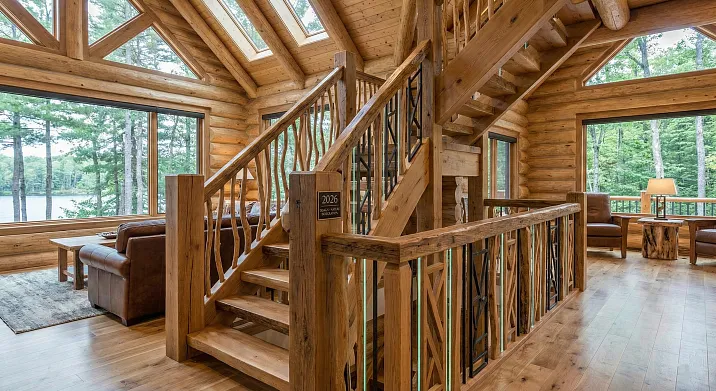
Balusters in a wooden house — not just a functional element, but an architectural centerpiece around which the interior is designed. And here, the key role is played bybalusters in a wooden housevertical posts connecting steps to the handrail, ensuring safety and visual integrity of the structure.
In 2026, country house construction is experiencing a real boom. People are moving from cities to nature, creating comfortable living spaces where modern technologies harmoniously blend with traditional materials. A wooden house becomes a place of power, where every detail matters — from the choice of wood species to the shape of balusters. Proper integration of staircase elements into the overall architectural concept turns the house into a work of art, where functionality is inseparable from aesthetics.


Wooden house as an integrated system
Why do balusters in a wooden house require a special approach? Wood is a living material that changes over time, reacts to humidity and temperature, and has natural shrinkage. A log cabin or timber frame house is a dynamic structure where all elements must function as a single organism. The staircase in such a house experiences additional loads due to the movement of the main structure.
correctly designed and installedWooden balusterstake into account these features. Compensatory joints are used, allowing the staircase to 'breathe' along with the house. Baluster fastenings are calculated to account for possible displacements, and flexible connections are applied where necessary. Only a comprehensive approach guarantees the longevity and safety of the structure.
Aesthetic integration is equally important. Balusters must harmonize with the overall style of the house — type of log cabin, thickness of logs or beams, finish character. A massive log house requires corresponding balusters — sturdy, substantial, possibly simpler in form. A house made of dressed timber in a modern style allows for more elegant, geometrically precise solutions.




Choosing wood species: material consistency
One of the main rules for integrating staircase elements is material consistency. If the house is built from pine, it makes sense to use pine balusters. If larch was used, the balusters should also be made of larch. This ensures uniformity of texture, color, and wood character.
However, there are also interesting contrasting solutions. For example, walls made of light pine beautifully complement dark oak balusters. This creates a noble contrast that emphasizes architectural lines. Ash balusters against a larch log cabin create a play of tones in a warm brown palette.
wooden balusters for staircasesWood from different species has different characteristics. Oak is the strongest, ideal for heavily used staircases. Ash combines strength with beautiful texture. Beech offers a smooth surface and pleasant light tone. Larch is the optimal choice for humid areas and locations with temperature fluctuations.
It is important to consider the origin of the wood. Northern wood is denser and more resistant to loads due to slow growth. Southern wood is softer and easier to process. For balusters, it is better to choose dense wood with minimal knots, properly dried to a moisture content of 10-12%.
Our factory also produces:


Stylistic diversity of balusters
The architecture of a wooden house can vary — from traditional Russian izbas to modern chalets, from minimalist Scandinavian style to luxurious country style. Each style requires corresponding balusters.
Traditional Russian style tends toward precisely turned balusters with smooth forms, handrails, and spherical elements. Such balusters evoke the craftsmanship of ancestors and create an atmosphere of a family hearth. Carved elements with plant motifs enhance the ethnic character of the interior.
Scandinavian minimalism implies simple, laconic forms. Square or rectangular balusters made of light wood — pine or ash — painted white or left in their natural state. No decoration, only pure geometry and functionality.Flat wooden balustersPerfectly fit into this aesthetic.
Chalet style originated in the Alps and adapted beautifully to Russian reality. Massive balusters made of dark wood, intentionally rough, emphasizing the naturalness of the material. Often, combinations of wood and metal — forged inserts — add a ruggedness.
Modern eco-style strives for naturalness while preserving technological efficiency. Balusters made of unprocessed wood with preserved natural texture, possibly with bark on certain sections. Or, conversely, perfectly sanded and oiled elements showcasing the beauty of wood.
Choosing the style of balusters is choosing the character of the entire house.Buy wooden balustersIt requires understanding the overall concept, consulting with an architect or designer, and considering all interior details.
Get Consultation
Round handrails: ergonomics and comfort
Balusters are inseparably linked to handrails — horizontal elements to which one holds when ascending or descending. A proper handrail ensures safety and comfort when using the staircase.Round Handrail— a classic solution, proven by centuries of use.
The handrail is made from the same wood species as the balusters. It is important that the texture and tone match — this creates visual continuity of the structure. The handrail surface must be perfectly smooth, without any roughness or burrs. Multiple sanding with gradually decreasing abrasive grit, followed by final polishing — this is the path to perfection.
a round wooden handrailProtective coating of the handrail is especially important. It is the most frequently touched surface in the house, subjected to constant mechanical stress and contact with skin. Wear-resistant lacquers, oils, and wax-based compounds are used. The coating must be not only durable but also pleasant to the touch, non-sticky, and non-slippery.
Handrail attachment to balusters is performed in various ways. The classic method involves placing the handrail on top of the baluster ends and securing it with screws. A modern method uses special handrail brackets with grooves into which the upper parts of the balusters are inserted.
High-quality handrails mean investing in the family's safety for many years.I buy a round handrailHigh quality means investing in family safety for many years.
Dimensions and proportions: the mathematics of beauty
A harmonious staircase means correct proportions of all elements. There are time-tested ratios that ensure both safety and aesthetics.
The height of the baluster is determined by the height of the railing, which, according to building codes, must be at least 90 cm. The optimal height is 100–110 cm — this is a comfortable level for hand support. The baluster itself has a height of about 80–90 cm, as part of the height is taken up by the tread thickness and handrail.
The diameter or thickness of the baluster varies from 30 to 80 mm. Thin balusters look elegant but require frequent installation. Thick ones are sturdy and reliable but may visually overload the space.Round handrail 50A diameter of 40–50 mm perfectly complements balusters with a diameter of 40–50 mm — resulting in a balanced composition.
The spacing between balusters is a critically important safety parameter. A maximum of 15 cm between the centers of adjacent balusters is a requirement that prevents a child from slipping between the posts. Typically, 2–3 balusters are installed per step, depending on the width of the staircase.
The proportions of decorative elements on turned balusters also follow certain rules. Handrails should not be too thin — this weakens the structure. Spherical elements are arranged harmoniously, creating rhythm. Professional turners know these rules and create balusters that delight the eye with their proportions.
Columns and balusters: hierarchy of elements
In the construction of a staircase railing, there is a hierarchy.wooden post balusterSupport columns — these are elements of different significance, although they are often confused.
Support columns (also called newel posts or tumbas) are strong vertical posts installed at the beginning and end of the staircase run, as well as at turns. They bear the main load from the handrail, ensuring the rigidity of the entire structure. The cross-section of support columns is usually 80–120 mm, and their height may exceed the height of regular balusters by 10–20 cm, creating visual accents.
Balusters and columns should match stylistically, but columns can be more decorative. For example, if the balusters are simple turned pieces, the support columns may be adorned with carved capitals, multi-tiered, with more complex profiles. This creates visual hierarchy and marks structurally important points.
The style of balusters and newel posts should match, but newel posts can be more decorative. For example, if the intermediate balusters are simple turned ones, the support posts are adorned with carved capitals, made multi-tiered, with a more complex profile. This creates visual hierarchy and marks structurally important points.
Balusters and posts made of woodFor country houses, columns and balusters are often custom-made according to individual sketches. This allows creating a unique staircase, unlike any other, perfectly integrated into a specific interior.
Balusters for the terrace: expanding the home's space
A wooden house is unthinkable without a terrace or veranda — spaces where the interior flows into the exterior, where you enjoy nature without leaving home. A terrace requires railing, and herebalusters for terracePlay a key role.
Terrace balusters operate under more demanding conditions than interior ones. They are exposed to precipitation, temperature fluctuations, and ultraviolet radiation. Therefore, material requirements and treatment here are higher. Species with natural moisture resistance — larch, oak — are used. Deep impregnation with antiseptics, moisture-protective compounds, and a finish with UV filters are mandatory.
The stylistic design of terrace balusters should match interior ones. This creates a visual connection between the house and its surrounding area. If interior balusters are precisely crafted pine, on the terrace it makes sense to use similar ones but made from more durable larch, possibly with additional oil treatment.
The height of the terrace railing is the same as for interior staircases — at least 90 cm. The distance between balusters — the same maximum of 15 cm. But structurally, terrace railings may differ. Often, more substantial support posts are used, possibly combined constructions — wooden balusters combined with glass panels or metal elements.
Round railings and trim: details create a whole
In addition to balusters and handrails, a wooden house uses many other trim elements that must be coordinated with each other.round wooden handrailsThis is a general term including balusters, handrails, and baluster supports.
round moldingThis is used not only in staircases. It includes baseboards, casing, thresholds, decorative elements. Unity of form and material of all these details creates a harmonious interior. If you have chosenround handrails 50 mmIt has many advantages. The absence of sharp edges makes it safe, especially in homes with children. Rounded shapes are easier to clean, and less dust accumulates on them. Visually, a round profile softens the space, making it cozier.
wooden round balustersIt has many advantages. The absence of sharp edges makes it safe, especially in homes with children. Rounded shapes are easier to clean, accumulate less dust. Visually, a round profile softens the space, making it cozier.
The production of quality round trim requires precise equipment. The wood must be perfectly dried; otherwise, the item will warp. Processing is done in several passes, gradually approaching the final size. Sanding is multi-stage, using abrasives of different grits.
round molding purchaseIt makes sense to purchase a set for the entire house. This ensures unity of color and texture — since even wood of the same species may vary in shade depending on the batch.
Technology of installing balusters in a wooden house
Installation of staircase elements in a wooden house has its own features. The main one is accounting for the building's shrinkage. A freshly assembled frame may shrink up to 10-15 cm in the first year. Even well-dried timber shrinks 3-5 cm. If rigidly fixed, the staircase may warp, and balusters may crack.
There are several technologies for installing staircases in wooden houses:
Independent construction — the staircase is mounted on its own stringers or treads, which are attached to the floor and ceiling through sliding joints. The house shrinks, but the staircase remains in place.Installing balusters on a wooden staircaseIn such a scheme, the staircase is installed in the usual way.
Attachment to the wall via compensators — one side of the staircase is attached to the wall through special sliding joints allowing vertical displacement. The other side — on support posts.
Fully independent staircase — a standalone structure, not attached to walls. Such a staircase does not react to house shrinkage but requires a strong foundation and careful calculation.
It is important to ensure the verticality of balusters. A level and plumb bob are used. Mounting is done using dowels, bolts, or through a baluster support.Fastening wooden balustersThe attachment to the treads must be secure but not prevent minor movements of the structure.
All metal fasteners must be embedded into the wood and covered with wooden plugs. This is not only aesthetically pleasing but also protects the fasteners from moisture and corrosion.
Processing and protection: longevity through quality
Even in the interior, wooden balusters require protection. Changes in humidity during winter heating and summer ventilation, mechanical impacts during use, and ultraviolet radiation from windows — all of this affects the wood.
The first stage — antiseptization. Even if balusters will not be exposed to direct moisture, antiseptic treatment is mandatory. This prevents biological damage, mold, and mildew. Modern antiseptics are safe for humans after drying and have no odor.
The second stage — priming. Primer equalizes the wood's absorption, ensuring better adhesion to the final finish. This is especially important for porous species — pine, spruce.
The third stage — final finish. Here are the options:
Varnish creates a durable protective film. It highlights the wood's texture and can be glossy, satin, or matte. The downside — over time, it may crack and requires complete removal upon renewal.
Oil penetrates the wood's structure, nourishes it, and highlights its texture. The surface remains matte and pleasant to the touch. Renewal is simple — just apply a new layer. The downside — lesser resistance to abrasion.
Wax provides a silky surface and water-repellent properties. Often used over oil. Requires periodic renewal.
Stain plus protective layer allows changing the wood's color and imitating expensive species. Pine can be stained to resemble oak, achieving the desired shade at lower cost.
How to install wooden balustersThis is not only a mechanical issue but also a matter of treating joints. Ends must be covered with an additional protective layer, as moisture penetrates through them most quickly.
Design solutions: from classic to avant-garde
Modern woodworking technologies open up boundless opportunities for creativity. Balusters are no longer just functional elements—they have become a canvas for design experiments.
Lacy balusters with pierced patterns create a play of light and shadow. Such elements are manufactured on CNC routers according to individual sketches. They can imitate lace, floral motifs, or geometric ornaments.
Combined balusters combine wood with other materials. Wooden base with glass inserts, metal decorative elements, leather wrappings. Such solutions are unique and create an unmistakable character for interiors.
Painted balusters challenge the conventional view of wooden staircases. White, gray, black, colored—paint allows integrating the staircase into any interior. The wood texture may either be concealed under opaque paint or subtly visible through semi-transparent finishes.
Asymmetric compositions alternate balusters of different heights, thicknesses, and shapes. This creates a dynamic rhythm, turning the staircase into an art object. Such solutions require precise calculation and a sense of proportion—easily crossing the boundary to achieve chaos instead of harmony.
Carved wooden balustersHandmade — a one-of-a-kind product. The master carver creates a unique piece, infusing soul into every element. Such balusters transform the staircase into an art gallery.
Staircase lighting: function and drama
Proper staircase lighting is a matter of both safety and aesthetics. In a wooden house, where many natural materials and textures are present, light plays a special role, revealing the beauty of wood and creating depth and dimension.
Step lighting — LED strips are embedded in the risers or along the edges of the steps. Soft light marks each step, eliminating the risk of tripping. Warm white light harmonizes with wood, emphasizing its texture.
Baluster lighting — spotlights at the base of balusters create a 'floating' staircase effect. Light is directed upward, highlighting the silhouettes of balusters and creating dramatic shadow play on walls and ceiling.
Handrail lighting—an LED strip is integrated into the handrail. Particularly effective when combined withround handrails for stairsSpecial profiles with grooves for the strip and semi-transparent caps are used.
Decorative lighting — pendant lights over the staircase landing, wall sconces. Such lighting is more decorative in nature, creating an atmosphere, but must be complemented by functional lighting.
Light control is also important. Motion sensors automatically turn on lighting when someone appears. Dimmers allow adjusting brightness according to time of day — minimal lighting during the day, slightly brighter at night for safety.
Ecological and health: breathing clean air
One of the main reasons for choosing a wooden house is its ecological nature. Wood breathes, regulates humidity, and creates a healthy microclimate. It is important that all house elements, including balusters, support this ecological concept.
Choosing wood species from an ecological standpoint means preferring local varieties. Pine, spruce, larch, oak, beech grow in Russia, their use does not require long-distance transportation and supports local manufacturers.Buy wooden balustersChoosing Russian-made balusters means selecting ecological products and supporting the domestic economy.
Wood treatment should also be ecological. Modern water-based compositions do not contain toxic solvents and are safe for humans and animals. Natural oils and waxes — linseed, tung, carnauba wax — are 100% natural products without synthetic additives.
Avoiding formaldehyde-containing adhesives and compositions is critically important. If balusters are manufactured using glued methods, only safe E0-class adhesives are used. Although the best option is balusters made from solid wood, without gluing.
Wooden balusters in a wooden house are not just beautiful—they are beneficial for health. Wood releases phytoncides — natural antiseptics that purify the air. Touching warm woodof round handrailprovides tactile pleasure and reduces stress.
Regional characteristics of wooden house construction
Russia is vast, and traditions of wooden house construction vary across different regions. This influences the choice of balusters.
Northern regions (Arkhangelsk Oblast, Karelia, Komi) have rich traditions of working with wood. Here, massive, sturdy forms are preferred, along with dense northern pine and spruce. Balusters are often simple but reliable, without excessive decoration. Emphasis is placed on strength and durability.
Central Russia (Moscow, Vladimir, Kostroma Oblasts) leans toward carved balusters with rich decoration. Traditions of wooden architecture here include abundant carving and precisely crafted elements of complex shapes. Both coniferous and deciduous species are used.
Siberia, with its harsh climate, requires particularly robust solutions. Siberian larch is the best material for balusters. Forms are usually simple and functional. Careful treatment with protective compounds is essential due to large temperature fluctuations.
Southern regions (Krasnodar Krai, Stavropol) use more hardwood species — oak, beech. The humid climate requires enhanced protection against rot. Stylistic elements often borrow from Caucasian architecture — more elegant forms, ornate details.
Round beech handrailsare popular in southern and central regions where beech is available. In northern areas, they are more commonly usedRound oak handrailor coniferous species.
Cost and value: an investment in quality
Price is always a relevant question. How much do quality balusters for a wooden house cost? The range is enormous — from a few hundred rubles for a simple pine baluster to tens of thousands for a hand-carved oak piece.
Price is influenced by:
-
Wood species — oak and exotic species are more expensive than pine
-
Complexity of shape — carved balusters are more expensive than turned ones, turned ones are more expensive than simple square ones
-
Method of manufacture — handcrafted items are more expensive than machine-made ones
-
Quality of processing — number of sanding stages, type of protective coating
-
Individuality — custom-made items according to a sketch are more expensive than standard ones
Balusters pricewhich may seem high, is actually justified by longevity. Quality balusters last as long as the house — 50-100 years. This makes them a worthwhile investment compared to cheaper alternatives that require replacement every 10-15 years.
When planning your budget, consider not only the cost of balusters, but also associated expenses: handrails, support posts, fasteners, protective coatings, and master craftsmen’s work. A comprehensive approach allows you to assess the true cost of the project.
Saving money makes sense only sensibly. You can choose a more affordable wood species, but do not compromise on processing quality. You can order a simpler baluster shape, but use high-quality protective coatings. False economy on critically important safety elements is unacceptable.
STAVROS — quality proven over time
When it comes to balusters for a wooden house, the choice of manufacturer is critically important. STAVROS is a recognized leader in the wood processing market in Russia. Decades of experience, modern equipment, quality control at every stage — these are the foundations of the company’s reputation.
STAVROS offers an extensive range of balusters — from classic turned to modern designer styles. Any wood species, any shapes and sizes. The company works with both private clients and large construction projects, ensuring consistently high quality.
Specialized direction — manufacturing balusters according to individual sketches. You can come with your own idea, and experienced craftsmen will bring it to life in wood.Buy round wooden handrail— you can select the perfect balusters, support posts — everything can be done at STAVROS as a turnkey solution.
The company uses only certified wood from sustainably managed forests. All protective coatings have ecological certifications and are safe for use in residential spaces. STAVROS — responsible production approach and care for the environment.
The company’s service includes consultations on material selection, calculation of required quantities, installation and maintenance recommendations, nationwide delivery. Working with STAVROS, you receive not just a product, but a comprehensive solution for your home.
Conclusion: the staircase as the soul of the house
The staircase in a wooden house is more than just a way to reach the second floor. It is a vertical element organizing space, a central interior feature, the house’s calling card. And balusters — the soul of this staircase, its character, its voice.
Correctly selectedbalusters in a wooden housecreate harmony, unify all interior elements, ensure safety and comfort. They serve for decades, delighting the eye with their beauty and offering tactile pleasure upon touch.
Integrating staircase elements into country architecture — this is an art requiring knowledge, experience, and a sense of style. The year 2026 brings new wood processing technologies, new protective coatings, new design solutions. But the fundamental principles remain unchanged: material quality, craftsmanship, attention to detail.
Choose balusters made of natural wood. Trust proven manufacturers. Do not compromise on quality and safety. And your staircase will become a home decoration, a source of pride, an inheritance for future generations.
STAVROS is ready to become your partner in creating your dream home. Qualitywooden balusters for staircasesprofessional consultations, reliable service — everything to make your wooden house perfect.