Article Contents:
- Philosophy of the Square Shape in Design
- Aesthetics of Minimalism
- Technical Advantages of Square Cross-Section
- Mechanical properties
- Technological features of production
- Wood science: choosing wood for square balusters
- Oak — The Standard of Quality
- Ash — Strength and Beauty
- Beech — Uniformity and Stability
- Spruce — Accessibility and Practicality
- Dimensional Scale and Standards
- Standard Cross-Sections
- Height Parameters
- Manufacturing and processing technologies
- Raw Material Preparation
- Mechanical processing
- Final finishing
- Installation of square balusters
- Marking and Preparation
- Mounting methods
- Features of Working with Square Cross-Section
- Design solutions and stylistic directions
- Minimalism and High-Tech
- Scandinavian Style
- Loft and Industrial Style
- Economic aspects of selection
- Production Cost
- Long-Term Economic Efficiency
- Maintenance and care
- Regular Cleaning
- Recoating
- Trends and innovations
- Ecological innovations
- Technological innovations
- Conclusion
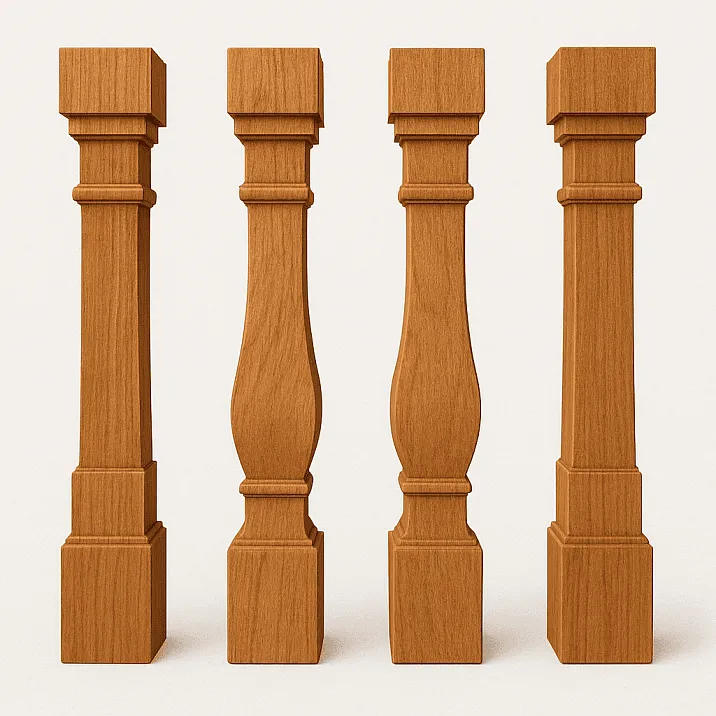
In the world of architectural solutions, where every detail matters, straight square wooden balusters occupy a special place as embodiments of minimalist elegance and functional reliability. These minimalist elements of stair railings represent an ideal balance between simplicity of form and refined execution, where every edge is polished to perfection, and every angle emphasizes the strict geometry of modern design.
Square cross-section is not merely a fashion trend or an attempt to simplify production. It is a deliberate choice in favor of architectural honesty, where form follows function, and beauty arises from the harmony of proportions. The straight lines of square balusters create a rhythmic structure that soothes the eye and imparts to the staircase a sense of confidence and stability.
Modern interiors require elements that do not shout about themselves but quietly and confidently perform their role, creating the foundation for the overall composition. Square wooden balusters are precisely such elements — they do not aspire to be the main characters, but without them, the entire structure loses its completeness and harmony.


Philosophy of the Square Shape in Design
The square in architecture is a symbol of stability, order, and rationality. When we speak of square balusters, we refer to deep principles of human spatial perception. Four equal sides, four right angles — this is mathematical precision embodied in wood.
Psychology of geometric form perception shows that the square is associated with reliability, solidity, and honesty. These qualities are especially important for safety elements, such as balusters. Humans subconsciously trust constructions with clear, understandable forms.




Aesthetics of Minimalism
In an era of information overload and visual noise, the ability to create calm, harmonious spaces becomes especially valuable. Square balusters fit perfectly into the philosophy of minimalism, where each element must be functionally justified and aesthetically perfect.
The absence of decorative excesses does not mean the absence of beauty. On the contrary, the beauty of square balusters lies in their ability to highlight the natural texture of wood, the play of light and shadow on their faces, the precision of carpentry craftsmanship. Every surface becomes a canvas on which nature draws its patterns.
Our factory also produces:


Technical Advantages of Square Cross-Section
The choice of square cross-section for balusters is determined not only by aesthetic but also technical considerations. The square shape ensures optimal load distribution and maximum rigidity with minimal material consumption.
Get Consultation
Mechanical properties
The moment of resistance of a square cross-section significantly exceeds the corresponding value for a circular cross-section of the same perimeter. This means that a square baluster, using the same amount of wood, will be stronger and more resistant to bending loads.
The four sides of the square newel post create additional stiffening ribs that prevent deformation under load. This is especially important for tall newel posts, where even minor deviations can lead to loss of stability of the entire structure.
The square cross-section also provides better resistance to torsional loads. Under lateral force on the handrail, square newel posts perform more effectively than round ones, thanks to a greater moment of inertia relative to diagonal axes.
Technological Features of Production
Manufacturing square newel posts requires high precision and quality equipment. Each face must be perfectly flat, the angles strictly right, and all four sides absolutely parallel. Even the slightest deviations become immediately noticeable and spoil the overall impression.
Modern four-sided planers allow achieving the required precision, ensuring deviations no more than ±0.1 mm. This is critically important for creating quality products, where each part must fit perfectly with adjacent elements.
Finishing square newel posts requires special attention to the corners. Sharp edges should be slightly rounded for safety and ease of use, while still preserving the geometric clarity of the shape.
Wood Science: Choosing Wood for Square Balusters
Choosing the wood species for manufacturing square newel posts is an art requiring deep understanding of the properties of different types of wood. Each species has its own characteristics that affect both the technical properties of the finished product and its appearance.
Oak — the standard of quality
Oak straight square wooden balusters represent the pinnacle of carpentry craftsmanship. Oak's density of 700-800 kg/m³ ensures exceptional strength and durability. Tannins contained in the wood create natural protection against rot and pests.
Oak's texture with clearly visible growth rings creates a beautiful pattern of parallel lines on the faces of square newel posts. This natural decoration emphasizes the geometry of the shape and adds visual interest without disrupting minimalist aesthetics.
Oak's color palette ranges from light golden to dark brown, allowing selection of a shade to match any interior concept. Especially prized is stained oak, which acquires a noble dark color and unique patina.
Ash — strength and beauty
Ash square newel posts combine high strength with expressive texture. Ash's density of 650-750 kg/m³ provides excellent mechanical properties at a relatively low weight of the structure.
A distinctive feature of ash is its contrasting texture with a clear distinction between light sapwood and dark heartwood. On the faces of square newel posts, this feature creates an interesting visual effect, emphasizing the geometry of the shape.
Ash is easily processed and finished. Its open porous structure readily absorbs stains and varnishes, allowing various color effects to be created while preserving the natural texture.
Beech — uniformity and stability
Beech square newel posts are valued for their exceptional uniformity of structure and stability of dimensions. Beech's fine-grained texture creates a delicate, subtle pattern on the surface of the faces, which does not distract from the geometry of the shape.
Beech's density of 650-700 kg/m³ ensures sufficient strength with excellent workability. Beech is easily planed, milled, and sanded, allowing perfectly smooth surfaces on the faces to be achieved.
A feature of beech is its ability to evenly take stain. This allows creating square newel posts of any desired shade, from natural light rose to deep dark brown.
Spruce — accessibility and practicality
Spruce square newel posts offer an optimal combination of quality and accessibility. Spruce's density of 400-500 kg/m³ makes the structure lightweight, reducing the load on the staircase base.
Spruce's contrasting texture with a clear distinction between light sapwood and dark heartwood creates an expressive pattern on the faces of square newel posts. The resinous nature of the wood provides natural protection against moisture and biological damage.
Spruce is well-suited for all types of finishing treatments. It can be stained, painted, or varnished, creating various decorative effects while maintaining an affordable cost.
Size range and standards
Square newel posts are manufactured in a wide range of sizes, allowing selection of the optimal solution for any project. Standardization of sizes ensures compatibility of elements and simplifies the design of stair railings.
Standard cross-sections
The most popular are square newel posts with cross-sections of 40×40 mm, 50×50 mm, and 60×60 mm. The choice of a specific size depends on the height of the newel posts, the distance between them, and expected loads.
Newel posts with a 40×40 mm cross-section are suitable for light structures with low height and frequent placement of posts. They create an elegant, airy appearance of the railing without visually overloading the staircase space.
A 50×50 mm cross-section is a universal solution for most residential staircases. Such newel posts provide sufficient strength while maintaining an elegant appearance.
Newel posts with a 60×60 mm cross-section are used for tall railings or in cases of increased loads. They create a more substantial, robust appearance of the structure.
Height parameters
The standard height of square balusters is 800-900 mm, which ensures the creation of a guardrail of standard height 900-1000 mm, taking into account the handrail thickness. For children's staircases, balusters of lesser height may be used.
Long balusters of height 1000-1200 mm are used when it is necessary to create a guardrail of increased height or when the steps have increased thickness.
Accuracy in height manufacturing is critically important for the quality of the entire structure. Deviations must not exceed ±1 mm; otherwise, the handrail will have an uneven line.
Manufacturing and processing technologies
Manufacturing high-quality square balusters requires modern equipment and strict adherence to technological processes. Each stage of production affects the quality of the finished product.
Raw material preparation
The process begins with careful selection of timber. The blanks must be properly dried to a moisture content of 8-12% and must not have defects that may appear after processing. Special attention is paid to the grain direction — it must be parallel to the axis of the future baluster.
Wood drying is a critically important stage, determining the dimensional stability of the finished products. Chamber drying with controlled parameters of temperature and humidity ensures even moisture removal without internal stresses.
Sorting blanks by density and color allows creating homogeneous batches of balusters with identical characteristics. This is especially important for large projects, where all elements must appear uniform.
Mechanical processing
The blanks are planed on four-sided planers, which simultaneously process all four sides. This ensures ideal parallelism of opposite sides and strict perpendicularity of adjacent sides.
Machine setup requires high operator skill. The blades must be perfectly sharpened and correctly installed. Minor deviations lead to surface defects or distortion of the cross-section geometry.
Dimensional control is performed at every processing stage. Precision measuring tools are used, ensuring accuracy to 0.1 mm. This guarantees that finished products meet specified parameters.
Final finishing
Sanding square balusters requires special attention to corners and edges. All surfaces must be perfectly smooth, without tool marks or wood defects. Multi-stage sanding with gradually decreasing abrasive grit is used.
Final quality inspection includes visual control, dimension measurement, and geometry verification. Only products fully meeting quality standards are allowed for packaging and shipment.
Correct installation of square balusters is the key to the reliability and longevity of the entire guardrail. The process requires precision, care, and understanding of working with a square cross-section.
Installation of Square Balusters
Proper installation of square balusters is the key to the reliability and longevity of the entire railing. The process requires precision, care, and understanding of working with a square cross-section.
Marking and Preparation
Accurate marking of installation locations is the first and critically important stage of installation. All balusters must be positioned strictly vertically and at equal distances from each other. For square balusters, it is especially important to ensure correct orientation of the faces.
Square balusters are typically installed so that one of their faces is parallel to the step edge. This creates a visually correct perception and ensures optimal load distribution.
The distance between balusters must not exceed 150 mm to ensure safety. When using square balusters, this distance is measured between the centers of the cross-sections.
Methods of mounting
Mounting of square balusters can be performed in various ways depending on the staircase construction and aesthetic requirements. The most common methods are using dowels, bolts, or self-tapping screws.
Dowel connection provides hidden mounting without visible elements. Holes for wooden dowels of 8-12 mm diameter are drilled in the center of the bottom end of the baluster and in the step. The connection is made using carpenter's glue.
Mounting with metal bolts is stronger and allows for adjustment. The threaded bolt is screwed into the step, and the baluster is mounted on top. This connection can be disassembled if necessary for repair.
Features of working with a square cross-section
Square cross-section requires special precision when drilling holes. The center of the cross-section must be determined with high accuracy; otherwise, the baluster will be installed at an angle.
The center of a square cross-section is determined by the intersection of diagonals. Marking is done using a square and ruler. Marking accuracy is critically important for the quality of the entire guardrail.
Drilling holes in square balusters requires the use of guiding fixtures. The drill must enter strictly perpendicular to the end surface; otherwise, the baluster will be tilted.
Design Solutions and Stylistic Directions
Square balusters, due to their versatility, fit perfectly into various stylistic directions. Their minimalist form allows creating both strict minimalist compositions and more complex design solutions.
Minimalism and High-Tech
In minimalist interiors wooden square balusters They become an ideal choice. Their simple geometric shape does not distract from the overall composition, but highlights the purity of lines and functionality of the space.
Color solutions in a minimalist style lean toward monochromatic tones. White, gray, or black balusters create a strict, modern look. Natural wood tones are also appropriate if they harmonize with the overall color palette of the interior.
Combining square wooden balusters with metallic elements creates an interesting material contrast. Steel handrails or decorative inserts emphasize the technological aspect of the high-tech style.
Scandinavian style
Scandinavian design values the naturalness of materials and simplicity of forms. Square balusters made of light-colored wood fit perfectly into this aesthetic. Pine, birch, or whitewashed oak create a sense of freshness and purity.
A feature of Scandinavian style is the use of natural wood tones without staining. This highlights the natural beauty of the material and creates a sense of closeness to nature.
Functionality is a key principle of Scandinavian design. Square balusters fully align with this principle, providing maximum practicality with minimal decorative elements.
Loft and industrial style
In loft-style interiors, square wooden balusters create an interesting contrast with rough industrial materials. The warmth of wood softens the coldness of concrete and metal, making the space more cozy.
Color solutions in loft style lean toward dark, saturated tones. Dark brown or black balusters harmonize with the overall interior palette. A weathered effect adds authenticity.
Combining square wooden balusters with metal structures emphasizes the industrial character of the style. Open bolt connections and rough welds create the desired atmosphere.
Economic aspects of selection
Choosing square balusters is often determined not only by aesthetic but also economic considerations. The simplicity of the shape ensures relatively low production cost while maintaining high quality.
Production cost
Manufacturing square balusters requires less time and material compared to complex shaped items. The simplicity of processing reduces waste and increases productivity.
Standardization of dimensions allows for organized mass production with a high degree of automation. This further reduces cost and improves product quality.
The versatility of square balusters ensures stable demand, allowing manufacturers to plan large-scale production and optimize costs.
Long-term economic efficiency
The simplicity of the square baluster's shape ensures their durability. The absence of complex profiles and decorative elements reduces the risk of damage and simplifies maintenance.
Repair and replacement of square balusters are simpler and cheaper due to standardization of dimensions. In case of damage to individual elements, they can be easily replaced without dismantling the entire structure.
The versatility of the design ensures the long-term relevance of square balusters. They do not go out of style and do not require replacement when interior trends change.
Care and Maintenance
Due to their simple shape, square balusters require minimal maintenance. The absence of complex profiles and decorative elements simplifies cleaning and servicing.
Regular cleaning
The smooth edges of square balusters are easily cleaned of dust and dirt. Regular dry cleaning with a soft cloth or vacuum cleaner with a soft attachment is sufficient.
Wet cleaning is performed as needed using special wood care products. It is important to avoid excessive moisture, which may damage the protective coating.
The corners of square balusters require special attention during cleaning. Dust and dirt may accumulate here, so special brushes or cloths are used.
Recoating
The lacquer coating of square balusters requires periodic renewal. The simplicity of the shape significantly simplifies this process compared to complex shaped items.
Surface preparation includes light sanding to remove old coating and create a rough surface for better adhesion of the new layer. Flat edges are easily processed with sanding machines.
Applying new coating is done with a brush, roller, or spray. The square shape allows for even distribution of material across the entire surface without streaks or pooling.
Trends in development and innovation
The market for square balusters continues to develop, offering new solutions and technologies. Main trends are associated with improving product quality, eco-friendliness, and functionality.
Ecological Innovations
Growing attention to ecology stimulates the development of new wood processing technologies. Environmentally friendly stains and water-based coatings that do not emit harmful substances are used.
Certification of wood according to sustainable forestry standards is becoming a mandatory requirement. Consumers increasingly choose products made from responsibly harvested wood.
Waste recycling technologies allow the use of almost all wood, minimizing environmental impact. Sawdust and shavings are used to produce fuel briquettes or composite materials.
Technological innovations
Automation of production increases quality and reduces the cost of square balusters. Robotic lines ensure high precision of processing and stable parameters.
Quality control systems using machine vision allow defects to be detected at early production stages. This reduces the amount of scrap and improves overall product quality.
New wood drying methods provide better dimensional stability and reduce production cycle time. Vacuum drying and drying in inert gas environments open up new possibilities.
Choosing Straight square wooden balustersBy investing in functionality, beauty, and durability of your staircase, you are laying a reliable foundation for creating a safe and aesthetically pleasing railing.
Conclusion
The world of square wooden balusters is a wonderful blend of simplicity and perfection, where geometric precision meets the natural beauty of wood. Every edge, every angle is thoughtfully designed and refined, creating elements that serve not only functional purposes but also become an essential part of architectural composition.
In an era of complex technologies and excessive ornamentation, square balusters remind us of the value of simplicity and honest form. They do not strive to impress with extravagance or complexity — their strength lies in their simplicity, reliability, and ability to harmoniously fit into any space.
Choosing square wooden balusters is choosing in favor of rationality and longevity. This is a solution for those who understand that true beauty does not require excess, and quality is measured not by manufacturing complexity, but by the ability to serve long and reliably.
STAVROS understands the full importance of creating ideal square balusters and offers solutions that surpass the highest expectations. Years of experience working on elite projects, use of only the best materials and advanced technologies, strict quality control at every stage of production — all of this makes STAVROS a leader in the field of creating wooden staircase components. Choosing STAVROS means choosing not just a supplier, but a partner who shares your pursuit of perfection and is ready to bring it to life in every detail of your home.