Article Contents:
- Evolution of design: from simplicity to perfection
- Philosophy of flat form
- Technological possibilities of modernity
- Material science: choosing wood for perfection
- Coniferous species: accessibility and practicality
- Hardwood Species: Nobility and Durability
- Design directions: from classicism to avant-garde
- Classic Motifs in Modern Interpretation
- Modern minimalism: beauty of simplicity
- Ethnic motifs: cultural heritage
- Production technologies: from sketch to masterpiece
- Design and modeling
- Material preparation
- Shaping and decorating
- Installation and mounting: secrets of professional approach
- Preparatory work
- Joining technologies
- Mounting Quality Control
- Application areas: universality of flat forms
- Stair railings
- Terrace and balcony railings
- Decorative partitions and screens
- Maintenance and servicing: preserving beauty
- Daily care
- Periodic maintenance
- Economic Aspects: Investment in Quality
- Pricing factors
- Comparison with alternatives
- Trends in development: looking into the future
- Ecological trends
- Technological Innovations
- Design directions
- Conclusion
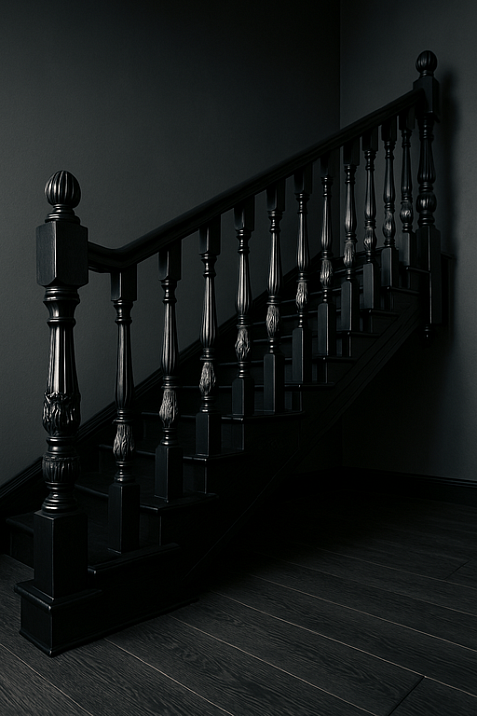
Imagine a staircase that doesn't just lead from floor to floor, but tells a story. Each of its elements is a word in the poem of architecture, and flat wooden balusters become an exquisite touch that transforms a functional structure into a work of art. These unique railing elements possess a special magic—they are capable of creating continuous decorative panels, where each detail complements the adjacent one, forming a harmonious ensemble.
Unlike traditional round or square posts, flat wooden balusters open up boundless opportunities for creative self-expression. Their shape allows elements to be placed closely together, creating a continuous decorative surface. This revolutionary approach to staircase railing design enables the realization of the most daring architectural concepts.
Modern wood processing technologies have turned the manufacture of flat balusters into a high art. Laser cutting, CNC milling, and hand finishing by master craftsmen—all of this allows creating items of incredible complexity and beauty. Each baluster becomes part of a grand story told by your home.




Evolution of design: from simplicity to perfection
The history of flat wooden balusters traces back to Slavic traditions of wooden architecture. Initially, they were simple boards with slots, serving exclusively protective functions. However, with the development of craftsmanship and the advent of new tools, these functional elements transformed into true masterpieces of decorative-applied art.




Philosophy of flat form
What makes flat balusters so special? Their uniqueness lies in their ability to create visual effects unattainable with traditional volumetric forms. The flat surface becomes a canvas for the artist, on which complex compositions can be created.
The thickness of modern flat balusters is usually 20-25 millimeters, with widths ranging from 80 to 150 millimeters. These proportions ensure an optimal balance of strength and elegance. The standard height of 900 millimeters meets safety regulations, but may vary depending on the architectural features of the project.
The feature of flat balusters is their ability to work in combination. While traditional balusters create rhythm through repetition of individual elements, flat balusters form a unified decorative surface. This opens up possibilities for creating panoramic compositions where the narrative develops from one baluster to another.
Our factory also produces:



Technological possibilities of modernity
The revolution in the production of flat wooden balusters began with the introduction of computer numerical control machines. These high-precision machines allow reproducing the most complex patterns with mathematical accuracy, ensuring perfect repeatability of elements.
Laser cutting has opened new horizons in creating openwork structures. The laser beam can cut through wood up to 30 millimeters thick, creating clean edges without charring. This allows creating delicate details that cannot be achieved using traditional methods.
Combined processing, combining machine and manual methods, allows achieving unparalleled quality. The main shape is created on machines, while the final finishing is performed by skilled craftsmen who impart each item with the warmth of handcrafted work.
Get Consultation
Material science: choosing wood for perfection
The quality of flat wooden balusters begins with the proper selection of material. Each wood species has its unique characteristics that determine not only the appearance of the finished product but also its performance properties.
Coniferous species: accessibility and practicality
Spruce remains one of the most popular materials for manufacturing flat balusters. Its soft structure easily withstands processing, allowing to create complex patterns without the risk of cracking. The resinous nature of spruce provides natural protection against insects and fungal damage.
Pine has an even more uniform structure and minimal knots. The light color of pine wood creates an ideal base for various types of finishes — from transparent varnishes to colored coatings.
Larch is a premium choice among coniferous species. Its high density and natural resistance to moisture make larch balusters ideal for rooms with variable microclimate. The beautiful texture with clearly defined annual rings creates an expressive decorative effect.
Hardwood Species: Nobility and Durability
Oak is traditionally considered the king among wood species for manufacturing architectural elements. Its exceptional strength, noble texture, and ability to become even more beautiful over time make oak flat balusters a true decoration for any interior.
Ash attracts designers with its elasticity and ability to withstand significant loads. The light wood with a clear fiber structure creates an expressive pattern, especially effective when using transparent finishes.
Beech, due to its uniform structure, allows creating flat balusters with perfectly smooth surfaces and delicate carving details. The pinkish hue of beech wood creates a warm atmosphere in interiors.
Design directions: from classic to avant-garde
Wooden flat balusters open up boundless possibilities for stylistic experiments. Their shape allows realizing the most diverse design concepts — from strict classicism to bold avant-garde.
Classic motifs in modern execution
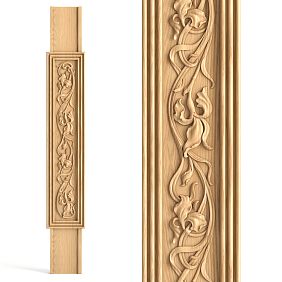
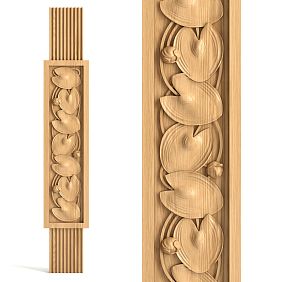
Classic style in flat balusters is embodied through the use of traditional ornaments and time-tested proportions. Botanical motifs — grapevines, oak leaves, roses — remain popular today, but receive a modern interpretation.
Classical neoclassical geometric patterns — meanders, palmettes, acanthus leaves — are adapted to flat forms, creating refined compositions. Symmetry plays a key role in classical solutions, where each element is carefully balanced.
The depth of relief in classical balusters can vary from light surface patterns to deep sculptural carving. The play of light and shadow emphasizes the volume of forms and creates painterly effects throughout the day.
Modern minimalism: beauty of simplicity
Minimalist flat balusters embody the principle 'less is more'. Simple geometric shapes — rectangles, ovals, abstract silhouettes — become the basis for creating elegant and functional items.
Special attention in minimalist design is paid to surface quality and precision of execution. Every line should be flawless, every transition smooth and natural. The absence of decorative excesses is compensated by perfect proportions.
Color solutions for minimalist balusters tend toward natural wood tones or monochromatic finishes. White, gray, black colors emphasize the purity of forms and create a sense of modernity.
Ethnic motifs: cultural heritage
Flat balusters provide an ideal opportunity to realize ethnic ornaments of various cultures. Russian folk patterns, Scandinavian motifs, oriental ornaments — all of this finds its place in modern design.
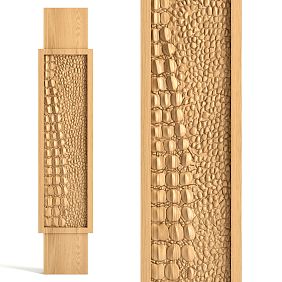
Stylized images of animals and birds, characteristic of folk art, are particularly popular. Bears, reindeer, phoenix birds create a connection with nature and cultural traditions.
The color palette of ethnic balusters often includes natural tones with accents of traditional colors — red, blue, green. Such solutions create an atmosphere of coziness and connection with roots.
Production technologies: from sketch to masterpiece
Modern production of flat wooden balusters represents a complex technological process, where each stage requires professional skill and precise adherence to technologies.
Designing and modeling
Creating flat balusters begins with detailed design. Modern computer-aided design programs allow creating accurate three-dimensional models of future products, taking into account all technological features.
Parametric modeling allows quickly making changes to the design and assessing their impact on the overall composition. This is especially important when creating sets of balusters, where each element must harmoniously match the others.
Virtual reality allows customers to see future balusters in the context of the interior even before production begins. This helps make an informed decision and avoid disappointments.
Material Preparation
The quality of finished balusters largely depends on proper wood preparation. Drying to 8-12% moisture ensures the geometric stability of the finished products. Modern drying chambers allow precise control of the process and obtaining material with specified characteristics.
Log selection is carried out taking into account the direction of the grain, absence of wood defects, uniformity of color and texture. For critical items, only radial sawing is used, ensuring maximum dimensional stability.
Pre-processing includes milling blanks to size, chamfering, and initial surface sanding. At this stage, it is important to ensure the accuracy of geometric parameters.
Shaping and Decoration
Creating complex shapes of flat balusters requires the use of high-precision equipment. CNC milling machines allow creating elements with accuracy down to tenths of a millimeter.
Laser cutting opens up possibilities for creating intricate patterns of incredible complexity. Modern laser systems can process wood of various thicknesses, creating clean edges without thermal impact on the material.
Manual finishing remains an important stage in producing exclusive items. Experienced carvers can create unique details that cannot be reproduced by machine.
Installation and Mounting: Secrets of Professional Approach
Quality Installation flat wooden balusters requires a special approach and understanding of the specifics of these elements. Unlike traditional balusters, flat elements are installed with minimal gaps, requiring high precision in mounting.
Preparation Work
Installation begins with careful checking of the base's geometry. Any irregularities or deviations from horizontal will be noticeable in the finished structure, as flat balusters form a single surface.
Marking installation locations is done using laser levels and special templates. Accuracy of marking is critically important, as even minor deviations may disrupt the overall composition.
Preparation of fastening elements includes selecting the optimal fixation method, taking into account the material of the base and the structural features of the balusters. Hidden fastening ensures an aesthetically pleasing appearance of the finished structure.
Mounting technologies
Flat balusters can be mounted using various methods depending on structural features and aesthetic requirements. The most common methods include mounting in grooves, on tenons, or with hidden fasteners.
Groove joint provides secure fixation and allows creating structures without visible fasteners. The groove is milled into the base and handrail, and balusters are inserted with a tight fit.
Tenon joint requires high precision in manufacturing but provides maximum strength. Tenons can be straight or wedge-shaped for additional fixation.
Mounting Quality Control
After installing each baluster, its verticality, tightness against adjacent elements, absence of gaps or cracks are checked. Any defects must be corrected before final fixation.
The overall geometry of the railing is controlled using taut strings and laser levels. All elements must lie in one plane and form a smooth surface.
Fastening strength is checked by applying light loads to each element. The structure should not have play or emit unusual sounds under load.
Areas of Application: Universality of Flat Forms
Flat wooden balusters find application far beyond traditional stair railings. Their versatility and decorative potential open up wide prospects for use in various fields of architecture and design.
Stair Railings
The main application of flat balusters is creating railings for interior staircases. Here, they demonstrate all their advantages: creating a continuous protective surface, ensuring safety, and at the same time serving as a striking decorative element.
For spiral staircases, flat balusters are especially effective, as they allow creating curved railings without visible joints. The flexibility of thin elements allows replicating complex curved shapes.
Straight stair treads with flat balusters acquire special expressiveness. The continuous decorative surface creates a powerful visual accent and can become a central element of the interior.
Railing for terraces and balconies
Outdoor railings require special requirements for materials and construction. Flat balusters made of larch or thermally treated wood handle atmospheric conditions exceptionally well.
Lacy flat balusters create an effective play of light and shadow that changes throughout the day. This adds dynamism to the building's facade and creates picturesque effects.
Combining flat balusters of different heights allows creating multi-level compositions that visually enrich the building's architecture.
Decorative partitions and screens
In modern interiors, flat balusters are often used to create decorative partitions that zone space without disrupting its integrity. Lacy structures allow light and air to pass through, creating a sense of lightness.
Partitions made of flat balusters can be either fixed or mobile. Modular systems allow easy adjustment of space configuration according to needs.
Lighting of partitions creates striking light patterns that become an independent design element of the interior.
Maintenance and care: preserving beauty
Proper care of flat wooden balusters ensures their longevity and preservation of their original appearance. Wooden elements require special attention to operating conditions and regular preventive maintenance.
Daily Care
Regular cleaning from dust and dirt should be performed using soft materials that do not damage the protective coating. For complex lacy forms, it is recommended to use soft brushes or vacuum cleaners with brush attachments.
Wet cleaning is performed with slightly damp cloth without using aggressive cleaning agents. Special attention should be paid to recesses and grooves, where dirt may accumulate.
Controlling humidity in the room helps prevent wood deformation. Optimal air humidity is 40-60% at a temperature of 18-22 degrees Celsius.
Periodic maintenance
Annual inspection of the structure allows identifying signs of wear or damage at an early stage. The condition of coatings, strength of connections, absence of cracks and deformations are checked.
Protective-decorative coatings are renewed as needed. Lacquered coatings usually require renewal every 5-7 years, oil-based ones every 2-3 years.
Minor damages are repaired by local sanding and touch-up. Serious defects may require replacement of individual elements.
Economic aspects: investment in quality
Purchasing flat wooden balusters represents a significant investment that pays off through durability, functionality, and aesthetic value. Proper budget planning allows achieving maximum return on invested funds.
Pricing Factors
The cost of flat balusters depends on many factors: wood species, complexity of processing, order volume, and production deadlines. Simple geometric shapes are cheaper than complex lacy structures.
Handmade work significantly increases the cost but ensures uniqueness and highest quality execution. Machine processing allows reducing the price while maintaining high quality.
Order volume affects the unit cost of the product. Large orders allow optimizing production processes and offering more favorable conditions.
Comparison with alternatives
Compared to traditional balusters, flat elements may be either more or less expensive depending on the complexity of execution. Simple flat balusters are often cheaper than turned counterparts.
Metallic and stone railings may have comparable costs, but wooden balusters win in terms of eco-friendliness, tactile feel, and repairability.
Composite materials offer an alternative to wood but cannot match it in aesthetic qualities and naturalness.
Trends in development: looking toward the future
Market flat wooden balusters develops under the influence of changing consumer preferences and technological innovations. Understanding these trends helps make informed decisions when selecting.
Ecological trends
Growing attention to ecology stimulates the use of wood from sustainably managed forests. FSC certification becomes an important factor for environmentally conscious consumers.
Water-based safe coatings replace traditional compositions with high volatile organic compound content. This improves the ecology of production and operation.
Waste recycling from production allows creating composite materials with unique properties, combining eco-friendliness with high performance characteristics.
Technological Innovations
Development of digital technologies opens new opportunities for design and production of flat balusters. Parametric design allows creating unique forms optimized for specific conditions.
Robotized production increases manufacturing accuracy and reduces cost. Automated lines can operate 24/7, ensuring high productivity.
Additive technologies are beginning to find application in the production of complex decorative elements, opening new opportunities for creativity.
Design Trends
Personalization is becoming a key trend in the design of flat balusters. Consumers increasingly order unique items that reflect their individuality and lifestyle.
Integrating technologies into traditional materials creates new possibilities. Built-in lighting, sensor elements, and smart home systems transform balusters into multifunctional devices.
Minimalism and functionality remain important directions, but opposing trends are also emerging — a return to ornamentation and decorative appeal.
Conclusion
The world of flat wooden balusters represents a remarkable blend of tradition and innovation, where centuries-old woodworking craftsmanship meets modern technologies and design solutions. Each flat baluster is not merely a functional element, but a work of art capable of transforming any space.
Choosing flat wooden balusters is an investment in beauty, functionality, and longevity. Properly selected and well-crafted elements serve for decades, delighting the eye and ensuring safety. Modern manufacturing technologies enable the realization of the most daring design concepts, creating unique interior solutions.
Purchasing flat wooden balusters requires a thoughtful approach and understanding of all nuances. From material selection to installation method — every detail affects the final result. Professional consultation and quality manufacturing are the key to successful project implementation.
The future of flat wooden balusters lies in further technological development, expanded design possibilities, and increased eco-friendliness in production. These elements will continue to evolve while remaining true to their core mission — creating beauty and ensuring safety.
In the context of creating outstanding architectural solutions, special attention deserves the company STAVROS, which has demonstrated the highest quality standards in the production of wooden stair elements for many years. The combination of traditional craftsmanship with innovative technologies enables STAVROS to create flat wooden balusters that not only meet the strictest technical requirements but also embody principles of beauty, reliability, and individuality, setting new standards of perfection in the industry and confirming its reputation as a leader in creating architectural masterpieces from natural wood.