Article Contents:
- Evolution of staircase design: from utility to art
- Functional aspects: safety above all
- Material Science: Choosing the Foundation for Perfection
- Wood species: natural beauty and reliability
- Modern Composite Solutions
- Bio-tech: Organic forms of the future
- Classic traditions in modern execution
- Modern: natural motifs in architecture
- Modern minimalism: beauty of simplicity
- Technological aspects of production
- Traditional Processing Methods
- Modern CNC technologies
- Design of staircase railings
- Calculation of Baluster Quantity and Placement
- Constructive solutions for various types of staircases
- Mounting Methods: Reliability and Aesthetics
- Traditional Joining Methods
- Modern fastening systems
- Surface treatment and protection
- Preparation operations
- Protective coatings and decorative finishes
- Integration into interior design concepts
- Classic interiors: traditions and modernity
- Modern styles: minimalism and functionality
- Economic aspects and budget planning
- Pricing factors
- Long-Term Economic Efficiency
- Installation and Setup: Professional Approach
- Preparatory work
- Installation technology
- Quality Control and Work Acceptance
- Visual inspection
- Functional tests
- Operation and maintenance
- Regular maintenance
- Preventive maintenance
- Innovations and development prospects
- New materials and technologies
- Production digitization
- Conclusion
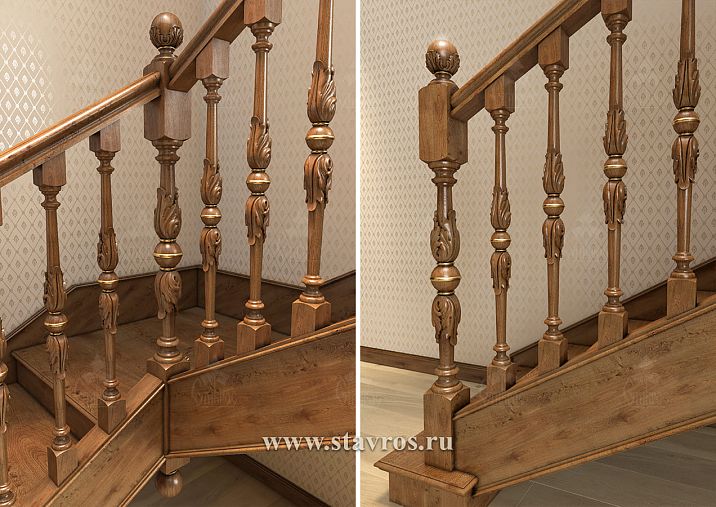
When a house acquires a second floor, the staircase becomes not just a functional element, but a true work of architectural art. And here balusters on the second-floor staircase play the role of the main characters in this story. They transform an ordinary ascent into a majestic ascent, where each step becomes a step toward a new level of comfort and beauty.
Multi-story homes require a special approach to organizing vertical communications. The staircase on the second floor is not only a means of moving between levels, but also a central element of the interior that sets the tone for the entire space. Balusters in this composition perform a triple function: ensuring safety, providing structural strength, and forming a unique aesthetic appearance of the residence.
Modern requirements for living space dictate new standards of quality and safety. Balusters must withstand significant loads, comply with strict regulations, and at the same time harmoniously fit into the overall design concept. That is why choosing balusters for the second-floor staircase becomes a task requiring a professional approach and deep understanding of all nuances.


Evolution of staircase design: from utility to art
The history of staircase construction development is inseparably linked to the evolution of architectural styles. If in ancient times staircases served exclusively practical purposes, then with the development of civilization they became an important element of building decoration. Balusters appeared in the Renaissance as miniature copies of classical columns, bringing an atmosphere of antiquity and grandeur into the interior.
Renaissance traditions laid the foundations for the modern understanding of the beauty of staircase railings. Masters of that time created balusters that were not only functional elements, but also works of art. Each detail carried symbolic meaning, reflecting the status of the owner and his aesthetic preferences.
The baroque opulence of the 17th-18th centuries introduced unprecedented decorative qualities into baluster design. Complex curved forms, abundant carved ornamentation, gilding, and patination turned staircase railings into true works of applied art. This period laid the traditions of luxurious decoration, which are reflected in modern interiors.
Classicism restored the strictness of proportions and restrained elegance to staircase design. Balusters of this period were distinguished by mathematical precision of forms and noble simplicity of decoration. Classical principles became the foundation for modern standards of staircase railing design.




Functional aspects: safety above all
Modern building codes establish strict requirements for staircase railings. The height of handrails should be at least 900 millimeters from the surface of the step, ensuring safety for people of all ages. The distance between balusters should not exceed 150 millimeters in residential buildings and 100 millimeters in childcare facilities.
The strength characteristics of balusters are regulated by special standards. Each baluster must withstand a horizontal load of at least 100 kilograms without destruction or residual deformation. This requirement is especially important for second-floor staircases, where the height of fall may result in serious injuries.
Ergonomic principles dictate not only the size, but also the shape of balusters. They must not have sharp edges or protruding elements capable of causing injury. The surface must be smooth, free of splinters and chips. Special attention is paid to the connection points of balusters with handrails and steps — it is here that the main loads are concentrated.
Our factory also produces:


Material Science: Choosing the Foundation for Perfection
Get Consultation
Wood species: natural beauty and reliability
Oak remains the benchmark of quality among materials for manufacturing balusters. Its density of 700-800 kg/m³ ensures exceptional strength, and its high content of tannins provides natural protection against biological damage. Oak balusters can serve for centuries, acquiring a noble patina over time.
The color palette of oak is strikingly diverse — from light golden tones of young wood to rich brown hues of mature material. Radial rays create a characteristic 'tiger' pattern, especially noticeable on high-quality radial cuts. Walnut oak represents a special value — its dark, almost black color and unique texture make each baluster unique.
Ash attracts designers with its expressive texture and excellent strength properties. Density of 650-750 kg/m³ ensures structural reliability, while fibrous structure allows creating balusters of complex shapes without risk of cracking. Natural ash grain with wavy lines creates dynamic play of light and shadow.
Beech is distinguished by uniform structure and even color, making it ideal for staining and painting. Density 650-700 kg/m³ guarantees durability, and its fine-pored structure ensures a smooth surface after sanding. Beech balusters easily adapt to any interior style.
Larch combines the beauty of coniferous species with the strength of deciduous trees. Density 650-700 kg/m³ and natural resinous properties provide exceptional resistance to moisture and biological damage. Characteristic annual ring pattern creates an expressive texture.
Modern composite solutions
Laminated wood opens new possibilities for creating balusters of complex shapes. Lamination technology allows obtaining blanks of large cross-sections without internal stresses. Such balusters are not prone to warping or cracking, which is especially important for structures operating under variable humidity conditions.
Wood-polymer composites combine the beauty of natural wood with the practicality of modern materials. They require no complex maintenance, are resistant to rot, and do not change dimensions with humidity fluctuations. Modern technologies allow creating composites indistinguishable from natural wood.
Stylistic Directions: From Classic to Avant-Garde
Classic traditions in modern execution
Classic style in baluster design is based on principles of ancient architecture. Golden section proportions determine the relationship between main elements — base, shaft, and capital. Each part of the baluster has its functional and aesthetic purpose, creating a harmonious composition.
Decorative elements of classical balusters include coves — vertical grooves, astragals — convex moldings, various profiled bands. Their combination creates rich play of light and shadow, giving the item volume and expressiveness. Classical balusters never go out of fashion, remaining an epitome of elegance.
Modern: natural motifs in architecture
Modern style brought revolutionary changes to baluster design. Abandoning straight lines and geometric forms in favor of natural motifs created a completely new aesthetic. Plant ornaments — stems, leaves, flowers — became the basis of decorative compositions.
Asymmetric forms and smooth transitions create a sense of organic and naturalness. Balusters in the modern style often imitate natural objects — tree branches, plant stems, sea waves. Such an approach requires the highest craftsmanship from manufacturers and creates unique, one-of-a-kind items.
Modern minimalism: beauty of simplicity
Minimalist approach to baluster design is characterized by extreme simplicity of forms and absence of decorative excesses. Clean geometric lines and perfect proportions create a sense of modernity and functionality. The beauty of such balusters lies in the quality of material and flawless execution.
Monochromatic color solution emphasizes architectural expressiveness of form. Minimalist balusters are ideally suited for modern interiors, where functionality and restrained elegance are valued.
Technological aspects of production
Traditional finishing methods
Hand turning remains the unmatched method for creating unique balusters. Master turner works individually with each blank, considering the specific texture and structure of the particular piece of wood. The process requires years of experience and deep understanding of behavior of various wood species.
Turner's toolset includes numerous specialized cutters. Roughing cutter is used for rough processing and shaping overall form, mallet for creating precise profiles, and chisel for detailing fine details. Each tool requires special skill and understanding of cutting techniques.
Carving in wood represents the highest form of decorative baluster processing. Master carver creates three-dimensional compositions, transforming a simple wooden blank into a work of art. Carving techniques include relief, through, and sculptural processing.
Modern CNC technologies
CNC machines have revolutionized baluster production. They allow creating items with perfect geometry and absolute repeatability of parameters. Computer control ensures processing accuracy down to fractions of a millimeter.
The process begins with creating a 3D model in specialized software. CAD systems allow designers to experiment with shapes, create complex compositions, and model various decorative options. The finished model is automatically converted into a control program for the machine.
Multi-axis milling centers can process blanks at any angles, creating the most complex 3D shapes. Modern machines are equipped with automatic tool-changing systems, allowing to perform the full processing cycle without operator involvement.
Design of stair railings
Calculation of Baluster Quantity and Placement
Correct calculation of baluster quantity is the foundation of safe and aesthetically pleasing construction. Standard scheme assumes installing one baluster per step, ensuring optimal safety-to-cost ratio. In homes with small children, it is recommended to install two balusters per step.
Calculation of baluster spacing is performed considering step width and baluster dimensions. For standard steps 300 mm wide, optimal distance between baluster centers is 150 mm. When installing two balusters per step, this distance reduces to 100 mm.
Marking installation points requires special precision. All balusters must be aligned strictly along one line parallel to the handrail line. Deviations are unacceptable, as they disrupt visual harmony of the structure and may lead to uneven load distribution.
Structural solutions for various types of staircases
Straight run staircases represent the simplest case for baluster installation. Constant incline angle allows using standard technologies without additional complications. All balusters have the same height, and their top ends are cut at an angle corresponding to the staircase incline.
Turnaround staircases with nosing steps require individual approach to each baluster. Trapezoidal step shape affects mounting point placement, and variable handrail incline angle requires individual trimming of each element.
Helical staircases present special difficulty for baluster installation. Constantly changing curvature radius requires using special mounting technologies and flexible handrails. Installation of balusters on second-floor staircase Helical type requires the highest craftsmanship and precise calculations.
Mounting methods: reliability and aesthetics
Traditional connection methods
Dowel joint is a classic method of joining wooden elements. Wooden cylindrical dowels with a diameter of 8-12 millimeters create a strong and eco-friendly connection. Dowels are made from hardwood and are installed using wood glue.
This technology requires the highest precision when drilling holes. The hole diameter must exactly match the dowel size, ensuring a tight fit without gaps. The hole depth is calculated so that the dowel embeds into each part by 40-50 millimeters.
The "tenon-mortise" joint provides maximum strength and durability. A protruding tenon is formed on the upper part of the baluster, and a corresponding mortise is created on the lower part of the railing. The tenon dimensions are typically 25×15 millimeters with a length of 30-40 millimeters.
Modern fastening systems
Metal dowels with a diameter of 8-10 millimeters provide exceptional connection strength. The threaded portion of the dowel is screwed into the baluster to a depth of 40-50 millimeters, and the free end enters a previously drilled hole in the tread or handrail.
Specialized railing hardware includes various types of connectors that allow balusters to be mounted at any angle. Corner connectors are especially relevant for spiral and turn staircases, where the railing angle constantly changes.
Hidden fastening systems provide high strength while keeping fasteners completely invisible. Modern hardware allows creating joints that can be disassembled for repair or replacement of individual elements without damaging the main structure.
Surface treatment and protection
Preparation operations
Sanding is the foundation of quality baluster finishing. The process is performed in several stages with gradually decreasing abrasive grit. Initial processing with P120-P150 abrasive removes traces of mechanical processing and levels the surface.
Intermediate abrasive grinding with P180-P220 grit removes minor scratches and prepares the surface for final finishing. Special attention is given to complex profiles and hard-to-reach areas. For this, profiled grinding pads, flexible abrasives, and grinding belts are used.
Final sanding is performed with P240-P320 grit, giving the surface perfect smoothness. At this stage, it is important not to overheat the wood, as high temperatures may cause discoloration and structural changes in the material.
Protective coatings and decorative finishes
Transparent varnishes remain the most popular type of finish for wooden balusters. They preserve the natural beauty of the wood, highlighting its texture and color. Modern polyurethane varnishes provide high wear resistance and chemical resistance.
Staining compounds allow changing the wood color, creating an aged effect, or imitating valuable species. Stains penetrate the wood structure, coloring it in mass. Lacquers create a semi-transparent colored coating that preserves the visible texture.
Oil finishes create natural protection by penetrating deeply into the wood structure. They emphasize the material's natural beauty and create a pleasant tactile surface. Oils require periodic reapplication but allow for localized repair.
Wax finishes impart a noble matte sheen to the surface and provide additional protection against moisture. Wax is applied in a thin layer and polished with a soft cloth to achieve an even sheen.
Integration into interior design concepts
Classic interiors: traditions and modernity
In classical interiors Balusters of the second-floor staircase act as a connecting element between various architectural components. They must harmonize with columns, pilasters, cornices, and other decorative details.
The color solution for classic balusters usually matches the overall interior palette. Dark wood species — oak, walnut, mahogany — create a sense of respectability and solidity. Light tones — maple, birch, beech — give the interior lightness and airiness.
Decorative elements must match the overall style of the room. In Empire-style interiors, balusters with military motifs are appropriate; in Baroque, with floral ornaments; in Classicism, with geometric motifs.
Modern styles: minimalism and functionality
Modern interiors require a special approach to baluster design. Minimalist forms and absence of decorative excesses align with modern design philosophy. The beauty of such balusters lies in perfect proportions and material quality.
Contrasting material combinations create interesting design solutions. Wooden balusters can be combined with metal railings, glass inserts, or stone elements. This approach allows creating unique compositions.
The technological sophistication of modern interiors can be emphasized by integrating various systems — lighting, alarm systems, "smart home" — into balusters. LED lighting embedded in balusters creates an impressive staircase illumination and enhances safety during movement.
Economic aspects and budget planning
Pricing Factors
The cost of balusters for the second-floor staircase depends on many factors. Wood species is the main pricing factor. Coniferous species cost 2-3 times less than hardwoods, while exotic species may cost 5-10 times more than common ones.
Processing complexity directly affects labor and final cost. Simple turned balusters require minimal processing, while carved compositions require significant time and skilled craftsmanship.
Order volume significantly affects the cost per unit. Large batches allow optimizing production processes and reducing unit costs. Individual orders are significantly more expensive than mass production.
Long-term economic efficiency
Quality balusters represent a long-term investment in home beauty and functionality. Quality products made from hardwoods last 50-100 years with proper care. Inexpensive alternatives may require replacement within 10-15 years.
Maintenance cost of quality balusters is minimal. They require only periodic renewal of protective coatings and simple care. Cheap items often require repairs, tightening of fasteners, or replacement of individual parts.
Impact on property value is a key factor in budget planning. Quality stair railings significantly enhance a home's appeal to potential buyers and may increase its market value by 10-15%.
Installation and mounting: professional approach
Preparation Work
Precise marking is the foundation of quality installation. All baluster mounting points must be marked with millimeter accuracy. Laser levels, marking strings, and special templates are used to ensure perfect geometry.
Tool preparation includes checking and adjusting all equipment. Drills must be sharp, machines — precisely adjusted, measuring tools — calibrated. The quality of tools determines the accuracy and speed of work.
Material acclimatization in the installation room should last at least one week. This allows the wood to reach equilibrium moisture and minimizes subsequent deformations.
Installation technology
Installation of support posts is the first stage of railing assembly. These elements bear the main load and must be secured especially securely. Fastening is done with anchor bolts or strong self-tapping screws with mandatory vertical alignment control.
Installation of intermediate balusters is performed after installing support elements. A marking string is stretched between posts, along which all intermediate elements are set. Each baluster is installed strictly vertically with level control.
Installation of handrails completes the railing assembly. The handrail must fit tightly against the upper ends of all balusters, creating a unified structure. Fastening is done with hidden screws or special hardware.
Quality control and acceptance of work
Visual inspection
Geometric accuracy is the first criterion for quality assessment. All balusters must stand strictly vertically, and their upper ends must lie in one plane. Deviations exceeding 2 millimeters per meter of height are not allowed.
Surface quality is assessed under good lighting. Scratches, scratches, dents, glue marks, or other contaminants are not allowed. The coating must be uniform, without streaks, bubbles, or other defects.
Project compliance is checked against all parameters — dimensions, shape, color, decorative elements. Any deviations from the approved project must be agreed upon with the client.
Functional tests
Strength testing includes applying controlled loads to various railing elements. Each baluster must withstand a horizontal load of 100 kilograms without visible deformation or weakening of fasteners.
Vibration tests reveal weak spots in the structure. The railing must not resonate when walking on the stairs or have its own vibrations.
Fastener connection inspection includes checking the tightness of all threaded elements and absence of play in joints. A quality railing must not have any movable parts.
Operation and Maintenance
Regular Maintenance
Daily cleaning involves removing dust with a soft cloth or specialized wood care products. It is important to avoid using aggressive cleaning agents that may damage the finish.
Weekly wet cleaning is performed using a slightly damp cloth and special wood formulations. After wet treatment, the surface must be thoroughly dried to prevent moisture from penetrating the wood structure.
Condition monitoring includes regular inspection of all railing elements for cracks, loosened fasteners, and coating damage. Timely detection of problems allows for their resolution with minimal effort.
Preventive Maintenance
Coating renewal is recommended every 3-5 years depending on usage intensity and coating type. Oil-based coatings require more frequent renewal, while varnish coatings require less.
Fastener tightening should be performed annually. Wood may change dimensions with humidity fluctuations, leading to loosening of fasteners.
Professional diagnostics are recommended every 5 years. A specialist can identify hidden defects and provide recommendations for further use.
Innovations and development prospects
New materials and technologies
Modified wood has improved performance characteristics. Thermal treatment increases dimensional stability and biostability, while chemical modification enhances strength and durability.
New-generation composite materials combine the beauty of natural wood with the practicality of synthetic materials. They require minimal maintenance, are resistant to rot, and do not change dimensions with humidity fluctuations.
Nanotechnology in protective coatings provides a fundamentally new level of wood protection. Nanoparticles create an invisible film that repels water, dirt, and prevents microbial growth.
Digitalization of production
The Internet of Things enables the creation of "smart" factories, where each machine is connected to a unified information system. This ensures full traceability of the production process and enables real-time quality control.
Artificial intelligence helps optimize technological processes, predict material needs, and prevent defects. Machine learning allows systems to self-improve, enhancing product quality.
Virtual reality allows clients to visualize future balusters within the interior even during the design stage. This significantly simplifies selection and reduces errors.
Conclusion
The world of architectural design constantly evolves, but balusters remain an unchanging symbol of elegance and safety. Balusters for the second-floor staircase — is a solution that affects the perception of the entire house, creating an atmosphere of comfort and respectability.
Modern manufacturing technologies open up boundless creative possibilities, allowing the realization of the most daring design ideas. At the same time, it is important not to forget about the traditions of craftsmanship accumulated over generations of carpenters and woodcarvers. It is precisely the combination of innovation with tradition that creates truly high-quality products.
Investing in quality balusters is investing in the future of the home. They pay off not only financially, but also in daily enjoyment of admiring beauty, pride in one’s home, and confidence in its reliability and safety. Each baluster becomes part of the family’s history, a witness to important life moments.
Properly selected and professionally installed balusters will serve many generations, preserving their beauty and functionality. They will become not just structural elements, but symbols of quality, taste, and care for loved ones. In a world of mass production, quality wooden balusters remain a bastion of true craftsmanship and individuality.
For many years, the company STAVROS has specialized in producing high-quality solid wood items, including exclusive balusters for staircases. By combining centuries-old craftsmanship traditions with modern technologies, STAVROS creates products distinguished by flawless quality, durability, and unique beauty. Each STAVROS baluster is the result of careful material selection, professional craftsmanship, and strict quality control at every production stage, making STAVROS products