












































































Article Contents:
- Philosophy of miniaturization in architectural design
- Psychology of perception of compact elements
- Functional advantages of compact solutions
- Technical specifications of miniature balusters
- Dimensional parameters and their influence on construction
- Strength Characteristics and Loads
- Materials science for miniature elements
- Working with different wood species: characteristics and techniques
- Influence of humidity on dimensional stability
- Design solutions for compact spaces
- Visual effects and optical illusions
- Stylistic directions
- Manufacturing technologies for miniature elements
- Turning of small diameters
- Milling of complex profiles
- Hand threading in miniature
- Installation features of miniature balusters
- Marking and positioning
- Mounting methods
- Mounting Quality Control
- Economic aspects of using small balusters
- Material consumption and cost optimization
- Comparison with alternative solutions
- Maintenance and operation of miniature elements
- Service features
- Repair and replacement of elements
- Innovative solutions in design of small balusters
- Integration of modern technologies
- Ecological innovations
- Future of miniature architectural elements
- Trends in design development
- Technological prospects
- Conclusion
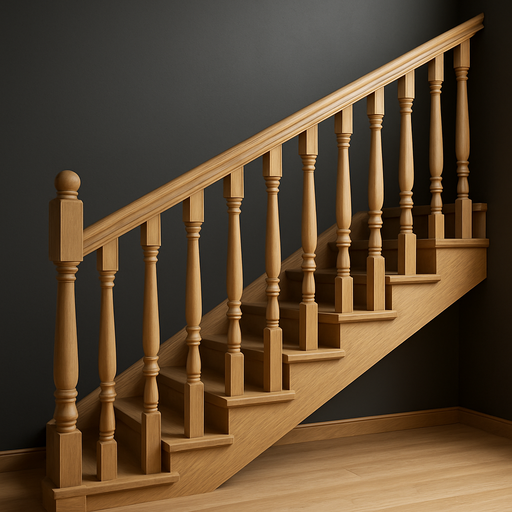
Who said size determines importance? In the world of architectural details small balusters prove the opposite, transforming modest dimensions into a powerful tool of design impact. These miniature safety guardians can radically transform the perception of space, creating a sense of lightness where massive elements would appear bulky and inappropriate.
Modern architecture increasingly turns to principles of minimalism, where every element must be functionally justified and aesthetically perfect. It is precisely in this context that small balusters acquire special value — they perform all necessary safety functions, visually not overloading the space and allowing other interior elements to fully express themselves.


Philosophy of miniaturization in architectural design




Psychology of perception of compact elements
Human perception is wonderfully structured — we instinctively associate large elements with reliability and solidity, while miniature ones with elegance and refinement. Small balusters play on these psychological traits, creating a sense of lightness and elegance throughout the entire staircase structure.
In compact spaces, where every centimeter counts, using miniature balusters becomes not just a design solution, but a necessity. They allow preserving the feeling of spaciousness without compromising safety. The visual weight of the structure is significantly reduced, which is especially important in modern studio apartments or open-plan homes.
Color perception also plays an important role in assessing the size of elements. Light wood tones visually reduce the appearance of objects, while dark tones increase them. Small balusters made of light-colored wood create an effect of almost weightless elements floating in space.
Our factory also produces:


Functional advantages of compact solutions
Safety is the primary task of any stair railing, and small balusters perform this task no worse than their larger counterparts. Moreover, reduced spacing between elements often provides even greater protection, especially for small children.
The economic aspect cannot be ignored either. Less material consumption per baluster allows either to save budget or invest saved funds in higher quality wood or complex finishing. This is especially relevant when using expensive exotic species.
Installing miniature elements requires less physical effort and can be done even by one person. Transportation is also simplified — significantly more small balusters fit into a standard passenger car than large ones.
Get Consultation
Technical characteristics of miniature balusters
Dimensional parameters and their influence on the structure
Standard sizes of small balusters range from 30x30 to 40x40 mm in cross-section at a height of 800-900 mm. These parameters provide an optimal balance between structural strength and visual lightness. Small balusters for staircases Require more frequent installation — usually with a 80-100 mm spacing between centers.
The proportions of miniature elements require special attention to details. Every millimeter matters, and even minor deviations from calculated dimensions may disrupt the overall harmony of the composition. That is why manufacturing small balusters requires the highest precision and craftsmanship.
The wall thickness of hollow balusters during manufacturing should be at least 8-10 mm to ensure sufficient strength. The internal cavity can be used for laying communications — electrical cables for lighting or sensors for "smart home" systems.
Strength characteristics and loads
Despite their modest dimensions, small balusters must withstand significant loads. Horizontal load on a single element can reach 30-50 kg, requiring the use of quality wood and reliable fastening methods.
The section resistance moment of small balusters is less than that of larger elements, so special attention is paid to selecting wood species. Hardwood species — oak, beech, ash — are preferable to soft coniferous species, although modern processing technologies allow using pine provided proper design is applied.
Fatigue strength is an important parameter for elements subjected to cyclic loads. Small balusters installed with smaller spacing distribute the load more evenly, reducing peak stresses in each individual element.
Wood science for miniature elements
Features of working with different wood species
Hardwood species are ideal for manufacturing small balusters due to their high density and strength. Oak, despite its processing difficulty, provides maximum durability and resistance to deformation. Its dense structure allows creating thin elements without risk of cracking.
Beech is attractive for its contrasting texture and high impact toughness. This species is especially suitable for balusters of complex shapes, where resistance to dynamic loads is important. The light color of beech visually lightens the structure, which is especially important for miniature elements.
Beech has a uniform structure and a pinkish hue. This species is easily tinted and can imitate more expensive exotic species. High density of beech allows creating very thin elements while maintaining strength.
Coniferous species require a special approach when manufacturing small balusters. Pine and spruce have a looser structure, which may lead to chipping when processing thin sections. However, modern wood stabilization technologies allow successfully using these species as well.
Influence of humidity on dimensional stability
Small balusters are more sensitive to humidity changes due to smaller wood volume. Even minor fluctuations in humidity may cause noticeable deformations, especially in thin sections. Therefore, the moisture content of the raw material should be stabilized at 6-8%.
Kiln drying is a mandatory stage in preparing wood for miniature elements. The process must be slow and controlled to avoid internal stresses that may manifest during subsequent processing.
Protective coatings play a critically important role in stabilizing the dimensions of small balusters. Quality varnishes and oils create a barrier preventing rapid moisture changes in wood due to atmospheric fluctuations.
Design solutions for compact spaces
Visual effects and optical illusions
Small balusters create unique visual effects due to their size. Frequent placement of elements creates a "picket fence" effect, which may be an advantage or disadvantage depending on the overall design concept. Proper use of this effect allows creating a sense of rhythm and dynamism.
Scale play is a powerful tool in the designer's hands. Small balusters against large architectural elements create contrast, emphasizing the monumentality of main structures. Conversely, in miniature interiors, they help maintain proportionality of all elements.
Perspective distortions also work in favor of small balusters. Looking along the staircase creates an effect of receding colonnades, visually increasing the length of the staircase and ceiling height.
Stylistic directions
Minimalism is a natural environment for small balusters. Simple geometric forms, absence of excessive decoration, emphasis on functionality — all this perfectly complements the compact dimensions of the elements. Compact balusters In a minimalist interior, they become almost imperceptible, allowing the architecture of the space to speak for itself.
Scandinavian style also favors miniature elements. Light wood tones, simple forms, functionality — all harmoniously combine with the philosophy of small balusters. Elements made of birch or pine with natural texture look especially striking.
Modern classic style allows using small balusters with more complex profiles. Reduced copies of classical forms create a sense of elegance and refinement. It is important to maintain proportions — all decorative elements must be proportionally scaled down.
High-tech style opens wide opportunities for experimenting with small balusters. Integration of LED lighting, use of modern coatings, combination with metallic elements — all this creates a futuristic image of the staircase.
Technologies for manufacturing miniature elements
Turning of small diameters
Manufacturing small balusters on a lathe requires special skill and specialized tools. High spindle speeds are necessary to achieve a smooth surface at small diameters. Vibrations, imperceptible when machining large parts, can significantly affect the quality of miniature elements.
Cutting tools for machining small balusters must be perfectly sharpened and have minimal radii at the tip. Even minor chips or dulling of the tool result in defects, especially noticeable at small sizes.
The clamping system for workpieces also requires special attention. Excessive clamping force may deform a thin workpiece, while insufficient force may cause vibrations and defects. Modern collet chucks ensure even distribution of clamping force.
Milling of complex profiles
CNC milling opens new possibilities for creating complex profiles of small balusters. High positioning accuracy allows creating elements with extremely fine details, unattainable with manual machining.
Special end mills with small diameters — from 1 to 6 millimeters — allow creating thin grooves, complex reliefs, miniature carved elements. Cutting speed must be optimized for each tool diameter and wood species.
Multi-axis machining allows creating spiral elements, interwoven ornaments, three-dimensional compositions in miniature. Such balusters become true works of art, where every detail is precisely calibrated with mathematical accuracy.
Hand carving in miniature
Hand carving of small balusters is the highest expression of a carver’s skill. Working with miniature elements requires exceptional precision of movements, extremely sharp tools, and deep understanding of wood properties.
Tools for miniature carving are manufactured using special technologies. Chisels with widths of 1–3 millimeters must be perfectly balanced and sharpened. Handles are made thinner for better control of movements.
Lighting at the workstation becomes critically important when working with small details. Modern LED lamps with adjustable color temperature allow creating optimal conditions for delicate work.
Features of installing miniature balusters
Marking and Positioning
Accuracy of marking when installing small balusters becomes especially important due to their large number per unit length of the staircase. Even small marking errors accumulate and may lead to noticeable distortions in the overall geometry of the railing.
Laser levels and measuring systems become indispensable tools when working with miniature elements. Positioning accuracy must be ±1 millimeter, requiring professional equipment.
Templates and fixtures help ensure uniform placement of all elements. For small balusters, especially important is maintaining parallelism and equal spacing between adjacent elements.
Methods of mounting
Traditional fastening methods require adaptation for miniature elements. The diameter of dowels and bolts must be proportionally reduced — typically, elements with diameters of 6–8 millimeters are used instead of standard 10–12 millimeters.
Adhesive joints gain special importance when working with small balusters. Contact area is smaller, so the quality of adhesive and precision of fitting elements become critically important factors.
Hidden fastening methods are preferred for miniature elements, as visible fasteners will appear disproportionately large. Magnetic connections using neodymium magnets — a modern solution for disassemblable structures.
Mounting Quality Control
Checking the verticality of each small baluster requires special attention due to their large number. Using laser plumb bobs allows quickly controlling the correct installation of multiple elements simultaneously.
Uniform spacing between balusters is controlled by special templates or measuring instruments. Deviations exceeding 2 millimeters are unacceptable and require correction.
Overall structural rigidity is checked by applying standard loads. A large number of small balusters may provide even greater rigidity than fewer large elements, due to better load distribution.
Economic aspects of using small balusters
Material consumption and cost optimization
Paradoxically, using small balusters can both reduce and increase the overall project cost. On one hand, less wood consumption per element reduces material costs. On the other hand, a greater number of elements increases labor costs for manufacturing and installation.
Material cutting optimization becomes especially important when manufacturing a large number of miniature elements. Modern cutting programs allow minimizing waste and maximizing the efficient use of each cubic meter of wood.
Production automation becomes economically justified when manufacturing large quantities of small balusters. CNC machines allow producing dozens of identical elements without operator involvement.
Comparison with alternative solutions
Glass railings are the main alternative to traditional balusters in modern design. However, the cost of quality tempered glass and its installation often exceeds the cost of even expensive wooden balusters.
Metal railings may be cheaper to manufacture than wooden ones, but require regular maintenance and painting. Miniature wooden balusters With proper care, they serve for decades without additional costs.
Combined solutions combining small balusters with other materials can provide an optimal price-to-quality ratio. For example, wooden balusters with metal handrails or glass inserts.
Care and operation of miniature elements
Maintenance features
A large number of small balusters requires more time for maintenance, but each element is processed faster due to smaller surface area. Regular dust cleaning becomes more important, as dirt on small elements is more noticeable.
The inspection of fasteners should be conducted more frequently due to the lower safety margin of each individual element. Weakening one baluster may lead to load redistribution onto adjacent elements.
Updating protective coatings on small balusters may require dismantling elements for thorough processing of all surfaces. This should be considered when planning maintenance work.
Repair and replacement of elements
The advantage of small balusters is the ability to replace individual damaged elements without dismantling the entire structure. Spare parts take up little space and can be stored at home.
Manufacturing accurate copies of damaged elements is simplified due to smaller dimensions. Even manual production of one or two balusters does not require significant time and material investment.
Modernizing railings is also simplified — it is possible to replace some elements with balusters of another design, creating interesting compositional solutions without complete reconstruction of the structure.
Innovative design solutions for small balusters
Integration of Modern Technologies
LED lighting can be integrated even into the smallest balusters thanks to modern high-brightness LEDs smaller than a millimeter. Hidden wiring is routed inside hollow elements or in special grooves.
Sensory elements that respond to touch can be embedded in small balusters to control lighting or other "smart home" systems. Miniature sensors are practically invisible within the overall composition.
Monitoring systems for structural condition using built-in deformation sensors allow real-time monitoring of loads on railings. Such systems are especially relevant for public buildings.
Ecological Innovations
Using fast-growing wood species for manufacturing small balusters reduces pressure on forest resources. Bamboo, pavia, and other fast-growing species can successfully be used for miniature elements.
Biodegradable coatings based on natural components replace synthetic varnishes and paints. Such coatings are safe for health and do not harm the environment.
Recycling technologies allow using production waste from large elements to manufacture small balusters. This reduces overall waste and increases raw material efficiency.
The future of miniature architectural elements
Design development trends
Urbanization and densification of construction make compact solutions increasingly relevant. Small balusters fit perfectly into the concept of micro-housing and compact spaces, which are becoming standard in large cities.
Personalization of design becomes more accessible thanks to digital manufacturing technologies. Each small baluster can have unique decoration, creating one-of-a-kind compositions.
Modularity and transformability are important trends in modern design. Small balusters adapt more easily to changing needs, allowing modifications to railings without major reconstruction.
Technological prospects
3D printing with wood composites opens new possibilities for creating complex shapes of small balusters. The technology allows manufacturing elements impossible with traditional processing.
Nanotechnology in coatings promises the creation of self-cleaning, antibacterial, and color-changing surfaces. Such coatings are especially relevant for small elements, where ease of maintenance is crucial.
Artificial intelligence in design will allow creating optimal configurations of small balusters, taking into account all factors—from strength to aesthetics. Machine learning algorithms will find solutions inaccessible to human reasoning.
Conclusion
The world of small balusters is a wonderful universe where every millimeter matters, and perfection lies in the details. These miniature architectural elements prove that size does not determine importance, and craftsmanship is revealed in the ability to create maximum effect with minimal means.
Modern technologies open boundless creative possibilities for designers and craftsmen in miniature scale. From the simplest geometric forms to the most intricate carved compositions—small balusters can realize any design idea while maintaining functionality and reliability.
Choosing small balusters is choosing elegance, refinement, and a modern understanding of space. These elements not only perform their protective function but also create a unique atmosphere of lightness and airiness, highly valued in contemporary design.
In the world of quality architectural solutions, STAVROS holds leading positions, offering an extensive range of balusters in all sizes and configurations. Decades of experience, deep understanding of client needs, and commitment to perfection in every detail make STAVROS a reliable partner for those who value quality, innovation, and flawless execution in creating architectural masterpieces of any scale.





