Article Contents:
- Moscow Market for Wooden Balusters: Landscape of Offers
- Wood Species: Choosing Between Aesthetics and Practicality
- Styles and Forms: From Classic to Minimalism
- Production Technology: From Machine to Finishing
- Dimensions and Standards: What You Need to Know When Ordering
- Kit Components: Balusters, Posts, Handrails
- Price range: from budget to premium
- Where to Buy in Moscow: Sales Point Overview
- Delivery in Moscow and Region: Logistics and Timelines
- Installation: DIY or with professionals
- Criteria for selecting a supplier: what to pay attention to
- Trends 2025-2026: What's Relevant in Baluster Design
- Care and Maintenance: How to Preserve Balusters for Decades
- Alternatives to Wood: Is It Worth Considering
- Frequently Asked Questions
- Conclusion: Choosing in Favor of Quality and Reliability

Moscow is a city of contrasts, where historic mansions neighbor modern townhouses, and classic interiors intertwine with minimalist solutions. In this diversity of styles, a special place is occupied bywooden balusters moscow— elements that transform an ordinary staircase into a work of architectural art. The question of choosing a baluster supplier in the capital is not as simple as it seems: the market is overloaded with offers, quality varies from outright defects to exclusive products, prices range from dumping to sky-high. How not to make a mistake? Where to turn? What to pay attention to when choosing? Let's break it down in detail.



Moscow Market for Wooden Balusters: Landscape of Offers
The capital's baluster market can be roughly divided into several segments. The first — large construction hypermarkets and chain stores, where mass-produced products of average quality at standardized prices are presented. Here you canbuy wooden balusters in Moscowquickly and without much hassle, but don't expect uniqueness or premium quality. The assortment is limited to a dozen standard models, predominantly made of pine, with basic processing, and no individual approach.
The second segment — small private workshops and workshops working to order. Here you can find author's solutions, non-standard forms, and individual design. Quality varies from high to questionable — it all depends on the master's qualifications and the equipment used. Production times can stretch for weeks and months, prices are unpredictable, and guarantees are often conditional.
The third segment — specialized manufacturers with their own production facilities, years of experience, and a clearly established quality control system. It is here that you canwooden balusters in Moscowpurchase with a guarantee of compliance with stated parameters, with a wide range of models and wood species, with professional consulting support and an adequate price-quality ratio.




Wood Species: Choosing Between Aesthetics and Practicality
When it comes to wooden balusters for Moscow projects, the choice of wood species is critically important. The climatic conditions of the capital region — sharp temperature and humidity fluctuations in winter, dry air during the heating season — impose increased requirements on material stability. Oak is the undisputed leader in durability and status. Oak solid wood is dense, heavy, resistant to mechanical damage and deformation. The texture is expressive, with characteristic large pores and annual rings. Over time, oak darkens nobly, acquiring depth of tone.
Beech — the optimal balance between price and quality. The wood is dense, homogeneous, excellent for processing, accepts any shapes during turning and carving. Beech is lighter than oak, has a neutral warm shade with a slight pinkish undertone. It takes stains perfectly and can be sanded to a mirror-like smoothness. The only nuance — it requires thorough protection from moisture, so beech is not recommended for exterior stairs, but for interior objects — it's ideal.
Ash — a species for connoisseurs of contrasting texture and high strength. In hardness, ash is comparable to oak, but lighter and has a more pronounced wood grain. Ash fibers are elastic, making it a suitable material for balusters of complex shapes with thin details. Ash holds fasteners well, does not chip when drilled, and is resistant to abrasion.
Pine — a budget option for temporary solutions or country houses. Soft wood is easy to process, affordable in price, but inferior to hardwood species in strength and durability. Pine is prone to chipping, resin pockets, and darkens unevenly over time. For serious urban projects, pine is not the best choice, but if the budget is limited, you can start with it, planning to replace it with a more noble species in the future.
Our factory also produces:


Styles and Forms: From Classic to Minimalism
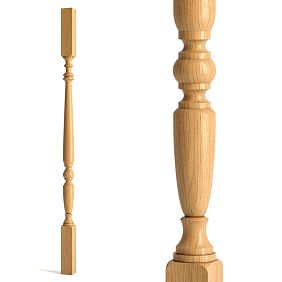
Moscow interiors demonstrate the entire spectrum of architectural styles, andBuy wooden balusters in Moscowcan be matched to any of them. Turned balusters — a classic, tested for centuries. Symmetrical profiles created on a lathe — smooth transitions from narrow necks to rounded bodies, from cylindrical sections to spherical elements. Turned balusters are universal: they look organic both in classic mansions on Ostozhenka, and in modern apartments in Khamovniki, and in country residences on Rublyovka.
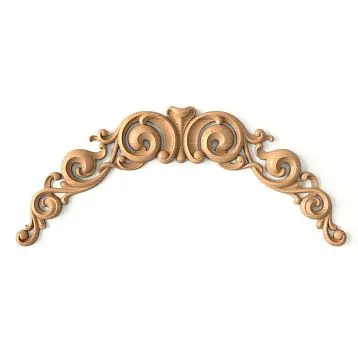
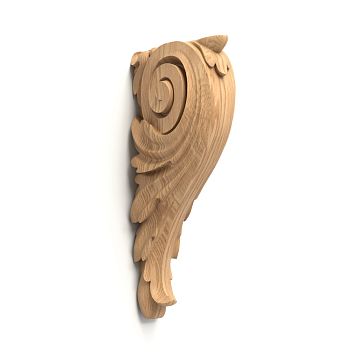
Carved balusters — a choice for those unafraid of luxury. Three-dimensional carving transforms each baluster into a miniature sculpture: acanthus leaves, grapevines, geometric patterns, floral motifs. Carved elements are created on CNC milling machines using 3D models, ensuring identical parts within a batch and crisp detailing. Such balusters are an attribute of Baroque, Empire, Classicism, and Neo-Renaissance styles.
Flat balusters — a modern solution for minimalist and loft spaces. Cut from furniture board or wide planks, they can feature strict geometric contours or complex curvilinear silhouettes. Flat balusters are visually lighter than three-dimensional ones, create rhythmic graphics, and pair well with metal and glass. Relevant for interiors in Scandinavian, contemporary, and eco styles.
Twisted balusters — a separate category requiring high manufacturing skill. The spiral form, twisted around an axis, creates dynamism and volume. Twisted balusters are complex to produce and, accordingly, more expensive, but the effect is worth it — a staircase with twisted balusters transforms into a sculptural composition that captivates the eye.
Get Consultation
Production technology: from machine to finishing
The quality of balusters directly depends on their production technology. Modern enterprises use CNC lathes and milling machines, guaranteeing dimensional accuracy and part repeatability. The process begins with selecting the blank — a square-section block of select wood without knots, cracks, or rot. Wood moisture should be 8-10 percent — this ensures stability and absence of deformation after installation.
On a lathe, the blank is turned to the required profile. A computer program controls the cutter's movement, ensuring all balusters in the batch are identical. After turning, balusters are sanded in several stages — from coarse (80-100 grit) to finish (220-320 grit). Sanding is performed on a rotating machine and manually for hard-to-reach areas.
Carved balusters undergo an additional stage of 3D milling. A computer-controlled milling cutter carves a three-dimensional pattern according to a given model. The depth of carving, ornament detail, and line clarity — all depend on equipment precision and programming quality. After milling, carved elements are hand-finished to soften transitions and remove the finest burrs.
Finishing — the final stage. Balusters can be supplied untreated (only sanded), stained, or coated with oil, wax, or varnish. The choice of coating depends on operating conditions and aesthetic preferences. Varnish creates a durable protective film, oil emphasizes texture and imparts a silky feel, staining allows changing the wood color while preserving its structure.
Dimensions and standards: what you need to know when ordering
The standard baluster height for interior staircases is 900 millimeters. This is the distance from the step surface to the top point of the handrail, defined by building codes as optimal for adult safety. From this value, subtract the handrail thickness (usually 40-60 millimeters) and the sub-rail strip thickness (if used, 18-25 millimeters) to get the net baluster height — typically 820-840 millimeters.
The baluster cross-section at its widest part varies from 40 to 80 millimeters depending on the model and style. Turned balusters usually have a maximum diameter of 50-60 millimeters, carved ones can be larger — up to 80 millimeters. Flat balusters have a thickness of 30-50 millimeters and a width from 60 to 120 millimeters. It is important that all balusters in one batch are identical in size — a deviation of more than 1-2 millimeters is unacceptable.
The clear distance between balusters (i.e., minus their thickness) should not exceed 150 millimeters according to safety requirements. In practice, two balusters are usually installed per step, resulting in a gap of about 100-120 millimeters with a standard step width of 250-300 millimeters. For wide steps or grand staircases, three balusters per step can be installed.
Balusters are only part of the task of arranging a staircase railing. A complete structure requires additional elements. Support posts — massive vertical elements with a cross-section from 80x80 to 120x120 millimeters, installed at the beginning and end of a flight, at turns, and on intermediate landings. Posts bear the main load, serve as handrail attachment points, and define the geometry of the entire railing.
Purchasewooden balusters in Moscow— this is only part of the task of installing a stair railing. For a complete structure, additional elements will be required. Support posts are massive vertical elements with a cross-section from 80x80 to 120x120 millimeters, installed at the beginning and end of a flight, at turns, and on intermediate landings. The posts bear the main load, serve as attachment points for the handrail, and define the geometry of the entire railing.
Handrail — a horizontal element held onto when ascending and descending.Buy round wooden handrailYou can buy round handrails of standard 50-millimeter diameter — this is the optimal cross-section, comfortable for an adult hand to grip. For children and elderly people, an additional handrail of smaller diameter (40 millimeters) is sometimes installed at a height of 700-750 millimeters.
Sub-rail strip — a flat board 18-25 millimeters thick and 80-120 millimeters wide, attached to the top ends of balusters and serves as a base for handrail installation. The strip simplifies mounting, increases contact area, and enhances structural rigidity. All elements should be made from the same wood species and have a unified processing style — only then will the staircase look harmonious.
Price range: from budget to premium
How much do balusters cost?buy wooden balusters in MoscowThe price depends on many factors: wood species, shape complexity, processing type, quality category, batch volume. The most affordable are simple turned balusters made of pine in the Standard category. Their cost starts from 300-400 rubles per piece. This is a basic option for country house staircases or temporary structures.
Balusters made of oak or beech in the Standard category cost from 1500 to 3000 rubles per piece depending on profile complexity. This is the optimal choice for most urban projects — the price-quality ratio here is most balanced. The wood is select, processing is high-quality, dimensions are precise, and appearance is respectable.
Carved balusters in the Prestige category made of oak or beech — this is already the premium segment. Prices start from 4000-5000 rubles and can reach 15000-20000 rubles per piece for particularly complex custom models with deep, multi-level carving. Such balusters are made individually or in small batches, each undergoes manual finishing and polishing, and is packaged individually.
Don't forget about associated costs: support posts cost from 3000 to 10000 rubles per piece,you can buy round handrailsat a price from 2000 to 4000 rubles per linear meter, sub-rail strips — 800-1500 rubles per linear meter. For a staircase with 15 steps, a full railing kit will cost from 50000 to 200000 rubles depending on the chosen materials and complexity level.
Where to buy in Moscow: overview of sales points
Geographically, sales points for wooden balusters in Moscow are unevenly distributed. Large construction hypermarkets (Leroy Merlin, OBI, Castorama) exist in all administrative districts, but their baluster assortment is limited and uniform. Specialized salons and showrooms of manufacturers are concentrated mainly in central and western districts — where design clusters are located and where the audience's purchasing power is higher.
Southern and southeastern directions — the territory of small private workshops and workshops working to order. Affordable solutions can be found here, but quality is unpredictable. Northern and northeastern directions — industrial zones where production facilities of large companies are located. It makes sense to go here for wholesale batches or when ordering non-standard items in large volumes.
The optimal option for Moscow residents is visiting a manufacturer's showroom with its own production. Here you can see samples of all models in person, touch the wood, assess processing quality, receive professional consultation, and calculate an exact kit for a specific project. Most serious manufacturers offer free on-site measurement and estimate preparation — this saves time and eliminates calculation errors.
Delivery in Moscow and the region: logistics and timelines
Logistics is an important aspect when buying wooden balusters. The items are quite fragile, long (about a meter), and require careful transportation. Most Moscow suppliers offer delivery via their own transport or through trusted transport companies. Delivery within the Moscow Ring Road usually takes 1-2 days after order assembly, costing from 1500 to 3000 rubles depending on weight and volume.
Delivery to the Moscow region — 2-3 days, cost depends on the object's distance: nearest settlements within 10-20 kilometers from the Moscow Ring Road — about 2000-3000 rubles, distant areas (50-100 kilometers) — from 4000 to 8000 rubles. Serious suppliers pack balusters in multi-layer protection: each baluster is wrapped in bubble wrap, placed in a corrugated cardboard box with rigid spacers, and the box is sealed with stretch film.
Pickup is an option for those who want to save on delivery and have suitable transportation. Most manufacturers have warehouse terminals in Moscow where you can collect your order at a convenient time. When picking up, be sure to inspect each baluster for chips, cracks, and dimensional deviations—quality claims are not accepted after removal from the warehouse.
Installation: Do It Yourself or With Professionals
Installing wooden balusters is a task that requires precision and skill. You can perform the installation yourself if you have basic carpentry tools and follow the technology, but the result will depend on your experience. The main stages are: marking the positions of the balusters on the steps, drilling holes for dowels or studs, installing support posts, mounting intermediate balusters, attaching the handrail base, and installing the handrail.
Each stage is critical. An error in marking will cause the balusters to stand crookedly or with uneven intervals. A deviation from vertical by 2-3 degrees will make it impossible to attach the handrail properly. Weak fastening of the support posts will lead to the entire structure becoming loose after a few months of use. If you are not confident in your abilities, it is better to hire professionals.
The cost of installing balusters and railings in Moscow ranges from 3,000 to 8,000 rubles per linear meter, depending on the complexity of the structure. A straight run is the simplest option, costing about 3,000-4,000 rubles per meter. A staircase with turns, winder steps, and complex connection nodes costs from 6,000 to 8,000 rubles per meter. This price usually includes marking, drilling, installation of all elements, and final fitting.
Criteria for selecting a supplier: What to pay attention to
When choosing whereBuy wooden balusters in MoscowPay attention to several key parameters. First—the presence of in-house production. Companies that manufacture balusters themselves control quality at all stages, guarantee dimensional compliance, can fulfill custom orders, and promptly resolve any issues that arise. Resellers and intermediaries do not have such capabilities.
Second—the range of models and wood species. The wider the selection, the higher the likelihood of finding exactly what you need for your project. A good manufacturer offers at least 30-50 baluster models in various styles, works with 3-4 wood species, and has several processing categories. This indicates the company's maturity and the availability of production capacity.
Third—the presence of a physical showroom where you can view samples. Buying balusters from photos on the internet is risky: the wood color, processing quality, and actual dimensions may differ from the image. In a showroom, you see the product in person, can compare different models, and get a tactile sense of the material.
Fourth—production timelines and payment terms. Serious manufacturers work with a 30-50 percent prepayment, with the remainder due upon receipt of the goods. Production times for standard models are 5-10 working days; for custom models, up to 3-4 weeks. If you are offered 100 percent prepayment and production times of a month to a month and a half for standard items—this is a reason to be cautious.
Fifth—guarantees and returns. A conscientious supplier provides a warranty on their products from 6 months to a year, accepts returns of defective goods, and compensates for shortages or damages during delivery. All these points should be specified in the contract or on the company's website in the return policy section.
Trends 2025-2026: What's Relevant in Baluster Design
The Moscow interior design market is sensitive to global trends, adapting them to local specifics. In 2025-2026, several distinct directions are observed in wooden baluster design. First—a return to classic styles, but with a modern interpretation. Turned balusters of traditional forms are made from contrasting wood species (combinations of light ash and dark oak), tinted in non-standard shades (graphite, anthracite, whitewashed oak), and combined with metal elements.
The second direction—minimalism and concise forms. Flat balusters with strict geometric contours, without decorative excesses, focusing on the wood texture. Often, such balusters are made from wide boards (80-120 millimeters wide, 30-40 millimeters thick), placed with increased spacing, creating an effect of airiness and lightness in the structure.
The third direction—eco-style and naturalness. Solid wood balusters with preserved natural texture, minimal processing, coated with natural oils and waxes instead of varnishes. Slight irregularities, knots (if they do not reduce strength), and color transitions are allowed—everything that emphasizes the natural origin of the material.
The fourth direction—mixing styles and materials. Wooden balusters are combined with glass screens, metal cables, and forged elements. This approach allows for creating unique railings where wood serves as a warm tactile accent, and other materials add modernity and lightness.
Care and Maintenance: How to Preserve Balusters for Decades
With proper care, wooden balusters last for decades, preserving their original appearance. The main rule is regular dry or slightly damp cleaning with a soft cloth to remove dust. Do not use abrasive cleaning agents, stiff brushes, or solvents—they damage the protective coating and scratch the wood. For washing, use special wood cleaners or a mild soap solution; after damp cleaning, wipe dry.
The handrail, which undergoes maximum wear from constant contact with hands, requires periodic coating renewal. A varnish coating is recommended to be renewed every 3-5 years: remove the old varnish with fine sandpaper or a scraper, degrease the surface, and apply 2-3 fresh coats of varnish. An oil coating is renewed more frequently—every 1-2 years, apply an additional layer of oil; this maintains protection and refreshes the appearance.
Monitor the humidity and temperature in the room. Sharp fluctuations (from +25 to +15 degrees, from 70 to 30 percent humidity) lead to wood deformation, cracking, and weakening of fastenings. Optimal conditions: temperature +18...+22 degrees, humidity 45-60 percent. In winter, when heating is on and the air is dry, use humidifiers.
Periodically inspect the baluster fastenings. If you detect play, tighten the fasteners or reinforce the connection with additional elements. Immediately sand and coat any scratches and chips that appear with a protective compound—unprotected wood quickly darkens and begins to deteriorate. Local repair is always simpler and cheaper than a full element replacement.
Alternatives to Wood: Are They Worth Considering?
In Moscow, not only wooden balusters are available—the market offers metal, glass, polyurethane, and composite options. Are they worth considering as alternatives to natural wood? Metal balusters (stainless steel, chrome-plated steel, wrought iron) are strong, durable, and do not require complex maintenance, but they are cold to the touch, lack the natural warmth of wood, and are visually more austere and industrial.
Glass screens instead of balusters are a modern solution that gives a sense of lightness and transparency to space. Glass does not block the view, visually does not clutter the interior, and is easy to clean. But glass requires constant maintenance (fingerprints and water streaks are visible), it is fragile and can crack upon impact, cold, and does not provide tactile comfort when touched.
Polyurethane balusters—imitations of wood or plaster moldings made from lightweight polymer material. Pros: low price, light weight, moisture-resistant, do not deform. Cons: artificial appearance, lack of natural texture, yellow over time and lose their appearance, chip under mechanical damage. For budget projects or temporary solutions—an option, but for a serious home—a compromise in taste.
Wood remains the optimal choice for those who value natural materials, tactile comfort, visual warmth, the possibility of restoration, and a long service life. Yes, wood requires maintenance, yes, it is more expensive than polyurethane and some types of metal, but it creates that very home atmosphere that no artificial materials can replace.
Frequently Asked Questions
Where in Moscow can you view balusters in person before buying? Most manufacturers have showrooms in central and western districts of Moscow. It is recommended to book a viewing appointment in advance by phone or through the website to receive a personal consultation and see the full range.
How much does delivery of balusters cost in Moscow? Delivery within the Moscow Ring Road (MKAD) usually costs 1,500-3,000 rubles depending on the volume and weight of the order. Delivery to the near Moscow region (up to 20 kilometers from MKAD)—2,000-3,000 rubles; to distant areas—from 4,000 rubles.
Can I order balusters of non-standard height? Yes, most manufacturers produce balusters to individual dimensions. The cost and production time may increase by 20-30 percent compared to standard models.
Which wood species is best for the Moscow climate? Oak and ash are the optimal choice. These species are resistant to temperature and humidity fluctuations typical of the capital region. Beech is also good but requires thorough protection from moisture.
How many balusters are needed for a staircase with 15 steps? Usually, 2 balusters are installed per step, which gives 30 balusters for 15 steps. Additionally, 2-4 support posts (depending on the staircase configuration) and a handrail are required.
Can I buy balusters individually or only in sets? Most manufacturers sell both individually and in sets. When purchasing a set (more than 20 pieces), a 5-10 percent discount is usually provided.
How long does it take to manufacture custom balusters? Standard models from stock or warehouse — 3-5 business days. Manufacturing standard models to order — 7-10 business days. Non-standard sizes or custom design — 3-4 weeks.
Do balusters require additional treatment after purchase? It depends on the processing category. Prestige category balusters with a finish coating are ready for installation immediately. Standard category balusters require finishing — tinting and coating with varnish or oil.
What guarantees does the manufacturer provide? Reputable manufacturers offer a warranty from 6 months to a year against defects in wood and processing. The warranty does not cover damage during transportation (if you picked up the goods yourself) and defects arising from improper use.
Can balusters be returned if they don't fit? Yes, within 14 days of purchase, you can return goods of proper quality if they have not been used and their original appearance is preserved. Refunds are processed within 10 days after the goods are accepted back.
Conclusion: choosing in favor of quality and reliability
wooden balusters moscow— is a market with high competition, a wide range, and significant variation in quality and prices. Choosing the right supplier is critical: it affects not only the appearance of your staircase but also its safety, durability, and comfort of use. Don't chase cheapness — balusters made from raw wood, with inaccurate dimensions, or poor processing will ultimately cost more due to the need for rework or replacement.
Pay attention to the manufacturer's reputation, availability of own production facilities, product range, and warranty terms. Visit showrooms, see samples in person, ask consultants questions. Request quality certificates for the wood, clarify processing technology, storage, and transportation conditions. Remember: a staircase with quality balusters made from noble wood is an investment for decades.
The company STAVROS has been manufacturing wooden staircase elements for over twenty years, offering Moscow customers the widest selection of balusters made from solid oak, beech, and ash. The STAVROS range includes over 50 models of turned, carved, and flat balusters in various styles — from strict classic to modern minimalism, from luxurious Baroque to concise Scandinavian design.
All STAVROS products are manufactured in-house using high-precision CNC equipment, ensuring batch consistency and dimensional accuracy to the millimeter. The wood undergoes multi-stage drying to a moisture content of 8-10 percent, eliminating deformation after installation. Each baluster is carefully hand-sanded, checked for defects, and packaged in multi-layer protective packaging for safe transportation.
STAVROS offers two processing categories — Standard for functional staircases and Prestige for grand projects with high aesthetic requirements. A showroom operates in the capital where you can see all models in person, receive advice from professional designers, and calculate the exact configuration for your project. Delivery within Moscow and the region is carried out by their own transport within 1-2 days after order assembly.
Choosing STAVROS, you get not just balusters, but a comprehensive solution for creating your dream staircase — with quality guarantees, professional support at all stages, fair prices, and an impeccable reputation confirmed by thousands of completed projects across Russia and CIS countries.