Article Contents:
- Anatomy of stair railing: roles and functions
- Balusters: vertical guardians of safety
- Newel posts: structural points of the construction
- Interaction between balusters and newel posts
- Materials: the soul of wooden verticality
- Oak — symbol of eternity
- Ash — northern lightness
- Beech — balance of quality and price
- Walnut — aristocratic luxury
- Larch — Siberian strength
- Baluster styles: from palace carving to cosmic minimalism
- Classic: precisely turned balusters
- Carving: sculptural verticality
- Minimalism: geometric purity
- Flat balusters: Slavic tradition
- Combined Solutions
- Futurism: 3D milling and parametric design
- Newel posts: points of strength and beauty
- Classic newel posts with capitals
- Newel posts with finials
- Minimalist newel posts
- Carved newel posts — sculptures
- Newel posts with integrated lighting
- Components for wooden stairs: system of elements
- Handrails: tactile finish
- Stringer board
- Steps and risers
- Stringers and diagonal braces
- Decorative overlays and sockets
- Color solutions 2026: from natural palette to bold experiments
- Natural shades
- Tinted Wood
- Brushing with Colored Oil
- Contrasting solutions
- Assembly and Installation: Creating a Durable Structure
- Attaching Balusters to Steps
- Post mounting
- Attaching the Handrail
- Maintenance and Care: Longevity of Beauty
- Regular Cleaning
- Recoating
- Fastening Check
- Protection from Moisture and Temperature
- FAQ: Answers to Popular Questions
- What is the difference between a baluster and a post?
- How many balusters are needed for one step?
- Can different baluster styles be combined?
- Which wood species is best for balusters?
- Are support posts mandatory?
- Can balusters be installed by oneself?
- How to care for carved balusters?
- How long do wooden balusters last?
- What to do if a baluster cracks?
- What budget is needed for balusters and posts?
- Conclusion: Entrust Vertical Architecture to Professionals
- Why STAVROS — the Right Choice
- Staircase as an Investment in Quality of Life
- Start Creating Your Ideal Staircase
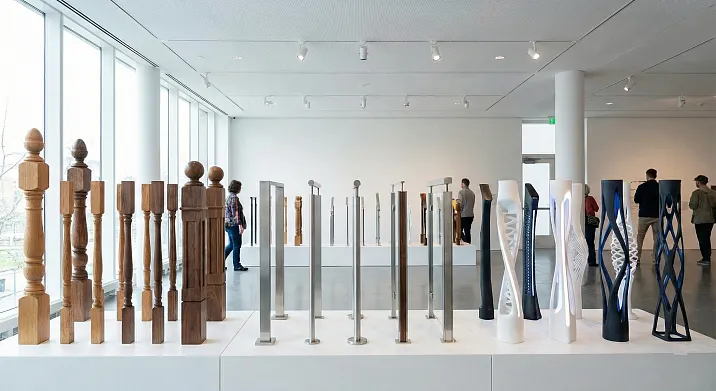
In 2026, balusters and posts are experiencing a true renaissance — from the revival of classical carving to futuristic minimalist forms, from traditional techniques to digital modeling and CNC milling.Balusters and posts made of woodStaircase Baluster Post L-003R
Why are balusters and posts back in the spotlight of designers and architects now? The answer lies in the shift of interior philosophy. After the period of total minimalism, when staircases became invisible glass or metal structures, the world realized the need to return to materiality, tactility, and connection with craft traditions. Wood — a living material with memory, texture, and aroma — has returned to interiors as a symbol of authenticity, eco-friendliness, and humanity of space.
Balusters and posts — vertical poetry of the interior. Eachwooden post balustertells a story — about the craftsman who created it, the wood it was carved from, the style of the era, and the homeowner’s taste. When you ascend the staircase, your gaze glides along the rhythm of the balusters, your hand touches the warm handrail resting on a sturdy post — this is a physical and emotional experience that turns a house into a home, not just a living space.




Anatomy of Staircase Railing: Roles and Functions
Before diving into stylistic diversity, it is important to understand how balusters differ from posts and what role each element plays in the staircase structure.




Balusters: vertical safety guards
Balusters are vertical railing elements placed between steps and handrails. They create a barrier preventing falls from the stairs while simultaneously supporting the handrail. Standard baluster height is 700–900 mm, diameter or cross-section 40–70 mm depending on style.
Baluster Functions:
-
Safety — create a barrier, especially important for children and elderly people
-
Structural support — distribute the load from the handrail onto the steps
-
Aesthetics — form visual rhythm, decorative staircase elements
-
Tactility — create a sense of security through visual density of the barrier
Building codes require that the distance between balusters does not exceed 150 mm (for homes with children — 100–120 mm). This means installing 1–2 balusters per step depending on its width.
Our factory also produces:



Support Posts: structural anchor points
Support posts (also called newels, support columns, end posts) are heavier vertical elements installed at key points of the staircase: at the beginning and end of the run, on landings, at junctions.
Typical support post dimensions — height 1000–1200 mm, cross-section 80x80, 100x100, or even 120x120 mm. Posts are significantly thicker than balusters and appear as accent elements, vertical dominants.
Support Post Functions:
-
Primary structural support — bear the maximum load from the handrail
-
Structural rigidity — connect the staircase into a single structure
-
Visual accents — mark the start, end, and turns of the staircase
-
Decorative appeal — often adorned with carved capitals, spheres, finials
Support posts are the 'kings' of staircase architecture, around which the entire composition is built. If balusters are the rhythm, then posts are the strong beats, accents, points of support — not only structural but also visual.
Get Consultation
Interaction between balusters and posts
Balusters and posts for wooden staircasesWork as a unified ensemble. Posts define anchor points, balusters fill the space between them. Harmony is achieved through stylistic unity — posts and balusters must be made of the same wood species, have coordinated decoration, and complementary shapes.
Typical layout: support post at the start of the run → row of balusters on steps → support post on the landing or at the end of the run. The handrail rests on the posts and is supported by balusters along its entire length.
Materials: the soul of wooden verticals
The choice of wood species determines the character, durability, and cost of the staircase railing.
Oak — symbol of eternity
Oak — king among materials for balusters and posts. Dense, hard wood with expressive texture and rich color palette ranging from light golden to dark brown. Oak elements withstand colossal loads, do not wear out, and serve for centuries. In old European mansions, oak staircases have stood for 300–500 years, retaining their strength.
Oak is ideal for carving — it holds fine details without chipping. Polished oak balusters achieve a silky smoothness. Steamed oak (aged in water for decades) has a noble dark color with a silver sheen — material for exclusive projects.
Drawbacks of oak: high cost, significant weight, difficulty in processing (requires heavy equipment and sharp tools).
Ash — northern lightness
Ash is lighter than oak, with a beautiful striped texture creating visual dynamism. Its strength is close to oak, but visually lighter and more airy. Ash balusters and posts are ideal for Scandinavian, minimalist, modern interiors where light, space, and clean lines are valued.
Ash tones beautifully — any shade from whitewashed to dark gray can be achieved while preserving the texture’s expressiveness. The material is elastic and works well under bending, which is important for curved elements.
Beech — balance of quality and price
Beech — optimal balance of strength, aesthetics, and cost. Uniform fine-grained structure, pleasant pink-cream tone. Beech works excellently on a lathe — allows carving complex shapes with delicate details.
Beech balusters — choice for those who want quality without paying a premium for the oak brand. Material is universal, suitable for styles from classic to modern.
Walnut — aristocratic luxury
Walnut has a unique chocolate palette with purple, almost black tones. Wavy texture, soft noble sheen. Walnut balusters and posts — choice for luxurious interiors where every detail emphasizes status, elegance, individuality.
Walnut is softer than oak, requires more careful handling, but its aesthetics compensate for this nuance. Material is expensive, but the result is impressive.
Larch — Siberian strength
The only coniferous species recommended for staircases. Density comparable to oak, higher resistance to moisture, rot, and pests than any deciduous species. Larch — choice for outdoor staircases, terraces, humid rooms.
Color — beautiful reddish-gold with contrasting annual rings. Over time, outdoors, it develops a noble silver tone.
Baluster styles: from palace carving to cosmic minimalism
In 2026, all styles coexist — from historical reconstructions to futuristic experiments. Variety gives freedom of choice for any interior.
Classic: turned balusters
Turned balusters on a lathe — classic, tested over centuries. Organic shapes — spheres, ovoids, vases, spindles — create rhythmic verticality, pleasing to the eye.
Characteristic elements:
-
Base — widened lower part (70–90 mm diameter) for stability
-
Central body — decorative part with alternating elements (spheres, discs, vases, flutes)
-
Neck — taper (40–50 mm diameter), creating elegance
-
Upper part — expansion, on which the handrail rests
Classic turned balusters are universal — suitable for traditional, country, Provence, English, and American interiors.Handrails and balustersIn this style, they create a sense of reliability, time-testedness, and respectability.
Carving: sculptural verticality
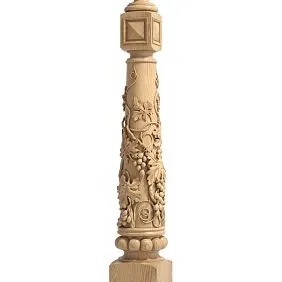
Carved balusters — the highest expression of craftsmanship. Each baluster is a miniature sculpture with vegetal ornaments (grapevines, acanthus leaves, roses), geometric patterns (woven, braided), and figurative elements (animals, human faces).
Carved balusters transform the staircase into a gallery object. They suit baroque, Renaissance, oriental (with arabesques), and maximalist interiors. Each baluster is unique — even when reproducing the pattern, hand-carving adds individuality.
Carved posts are often adorned with capitals (widened upper part with ornament), finials (decorative tops — spheres, urns, pediments), and ring carving (horizontal bands of ornament).
Minimalism: geometric purity
Complete opposite of carving — minimalist balusters with rectangular or square cross-sections, no decoration. Simply vertical wooden blocks 40x40, 50x50, 60x60 mm in natural wood.
Beauty is created through material, not form. Expressive texture of oak or ash, preserved annual rings, natural color, oil finish highlighting wood grain — that’s enough. Rhythm of verticals, play of light and shadow on edges create visual dynamics.
Minimalist balusters — choice for Scandinavian, Japanese, loft, high-tech interiors. They do not draw attention, allowing space to breathe.
Flat balusters: Slavic tradition
Flat balusters — boards 30–50 mm thick with carved outline. Shape can be any — from simple rectangles with rounded corners to complex silhouettes with carved recesses.
Flat balusters create a continuous visual plane, screening the space under the stairs. They suit Russian traditional, country, and rustic interiors. Often adorned with carved patterns featuring geometric or floral motifs.
Combined Solutions
In 2026, popular are mixes: alternating turned and plain balusters, integrating carved panels between groups of smooth balusters, combining wood with metal (wooden balusters with metal inserts), using balusters of different heights to create a wavy rhythm.
The main rule — the combination should be logical and rhythmic, not chaotic. For example: three plain balusters → one carved → three plain. Or a gradient from massive at the base to elegant at the top.
Futurism: 3D milling and parametric design
The most modern direction — balusters created by 3D milling on CNC machines. Computer modeling allows creating forms impossible in traditional processing — organic sculptural surfaces, interwoven elements, parametric patterns.
Futuristic balusters look like sculptures of modern art — streamlined, biomorphic, alien-like. They suit avant-garde, high-tech, and art nouveau interiors, where innovation, uniqueness, and technology are valued.
Support columns: points of strength and beauty
If balusters are rhythm, then columns are accents, vertical dominants, visual anchors of the staircase.
Classical columns with capitals
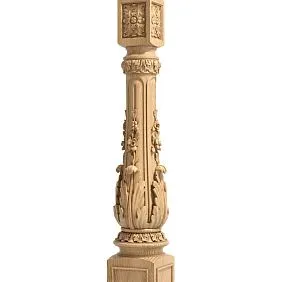
A classical support column resembles a column — a massive base, the column body (smooth or fluted — with vertical grooves), a capital (an expanded decorative top part).
Capitals can be of various orders:
-
Doric — simple, strict, with a round cushion and a square slab on top
-
Ionic — with decorative scrolls (volutes)
-
Corinthian — richly decorated with acanthus leaves, the most decorative
Classical columns create grandeur and monumentality. They suit mansions, spacious halls, interiors with high ceilings.
Columns with finials
Finial — decorative top of a column. Popular shapes:
-
Sphere — classic solution, symbolizing completion, harmony
-
Urna — vase-shaped form, elegant, refined
-
Pinnacle — pointed top, gothic, reaching upward
-
Carved capital — individual ornament, sculptural element
Finials transform columns into sculptural objects that attract attention. They emphasize the importance of the column as an accent element.
Minimalist columns
A simple square-section column 100x100 or 120x120 mm without decoration — a choice for modern interiors. Beauty is created through proportions, material quality, and precision of execution.
A minimalist column may have light milling along the edges — rounding for softness or chamfering for graphic effect. But the main aesthetic lies in the purity of form and expressiveness of wood texture.
Carved column-sculptures
An exclusive solution — a column adorned with three-dimensional carving along its entire height. Floral ornaments, interwoven vines, figures of animals or mythological creatures, geometric patterns — a carved column becomes a work of art.
Such columns are custom-made by master carvers or on multi-axis CNC milling machines. Each column is a unique, one-of-a-kind element defining the character of the entire staircase.
Columns with integrated lighting
An innovative 2026 solution — columns with built-in backlighting. An LED strip is installed inside the column, light exits through decorative cutouts, creating a light sculpture. Especially effective at night — columns become glowing beacons.
Staircase Components: Element System
Balusters and newels do not exist in isolation. They are part of a systemstaircase components, where each element performs its function and must harmonize with the others.
Handrails: Tactile Finishing
Handrail — a horizontal element held onto while ascending/descending. It rests on newels and is supported by balusters. Standard shapes:
-
Round, diameter 45–55 mm — classic, ergonomic
-
Oval, 50x70 mm — modern, dynamic
-
Rectangular with rounded edges — minimalist
The handrail must be absolutely smooth, polished to a silky finish. It is an element of constant tactile contact.
Handrail Support Block
Horizontal block 40x60 or 50x70 mm, installed on the top ends of balusters and serving as the base for the handrail. The block connects all balusters, distributes load, and creates structural rigidity.
Steps and treads
Horizontal staircase elements. Treads — surfaces stepped on. Risers — vertical panels between treads. They must be made of the same wood species as balusters and newels, for visual unity.
Stringers and Risers
Load-bearing staircase beams. Stringers — side inclined beams with grooves into which treads are inserted. Risers — beams onto which treads are laid from above. These elements are often decorated with carving or routing to match the style of balusters.
Decorative overlays and rosettes
Additional elements — rosettes (circular decorative plates at handrail-to-newel attachment points), riser caps, decorative corner elements. They add detail and completeness.
Color Solutions 2026: From Natural Palette to Bold Experiments
Natural Tones
Preserving the natural wood color — the main trend of biophilic design. Transparent oil or varnish enhances the natural tone, deepening it, but does not radically alter it.
Natural Wood Palette:
-
Light tones: beech, birch, whitewashed oak (cream, beige, light gray)
-
Medium tones: ash, oak, spruce (honey, golden, warm brown)
-
Dark tones: walnut, stained oak (chocolate, dark brown, nearly black)
Stained Wood
Stains allow color change while preserving texture visibility. Popular directions:
-
Gray Wood — trendy stain creating Scandinavian or loft aesthetics
-
Whitewashed Wood — lightening while preserving structure, airy feel
-
Dark Walnut — deep, almost black color for dramatic effect
Brushed Wood with Colored Oil
Brushing (removal of soft fibers with a brush) creates a textured surface. Applying colored oil into the pores highlights growth rings — creating a 3D volumetric effect. Popular combinations: dark oil in pores on light background, white oil in pores on dark background.
Contrasting solutions
Intentional color contrast — an effective technique. For example:
-
Dark balusters and newels against light steps
-
Light balusters between dark newels
-
Alternating light and dark balusters
The key is that the contrast must be clear, deliberate, not random.
Assembly and installation: creating a sturdy structure
The beauty of balusters is meaningless if installed incorrectly. Reliable mounting is the foundation of safety.
Attaching balusters to steps
Main methods:
-
On wooden dowels — classic, completely hidden mounting
-
On metal spikes — maximum strength
-
With concealed screws — fast, simple
-
Through a baluster support — a plank on the steps, simplifying installation
Mounting newels
Newels bear the main load, so mounting must be maximally secure:
-
Through-bolt with nut tightened from below the step
-
Anchor mounting to concrete base
-
Insertion into the stringer with additional adhesive and bolted mounting
-
Metal reinforcing plates for heavily loaded points
Handrail mounting
The handrail is mounted on newels and rests on a support plank. Methods:
-
Slot in the handrail slips over the plank — secure, inconspicuous
-
Screws from below through the plank into the handrail — concealed mounting
-
Threaded inserts in newels and handrail for detachable connections
Maintenance and care: longevity of beauty
Wooden balusters and newels, with proper care, serve for decades without loss of quality.
Regular cleaning
Weekly dry cleaning with a soft brush or vacuum cleaner. Weekly damp wiping with slightly damp (not wet) cloth to remove dirt. Avoid aggressive cleaning agents, solvents, abrasives.
Recoating
Oil or wax requires annual renewal — apply a thin layer with a pad, rub in, remove excess. Lacquer is more durable — renewal every 3–5 years. For scratches or scuffs — local restoration: light sanding, application of finish.
Checking fasteners
Check the strength of baluster and newel fasteners every six months. If looseness is detected, tighten the fasteners. Early detection of loosening prevents connection failure.
Protection from moisture and temperature
Avoid water contact with wooden elements (leaking roof, excessive water cleaning). Maintain stable air humidity at 40-60% — dry air causes cracking, overly humid air causes wood swelling.
FAQ: Answers to popular questions
What is the difference between a baluster and a post?
A baluster is a thin vertical element (40-70 mm), installed on each step, creating a railing. A post is a heavy support (80-120 mm), installed at key points, bearing the main load.
How many balusters are needed per step?
Standard — 1-2 balusters per step depending on step width and safety requirements. The distance between balusters should not exceed 150 mm (for homes with children — 100-120 mm).
Can different baluster styles be combined?
Yes, but cautiously. Successful combinations: classical and minimalist in a certain rhythm, carved accents between simple ones. Chaotic mixing destroys harmony.
Which wood species is best for balusters?
For interior staircases — oak (maximum strength and durability), beech (optimal price/quality ratio), ash (light aesthetic). For exterior — larch (resistance to moisture).
Are support posts mandatory?
Yes, for safety and structural integrity. Posts bear the main load; without them, the railing will be unreliable.
Can balusters be installed by oneself?
With basic carpentry skills, proper tools, and following instructions — yes. However, for complex structures, carved elements, and ensuring guaranteed safety, it’s better to hire professionals.
How to care for carved balusters?
Regular dry cleaning with a soft brush to remove dust from carved recesses. Periodic renewal of protective coating with a brush penetrating all details. Avoid impacts and scratches.
How long do wooden balusters last?
With proper manufacturing, correct installation, and maintenance — 50-100 years and more. Oak balusters in historic buildings last for centuries.
What to do if a baluster cracks?
A small crack can be glued with carpentry glue, clamped with a clamp. Serious damage requires replacing the baluster. Always order 2-3 spare balusters in case of damage.
What budget is needed for balusters and posts?
It depends on wood species, complexity, and quantity. Simple pine balusters — from 300-500 rubles each. Precision beech balusters — 800-1500 rubles each. Carved oak balusters — 3000-8000 rubles each. Support posts — 3000-15000 rubles each depending on size and decorative finish.
Conclusion: entrust vertical architecture to professionals
Creating a harmonious staircase with balusters and posts — an art requiring not only design vision but also deep understanding of materials, precision execution, and years of experience. You may have a beautiful concept, but without quality materials and professional manufacturing, it will remain unrealized.
Company STAVROS — a recognized leader in producing wooden staircase elements with 20 years of experience, full-cycle in-house production, reputation confirmed by thousands of projects implemented across Russia.
Why STAVROS is the right choice
Comprehensive solutions. STAVROS offers complete staircase component systems — balusters, posts, handrails, treads, nosings, and stringers — all from one batch of wood, in a unified style. This guarantees perfect color, texture, and size matching. You receive not a set of separate elements, but a ready-made system for creating a harmonious staircase.
Material quality. The company works exclusively with premium kiln-dried wood at 8-10% moisture — the ideal level preventing deformation. High-grade oak, ash, beech, walnut without knots, cracks, or defects. Each blank undergoes inspection before entering production.
In-house production. Modern CNC lathes, multi-axis milling centers, traditional hand-carving equipment — a full arsenal of technologies from classical to innovative. Hand-finishing by experienced masters guarantees quality unattainable on a production line.
Extensive assortment. Over 50 baluster models — from classic turned to modern minimalist, from carved baroque to futuristic 3D-milled. Dozens of post options — with capitals, finials, carving, or simple. You’ll find elements for any style, from palace classicism to cosmic futurism.
Custom Projects. Didn't find the perfect option in the catalog? STAVROS will manufacture balusters and posts according to your drawings, sketches, photos. Our own production allows us to implement unique design concepts without additional cost and with quality guarantee.
Professional Consultations. The company’s specialists are not just salespeople, but experts with deep knowledge of woodworking, architecture, and design. They will help you choose the optimal combination of elements, recommend a wood species suitable for your budget and style, calculate the quantity, and provide installation and maintenance recommendations.
Quality Guarantee. STAVROS is confident in its products and provides a manufacturer’s warranty. Each element undergoes multi-stage quality control. If a material or manufacturing defect is detected, the element will be replaced without questions.
Logistics across Russia. Delivery with careful packaging protecting elements during transport. Each baluster and post is individually wrapped and placed in special packaging. You will receive components in perfect condition, ready for installation.
Staircase as an investment in quality of life
When you choose balusters and posts from STAVROS, you are investing not just in structural elements, but in beauty that will surround you daily. Every time you ascend the staircase, you will see the play of light on carved elements, feel the smoothness of polished handrails, and sense the reliability of the structure. These are micro-moments of aesthetic pleasure that accumulate, creating an overall sense of well-being, harmony, and home as a place of strength.
A wooden staircase with balusters and posts from STAVROS is not a trend that will become outdated. It is timeless value, classic design that will remain relevant for decades. It is an architectural element you will pass on to your children and grandchildren as part of your family’s history.
Start creating your ideal staircase
Visit the STAVROS website, explore the catalog, be inspired by completed projects. Contact our specialists — discuss your concept, receive professional recommendations, order samples. See and touch the material before making your final decision.
Vertical interior architecture — it’s not just balusters and posts. These are sculptural elements that create space rhythm, define the character of the home, and ensure family safety. It’s a connection to craftsmanship tradition, to the material, to beauty created by hands and heart.
Choose STAVROS — choose quality, reliability, beauty from classic to futuristic. Create staircases you can be proud of. Your ideal vertical architecture begins here.