Article Contents:
- Philosophy of verticals and horizontals: the language of architecture
- Balusters: vertical axis of safety and beauty
- Types of balusters: from classic to minimalism
- Wood species for balusters: character in material
- Role of balusters in space organization
- Baseboards: horizontal framing of space
- Functions of baseboard: from practicality to beauty
- Baseboard dimensions and proportions
- Wooden baseboard: material defining character
- Crown mouldings and casings: completing horizontals and verticals
- Crown mouldings: line defining height
- Casings: frame for openings
- Creating vertical-horizontal harmony: practical principles
- Principle 1: Unity of material
- Principle 2: Consistency of finish
- Principle 3: Unity of finish
- Principle 4: Consistency of tone
- Principle 5: Proportionality
- Interior styles and wooden harmony
- Classic and neoclassic
- Minimalism and Scandinavian style
- Loft and Industrial Style
- Eco-style and biophilic design
- Company STAVROS: creating wooden harmony
- Conclusion: wood as the language of harmony
Interior is not just a set of furniture, wallpaper, and lighting fixtures. It is a complex architectural composition where each element plays its role in creating a cohesive space. In 2026, designers and architects increasingly turn to fundamental principles of harmony — interaction between vertical and horizontal lines through wooden elements. Balusters, rising from the floor to the stair handrail, create a powerful vertical that draws the gaze upward, giving the space height and lightness. Baseboards, crown mouldings, casings, and mouldings form horizontals that ground the composition, connecting walls to floors and ceilings, structuring space into logical zones.
When these elements are made of natural wood of the same species, processed in a unified style, and coated with matching finishes — a sense of completeness and integrity of the interior emerges, distinguishing professional design from a random collection of details. Wood as a material possesses a unique ability to unite disparate elements into an organic system thanks to its natural texture, warm tone, and tactile appeal. In this article, we will examine how to create vertical-horizontal harmony through thoughtful use of wooden elements, which will become the visual and emotional foundation of your home.


Philosophy of verticals and horizontals: the language of architecture
Human perception of space is deeply rooted in geometry. Vertical lines evoke a sense of upward movement, create dynamism, and visually expand the height of a room. High Gothic cathedral columns, slender trees in the forest, vertical slats of lath partitions — all of them activate the gaze, compel one to lift the head, and feel spaciousness. Horizontal lines, on the other hand, calm, stabilize, and create a sense of reliability and peace. The horizon line, the expanse of a plain, horizontal stripes on a building’s facade — all of these ground the composition and provide a sense of support.
In interior design, balancing verticals and horizontals is critical for comfortable perception. An excess of vertical elements without sufficient horizontals creates unease and a sense of instability — the space appears elongated and uncomfortable. Dominance of horizontals with insufficient verticals makes the room low and oppressive, visually lowering the ceiling. Harmony is achieved through balanced presence of both types of lines, where wooden elements serve as organizing axes.
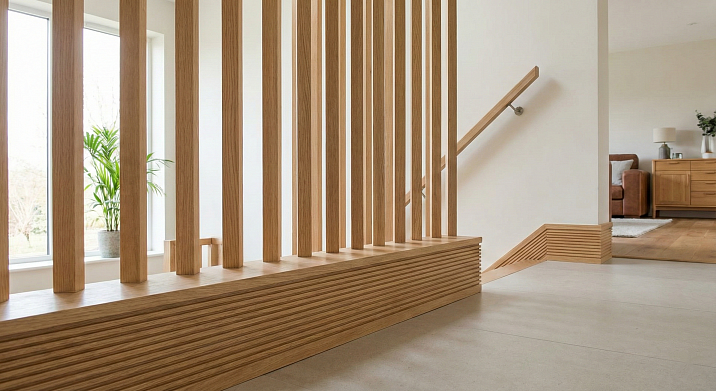
Wooden balustersOn a staircase — a classic example of functional verticality. They not only ensure safety by supporting the handrail, but also create a rhythmic vertical pattern that structures the staircase space. Repeating balusters at regular intervals form a visual rhythm — measured, calming, and organizing the chaos of open space into an orderly composition. This same principle applies to lath partitions, vertical decorative slats on walls, tall narrow casings.
Baseboards, cornices, moldings — horizontal elements that frame the space.Wooden baseboardIt runs along the perimeter of the room at the junction of the wall and floor, visually completing the vertical line of the wall, protecting it from dirt and mechanical damage, concealing technical gaps. But its role is not purely utilitarian. A baseboard is a horizontal line that connects the floor to the wall, creating a transition and adding graphic interest to the interior. A tall baseboard (100–150 mm) becomes a full-fledged architectural element, especially expressive if made of wood with a vivid grain.
Cornices work similarly but on the opposite level — they frame the junction of the wall and ceiling.wooden corniceIt creates a horizontal shadow separating the ceiling from the wall, adding a classic sense of completion to the room. In high-ceilinged rooms, a cornice visually fixes the ceiling line, preventing the sensation of endless vertical space. In low rooms, a thin cornice, close in color to the ceiling, visually lifts the height instead.
When vertical balusters and horizontal baseboards with cornices are made from the same type of wood, processed in the same way, and coated with the same oil or varnish — a visual connection emerges between different levels of the room. The eye easily glides from the floor to the wall, from balusters to the handrail, from baseboard to cornice, perceiving all of this as a single wooden composition, as an architectural dialogue between verticals and horizontals.




Balusters: the vertical axis of safety and beauty
Balusters are vertical posts of staircases, balconies, or terraces, located between support posts and supporting the handrail. Their function is dual: practical (ensuring safety, preventing falls) and aesthetic (creating visual rhythm, decorating space, demonstrating style).
Our factory also produces:


Types of balusters: from classic to minimalist
Turned balusters — the classic of carpentry. Turned on a lathe from a solid block of wood, they have a circular cross-section with variable diameter: thickening (vases), transitions, rings, spherical elements alternate, creating a complex profile. A turned baluster can be laconically simple — just two or three profile elements — or incredibly complex with ten diameter transitions, creating a play of light and shadow. Such balusters are ideal for classic interiors, country houses in traditional style, staircases where craftsmanship is valued.
Carved balusters — the pinnacle of decoration. Three-dimensional carving is applied to the baluster body: plant ornaments, geometric patterns, animal motifs. The carving can be relief (projecting above the surface), counter-relief (sunken), or through (cutting through the baluster, creating a lacy effect). Carved balusters require the handiwork of a master carver, which increases cost, but the result is unique — each baluster becomes a small sculpture. Suitable for luxurious interiors in Baroque, Rococo, or Russian terem styles.
Flat balusters — a modern interpretation of traditional form. Instead of a circular cross-section, rectangular or trapezoidal shapes are used. An ornament can be carved into the flat surface, a pattern cut through, or a clean flat surface left. Flat balusters visually appear lighter than turned ones, creating a more graphic, strict composition. Suitable for Scandinavian interiors, ethnic styles (Slavic carving motifs), modern spaces with an emphasis on clean lines.
Square and rectangular balusters — minimalism in its purest form. A simple square-section block, 40x40 or 50x50 mm, with rounded or beveled edges. No decoration — all beauty lies in the quality of the wood, its texture, tone. Such balusters create a strict vertical rhythm, not distracting from the overall architecture of the space. Ideal for lofts, minimalist interiors, modern homes with an emphasis on functionality.
Get Consultation
Wood species for balusters: character in material
The choice of wood species determines not only the strength and durability of balusters, but also their visual character, tactile sensations, and ability to fit into the interior concept.
Oak — symbol of reliability and nobility. Dense wood with expressive texture (large pores, pronounced annual rings) creates a powerful visual impression. Color varies from light honey in young oak to dark brown in stained oak. Oak balusters are heavy both physically and visually — they are suitable for spacious rooms with high ceilings, classic interiors where solidity is valued. Oak handles brushing well — a technique where soft fibers are combed out, leaving hard ones, creating an expressive relief.
Ash — lightness and airiness. Light-colored wood with delicate texture (smaller pores, smooth lines) creates a sense of freshness and purity. Ash is visually lighter than oak, making it ideal for Scandinavian interiors, bright spaces, small rooms where it’s important not to overload the environment. Ash balusters, after bleaching, become almost white, preserving the visible wood texture — an effect impossible with oak.
Beech — uniformity and warmth. Dense wood of pink or cream color with uniform, almost imperceptible texture. Beech is ideal for turned balusters with complex profiles — uniform structure allows creating thin elements without risk of cracking. Beech balusters appear warm and cozy, fitting perfectly into Provence, chalet, or modern spaces with an emphasis on naturalness without ostentation.
Larch — northern strength. Dense, resinous wood with amber-honey color and expressive texture. Larch is resistant to moisture and decay, making it optimal for veranda staircases, unheated houses, saunas. Visually, larch is warm, its tone creates a sense of sunlight even on cloudy days.
Spruce — accessibility and simplicity. Soft, light-colored wood with contrasting texture (dark annual rings on light background). Spruce is easy to work with, affordable, but requires more frequent re-coating and larger cross-sections to ensure strength. Spruce balusters are suitable for country houses, budget projects, interiors in country style.
Role of balusters in organizing space
Balusters on staircases create a visual rhythm — a repeating pattern of vertical elements with a specific spacing. This rhythm works like a musical measure, organizing the chaos of open space. Frequent spacing (balusters every 80–100 mm) creates a dense, almost monolithic vertical screen — the railing is perceived as a semi-transparent wall. Sparse spacing (150–200 mm) creates lightness and airiness, balusters read as individual verticals with plenty of air between them.
Height of balusters (usually 900 mm from step to top of handrail) determines the proportion of the railing relative to the staircase. Too low balusters (less than 800 mm) create a sense of being grounded and unsafe. Too high (more than 1000 mm) visually press down, turning the staircase into a narrow corridor. The standard height of 900–1000 mm has been refined over centuries of practice — it’s the optimal balance of safety, comfort of handrail support, and visual harmony.
Balusters can be not only on staircases. Vertical wooden rails serving as decorative or functional partitions work on the same principle. They create a vertical rhythm, zone space, without creating solid walls, allowing light and air to pass through. Such rails are especially popular in 2026 in biophilic design — they mimic tree trunks in the forest, creating a connection with nature.
Baseboards: horizontal framing of space
If balusters are vertical expressiveness, then baseboards are horizontal functionality that has transitioned into aesthetics. The baseboard runs along the perimeter of the room at the junction of the wall and floor, performing several tasks simultaneously.
Functions of baseboards: from practicality to beauty
Wall protection — when cleaning, a mop, vacuum cleaner, or other tools inevitably contact the lower part of the wall. Without a baseboard, wallpaper gets scratched, paint fades, plaster flakes. The baseboard absorbs these impacts, protecting the main wall covering.
Gap concealment — when laying floor covering (parquet, laminate, planks) around the room perimeter, a technical gap of 10–15 mm is left to compensate for material thermal expansion. This gap is unattractive and collects dust. The baseboard covers it, creating a neat transition from floor to wall.
Utility concealment — modern baseboards often have a cable channel — an internal cavity through which wires (electrical, internet, telephone) can be run. This eliminates the need to notch walls or lay cables openly.
Visual framing — the baseboard creates a horizontal line that frames the floor, separating it from the vertical wall. This is a visual frame, completing the composition. Without a baseboard, the floor and wall merge at the junction, creating a sense of incompleteness.
Baseboard style — shape, size, color, material — is a declaration of interior style. A tall white baseboard with a decorative profile — classic and neoclassical. A thin baseboard matching the floor color, almost invisible — minimalism. A wooden baseboard with pronounced texture — eco-style, biophilic design.
Baseboard Dimensions and Proportions
In 2026, there is a trend toward increasing baseboard height. If ten years ago the standard was baseboards 50–70 mm high, now 100–150 mm options are popular. A tall baseboard visually raises the ceiling (paradoxically, but factually — a clear horizontal line at 10–15 cm from the floor creates a visual support from which the eye reflects upward). It is also more expressive, especially if made of wood with a beautiful texture.
Baseboard thickness (projection from the wall) is usually 15–25 mm. A too thin baseboard looks like a glued strip, while a too thick one resembles a shelf. Optimal thickness creates a slight shadow at the junction of the baseboard and wall, adding depth.
Baseboard profile is determined by interior style. A rectangular profile without decoration — a universal solution for modern interiors. A baseboard with a beveled top edge — strictness and graphic quality. A baseboard with a rounded top edge — softness and classicism. A baseboard with a decorative profile (projections, grooves, moldings) — historicism, neoclassicism, traditional styles.
Wooden baseboard: the material defining character
Baseboards can be made of MDF, polyurethane, plastic, but a solid wood baseboard is a completely different level. Wood creates tactile warmth (plastic feels cold to the touch), visual elegance (it is impossible to confuse natural wood texture with imitation), durability (wooden baseboards last decades, while plastic yellows and cracks).
When a wooden baseboard is made from the same wood species as the staircase balusters, door casings, and furniture — visual unity emerges. An oak baseboard harmonizes with an oak floor and oak balusters, creating a sense of thoughtful, cohesive interior design. This is especially important in open-plan spaces, where the staircase, living room, and kitchen are visually unified — wooden elements of the same species act as a connecting thread.
The color of a wooden baseboard can match the floor (the baseboard blends with the floor, creating an effect of floor covering continuing onto the wall), contrast with the floor (a light baseboard on a dark floor or vice versa — a bright accent), or match the walls (the baseboard is painted to match the wall color, visually increasing wall area). In 2026’s biophilic design, natural wood color without staining — honey oak, light beech, warm larch — creates a sense of closeness to nature.
Crown molding and door casings: finishing horizontals and verticals
If a baseboard frames the lower part of the wall, then crown molding frames the upper part, creating a transition from wall to ceiling.Wooden casingFrames door and window openings, emphasizing them as architectural elements.
Crown molding: the line defining height
A wooden crown molding in a classical interior is a substantial profiled element that creates a pronounced shadow at the junction of wall and ceiling. In high rooms (3–4 meters), crown molding visually fixes the ceiling line, preventing the sensation of infinite vertical space. The eye hits the crown molding and stops, perceiving it as a logical conclusion of the wall.
In modern interiors, crown molding may be minimalist — a thin wooden strip or even absent, creating an effect of clean geometry at the junction of two planes. But even a thin wooden crown molding, especially if made from the same wood species as baseboards and balusters, creates a visual connection between the lower and upper parts of the room.
Door casings: frames for openings
A door or window casing frames the opening, concealing the installation gap between the door/window frame and the wall, while simultaneously emphasizing the opening as an architectural element. A wide casing (80–120 mm) makes the opening more expressive, drawing attention to it. A narrow casing (40–60 mm) delicately frames the opening without drawing unnecessary attention.
A wooden door casing may have a simple rectangular shape (modern interiors), a rounded shape (softening geometry), or a decorative profile with ornamental elements (classic, neoclassical). When all door casings in a house are made from the same wood species in a unified style, this creates architectural unity — each opening becomes part of a cohesive composition.
Creating vertical-horizontal harmony: practical principles
How to unite balusters, baseboards, crown moldings, and door casings into a harmonious system?
Principle 1: Material Unity
Use one wood species for all major wooden elements. If balusters are oak — baseboards, casings, crown moldings should also be oak. If balusters are beech — all other elements should be beech. Unity of species creates visual connection, even if elements are located in different parts of the room.
It is permissible to combine wood species, but cautiously: the main species (e.g., oak) for large elements (balusters, baseboards), accent species (e.g., walnut) for small details (narrow casings, decorative moldings). But no more than two species in one space — otherwise, visual chaos will arise.
Principle 2: Surface Treatment Consistency
All wooden elements must have the same surface treatment. If balusters are brushed (texture emphasized by soft fiber removal) — baseboards and casings should also be brushed. If balusters are smoothly sanded — all other elements should be smooth. Brushing creates a pronounced texture, tactile roughness, emphasizing the naturalness of wood — a choice for biophilic, eco-interiors, rustic styles. Smooth sanding creates a silky surface — a choice for classic, minimalist, modern spaces.
Principle 3: Finish Consistency
Oil, varnish, wax — the finish determines the visual character of wood. Oil creates a matte or semi-matte surface, emphasizes texture, preserves tactile warmth of wood. Varnish creates a glossy protective layer, enhances color, provides maximum durability. Wax creates a silky finish, a light satin sheen.
All wooden elements in a room must be finished with the same type of product. If balusters are oiled — baseboards and casings should also be oiled. If balusters are varnished — all other elements should be varnished. A difference in finish (some elements matte, others glossy) creates visual dissonance.
Principle 4: Tone Consistency
The color of wood must be consistent. All elements are either natural color without tinting (showing the natural tone of the species) or tinted to one shade. Popular stains: whitewashed (imitation of aged wood), gray (popular Scandinavian tone), dark stain (enhancing color to walnut or oak).
Combining light and dark shades is possible as a contrast: light balusters and dark skirting boards or vice versa. But this must be a deliberate design decision, not a coincidence.
Principle 5: Proportionality
The sizes of elements must be proportional to each other and to the room. In a spacious living room with ceilings three and a half meters high, massive balusters with a diameter of seventy millimeters, tall skirting boards one hundred and fifty millimeters, and wide architraves one hundred and twenty millimeters will be appropriate. In a compact room with two-meter seventy ceilings, balusters fifty millimeters, skirting boards seventy millimeters, and architraves sixty millimeters will be harmonious.
Violation of proportions creates visual discomfort: thin balusters in a huge hall look like matches, massive balusters in a small room look like pillars in a storeroom.
Interior styles and wooden harmony
Different styles require different approaches to balancing verticals and horizontals.
Classicism and neoclassicism
Here, clear proportions, symmetry, and pronounced profiles are important. Turned balusters with a classic profile (vase, rings, grips). Tall skirting boards (one hundred to one hundred fifty millimeters) with decorative profiles. Heavy cornices. Wide architraves with capitals (decorative tops). All made from noble woods: oak, beech, ash. Finish with varnish or oil, preserving the natural tone or slightly darkened with stain.
Minimalism and Scandinavian style
Simple forms, light tones, absence of decoration. Square or simple cylindrical balusters without profiling. Rectangular skirting boards seventy to one hundred millimeters high. Narrow architraves forty to sixty millimeters wide, rectangular. Woods: ash, birch, pine. Treatment: bleaching or natural light tone. Finish with matte oil or clear varnish.
Loft and industrial style
Roughness, massiveness, contrasts. Thick square or rectangular balusters from dark stained oak. Tall, massive skirting boards. Wide, rough architraves. Possible combination of wood with metal. Finish with oil highlighting texture, possible artificial aging.
Eco-style and biophilic design
Maximum naturalness, pronounced texture, natural tones. Balusters can be made from untrimmed wood with preserved bark or knots. Skirting boards with brushing, emphasizing the structure of annual rings. Architraves simple, without excessive decoration. Any wood species, but preserving the natural color. Finish with oil or wax, preserving the tactile quality of wood.
Company STAVROS: creating wooden harmony
Company STAVROS has been producing for interiors: balusters, skirting boards, cornices, architraves, moldings for over twenty years.Wooden itemsThe company's philosophy is to help create a harmonious space through high-quality wooden elements.
The STAVROS catalog features more than one hundred baluster models: from simple square to complex carved, from classic turned to modern flat. Skirting boards of various heights (from sixty to one hundred eighty millimeters) and profiles. Architraves from minimalist to decorative. Cornices from thin to massive. All made from solid oak, ash, beech, larch, pine.
The advantage of working with STAVROS is the ability to order all elements from the same wood species with a unified treatment and finish. Balusters, skirting boards, architraves, cornices will arrive identical in color, texture, sanding level, and staining. This guarantees visual unity, which is impossible to achieve by purchasing elements from different manufacturers.
STAVROS provides consultations for selecting elements to match a specific interior. Indicate the style, room dimensions, desired wood species — specialists will recommend optimal baluster, skirting board, and architrave models, calculate the required quantity, and suggest treatment and finish options.
For complex projects, STAVROS manufactures elements according to individual drawings: non-standard sizes, unique profiles, original carving. This allows creating an exclusive interior where every detail is thought out and executed for a specific space.
Conclusion: wood as a language of harmony
Vertical-horizontal harmony in interior design is not an abstract concept, but a specific visual and emotional effect achieved through proper use of wooden elements. Balusters raise the gaze upward, creating a sense of height and lightness. Skirting boards and cornices frame the space horizontally, giving a sense of stability and completion. Architraves emphasize openings as architectural accents.
When all these elements are made from natural wood of the same species, uniformly processed, and coated with a matching finish — a sense of interior unity emerges, distinguishing a thoughtfully designed space from a random collection of furniture and finishes. Wood, thanks to its natural texture, warm tone, and tactile appeal, acts as a universal unifying material, creating a connection between different levels and zones of the space.
In 2026, when biophilic design, the pursuit of natural materials, and mindful consumption become mainstream, wooden interior elements are experiencing a renaissance. This is not merely a fashion trend, but a return to fundamental principles of comfortable living environments, where natural materials create emotional well-being, reduce stress, and connect people with nature—even in urban apartments.
When creating an interior, do not neglect details. Balusters, skirting boards, cornices, architraves may seem secondary against the backdrop of furniture and wall finishes. But it is precisely they that create the architectural framework of the space, visual logic, rhythm, and completeness. Investing in high-quality wooden elements from a reliable manufacturer means investing in the longevity, beauty, and harmony of your home for decades to come.