Article Contents:
- Baluster as an Architectural Element: History and Functions
- Typology of Balusters: From Turned to Carved
- Turned Balusters: Classic and Universal
- Carved Balusters: Artistic Sculpture
- Flat and Square Balusters: Modernity and Minimalism
- Combined Balusters: Wood and Metal
- Wood Species for Balusters: Character and Durability
- Oak: the standard of strength and nobility
- Beech: Density and Versatility
- Ash: Contrast and Lightness
- Pine: Accessibility and Tradition
- Baluster Styles: From Baroque to Modern
- Classical Styles: Baroque, Renaissance, Empire
- Neoclassicism: modern interpretation of traditions
- Modern: Organic Forms and Fluidity
- Modern styles: Minimalism and Scandinavian
- Technical Aspects of Choosing and Installing Balusters
- Baluster height and spacing
- Ways to mount balusters
- Finishing Treatment of Balusters
- Where to Buy Balusters: Supplier Selection Strategy
- Construction Warehouses: Mass Production Without Quality
- Chinese Marketplaces: Unpredictability
- Specialized Manufacturers: Systematic Approach and Guarantees
- Balusters in the Complex of Stair Elements
- Handrails: Completion of the Balustrade
- Support Posts: Accents of the Structure
- Risers and Treads: Foundation of the Staircase
- Baluster Trends for 2026
- Large Cross-Sections and Massiveness
- Composite Materials
- Colored Balusters
- Ecological Awareness
- Why STAVROS is the Choice of Professionals

A baluster is not just a vertical post filling the space between steps and a stair handrail. It is a key architectural element that defines the stylistic character of the entire structure, its visual lightness or massiveness, its belonging to an era and aesthetic direction. The shape, profile, carving, and wood species of the baluster determine whether the staircase will be a ceremonial axis of the space or a modest functional transition between floors, whether it will become the compositional center of a hall or dissolve into the interior. In 2026, when suburban construction is booming and wooden staircases are returning as a symbol of status and eco-friendliness, the questionwhere to buy balusterssounds not like a technical task of finding components, but as a strategic choice among dozens of manufacturers, hundreds of models, numerous wood species, and levels of processing quality.
The market for stair balusters has undergone a fundamental transformation over the past decade. If previously the assortment was limited to several standard turned models made of pine, today professional builders, architects, and designers have access to a rich selection: from miniature turned balusters 700 millimeters high for compact stairs to monumental carved supports 1200 millimeters high for ceremonial flights, from laconic square balusters for modern interiors to richly ornamented carved balusters for classic mansions. The baluster has transformed from a utilitarian detail into a decorative element capable of transforming the character of an entire interior. This is precisely why the question of the quality, origin, and processing of balusters has become critical for those creating spaces for decades.


Baluster as an Architectural Element: History and Functions
The baluster has a centuries-old history, traceable from the ancient balustrades of Roman villas to the Renaissance palaces of Italy, where balusters first acquired their classic vase-like form. Each era created its canonical profiles: the turned balusters of the Baroque with their lush swellings and constrictions, the elegant balusters of Rococo with asymmetrical scrolls, the strict balusters of Classicism with fluting and precise proportions, the laconic balusters of Modernism with flowing organic forms. In the 20th century, industrialization simplified forms, but the 21st century is restoring the baluster's status as a decorative object, where CNC technologies allow the embodiment of the most complex profiles with historical accuracy.
wooden balusters for staircasesThey perform three key functions simultaneously. Structural function: balusters form a rigid vertical connection between the steps and the handrail, giving the entire balustrade stability and the ability to withstand horizontal loads when leaning on the railing. Protective function: balusters form a barrier that prevents falling from the stairs, which is critical for the safety of children and the elderly. Building codes regulate the maximum gap between balusters—usually no more than 100–120 millimeters—to eliminate the risk of a child slipping between the posts. Decorative function: balusters create a rhythmic structure that organizes the visual perception of the staircase, transforming it from a utilitarian structure into an architectural object.
A modern solid wood baluster is the product of a complex production cycle. Raw material selection excludes blanks with unacceptable defects: through knots, which can become points of failure under load; cracks that reduce strength; rot and blue stain, indicating fungal infection of the wood. Kiln drying reduces moisture content to 8–10%, which is the gold standard for interior products: at this moisture level, the wood is stable, does not shrink, crack, or warp under central heating conditions. Mechanical processing includes turning to create the profile, milling decorative elements on CNC machines, hand carving for exclusive models, and multi-stage sanding to achieve tactile perfection of the surface.




Baluster typology: from turned to carved
The variety of baluster forms is so great that it requires systematization according to several criteria simultaneously.
Our factory also produces:


Turned balusters: classic and universal
Turned balusters are the most common category, including products whose profile is created by turning on a lathe. Turning allows for symmetrical, axisymmetric shapes with alternating thickenings and narrowings, coves and beads, balusters and balls.Turned wooden balustersare universal in style: they work equally well in classic interiors due to their ability to embody historical profiles, and in modern ones thanks to the possibility of creating laconic geometric forms.
Turned balusters come in simple versions with two to three profile elements—suitable for restrained interiors where functionality without visual noise is important. Medium complexity with five to seven profile elements—an optimal balance between decorativeness and restraint, suitable for most classic and neoclassical interiors. Complex with ten or more profile elements—they create an expressive rhythmic structure, relevant for grand staircases in classic mansions, where the staircase is the main architectural object.
The advantage of turned balusters is the technological efficiency of production, which ensures perfect repeatability of the profile from one piece to another, consistent quality, and a reasonable price with high decorativeness. Turned balusters undergo thorough sanding after processing, making them ready for finishing with varnishes, oils, or paints.
Get Consultation
Carved balusters: artistic sculpture
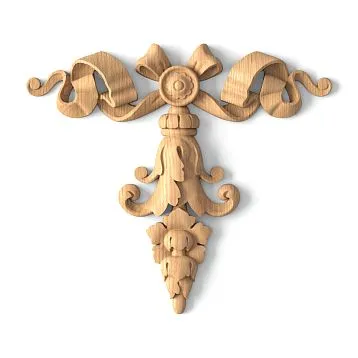
Carved balusters are the highest expression of furniture and architectural art, where wood is transformed into a three-dimensional sculpture. Carving can be relief, where the ornament protrudes above the background, or openwork, where the background is completely removed and the carving creates a lace-like structure.Carved balusters from solid woodare decorated with plant motifs: acanthus leaves—a classic ornament originating from antiquity; grapevines with clusters and leaves—a symbol of abundance and fertility; floral rosettes, lilies, palmettes.
Carved balusters are manufactured using a combined method: the basic shape is turned on a lathe, decorative elements are milled on a CNC machine according to a three-dimensional model, and final finishing is done by hand by a master carver, who sands the carving, emphasizes details, and removes technological marks. This approach combines the advantages of industrial production—repeatability and speed—with the merits of handwork—artistic expressiveness and uniqueness.
Carved balusters require the use of dense, fine-pored wood species capable of holding fine carving without chipping: oak with its high hardness, beech with its uniform structure, walnut with its suitability for carving. Carved balusters are significantly more expensive than turned ones due to the labor-intensive production, but they are precisely what transform a staircase into a work of art, worthy of being the centerpiece of an interior.
Flat and square balusters: modernity and minimalism
Flat balusters of rectangular cross-section with decorative milling on the front faces—a modern alternative to traditional round ones.Flat wooden balusterscreate a graphic rhythmic structure, where the alternation of vertical planes forms a strict geometry, relevant in modern and minimalist interiors.
Square balusters of constant cross-section along their entire height—the most laconic option, where decorativeness is achieved not by shape, but by material, wood texture, and finishing. Square balusters can be simple without decoration, with rounded edges for tactile comfort and safety, with shallow milling of longitudinal flutes (canelures), or with geometric inlays creating visual complexity.
Combined balusters: wood and metal
A current trend is the combination of wooden balusters with metal elements. The wooden body of the baluster is complemented by metal rings, brass overlays, or forged elements. Such balusters combine the warmth of wood with the technological nature of metal, tradition with modernity, creating interesting tactile and visual contrasts.
Wood species for balusters: character and durability
The choice of wood species determines not only the appearance of the baluster but also its durability, ability to hold carving, and reaction to humidity and temperature.
Oak: The Standard of Strength and Elegance
Oak—the king among species for producing staircase elements.Oak balusterspossess exceptional hardness: a density of 650–750 kilograms per cubic meter ensures the highest strength and resistance to mechanical impacts. Oak is not afraid of abrasion, which is critical for staircase elements subjected to constant loads when leaning on the railing. Oak is resistant to moisture due to its high tannin content, which is important for staircases in unheated rooms or on terraces.
The texture of oak is expressive: large annual rings create a contrasting pattern, especially noticeable on a radial cut. The color palette of oak varies from light honey to dark brown. Toning allows for any shade: from bleached Scandinavian to almost black stained oak. Oak balusters are ideal for grand staircases in classic mansions, where solidity, status, and connection with tradition are important.
Beech: Density and Versatility
Beech—a noble European species with a uniform, fine-pored structure and high density of 650–680 kilograms per cubic meter.Beech balustersin terms of strength, are not inferior to oak ones, but visually appear softer, warmer, and cozier due to their pinkish hue and fine-pored texture. Beech processes excellently: it turns easily, holds the finest carving details, and allows for the creation of the most complex profiles with clear transitions.
The natural color of beech—light pink with a slight peach tint—adds warmth to the interior. Toning beech yields any shade while preserving its characteristic fine-pored texture. Painting with enamel on beech looks perfect: the paint applies evenly, without revealing the texture, creating a smooth, flawless surface. Beech balusters are universal in style: they work equally well in both classic and modern interiors.
Ash: Contrast and Lightness
Ash is a wood species with a pronounced contrasting texture, where light and dark fibers create a dynamic pattern. The density of ash, 650–700 kilograms per cubic meter, provides high strength and elasticity. The light natural tone of ash is ideal for modern and Scandinavian interiors, which value purity, light, and conciseness. Ash balusters are visually lighter than oak ones, creating a sense of airiness, which is relevant for small spaces.
Pine: Affordability and Tradition
Pine is the most affordable coniferous wood species, traditionally used for producing stair elements.Pine balusters painted with quality white or other solid colors look quite decent. Pine steps are suitable for auxiliary staircases — to the attic or basement, but not for main staircases, where wear will be rapid.It is significantly cheaper than hardwoods, making them popular for budget projects. Pine is lighter and softer than oak and beech: density 450–500 kilograms per cubic meter. The softness of pine is both an advantage and a disadvantage: on one hand, pine is easy to work with; on the other, it is less resistant to mechanical damage and dents more easily upon impact.
Pine has a light yellowish-white color with a pronounced annual ring texture. The main disadvantage of pine is the presence of resin pockets, which may seep through the finish coating. Pine balusters are suitable for cottage stairs, auxiliary flights, and budget projects where functionality is important within a limited budget.
Baluster Styles: From Baroque to Modern
The shape of a baluster is one of the main markers of a staircase's stylistic affiliation.
Classical Styles: Baroque, Renaissance, Empire
Baroque balusters are characterized by opulence, sculptural quality, and dynamism. They feature a complex profile with alternating thickenings and constrictions, carved acanthus leaves, volutes, and are often topped with lion's paws or decorative balls. A Baroque baluster is a miniature sculpture where every element is meticulously crafted, often gilded or patinated to emphasize the relief.
Renaissance balusters follow the canons of the Italian Renaissance: vase-like shapes with clear proportions, classical profiles with balusters, balls, and discs. A Renaissance baluster is elegant, restrained, and demonstrates respect for ancient heritage.
Empire balusters are massive, monumental, often adorned with bronze overlays, fluting, and military symbolism. Empire style embodies imperial grandeur, where the staircase must demonstrate power and victory.
Neoclassicism: modern interpretation of traditions
Neoclassical balusters revive classical forms but interpret them in a modern language: proportions are preserved, but detailing is simplified, carving becomes more concise, and patina is more restrained.Neoclassical Balustersare recognizably classical but do not look like museum exhibits; they exist organically in a modern context.
Modern: Organic Forms and Fluidity
Balusters in the Modern style reject symmetry in favor of flowing organic forms reminiscent of plant stems. Modern balusters are often asymmetrical, have smooth curves, and feature plant motifs. Modernism is a rejection of historical quotations in favor of new forms born from nature.
Modern styles: Minimalism and Scandinavian
Minimalist balusters are simple geometric shapes without decoration: square or rectangular cross-section, smooth edges, absence of ornament. Minimalism values the honesty of the material: beauty is achieved not through carving, but through the quality of the wood, its texture, and the perfection of processing.
Scandinavian balusters are light, concise, often with a slight conical taper towards the bottom. Scandinavian style cultivates functional beauty, where form follows function, and decoration is provided by the natural texture of light wood.
Technical Aspects of Choosing and Installing Balusters
In addition to aesthetics, the choice of balusters is determined by technical parameters and safety requirements.
Height and Spacing of Balusters
The standard height of a baluster for interior stairs is 900–1000 millimeters from the surface of the step to the top point of the handrail, according to building codes. The spacing of balusters is determined by safety requirements: the gap between balusters should not exceed 100–120 millimeters to eliminate the risk of a child getting between the posts. Typically, two balusters are installed per step for a step width of 900–1200 millimeters, resulting in a spacing of about 150 millimeters.
Ways to Mount Balusters
Attaching the baluster to the step is a critical joint that determines the strength and durability of the structure. Dowel joint uses wooden cylindrical dowels inserted into holes in the lower end of the baluster and in the step, glued with wood glue. Dowel joint is traditional but non-demountable.
Threaded connection with a metal stud uses a threaded stud screwed into the baluster, which is inserted into a hole in the step and secured with a nut from below. Threaded connection is demountable, allowing for multiple assembly and disassembly, which is relevant for repair or replacement of elements.
Attachment to the handrail is performed through the upper end of the baluster with screws, the heads of which are countersunk and filled. An alternative is attachment using metal ties or special connecting elements hidden inside the structure.
Finishing of Balusters
Balusters can be supplied unfinished, giving the buyer the opportunity to choose a finish coating for a specific interior. Oil emphasizes the wood texture, deepens the color, creates a matte surface, and preserves the tactile feel of the wood. Varnish creates a protective film, facilitates maintenance, and can be matte or glossy. Enamel paint creates an opaque colored coating that hides the texture, which is relevant for colored interiors.
Patination is artificial aging, where the recesses of the carving are darkened, and the protruding parts are lightened or coated with metallic paint, creating an antique furniture effect. Brushing is mechanical processing that removes soft fibers and emphasizes the texture of annual rings, creating a pronounced relief.
Where to Buy Balusters: Supplier Selection Strategy
The market offers many channels for purchasing balusters, but not all of them provide the necessary quality, range, or guarantees.
Construction warehouses: mass quantity without quality
Construction hypermarkets offer a limited range of cheap pine balusters. The processing quality is low: the wood is often insufficiently dried with a moisture content of 15–20%, which guarantees deformation and cracking within a few months in a heated room. The processing is rough: tool marks, chips, uneven sanding. The geometry is approximate: deviations in length, curvature of the axis. For temporary structures, such balusters may be acceptable, but for permanent staircases, they are categorically unsuitable.
Chinese marketplaces: unpredictability
Online platforms offer cheap balusters from China. It is impossible to determine the quality of the wood, processing accuracy, or moisture content from a photograph. Often, material arrives with defects: knots, cracks, non-compliance with stated dimensions. The wood may not be of the claimed species. Returns are problematic, and delivery times stretch for months.
Specialized manufacturers: systematicity and guarantees
The optimal strategy is purchasing from a specialized manufacturer of staircase components with its own production facilities, years of experience, reputation, and a systematic catalog. This is precisely the approach implemented by the STAVROS architectural decor center.
where to buy balusterswith guarantees of wood quality, geometry, processing, and the ability to select compatible elements—handrails, posts, risers—from the same wood species and finish? From a manufacturer that controls the entire cycle from purchasing quality wood to the final packaging of the finished product.
STAVROS — over 20 years in the market of wooden decor and staircase components, own full-cycle Russian production, over 50 models of balusters in various styles and complexity, a reputation as a reliable partner among professional builders, architects, and interior designers.
The advantages of purchasing from STAVROS are obvious to professionals. Full quality control at all stages: oak, beech, ash, and pine wood undergoes chamber drying to a moisture content of 8–10%, guaranteeing geometric stability. Production takes place in a controlled microclimate, eliminating deformation during processing. Processing is performed on precision CNC lathes and milling machines, ensuring perfect profile repeatability from batch to batch.
Buy wooden balusterscan be purchased in two quality levels. Standard — high quality at a reasonable price for functional staircases, allowing for small healthy knots and minor color variations. Prestige — premium quality with selection of top-category wood, perfect processing, and uniform color, which is critical for grand staircases in prestigious interiors.
Systematic range means that balusters are developed as part of a holistic collection of staircase elements.where to buy door hardwareand all elements for staircases—balusters, handrails, posts, risers—so that they match in wood species, finish, and style? From a manufacturer that offers not a random set of disparate items, but well-thought-out systems where each element complements the others.
A large stock program ensures shipment of popular models from a single piece without waiting for production. Custom manufacturing allows for the production of balusters in non-standard sizes, unique profiles, and exclusive carvings based on customer sketches. Finishing services include tinting in any shades, varnishing, enamel painting, and patination.
Delivery across Russia and CIS countries is organized with professional packaging: each baluster is individually protected with corrugated cardboard, bubble wrap; for fragile carved parts, rigid backing is used, ensuring safety during long-distance transportation. Self-pickup is available from warehouses in Moscow and St. Petersburg.
Technical support includes consultations on selecting a model for a specific interior style, calculating the required number of balusters considering installation spacing and safety requirements, recommendations on fastening methods, and selecting component elements—handrails, posts, fasteners.
Balusters within the complex of staircase elements
A baluster does not exist in isolation—it is part of a complex system of staircase elements that must be coordinated in style, wood species, and finish.
Handrails: Completing the Balustrade
Solid wood handrailsare laid on the top ends of balusters, forming a continuous support line. The handrail must be ergonomic: a diameter of 40–50 millimeters for round or equivalent cross-section for shaped handrails allows for a comfortable grip. The handrail and balusters must be made from the same wood species and have the same finish to create visual unity.
Support posts: accents of the structure
Staircase postsare installed at the beginning and end of a flight, at turns, serving the structural function of main supports and the decorative function of accents. Posts are more massive than balusters, often decorated with carved capitals and finials. Posts must be coordinated with balusters in style: if the balusters are carved Baroque, then the posts should also be carved with corresponding ornamentation.
Risers and treads: the foundation of the staircase
Risers are vertical elements that close the space between steps. Treads are the horizontal surfaces of steps where the foot steps. To create a harmonious staircase, all elements must be made from the same wood species: oak balusters pair with oak steps, beech with beech.
Baluster trends for 2026
Large cross-sections and massiveness
After a decade of minimalism with thin balusters, the pendulum has swung towards massiveness. Balusters with increased cross-sections of 70–100 millimeters create visual weight, solidity, and monumentality. Massive balusters are a manifesto of stability and reliability.
Combined materials
Combining wooden balusters with metal elements is relevant: brass rings, forged overlays, bronze details. The combination of materials creates interesting contrasts, uniting the tradition of wood with the modernity of metal.
Colored balusters
Painted balusters in saturated colors—from pastels to deep dark tones—turn the staircase into a color accent of the interior. A colored baluster can support the color scheme of the space or create a contrast.
Environmental Awareness
Demand is growing for wood with certification guaranteeing legal origin from sustainably managed forests. Environmentally conscious customers choose manufacturers who can verify the origin of the wood.
Why STAVROS is the choice of professionals
When you ask yourself the questionwhere to buy balustersand you want not just components, but a guarantee of quality, supply stability, technical support, professional service — STAVROS remains the optimal choice. This is an architectural decor center with over 20 years of history, combining in-house full-cycle Russian production, over 50 baluster models in all styles, a culture of impeccable quality control, and a reputation earned through decades of honest work.
The company works with selected wood species — oak, beech, ash, pine — from environmentally clean regions, which undergo strict incoming quality control. Chamber drying using optimal regimes brings moisture content to 8–10%. Production is carried out on professional equipment that guarantees profile repeatability. Final sanding gives the surface perfection.
Working with STAVROS is not just purchasing components, but a partnership where the manufacturer is invested in the success of your project and is ready to support at all stages: from staircase concept development to installation consultations and finishing. In a world where the market is flooded with low-quality components of dubious origin, STAVROS remains the benchmark of professionalism, whereWooden balustersare created with respect for the material, for the craft, for the client, with the understanding that a staircase is built for decades and every detail must serve flawlessly.