Article Contents:
- Evolution of Woodworking: From Craft to Art
- Philosophy of Wooden Beauty
- Anatomy of Perfection: Constructive Features of Wooden Balusters
- Central Part: The Heart of Design
- Wood Species: Choosing for Connoisseurs of Quality
- Ash: Strength and Expressiveness
- Manufacturing technologies: from traditions to innovations
- Carved Masterpieces
- Dimensions and Proportions: The Mathematics of Beauty
- Distance between balusters: safety first
- Styles and Design Solutions: From Classicism to Avant-Garde
- Baroque: Opulence and Abundance
- Technical Aspects: Strength and Durability
- Protective treatment: guarantee of longevity
- Assembly and installation: art of connection
- Mounting with screws
- Care and maintenance: Preserving beauty for years
- Periodic Coating Renewal
- Economic Aspects: Investment in Quality
- Price-to-Quality Ratio
- Trends and Innovations: Looking to the Future
- Ecological trends
- Conclusion: A Choice That Defines the Character of the House
What turns an ordinary staircase into an architectural masterpiece? What makes ascending the steps not merely a functional act, but an aesthetic pleasure? The answer lies in the details — in those elements that create harmony between safety and beauty. Wooden balusters for stairs are precisely those details that transform a simple structure into a work of art, where each element plays its unique role in the symphony of architectural perfection.
Imagine a staircase without a railing — bare steps, lacking the completeness that makes ascent safe and comfortable. It is precisely wooden balusters that create that bridge between functionality and aesthetics, transforming the staircase into a central element of interior design. They do not merely support handrails — they create rhythm, set the style, and define the character of the entire space.
In the world of modern architecture, where every element must combine practicality and beauty, wooden balusters occupy a special place. They embody centuries of carpentry craftsmanship, adapted to the demands of modern life. Each baluster is not merely a supporting element, but a work of art, created by the hands of a master and intended to serve generations.


Evolution of Woodworking: From Craft to Art
The history of wooden balusters traces back to deep antiquity, when the first craftsmen began to understand that functionality could be beautiful. In the Renaissance, balusters first appeared as architectural elements, intended not only to ensure safety but also to demonstrate the skill of the creator.
Wooden balusters have undergone a long evolution — from simple turned posts to complex carved compositions capable of telling a whole story. Each era brought its own characteristics: Baroque offered opulence and decorative abundance, Classicism — strictness and harmony of proportions, Modernism — smooth lines and natural motifs.




Philosophy of Wooden Beauty
Wood is a material that lives and breathes even after processing. Each fiber carries the memory of growth years, of sun and rain, of winds and frost. When a craftsman takes a piece of wood in hand to create a baluster, he works not merely with material — he works with history, with the energy of nature, with the soul of the tree.
Modern Wooden balusters for the staircase They embody the best traditions of the past, enriched by the possibilities of modern technology. This is a symbiosis of handcraft and precision machine processing, where each element is created with consideration not only for aesthetic requirements but also for strict safety standards.
Our factory also produces:


Anatomy of Perfection: Constructive Features of Wooden Balusters
A wooden baluster is not merely a vertical element between a step and a handrail. It is a complex construction, each part of which performs its function. A classic baluster consists of three main parts: the base, the central part, and the support for the handrail.
The base of the baluster is its foundation, the point of attachment to the step or sub-baluster. This part must ensure maximum connection strength, withstanding not only vertical loads but also lateral forces that arise when leaning on the handrail. The shape of the base may be square, round, or decorative, depending on the overall style of the staircase.
Get Consultation
Central Part: The Heart of Design
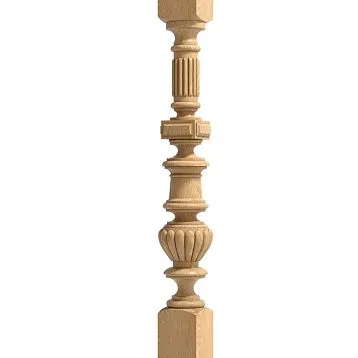
The central part of the baluster is its soul, the place where the craftsman can express all his artistry. It is here that decorative elements are located: carvings, turned details, router patterns. This part determines the style of the entire staircase, creates its character and atmosphere.
There are many options for decorating the central part: from simple geometric forms to complex floral ornaments. Classic balusters are often adorned with spiral grooves, creating a play of light and shadow. Modern variants may include abstract forms, minimalist lines, or ethnic motifs.
The upper part of the baluster is designed for attaching the handrail. It must ensure a secure connection with the horizontal railing element, creating a unified structure. The shape of the upper part often repeats the shape of the base, creating visual harmony and constructive logic.
Wood Species: Choosing for Connoisseurs of Quality
Choosing the wood species for manufacturing balusters is not merely a question of price or availability. It is a choice of character that will determine the appearance of the staircase for decades to come. Each species has its unique properties, texture, color, and performance characteristics.
Oak is the king among wood species for balusters. Its noble texture, exceptional strength, and resistance to deformation make it the ideal choice for creating premium-class stair railings. Oak balusters can withstand significant loads without losing their shape or beauty. The natural color of oak ranges from light yellow to dark brown, allowing one to select a shade to match any interior.
Ash: strength and expressiveness
Ash is no less strong than oak, but it has a more expressive texture. Contrasting annual rings create a unique pattern that looks especially striking with transparent finishing. Ash balusters are distinguished by high impact resistance and wear resistance, making them an ideal choice for heavily used staircases.
Ash is a compromise between beauty and accessibility. Its fine-grained structure allows creating balusters with a perfectly smooth surface, and its ability to take stain well opens up wide possibilities for color decoration. Ash balusters are easy to process, enabling the creation of complex decorative elements.
Larch has unique properties — high resin content, which provides natural protection against moisture and biological damage. Larch balusters are ideal for staircases in humid rooms or for outdoor structures. The distinctive wood grain with contrasting layers creates a unique decorative effect.
Manufacturing technologies: from traditions to innovations
Modern production of wooden balusters combines traditional wood processing methods with innovative technologies. Each manufacturing method has its own characteristics and allows creating balusters of various styles and complexity.
Turned balusters are made on lathes, where the blank rotates and the cutting tool shapes the profile. This method allows creating balusters with perfectly symmetrical forms, smooth transitions, and precise dimensions. Turning is an art requiring not only technical skills but also artistic taste from the craftsman.
Carved masterpieces
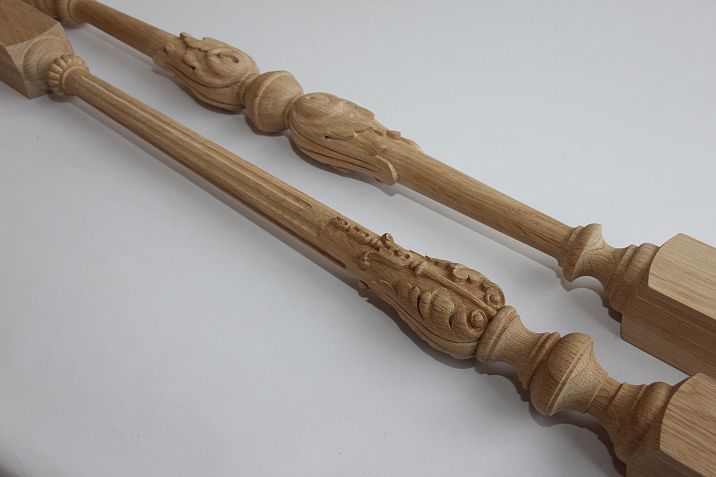
Carved balusters are created using milling machines, which allow performing complex three-dimensional shapes. This method opens up limitless creative possibilities — from classic spirals to modern abstract forms. Milling allows creating balusters with variable cross-sections, complex profiles, and detailed decorative elements.
Carved balusters are the pinnacle of carpentry art. Each such baluster is crafted by hand by a master carver who infuses it with a part of their soul. Carving can be relief or through, geometric or floral, simple or incredibly complex. Carved balusters transform a staircase into a work of art capable of becoming a central element of interior design.
Combined balusters combine various manufacturing technologies. The base may be turned, the central part — carved, and decorative elements — milled. This approach allows creating unique items combining different textures and styles.
Dimensions and proportions: the mathematics of beauty
The beauty of wooden balusters lies not only in the quality of the material and craftsmanship, but also in the correctness of proportions. Baluster dimensions must comply not only with technical safety requirements, but also with the laws of architectural harmony.
The standard height of balusters is 650–1000 millimeters, ensuring a comfortable handrail height for people of different heights. However, these dimensions may vary depending on specific conditions and design decisions. In rooms with high ceilings, balusters may be taller, creating a more majestic and grand appearance.
Distance between balusters: safety first
The distance between balusters is a critically important parameter determining staircase safety. According to building codes, the gap between adjacent balusters should not exceed 120–150 millimeters. This requirement is especially important in homes where children live — a smaller gap prevents slipping.
However, safety is not the only factor determining the distance between balusters. Aesthetic considerations also play an important role. Too frequent placement of balusters creates a sense of 'picket fence,' disrupting the visual lightness of the structure. Too sparse placement may make the railing unstable and unsafe.
The optimal distance between balusters depends on their thickness, staircase style, and overall interior design. Thin, elegant balusters can be placed more frequently, creating a rhythmic pattern. Heavy balusters require larger intervals to maintain proportionality.
Styles and design solutions: from classic to avant-garde
Wooden balusters can embody any architectural style — from strict classicism to bold avant-garde. Each style has its characteristic features, proportions, and decorative elements.
Classic style is characterized by strict proportions, symmetrical forms, and restrained decoration. Classic balusters often have turned shapes with smooth transitions between different elements. Decorative elements include fluting (vertical grooves), bands, capitals, and bases, executed in the traditions of ancient architecture.
Baroque: opulence and abundance
Baroque style implies rich decorative treatment, complex forms, and abundance of carved elements. Balusters in the Baroque style may include floral ornaments, scrolls, rosettes, and other decorative motifs. This style requires high craftsmanship and significant investment, but the result impresses with its luxury and grandeur.
Modernism brought smooth lines, natural motifs, and asymmetrical forms to baluster design. Balusters in the modern style may imitate plant stems, ocean waves, or abstract forms. This style allows the craftsman to fully express creativity, creating unique works of art.
Modern minimalism strives for simplicity of forms and purity of lines. Minimalist balusters are characterized by geometric strictness, absence of unnecessary details, and emphasis on material quality and processing. Such balusters fit perfectly into modern interiors, creating a sense of lightness and airiness.
Technical aspects: strength and durability
The beauty of wooden balusters should be combined with their functionality and durability. Technical characteristics of balusters determine their ability to withstand operational loads and retain their properties over a long period.
The strength of balusters depends on several factors: wood species, processing quality, mounting method, and operating conditions. Hardwood species (oak, beech, ash) provide maximum strength and resistance to mechanical impacts. Proper drying of wood to 8–12% moisture prevents deformation and cracking.
Protective treatment: guarantee of longevity
Protective treatment of wooden balusters includes several stages: antiseptization, priming, and final coating. Antiseptics protect wood from biological damage — fungi, mold, insects. Primers ensure better adhesion of the final coating and provide additional wood protection.
Final coating can vary: varnish, oil, wax, or paint. Each type of coating has its advantages and specific application features. Varnish coatings provide maximum protection and longevity, but may conceal the natural wood texture. Oil coatings highlight the beauty of wood, but require more frequent renewal.
Installation and mounting: the art of connection
Correct installation of wooden balusters is the guarantee of safety and longevity of the entire staircase structure. There are several ways to mount balusters, each with its own advantages and areas of application.
Mounting on bolts is the most common and reliable method. Holes are drilled coaxially in the end of the baluster and in the tread, into which a metal bolt is installed. This method ensures a strong connection and allows removing balusters without damage if necessary.
Mounting with screws
Mounting with screws is a simpler and faster method, but less aesthetic. Screws are screwed through the end of the baluster into the tread at an angle, ensuring secure fixation. Screw heads are pressed into the wood and covered with wooden plugs or putty.
Mounting in a groove is used when installing balusters on a baluster rail. A groove is milled into the horizontal plank, into which the lower part of the baluster is inserted. This method ensures precise positioning of balusters and creates a rigid structure.
Adhesive bonding can be used as an additional fixing method. Modern carpentry adhesives provide joint strength exceeding the strength of the wood itself. Adhesive bonding is especially effective when using wooden dowels.
Care and Maintenance: Preserving Beauty for Years
Wooden balusters, with proper care, can retain their beauty and functionality for decades. Regular maintenance includes dusting, checking the finish condition, and promptly addressing minor defects.
Daily care involves removing dust with a dry or slightly damp cloth. Avoid using aggressive cleaning agents or abrasive materials that may damage the finish. For cleaning stubborn stains, use specialized wood care products.
Periodic coating renewal
Periodic renewal of the protective coating is necessary to maintain the appearance and protective properties of the balusters. The frequency of renewal depends on the type of coating, usage intensity, and environmental conditions. Lacquer coatings are typically renewed every 5-7 years, while oil-based coatings every 2-3 years.
The coating renewal process includes light sanding of the surface, dust removal, and applying a new layer of coating. In case of significant damage, complete resanding and re-finishing may be required.
Economic aspects: investment in quality
The cost of wooden balusters depends on multiple factors: wood species, manufacturing complexity, finish quality, and manufacturer reputation. Simple turned pine balusters may cost several hundred rubles each, while exclusive carved oak balusters may cost tens of thousands of rubles.
When selecting balusters, it is important to consider not only the initial cost but also long-term maintenance expenses. High-quality balusters made from hardwoods with good protective treatment will last significantly longer than cheaper alternatives, ultimately proving to be a more economical solution.
Price-to-quality ratio
The optimal price-to-quality ratio is achieved by choosing mid-priced balusters from reputable manufacturers. Such products combine decent material and manufacturing quality with a reasonable price. Saving on baluster quality may result in replacement after a few years, ultimately costing more.
When planning a budget for stairs, it is important to note that balusters constitute a significant portion of the railing cost. Quality Wooden balusters for the staircase — is an investment in the safety, comfort, and beauty of your home.
Trends and innovations: Looking to the future
Modern design trends in wooden balusters reflect broader directions in architecture and interior design. There is growing popularity for eco-friendly materials, minimalist forms, and individual designer solutions.
Technological innovations open new possibilities for creating unique balusters. CNC machines allow manufacturing of items with complex shapes and jewel-like precision. Laser cutting and engraving add new decorative possibilities.
Ecological trends
Ecological trends influence material and production technology choices. Demand is growing for balusters made from wood harvested according to sustainable forestry principles. Water-based finishes, free of harmful solvents, are becoming popular.
Customization is another important trend. Clients increasingly demand unique solutions reflecting their personality and lifestyle. This stimulates the development of small-batch and single-unit production technologies, enabling the creation of exclusive items based on individual projects.
Conclusion: the choice that defines the character of the home
Choosing wooden balusters for stairs is not merely a technical decision, but a choice of the character and style of the entire home. Quality balusters create an atmosphere of comfort and safety, highlight the homeowner’s status and taste. They become an integral part of the interior, creating harmony between functionality and beauty.
The modern market offers a vast selection of wooden balusters in various styles, sizes, and price categories. However, it is important to remember that true quality is determined not only by appearance, but also by the materials used, manufacturing technologies, and the professionalism of the manufacturer.
Properly selected and well-made wooden balusters will serve for decades, delighting the eye and ensuring safety. They will become a source of pride for the owner and admiration for guests, creating a unique atmosphere in the home.
In the world of stair constructions, the company STAVROS has earned a reputation as a reliable partner offering products of the highest quality. Decades of experience working with wood, modern production technologies, and strict quality control enable STAVROS to create balusters that combine traditional craftsmanship with contemporary requirements. Choosing STAVROS products means choosing quality proven by time and beauty that never goes out of style.